
With more than 850,000 CDL carriers exiting the market since late 2024 and stricter FMCSA financial security rules now in full force, the logistics sector is facing a period of significant transition. You likely feel the pressure of rising diesel prices, which currently average $4.83 per gallon, or struggle with the administrative weight of vetting reliable partners in a shrinking market. It’s natural to wonder, what does a freight broker do to actually solve these problems rather than just adding another layer to your supply chain? A professional broker acts as a strategic risk-mitigation partner, providing the stability and visibility you need when market capacity feels thin.
We understand that your primary goal is to keep your cargo moving without the constant worry of missed pickups or complex compliance hurdles. This comprehensive guide clarifies the broker’s role in streamlining logistics and mitigating the risks inherent in modern shipping. You’ll discover how a vetted network of carriers can reduce your administrative burden and ensure on-time delivery for specialized freight. From navigating new transparency mandates to managing intermodal and flatbed logistics, we’ll show you how a steady partnership creates order in a complex industry.
Key Takeaways
- Understand the fundamental role of a licensed intermediary and why this legal distinction ensures a clear separation between cargo ownership and transportation management.
- Learn exactly what does a freight broker do during the shipment lifecycle to match your specific cargo requirements with the ideal equipment, such as van or flatbed units.
- Discover the strategic benefits of accessing a pre-vetted national carrier network, allowing your business to scale operations efficiently during seasonal peaks.
- Identify critical security measures, including the $75,000 surety bond and MC number verification, to protect your interests and ensure regulatory compliance.
- Explore how specialized logistics expertise in hot-shot loads and intermodal transportation provides a steady hand at the wheel for complex shipping needs.
Defining the Freight Broker: The Essential Link in National Logistics
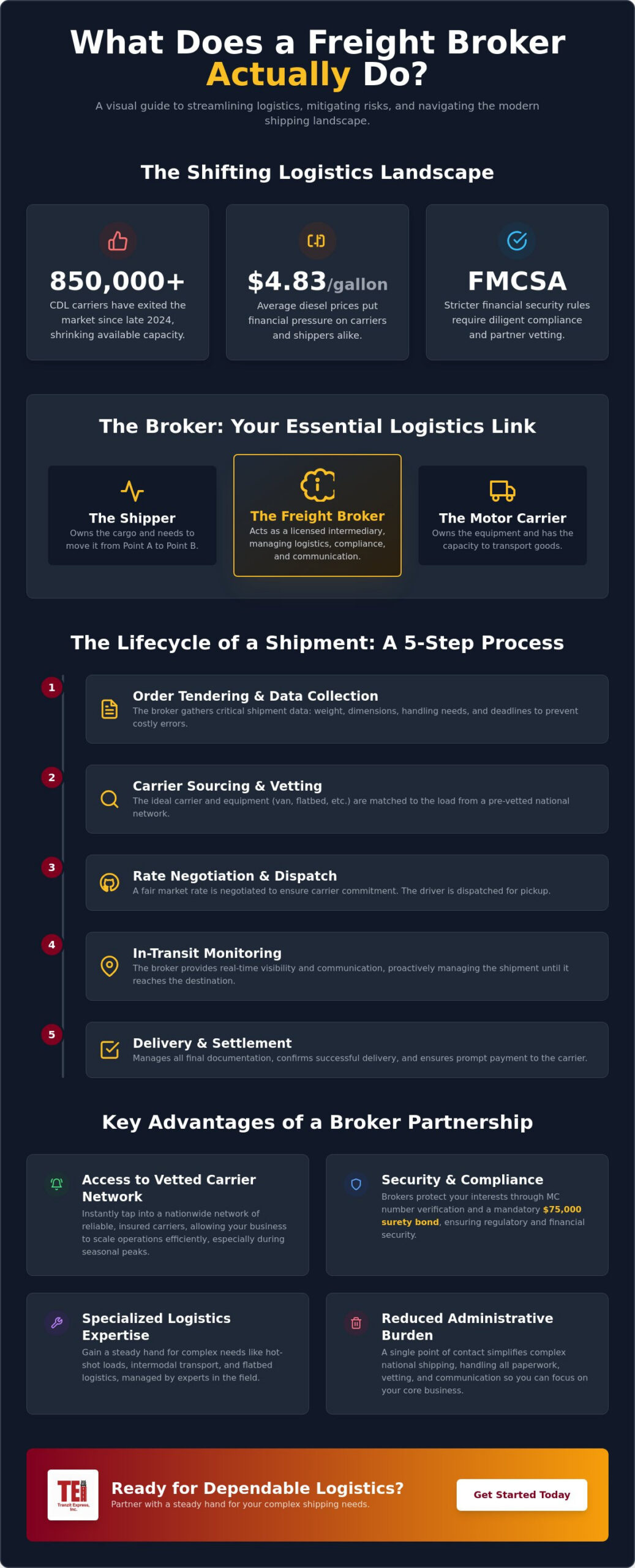
A freight broker acts as a professional bridge within the transportation industry. To understand what a freight broker is, you have to look at their role as a licensed intermediary. They facilitate the movement of goods by connecting shippers who have cargo with motor carriers who have the capacity to move it. Unlike a carrier, a broker doesn’t own the trucks, and unlike a shipper, they don’t own the products. This legal distinction is vital. It allows the broker to focus entirely on logistics management, compliance, and communication without the operational distractions of fleet maintenance.
The Federal Motor Carrier Safety Administration (FMCSA) regulates these operations strictly. As of the 2026 updates to financial responsibility rules, brokers must maintain high standards of accountability, including a $75,000 surety bond. This regulatory oversight ensures that when you ask, what does a freight broker do, the answer includes providing a layer of financial and operational security for both parties. They serve as a single point of contact, simplifying complex national shipping needs into a streamlined, manageable process.
The Intermediary Advantage
Small carriers often lack the sales infrastructure to reach large shippers, while large shippers can’t manage hundreds of individual owner-operators. Brokers bridge this gap by aggregating capacity. They ensure that even during seasonal spikes, shippers have reliable options for their freight. The broker earns their margin through the “spread,” which is the difference between what the shipper pays and what the carrier receives. This fee covers the extensive work of vetting carriers, managing paperwork, and providing real-time visibility. It’s a partnership that transforms a fragmented market into a cohesive, dependable network.
Freight Broker vs. Freight Forwarder
It’s easy to confuse these roles, but the legal liabilities differ significantly. A freight forwarder typically takes physical possession of the cargo, often consolidating small shipments into larger loads for international transit. They often act as the “shipper” to the carrier. In contrast, a domestic freight broker never touches the freight. They remain a pure service provider focused on the arrangement of transport. If your business is moving goods within North America, a specialized domestic broker is usually the most efficient choice. They provide deep institutional knowledge of local routes and regulations without the added complexity of international freight handling. When evaluating what does a freight broker do for your specific needs, remember that their expertise lies in the seamless coordination of domestic motor carriers. To further clarify how these roles affect your logistics decisions, reviewing a detailed breakdown of freight broker vs carrier responsibilities can help you determine the right partnership structure for your supply chain.
While domestic freight brokers handle road transport, the broader logistics sector also involves specialized maritime intermediaries. For companies looking to expand their capabilities through vessel acquisition, you can discover BTR Marine Services LLC for professional ship brokering and vessel sales.
The Lifecycle of a Shipment: How Freight Brokers Manage Your Cargo
The lifecycle of a load is a meticulous sequence of events that requires constant oversight. When exploring what does a freight broker do, it’s helpful to view them as the conductor of a high-stakes orchestra. The process begins with order tendering. At this stage, the broker collects critical shipment data, including weight, dimensions, and any specific handling requirements. Accurate data collection at the start prevents costly errors later in the transit. Once the requirements are established, the broker moves into carrier sourcing, where they match the load to the most appropriate equipment type while balancing current market trends with your specific budget.
After a carrier is selected, the broker handles rate negotiation and dispatch. This isn’t just about finding the lowest price. It’s about finding a fair rate that ensures carrier commitment and high service standards. The broker confirms the driver is on-site for pickup and monitors the cargo until it reaches its final destination. The lifecycle concludes with delivery and settlement, where the broker manages the complex documentation and ensures the carrier is paid promptly. This end-to-end management allows you to focus on your core business while we maintain a steady hand at the wheel.
Sourcing the Right Equipment
Every shipment has unique physical demands. A professional broker evaluates whether your cargo requires standard van freight services or specialized flatbeds for oversized items. For smaller, time-sensitive loads that don’t require a full trailer, we may coordinate hot shot trucking to ensure rapid delivery. For long-haul efficiency that balances cost and environmental impact, we often recommend intermodal transportation solutions. Having access to diverse equipment types ensures your freight is never forced into a sub-optimal shipping method. When open-deck transport is required, understanding the full scope of flatbed freight services USA — including permitting, securement standards, and equipment selection — is essential to keeping your cargo safe and on schedule.
The Importance of Constant Communication
Reliability in logistics is built on transparency. While some modern platforms rely solely on automated pings, a dependable broker understands that human communication is non-negotiable. We utilize a combination of GPS tracking and traditional “check calls” to verify a driver’s status. This proactive approach is essential for managing exceptions. If weather or traffic delays a load, the broker acts as a professional buffer, resolving the issue and updating the shipper before a minor delay becomes a major disruption. If you’re looking for this level of dedicated oversight, consider how a partnership with Tranzit Express can simplify your daily operations.
Strategic Advantages: Why Shippers Partner with Professional Brokerages
Partnering with a brokerage offers more than just a truck for a load. It provides a strategic layer of protection against a volatile market where capacity fluctuates daily. When shippers ask, what does a freight broker do to justify their role, the primary answer lies in their ability to provide immediate access to a pre-vetted, national network of thousands of motor carriers. This removes the massive administrative burden of verifying insurance certificates and operating authorities for every individual driver. Instead of managing a bloated internal department to handle seasonal spikes, you gain the ability to scale your shipping volume up or down without increasing your permanent headcount. Understanding the key distinctions in a freight broker vs carrier comparison makes it easier to see why many shippers choose the flexibility of a brokerage over a direct carrier relationship.
This scalability and professional vetting aren’t limited to cargo; for businesses that need to manage executive travel with the same level of oversight, you can explore Airport Transfers to ensure your team has reliable ground transportation to major airports.
Expertise in specialized routing and logistics management for shippers ensures that your cargo follows the most efficient path possible. This is particularly vital in 2026, as headline inflation sits at 4.2% and the Producer Price Index has reached 6.5%. These rising costs put upward pressure on every link in the supply chain. A professional broker helps you navigate these economic headwinds by acting as a dependable extension of your own team, prioritizing long-term stability over short-term gains.
Cost Efficiency Through Market Knowledge
Brokers leverage real-time data to protect your bottom line. By monitoring current trends, such as the national average flatbed spot rate of $3.77 per mile, we can secure fair flatbed freight rates that reflect the actual market condition. This prevents shippers from falling into the “spot market trap” during peak seasons, where prices often skyrocket due to artificial scarcity. We also look for opportunities to consolidate loads. Maximizing trailer space reduces your per-unit costs, ensuring that every mile driven contributes to your profitability rather than your overhead. Shippers managing oversized or irregularly shaped cargo can benefit from reviewing the full landscape of flatbed freight services USA to understand how open-deck logistics can be optimized for both cost and compliance.
Technology and Transparency
Modern logistics requires more than just a phone call. We provide high-level visibility through dedicated shipper portals, offering real-time tracking and comprehensive reporting at your fingertips. Digital platforms streamline the management of essential documentation like Bills of Lading (BOLs) and Proof of Delivery (POD) receipts. This digital-first approach reduces the risk of lost paperwork and speeds up the billing cycle. Beyond daily operations, we use data analytics to evaluate your historical shipping lanes. This identifies patterns that allow us to improve your future performance, proving that what does a freight broker do is fundamentally about providing a data-driven path to success.
Ensuring Security and Compliance: How to Evaluate a Reliable Freight Broker
Security in logistics isn’t just about locks and seals. It’s about the regulatory foundation of the company managing your freight. When you evaluate what does a freight broker do for your security, start with their operating authority. Every legitimate broker must have an active Motor Carrier (MC) number and current BOC-3 filings on record with the FMCSA. These aren’t just bureaucratic hurdles. They’re the first line of defense in ensuring you’re working with a professional entity rather than a fraudulent actor or an unvetted startup.
The most significant safeguard for your business is the $75,000 surety bond (BMC-84) or trust fund (BMC-85). As of January 16, 2026, the FMCSA has implemented stricter enforcement of this financial security requirement. If a broker’s funds drop below this threshold, they now receive a seven-day notice to replenish or face immediate suspension of their authority. This high standard protects shippers from financial instability within the brokerage. A reliable partner monitors these requirements constantly to maintain their standing and protect your interests during transit. To apply a rigorous, multi-step process for evaluating any logistics partner against these standards, our detailed resource on how to vet a freight broker walks through credential verification, financial stability checks, and operational integrity assessments designed for the high-stakes environment of 2026.
The Pillars of Carrier Compliance
Vetting is where a broker’s value becomes truly visible. Our carrier compliance freight broker protocols are designed to filter out high-risk operators in a market that has seen a self-reported reduction of over 850,000 CDL carriers since late 2024. We don’t just check if a truck is available. We verify the following:
- Safety Ratings: Monitoring Compliance, Safety, Accountability (CSA) scores to minimize transit risks and accidents.
- Insurance Verification: Ensuring carriers maintain active policies that cover your cargo for its full replacement value.
- Authority Status: Confirming the carrier has the legal right to move your specific freight type, which helps prevent illegal double-brokering and cargo theft.
Experience Matters: The 25-Year Standard
Longevity provides a level of security that newer firms simply can’t match. A brokerage with over 25 years of experience has survived multiple market cycles and regulatory shifts. This history indicates a stable financial foundation and deep-rooted carrier relationships. When you ask what does a freight broker do to secure capacity in a tight market, the answer often lies in these long-term partnerships built on trust. Watch for red flags in unvetted firms, such as an inability to provide electronic transaction records within 48 hours, which is the new transparency standard expected as of May 2026. For a partnership built on this 25-year standard of excellence, reach out to Tranzit Express to secure your next load.
The Tranzit Express Standard: Dependable Logistics for a National Market
Tranzit Express Inc. has spent over 25 years refining the answer to the question: what does a freight broker do to ensure client success? It’s not just about matching a load to a truck; it’s about providing a comprehensive suite of solutions that adapt to your specific business needs. Whether you require standard van freight services for retail goods, specialized flatbed shipping for industrial equipment, or urgent hot-shot loads, our team manages the process with meticulous care.
We prioritize on-time delivery and reliable communication above all else. This commitment is supported by our user-friendly shipper and carrier portals, which provide maximum transparency into every shipment. You’ll always know the status of your cargo through our Shipper Portal Access, allowing you to plan your warehouse operations with confidence. By combining institutional knowledge with modern visibility tools, we create a sense of order in an often chaotic industry. This methodical approach ensures that every load is handled with the professionalism you expect from a seasoned industry veteran.
A Partnership Built on Trust
We believe that logistics is more than just a series of independent transactions. It’s a long-term strategy that requires a “steady hand at the wheel.” This approach reduces the inherent stress of shipping by providing you with direct access to experienced professionals. You won’t be trapped in an automated system when you have a critical question. Instead, you’ll speak with a veteran who understands the nuances of the national market. We focus on the fulfillment of promises over marketing hype, ensuring that your supply chain remains resilient even when market conditions shift. This collaborative relationship allows us to anticipate your needs and mitigate risks before they impact your bottom line.
Whether you are seeking a “steady hand” for your professional logistics or looking for an expert to curate a seamless vacation, working with a specialist like Ares Elite Journeys ensures that every detail of your personal travel is managed with the same level of elite precision.
Ready to Streamline Your Supply Chain?
Streamlining your supply chain begins with a simple conversation. Shippers can request a quote for their next national load through our streamlined intake process, gaining immediate access to our vetted network of reliable motor carriers. For carriers, our portal offers consistent freight opportunities and professional settlement services. If you’re ready for a personalized logistics consultation that moves beyond the basics of what does a freight broker do, contact Tranzit Express Inc. today. We’re here to provide the security, stability, and excellence your business deserves.
Securing Your Supply Chain for the Future
Understanding what does a freight broker do is the first step toward building a more resilient logistics strategy. We’ve explored how a professional intermediary manages the complex lifecycle of a shipment, from initial tendering to final delivery. By prioritizing strict compliance and maintaining the required financial security, a dependable broker protects your interests in an inflationary market. This partnership provides the scalability you need to handle seasonal spikes without the overhead of an internal fleet. It’s about more than just moving cargo; it’s about creating a stable foundation for your business growth.
Tranzit Express Inc. brings more than 25 years of industry experience to every load. We offer national coverage across the United States with specialized expertise in Van, Flatbed, and Hot-Shot loads. Our goal is to provide a sense of order and security, acting as a steady hand at the wheel for your business. When you’re ready to move beyond transactional shipping and embrace a collaborative partnership, we’re here to help. Request a Reliable Freight Quote from Tranzit Express Inc. to experience the difference that professional logistics management makes. We look forward to supporting your long-term success.
Frequently Asked Questions
What is the difference between a freight broker and a carrier?
A carrier owns the physical assets, such as trucks and trailers, and is responsible for the actual movement of the cargo. In contrast, a freight broker is a licensed intermediary that coordinates the logistics between the shipper and the carrier. While the carrier handles the physical labor, the broker manages the communication, vetting, and documentation, providing the shipper with a single point of professional contact. For a deeper analysis of how these two roles compare in practice, our guide on freight broker vs carrier walks through the key differences in accountability, flexibility, and cost structure.
How do freight brokers make money?
Brokers earn their revenue through the “spread,” which is the difference between the price quoted to the shipper and the amount paid to the motor carrier. This margin isn’t just a fee for matching a load. It covers the cost of rigorous carrier vetting, real-time tracking technology, and the administrative labor required to ensure every shipment meets strict compliance and safety standards in a volatile market.
Do I need a freight broker if I only ship occasionally?
Yes, occasional shippers often benefit the most from a broker because they lack the volume to negotiate favorable direct rates with carriers. A broker provides you with immediate access to a pre-vetted network, ensuring your cargo receives professional service without the need for an in-house logistics team. This partnership allows you to access competitive market pricing and reliable equipment regardless of your shipping frequency.
How can I verify if a freight broker is legitimate?
To verify legitimacy, you should always check the broker’s MC number and BOC-3 filings on the FMCSA website. When asking what does a freight broker do to prove their reliability, look for a valid $75,000 surety bond. This financial security is a legal requirement designed to protect both shippers and carriers from potential fraud or financial instability within the logistics chain. Shippers who want a comprehensive checklist for this verification process can follow the step-by-step framework outlined in our guide on how to vet a freight broker to confirm credentials, surety bond status, and operational integrity before committing to a logistics partner.
What types of freight can a broker handle?
Most professional brokers handle a diverse range of cargo types. This includes standard dry van freight, oversized loads requiring flatbeds, and expedited hot-shot deliveries for time-sensitive cargo. Some also coordinate intermodal solutions to optimize long-haul costs. This versatility ensures that regardless of your cargo’s physical dimensions or weight, a broker can source the specific equipment needed for safe and efficient transport across the country.
Why do carriers choose to work with freight brokers?
Carriers partner with brokers to reduce empty miles and simplify their daily business operations. Small trucking companies often don’t have the resources to maintain a full-time sales staff to find new customers. By working with a broker, they gain access to a consistent stream of loads from reputable shippers. The broker also handles the complex billing and payment processes, allowing the carrier to focus on driving.
What happens if cargo is damaged during a brokered shipment?
If damage occurs, the broker acts as a professional intermediary to help resolve the situation. They gather the necessary evidence, such as the Bill of Lading and photos of the damage, to assist in the insurance claim process. While the carrier’s insurance is ultimately responsible for the cargo, a dependable broker provides the documentation and support needed to reach a fair settlement and minimize your administrative stress.
How does a freight broker determine the shipping rate?
Rates are determined by a combination of current market spot rates, fuel costs, and the specific equipment required for the cargo. When analyzing what does a freight broker do to set pricing, they look at national averages and lane-specific demand data. This data-driven approach ensures the rate is fair for the shipper while remaining high enough to secure a reliable carrier for your specific delivery timeline.