
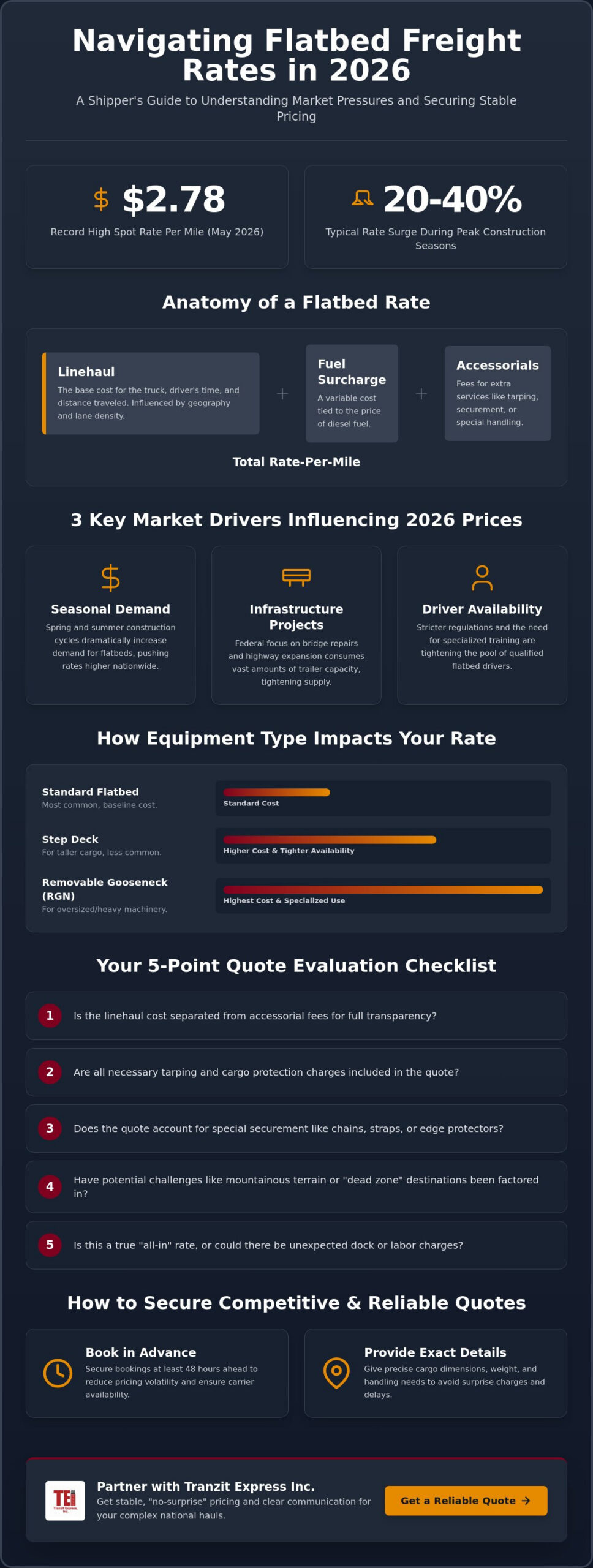
Did you know that flatbed spot rates reached a record high of $2.78 per mile in May 2026, marking 17 consecutive weeks of steady gains? If you’re feeling the strain of rising flatbed freight rates and a tightening market, you aren’t alone. Many shippers are currently struggling with carrier fall-offs and unexpected costs as the industry faces a significant supply-side crunch. Between the removal of non-compliant ELDs like the ROBINHOOD and WALKER devices and new English language proficiency enforcements, finding a dependable partner for your cargo has become increasingly complex.
We understand that your primary goal is to maintain order and predictability in your supply chain. It’s frustrating to face seasonal construction spikes or hidden accessorial charges that disrupt your budget. This article promises to help you master the nuances of the current market so you can evaluate every quote with the confidence of an industry veteran. You’ll gain the tools to ensure high safety standards and clear communication throughout every haul.
We will provide a comprehensive evaluation checklist that covers everything from contract negotiations to the impact of mountainous terrain on your final bill. This methodical approach will help you move from simple transactions to a secure, long-term shipping partnership.
Key Takeaways
- Learn to deconstruct quotes by separating linehaul costs from accessorials to better understand the true cost of your shipment.
- Identify the seasonal and industrial drivers that cause flatbed freight rates to fluctuate during peak construction and infrastructure cycles.
- Utilize our 5-question checklist to verify if a quote is “all-in” or if hidden charges for tarping and protection remain.
- Reduce pricing volatility and avoid unexpected dock charges by providing exact cargo dimensions and securing bookings at least 48 hours in advance.
- Discover how a stable B2B partnership provides the “no-surprise” pricing and clear communication necessary for complex national hauls.
Understanding the Components of Flatbed Freight Rates
A flatbed rate represents the total cost of transporting open-deck freight from point A to point B. It isn’t just a single number; it’s a composite of the linehaul, fuel surcharges, and various accessorial fees. Understanding how freight rates are determined is essential for any shipper looking to maintain a predictable budget in a complex market. While the spot market serves immediate, one-off needs with higher volatility, contract rates provide the long-term stability that many high-volume shippers prefer for their annual planning.
You’ll often find that flatbed freight rates command a premium over standard dry van services. This price difference exists because open-deck transportation requires a higher level of driver expertise and physical labor. Unlike a van where the cargo is simply rolled on, a flatbed driver must manually secure the load to the trailer using specific techniques. A freight broker acts as a steady hand here, aggregating these various costs into a single, transparent quote that accounts for the nuances of your specific haul.
Linehaul vs. Total Rate-Per-Mile
The linehaul is the base cost for the truck and the driver’s time. This figure is heavily influenced by geography and lane density. If you’re shipping into a “dead zone” where return loads are scarce, your linehaul will likely increase to cover the carrier’s empty miles. Be cautious of “all-in” rates that seem too low. These quotes often hide inefficiencies or fail to account for necessary services, leading to unexpected charges once the truck arrives at the dock. A true “all-in” rate should be a transparent reflection of the total commitment required to move your freight safely.
The Impact of Equipment Specifics on Pricing
The type of trailer you require significantly changes the final cost. A standard flatbed is the baseline, but taller cargo may require a Step Deck to stay within legal height limits. Extremely heavy or oversized machinery often necessitates a Removable Gooseneck (RGN) to allow for drive-on loading. These specialized trailers are less common in national fleets. This means their availability is tighter and their rates are higher than standard equipment.
Beyond the trailer itself, specialized securement adds to the total. Many shippers overlook the cost of chains, straps, and edge protectors. As of June 2026, loads requiring specialized handling like edge protection, blocking, or bracing can add between $200 and $600 in labor costs. If your cargo is fragile or requires protection from the elements, tarping fees will also apply. These aren’t just “extra” costs; they are vital investments in the safety of your cargo. When evaluating flatbed freight rates, always confirm that these securement tools are included in your initial quote to avoid “rate shocks” later in the process.
Market Drivers Influencing National Flatbed Pricing in 2026
Flatbed freight rates are inherently reactive to the broader economy. As we move through 2026, several factors converge to create a complex pricing environment. The spring and summer months traditionally see a surge in demand due to construction cycles. This seasonal pressure can drive rates upward by 20% to 40% during peak windows. When you combine this with the current federal focus on bridge repairs and highway expansion, the pressure on national capacity becomes clear. These cycles aren’t just local; they represent a nationwide shift in where trailers are positioned.
Driver availability remains a significant constraint. Unlike standard dry van haulage, flatbed work requires specialized training for securement and safety. According to trucking industry economic data, the pool of qualified drivers is tightening as regulatory requirements evolve. For instance, the recent mandate for electronic medical certificate submission and stricter English language proficiency tests has reduced the number of active operators. This limited supply of specialized talent naturally supports higher rate floors because the expertise required to haul heavy industrial loads is in high demand.
Infrastructure and Industrial Demand
Industrial machinery and building materials act as the anchor of the flatbed market. When large-scale utility and power-generation projects launch, they consume vast amounts of trailer capacity. This creates a ripple effect where even smaller, routine shipments must compete for space. Manufacturing shifts toward domestic production also play a role, as heavy equipment needs to move from factories to project sites across the country. Reliable flatbed shipping solutions help mitigate these fluctuations by securing capacity through established networks before the peak demand hits.
Capacity Fluctuations and Regulatory Impact
Regulatory compliance is a major driver of capacity shifts in 2026. The FMCSA’s removal of non-compliant ELD devices, such as the ROBINHOOD and WALKER models, has forced many carriers to pause operations. When these trucks leave the market, the remaining supply becomes more expensive. Safety ratings also dictate which carriers can handle high-value industrial loads, further narrowing the choice for shippers who prioritize cargo security. It’s a matter of choosing a partner that values stability over the lowest possible price.
The Flatbed Rate Evaluation Checklist: 5 Questions to Ask
Receiving a quote is only the first step in a successful haul. To avoid the hidden traps of underpriced loads that often lead to carrier fall-offs, you need a methodical framework for evaluation. While benchmarking against current flatbed freight rate data is helpful, the lowest number on a spreadsheet often lacks the necessary service components. Order requires clarity. Use these five questions to separate reliable partners from risky transactions.
- Is the quote “all-in” or are there pending accessorials? A transparent quote should account for the entire journey, not just the miles between zip codes.
- Does the rate include necessary tarping and protection? Open-deck freight is vulnerable. Confirming securement details upfront prevents disputes at the loading dock.
- How is the fuel surcharge calculated? Reliable carriers typically peg this to a standard index, such as the Department of Energy’s weekly diesel price report.
- What level of cargo insurance is included? Specialized loads often exceed standard policy limits. You must verify that your specific cargo value is fully covered.
- What is the carrier’s safety and on-time performance history? A low rate is a poor investment if the carrier has a history of regulatory non-compliance or frequent delays.
Assessing Accessorials and Tarping Fees
Accessorials are the most common source of “rate shock” for shippers. Common charges include detention fees for long loading times, layover fees if a driver is held overnight, and multi-stop charges for complex routes. Tarping is another critical variable. A quote might assume a 4-foot drop, but if your machinery requires 8-foot drops to stay protected, the price will naturally increase. These details matter. When flatbed freight rates are negotiated without these specifics, the risk of service failure rises significantly. Clear communication regarding dimensions ensures that the driver arrives with the correct equipment, saving you from costly last-minute adjustments.
Verifying Insurance and Carrier Compliance
High-stakes logistics require more than just a truck; they require a commitment to safety and financial security. A standard $100,000 cargo policy might be insufficient for specialized flatbed loads like industrial turbines or heavy construction machinery. In these cases, you need a partner who can verify supplemental coverage. This is where the role of an experienced carrier compliance freight broker becomes invaluable. A professional broker acts as a steady hand, vetting carrier authority and ensuring every truck meets FMCSA safety standards. By verifying compliance before the wheels turn, you protect your supply chain from the disruptions caused by non-compliant equipment or revoked operating authority. This level of diligence ensures that your flatbed freight rates reflect a partnership built on proven results and mutual trust.
How to Secure Competitive and Reliable Flatbed Quotes
Securing flatbed freight rates that are both competitive and reliable requires a shift in perspective. It isn’t just about finding the lowest number; it’s about providing the data that allows a carrier to commit with confidence. When you share precise dimensions and weight, you eliminate the ambiguity that leads to “rate shocks” at the dock. Carriers value certainty. Providing exact details allows them to calculate fuel efficiency and equipment wear accurately, resulting in a more stable quote and a smoother partnership.
The Importance of Accurate Load Specifications
Even a minor discrepancy can have significant financial consequences. For instance, an extra six inches of width can transform a standard haul into an “oversize” permit load, requiring specialized routing and additional fees. Permitted loads are shipments that exceed legal size or weight limits, requiring state-specific permits and often leading to restricted transit times and slower delivery schedules. By ensuring your specifications are exact, you avoid the logistical delays and cost overruns associated with miscalculated dimensions. Weight also plays a vital role in determining which equipment is suitable for the haul, as heavier loads impact fuel consumption and require specific axle configurations to remain compliant.
Lead Time and Rate Stability
Time is a currency in the logistics industry. Booking your shipment 48 to 72 hours in advance typically stabilizes your pricing by allowing brokers to find the best equipment match within their network. “Emergency” or same-day capacity often comes at a significant premium because it disrupts a carrier’s planned schedule and limits your options. If your cargo is smaller or highly time-sensitive, utilizing hot shot trucking can be a strategic way to maintain speed without the cost of a full-size trailer. Flexible pickup and delivery windows also make your load more attractive to carriers; it allows them to optimize their routes and reduce empty miles.
Site-specific requirements are another often-overlooked factor that can influence your final costs. If your delivery involves a crane appointment or restricted access at a construction site, this must be communicated upfront. These details allow your partner to plan for potential detention or specialized equipment needs. Leveraging a broker’s extensive network can also uncover backhaul opportunities, where a carrier is looking to move equipment back to its home base. These opportunities often result in more favorable flatbed freight rates for the shipper while ensuring the carrier remains profitable and efficient. Ready to streamline your next haul? You can request a flatbed quote from our team of experts today.
Partnering with Tranzit Express for Stable Flatbed Solutions
Tranzit Express Inc. has spent over 25 years navigating the shifts and complexities of the national open-deck market. This deep institutional knowledge is what allows us to offer stability in a year where flatbed freight rates have reached record highs. Our approach moves beyond the transactional nature of the spot market. We focus on creating a sense of order in an industry that can often feel chaotic and unpredictable. By choosing a partner with a proven track record, you secure more than just a truck; you gain a team dedicated to the seamless execution of your logistics strategy.
We prioritize a “no-surprise” pricing model. By accounting for the variables we discussed earlier, such as specific tarping requirements and site-access constraints, we provide quotes that hold firm. This commitment to transparency reduces the administrative stress of unexpected accessorial charges. You can budget with confidence, knowing that the rate you see is a true reflection of the service required to move your cargo safely across the country.
A “Steady Hand at the Wheel” for Your Logistics
Veteran expertise is a powerful tool for reducing shipper stress in volatile markets. At Tranzit Express, we act as a steady hand at the wheel for your supply chain. Every load is managed by a dedicated point of contact who understands your specific business needs. This personalized management ensures that you aren’t just another number in a database. We value long-term partnerships over one-off transactions. This philosophy encourages a collaborative environment where clear communication is the standard, not the exception. When challenges arise on the road, our team is already working on a solution before it impacts your bottom line.
Technology and Compliance Excellence
Modern logistics require modern tools, but technology should always serve the goal of reliability. Our shippers gain access to a dedicated portal for real-time tracking and streamlined documentation. This visibility allows you to monitor your freight’s progress without having to pick up the phone. Beyond tracking, we maintain rigorous carrier compliance standards that protect your supply chain from double brokering risks and insurance gaps. We vet every operator in our network to ensure they meet high safety ratings and FMCSA requirements. This level of due diligence addresses a common gap in generic market data, providing you with the security that your cargo is in professional hands. If you are ready to experience a more dependable approach to shipping, we invite you to request a freight quote online. Our team is prepared to help you manage your flatbed freight rates with the quiet confidence that only decades of experience can provide.
Mastering Your Flatbed Strategy for 2026 and Beyond
Managing your supply chain requires more than just reacting to market shifts. It’s about building a foundation of transparency and trust. You now have the tools to evaluate flatbed freight rates with precision, ensuring that every quote reflects the true requirements of your cargo. By focusing on accurate load specifications and asking the right questions about accessorials and insurance, you protect your business from the disruptions of underpriced loads and sudden carrier fall-offs. This methodical approach transforms a simple transaction into a reliable logistical process that supports your bottom line.
Tranzit Express Inc. stands ready to be your steady hand at the wheel. With over 25 years of industry experience and a commitment to comprehensive carrier compliance vetting, we provide the security of an A+ rated national logistics provider. We focus on long-term results rather than marketing hype, prioritizing clear communication throughout every haul. We invite you to Request a Reliable Flatbed Quote from Tranzit Express to see how a professional partnership can reduce your stress and streamline your national shipping. Let’s move your freight forward with the consistency and excellence your business deserves.
Frequently Asked Questions
How much are average flatbed freight rates per mile in 2026?
National averages for flatbed transport reached record highs in mid-2026, following 17 consecutive weeks of steady gains leading into the summer. These rates reflect a tightening market where demand for infrastructure and energy projects has outpaced the available supply of specialized drivers. While specific lane pricing varies based on distance and equipment type, the overall market floor has shifted upward due to increased operating costs and stricter regulatory enforcement.
Do flatbed rates include tarping and strapping by default?
Tarping and specialized securement are almost always treated as accessorial charges rather than being included in the base linehaul rate. You should expect an additional fee for the labor and equipment required to protect your cargo from road debris and weather. While standard strapping is expected for safety, any requirement for heavy-duty chains, edge protectors, or specific tarp sizes should be confirmed during the quoting process to avoid unexpected costs at the dock.
What is the difference between a flatbed and a step deck rate?
Step deck rates are generally higher because the trailers are specialized equipment designed to haul taller freight that cannot fit on a standard flatbed. These trailers sit closer to the ground, allowing you to transport taller machinery without the need for expensive over-dimensional permits. Because step deck trailers are less common in national carrier fleets, their availability is tighter, which naturally commands a premium in the open market.
How do fuel surcharges affect my total flatbed shipping cost?
Fuel surcharges act as a variable cost that fluctuates based on national diesel price indices, often accounting for 25% to 35% of a carrier’s total operating expenses. This surcharge protects both the shipper and the carrier from the volatility of the energy market. It’s important to verify that your quote uses a standard index so you can predict how shifts in fuel prices will impact your total bill throughout the duration of a haul.
Can a freight broker help me get lower flatbed rates than going direct?
Freight brokers often secure more competitive flatbed freight rates by leveraging their extensive networks to identify backhaul opportunities that individual shippers can’t see. When a carrier needs to move equipment back to a high-demand region, they are often willing to offer a better rate to avoid moving an empty trailer. A broker’s ability to aggregate these options provides you with cost-effective solutions while maintaining high standards for carrier safety and compliance.
What happens if my flatbed load is over-dimensional?
Over-dimensional loads require state-specific permits and may necessitate escort vehicles, which adds significant time and expense to the shipment. You’ll face restricted transit windows, as most states prohibit oversized freight from moving at night or during holiday weekends. These shipments require a higher level of coordination to ensure that the route can accommodate the load’s height and width, making it vital to provide exact dimensions during the initial evaluation.
Why do flatbed rates fluctuate more than dry van rates?
Flatbed capacity is more sensitive to seasonal industrial cycles, such as the spring construction surge and large-scale federal infrastructure projects. Unlike dry van freight, which follows retail consumer trends, the demand for flatbed freight rates is tied to heavy machinery, steel, and building materials. These sectors often experience simultaneous spikes in activity, causing rapid shifts in the load-to-truck ratio that drive pricing volatility across national lanes.
How much lead time is needed to get a firm flatbed quote?
Providing a lead time of 48 to 72 hours is the most effective way to secure a firm and reliable quote. This window allows your logistics partner to find the best equipment match and verify carrier compliance before the load is scheduled to move. While same-day capacity is sometimes available, it often comes at a significant premium and carries a higher risk of service failure due to the limited options available in an urgent market.