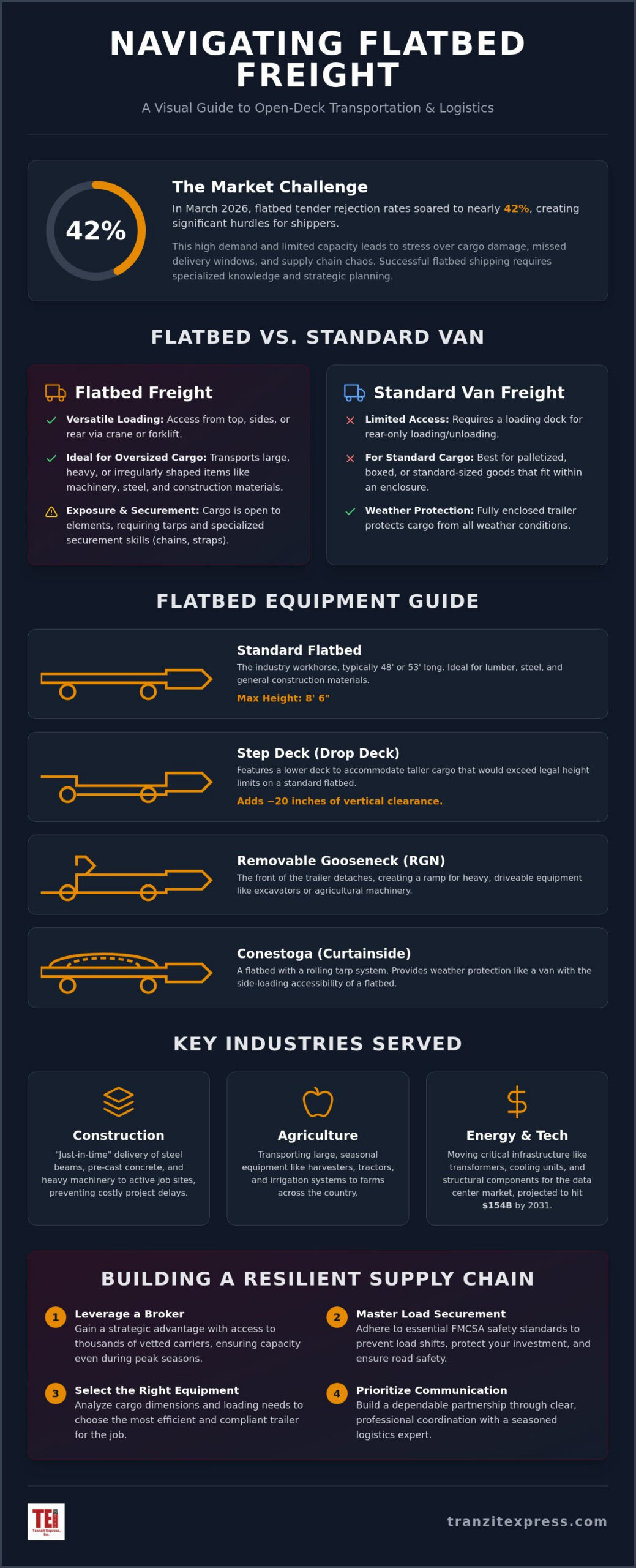
In March 2026, flatbed tender rejection rates climbed to nearly 42 percent, leaving many shippers struggling to find reliable equipment for their most critical loads. If you’ve ever dealt with the stress of cargo damage from poor securement or the headache of missing a delivery window at an active jobsite, you know that flatbed freight services USA require more than just a truck. It takes a steady hand and deep institutional knowledge to manage the unique variables of open-deck transportation.
We understand that your primary goal is to reduce chaos and establish a sense of order in your supply chain. This guide provides a comprehensive look at the equipment, safety standards, and permitting requirements necessary for successful shipping. You’ll learn how to navigate the current market of high demand and limited capacity while maintaining the high standards your clients expect. We’ll walk you through the essential logistics strategies that transform complex shipments into seamless, dependable partnerships.
Key Takeaways
- Determine whether a standard flatbed or a step deck trailer is necessary for your specific cargo based on height limits and loading requirements.
- Learn how a broker provides a strategic advantage by offering access to thousands of vetted carriers for flatbed freight services USA during peak seasons.
- Master the essential FMCSA safety standards for load securement to prevent shifts and protect your investment during transport.
- Identify the specific logistical needs of the construction, agriculture, and manufacturing industries to optimize your open-deck shipping strategy.
- Build a more resilient supply chain by prioritizing clear communication and professional coordination with a seasoned logistics partner.
Understanding Flatbed Freight Services in the USA
Flatbed shipping is the logistical answer for freight that simply won’t fit within the four walls of a standard trailer. By definition, flatbed freight involves the transport of cargo on trailers that lack a fixed roof or sides. This open-deck design is fundamental to the movement of large-scale equipment across the country. Understanding What is a Flatbed Truck? helps clarify why these vehicles are indispensable for national infrastructure. From the massive steel beams used in bridge construction to the specialized harvesters required for seasonal agriculture, flatbed freight services USA provide the flexibility needed to keep American industry moving. These services operate on a national scale, acting as a critical link in the supply chain for projects that drive industrial growth and modernize our shared infrastructure.
The core advantage of an open-deck trailer is the ease of loading. Unlike enclosed vans that require a loading dock, flatbeds allow for access from the side, top, or rear. This means a crane can lower a heavy generator directly onto the deck, or a forklift can load long lumber bundles from the side. This versatility serves critical sectors including energy, manufacturing, and heavy construction. As the U.S. data center construction market continues to grow toward a projected $154 billion by 2031, the demand for these specialized services remains high. They support the delivery of transformers, cooling units, and structural steel that are often too tall or wide for traditional trailers.
Why Flatbed Shipping is Essential for Heavy Industry
Standard dry vans are designed for boxed goods and palletized items. They cannot accommodate oversized machinery or raw materials that exceed standard width or height. In the construction sector, flatbeds are vital for “just-in-time” deliveries. Contractors rely on these trailers to bring materials to active jobsites exactly when they are needed, preventing project delays that can stall progress. The current boom in data center construction relies heavily on this precision to move high-value components safely. Flatbed freight is the backbone of American industrial logistics.
Key Differences Between Flatbed and Standard Van Freight
The most obvious difference is exposure. While van freight is protected from weather, flatbed loads are open to the elements, often requiring heavy duty tarps. This exposure demands a more specialized skill set from drivers. Securing a load with chains, straps, and binders is a precision task that directly impacts road safety. Because of the specialized equipment and the higher level of driver expertise required, flatbed freight services USA often carry different cost implications than standard van freight. These factors contribute to a market where capacity is often tighter, requiring a more strategic approach to carrier selection and scheduling. Working with a qualified logistics provider ensures you have the expertise and vetted carrier network necessary to navigate these complexities with confidence.
Flatbed Equipment Guide: Choosing the Right Trailer
Selecting the correct equipment is the first step toward a secure and efficient delivery. While many trailers look similar, their functional differences determine whether a load can move legally and safely. Standard flatbeds, typically 48 or 53 feet in length, are the versatile workhorses of the industry. They are ideal for lumber, steel coils, and various construction materials that don’t exceed standard height limits. When sourcing flatbed freight services USA, understanding these equipment nuances ensures you aren’t paying for more trailer than you need while maintaining total compliance.
For cargo that is slightly taller, step deck trailers, also known as drop decks, are essential. These trailers lower the deck height to accommodate loads that would otherwise exceed legal vertical limits. For industrial machinery that requires driving onto the trailer, the Removable Gooseneck (RGN) is the primary solution. The front detaches, creating a ramp for heavy equipment. When protection from the elements is required without sacrificing loading speed, Conestoga or curtainside trailers offer a rolling tarp system. This setup provides the security of a van with the accessibility of a flatbed. Regardless of the trailer type, drivers must adhere strictly to FMCSA cargo securement rules to ensure every shipment arrives without incident.
Navigating Weight and Height Constraints
Staying within legal dimensions is critical for avoiding costly fines and transit delays. Standard flatbed loads are typically capped at 8’6″ in width and 8’6″ in height. Once the cargo exceeds these measurements, it transitions into the category of “Oversized” or “Heavy Haul,” requiring specialized permits and often escort vehicles. Step deck trailers provide a strategic advantage here by offering an additional 20 inches of clearance. This allows for taller industrial components to move under bridges and power lines without triggering oversized load requirements. Managing these height variables is a core part of providing reliable flatbed freight services USA for the energy and manufacturing sectors.
Specialized Equipment for Unique Cargo
Some projects demand highly specific configurations. Extendable flatbeds are utilized for extremely long cargo, such as wind turbine blades or structural beams. For the tallest industrial equipment, double drop trailers feature a “well” that sits even lower to the ground than a standard step deck. Navigating these complexities requires advanced logistics management for shippers to ensure the right equipment is available at the right time. If you need assistance determining which trailer fits your next project, our team can help you review your flatbed shipping requirements with professional precision.
The Strategic Advantage of a Flatbed Shipping Broker
Partnering with a freight broker offers a level of agility that asset-based carriers simply cannot match. While a carrier is limited by the physical location of their specific fleet, a broker provides access to a vast network of thousands of vetted professionals. In a market where flatbed load-to-truck ratios reached 71.57 in May 2026, relying on a single fleet often leads to missed deadlines. Our role is to act as a steady hand at the wheel, managing the complexities of capacity so you don’t have to. By leveraging a broad network, we ensure that flatbed freight services USA remain available to our partners, even during the most demanding seasonal surges.
This brokerage model is particularly effective for managing high-stakes industrial projects. We take on the burden of vetting, compliance, and real-time tracking, allowing your team to focus on core operations. With 25 years of experience in national freight brokerage, Tranzit Express Inc. understands that consistency is the foundation of trust. We don’t just move cargo; we provide a sense of order in an industry that is often unpredictable. Our deep institutional knowledge allows us to anticipate market shifts and secure the equipment necessary for your most challenging routes. To make the most informed decision for your operation, reviewing a comprehensive flatbed shipping broker buyer’s guide can help you evaluate partners against the latest 2026 compliance and safety standards.
Carrier Vetting and Compliance Standards
Safety and risk mitigation are our top priorities. We employ a rigorous process to verify safety ratings and insurance coverage for every carrier in our network. Understanding what a freight broker does is critical for any shipper looking to minimize liability. We ensure that every driver and piece of equipment adheres to Federal truck size and weight limits. This commitment to FMCSA compliance is not just a legal requirement; it’s a core component of the dependable service we provide to our B2B partners across the country.
Flexibility and Scalability for National Logistics
The primary limitation of asset-based carriers is their rigid scheduling. If their trucks aren’t in your region, your cargo sits idle. A brokerage network solves this by finding specialized equipment in even the most remote locations. Whether you need an RGN for heavy machinery or a step deck for oversized components, our network provides the scalability required for national logistics. We utilize advanced shipper portals to offer real-time visibility into your shipments. This technology, combined with our decades of experience, ensures that your flatbed freight services USA are handled with professional precision and clear communication.
Load Securement and Safety: Protecting Your Investment
Safety on the road begins long before the driver shifts into gear. For any business utilizing flatbed freight services USA, understanding the mechanics of load securement is vital for protecting high-value assets. The primary federal cargo securement rules, outlined in 49 CFR Part 393, Subpart I, have provided a foundation for road safety since 2002. Drivers use a combination of grade 70 transport chains for heavy steel and synthetic webbing straps for more delicate materials like finished lumber. These are tightened with ratcheting or lever binders to ensure the load remains stationary during transit. It’s a methodical process that prioritizes stability above all else.
Beyond the hardware, stabilizers like dunnage play a critical role in a successful delivery. These wood blocks or timbers are placed between the cargo and the trailer bed to provide friction and allow for easier unloading with forklifts. When freight requires protection from road spray, moisture, or soot, professional tarping services become necessary. Properly secured tarps don’t just protect the finish of your product; they prevent debris from becoming a hazard to other motorists. If you’re ready to secure your next shipment with a partner who values precision, you can request a flatbed shipping quote today.
Tarping Options: From Steel to Smoke Tarps
Choosing the right tarp is a balance between protection and efficiency. Heavy-duty lumber tarps feature large flaps to cover the ends of a load, providing full protection from the elements. In contrast, lightweight smoke tarps are designed to cover only the front of the cargo, shielding it from exhaust soot and road grime. While tarping is mandatory for many industrial goods to prevent damage, it does impact fuel efficiency due to increased wind resistance. Professional drivers must inspect these securements within the first 50 miles of a trip and then every 150 miles or 3 hours of driving to maintain compliance with federal standards.
Jobsite Logistics and On-Time Delivery
Delivering to an active construction site is significantly more complex than a standard warehouse drop. These environments are dynamic and often have limited space for maneuvering large trailers. To ensure a seamless experience, shippers should follow a rigorous preparation checklist:
- Verify that a crane or forklift with adequate lift capacity is scheduled for the arrival time.
- Ensure the delivery path is clear of debris and has a sufficient turn radius for a 53-foot trailer.
- Confirm that labor is on-site to assist with unstrapping and spotting the driver.
For smaller, time-sensitive loads that don’t require a full trailer, utilizing hot shot trucking can provide the speed and agility needed to keep a project on schedule without the overhead of a standard flatbed. This specialized approach ensures that even the most urgent industrial needs are met with the same level of professional care as a full-scale flatbed operation.
Partnering with Tranzit Express Inc. for Dependable Flatbed Solutions
Tranzit Express Inc. has spent 25 years refining the art of national freight brokerage. We understand that a successful shipment is built on more than just equipment; it’s built on trust. Our team provides the quiet confidence of an industry veteran, ensuring your flatbed freight services USA are managed with methodical precision. We act as your advocate, managing the complexities of the market to provide a sense of order in a high-stakes industry. By choosing a partner with deep institutional knowledge, you gain a steady hand at the wheel for every mile of the journey. Shippers who want to fully understand the scope of support available to them can explore our comprehensive guide on what a logistics provider does and how to choose the right one for their supply chain needs.
Our commitment to excellence extends beyond the road. We prioritize stability and clear communication, moving away from the aggressive language of the modern startup world to focus on what matters: the fulfillment of our promises. This grounded approach ensures that your cargo is handled with the care it deserves, backed by a legacy of proven results. Whether you’re moving structural steel or heavy machinery, we provide the consistent, high-level B2B partnership required to maintain a seamless supply chain. Shippers who want to ensure they are working with a fully qualified partner can use our guide to choosing the right flatbed shipping broker to benchmark their current provider against industry best practices.
Seamless Communication and Real-Time Tracking
Logistical uncertainty causes unnecessary stress for your team and your clients. We aim to eliminate that friction through clear, professional communication at every stage of the shipping process. Our integrated Shipper Portal Access allows you to manage multiple loads with ease, providing a centralized hub for your shipping data. You get real-time tracking and proactive updates, so you aren’t left wondering about the status of your cargo at a critical jobsite. This isn’t just a simple transaction; it’s a partnership approach designed to support your long-term logistics strategy. We prioritize the fulfillment of promises, delivering results that reflect our high standards and commitment to excellence.
Requesting Your National Flatbed Quote
Securing your supply chain should be a straightforward and efficient process. When you request a quote for flatbed freight services USA, we look for specific details to ensure the highest level of accuracy. Providing precise dimensions, total weight, and any tarping or specialized equipment needs allows us to build a reliable rate that accounts for all variables. Our team reviews your specific requirements against our network of thousands of vetted carriers to find the ideal match for your timeline and cargo type. Taking this next step ensures your industrial goods move with the stability and security that only an experienced professional can provide. We invite you to experience the difference that a dependable, results-oriented partnership can make for your business.
Secure Your Supply Chain with Professional Precision
Success in open-deck logistics depends on more than just finding a trailer; it’s about the expert coordination of equipment, safety compliance, and reliable timing. By understanding the nuances of trailer types and the importance of rigorous load securement, you can better protect your high-value assets and ensure project continuity at every jobsite. Utilizing flatbed freight services USA through a seasoned broker provides the scalability and peace of mind necessary to navigate a tightening market with confidence.
Tranzit Express Inc. brings over 25 years of logistics experience to every partnership, offering access to a national network of vetted flatbed carriers and a dedicated shipper portal for real-time tracking. We act as a steady hand at the wheel, reducing your administrative burden so you can focus on your core industrial operations. Whether you’re hauling specialized machinery or essential construction materials, we’re here to provide a sense of order and excellence for your entire logistical process.
Request a Dependable Flatbed Quote from Tranzit Express Inc. and take the first step toward a more resilient, predictable supply chain today. We look forward to building a lasting partnership with your team.
Frequently Asked Questions
What is the maximum weight a standard flatbed trailer can carry?
A standard flatbed trailer can typically carry a maximum weight of 48,000 pounds. This limit is determined by the gross vehicle weight rating and the weight of the tractor and trailer combined. Shippers must ensure their cargo is distributed evenly across the axles to stay within legal weight limits for national highway travel and avoid costly fines at weigh stations.
How do flatbed shipping rates differ from dry van rates?
Flatbed rates are generally higher than dry van rates because they require specialized equipment and a higher level of driver expertise. The labor involved in securing cargo with chains or tarps and the time required for side loading also contribute to the cost. Since market capacity for flatbed freight services USA is often tighter, rates can fluctuate more significantly during peak construction or agricultural seasons.
When do I need a step deck trailer instead of a standard flatbed?
You need a step deck trailer when your cargo exceeds 8 feet 6 inches in height. These trailers feature a lowered deck that allows taller items to sit closer to the ground, which prevents them from hitting bridges or overhead power lines. This equipment is essential for industrial machinery that would otherwise require expensive oversized permits if transported on a standard flatbed.
Is tarping always required for flatbed freight services?
Tarping isn’t always mandatory, but it’s highly recommended for cargo that is sensitive to moisture, road debris, or exhaust soot. While items like structural steel or heavy machinery might survive exposure, finished lumber or sensitive industrial components require heavy-duty tarps to maintain their condition. The final decision usually depends on the shipper’s specific requirements for flatbed freight services USA.
How does a freight broker ensure my flatbed load is properly secured?
A freight broker ensures proper securement by vetting carriers based on their safety ratings and historical performance. We verify that the assigned drivers possess the necessary equipment, such as grade 70 chains and binders, to meet federal safety standards. This proactive approach reduces risk and ensures that every carrier in our network understands the high standards expected for secure and dependable transport.
What are the legal height and width limits for flatbed loads in the USA?
The standard legal limits for flatbed loads are 8 feet 6 inches in width and a total height of 13 feet 6 inches from the ground. Any cargo exceeding these dimensions is classified as an oversized load, which requires special permits and often escort vehicles. These regulations ensure that trucks can safely navigate the national highway system without damaging bridges or other infrastructure.
Can flatbed trailers deliver to residential areas?
Flatbed trailers are generally not suited for residential deliveries due to their massive size and the specialized equipment needed for unloading. Most residential streets can’t accommodate the turn radius of a 53-foot trailer, and these loads typically require a crane or forklift to remove cargo from the deck. Our services focus on B2B partnerships where deliveries are made to commercial jobsites or industrial facilities.
What is the difference between a flatbed and a Conestoga trailer?
A standard flatbed is a completely open trailer, while a Conestoga features a rolling tarp system that covers the entire deck. The Conestoga provides the protection of a dry van with the loading flexibility of a flatbed because the tarp can be retracted to allow side or top loading. This specialized equipment is ideal for high-value freight that needs total protection from the elements without the constraints of an enclosed trailer.