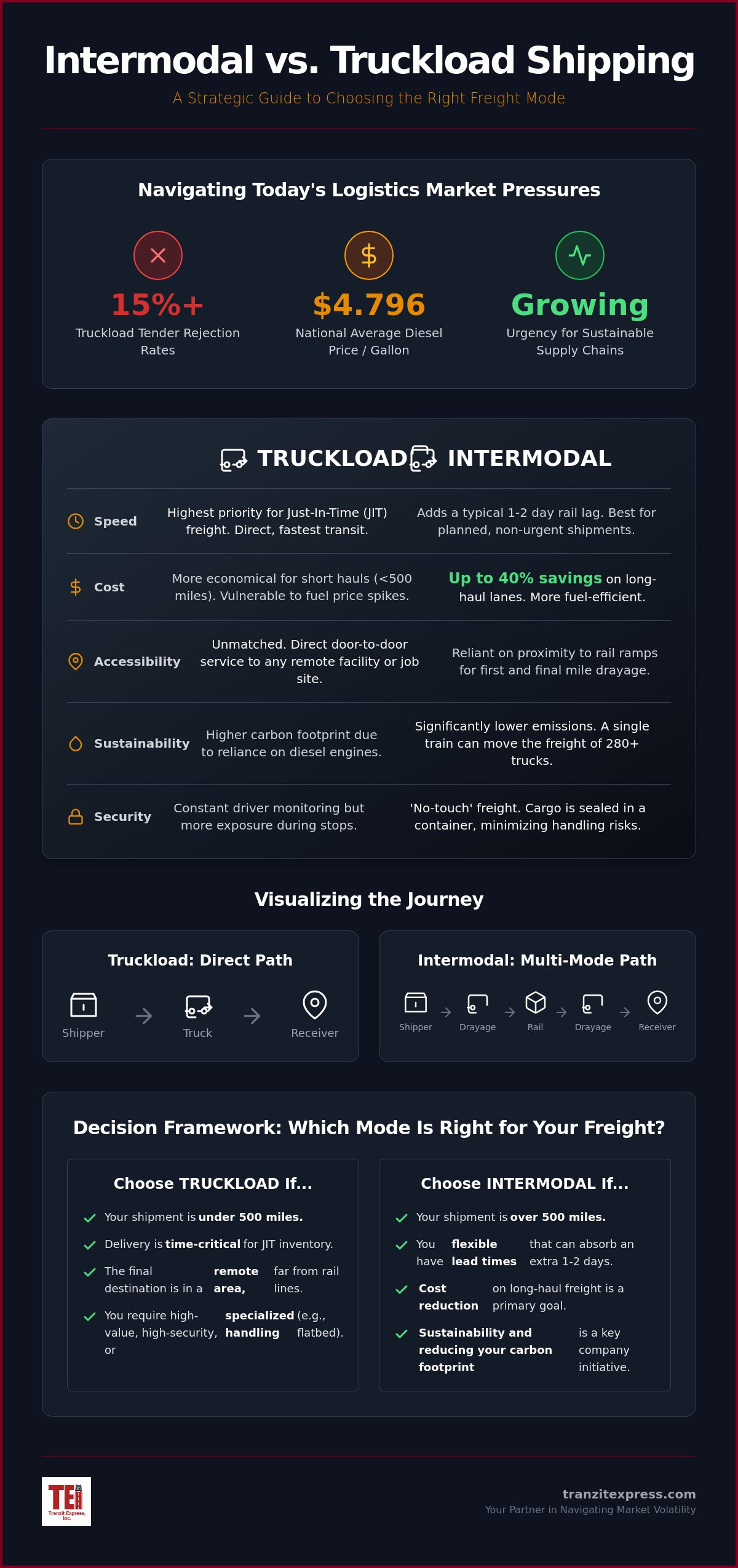
With truckload tender rejection rates climbing past 15 percent this July, many shippers are finding that their go-to capacity is suddenly vanishing when they need it most. You’ve likely felt the pressure of rising diesel prices, which hit a national average of $4.796 per gallon this month, alongside the growing urgency to meet strict sustainability mandates. It’s a challenging time to manage a national supply chain when the traditional methods of moving freight no longer guarantee the same stability they once did.
At Tranzit Express, we’ve spent more than 25 years helping our partners find order in this type of market volatility. We know that the choice between intermodal vs truckload shipping is about more than just a line item; it’s about building a resilient strategy that protects your bottom line. This article provides a clear ROI framework for modal conversion, helping you reduce shipping costs without sacrificing the integrity of your deliveries. We’ll explore the critical differences in cost, speed, and reliability to help you determine the most efficient path forward for your 2026 logistics planning.
Key Takeaways
- Learn when to prioritize truckload shipping for time-sensitive, just-in-time inventory and remote facility access.
- Understand how intermodal solutions can reduce long-haul costs by up to 40 percent while significantly lowering your supply chain’s carbon footprint.
- Determine the ideal distance and lead time thresholds to decide between intermodal vs truckload shipping for your specific freight lanes.
- Account for the typical one-to-two-day rail lag and learn how to adjust your supply chain planning for maximum efficiency.
- Discover how a seasoned logistics partner simplifies the complexity of multi-mode contracts through centralized management and vetted carrier networks.
Understanding the Fundamentals: What Sets Intermodal and Truckload Apart?
The logistics industry is currently navigating a significant period of transition. Shippers are re-evaluating the traditional choice of intermodal vs truckload shipping as market pressures like rising fuel costs and capacity constraints become more pronounced. At its core, truckload shipping involves a single trailer moving directly from the shipper to the receiver. In contrast, Intermodal freight transport utilizes two or more modes of transportation, typically combining the flexibility of trucks with the long-haul efficiency of Class I railroads.
One of the most dependable aspects of modern intermodal shipping is the ‘no-touch’ rule. Your cargo is loaded into a secure container at the origin and remains there until it reaches its final destination. This minimizes handling risks and enhances security during modal transfers. In 2026, where cargo theft and liability are high-priority concerns for every logistics manager, this structural security provides much-needed peace of mind. Market dynamics in 2026, including diesel prices reaching a national average of $4.796 per gallon this July, are forcing a closer look at how these two pillars of transportation can work together to protect your margins.
The Mechanics of a Truckload Move
Truckload shipping remains the industry standard for direct, door-to-door service. It’s the preferred choice for high-value or time-sensitive freight that requires constant monitoring and minimal transit time. However, the landscape has changed. ELD mandates now strictly regulate driver hours, which means that long-haul transit times are more rigid than they were a decade ago. For shipments under 500 miles, the truckload mode is almost always the most efficient path, offering a level of accessibility to remote facilities that rail simply cannot match. It provides a straightforward solution for freight that doesn’t fit the schedule of a rail-based journey.
The Anatomy of an Intermodal Journey
An intermodal move is a coordinated effort that starts and ends with intermodal drayage services. These specialized local carriers handle the “first mile” from your facility to the rail ramp. Once on the tracks, Class I railroads manage the long-haul middle leg, which is significantly more fuel-efficient than road transport. Managing these moving parts can be complex. A seasoned broker acts as a single point of contact, streamlining what would otherwise be a series of separate contracts into one seamless logistical process.
It’s also helpful to understand how containers move between rail hubs. You might encounter two types of transfers:
- Steel-wheel interchange: The container stays on the rail system as it moves from one railroad provider to another.
- Rubber-wheel interchange: A truck moves the container across town between different rail terminals to continue the journey.
While rubber-wheel transfers can add a small amount of time, they often provide more routing options in complex national networks. At Tranzit Express, we’ve spent 25 years refining these routes to ensure your freight moves with the quiet confidence of a well-oiled machine.
The Truckload Advantage: When Speed and Flexibility are Non-Negotiable
While the efficiency of rail is compelling, truckload shipping remains the gold standard for shipments where timing is the primary priority. In the high-stakes environment of 2026, many manufacturers rely on Just-In-Time (JIT) inventory models to keep overhead low. For these operations, a delay of even a few hours can halt a production line. Direct trucking provides a level of precision that rail networks often struggle to match. When you choose a truckload move, your freight isn’t subject to the schedules of a locomotive or the congestion of a busy rail terminal.
Accessibility is another area where trucking excels. Not every facility is located near a Class I rail head or an intermodal ramp. For remote warehouses or job sites, the only viable option is a professional driver who can navigate local roads directly to your dock. This is particularly true for oversized or heavy equipment that requires flatbed freight services USA. These open-deck solutions provide the specialized equipment necessary for cargo that simply won’t fit into a standard intermodal container.
Communication is also more streamlined in the truckload model. Tracking a single vehicle through our dedicated shipper portal offers a clear, real-time view of your freight’s progress. You aren’t managing the hand-offs between drayage drivers and rail carriers. Instead, you have a direct line of sight to one driver and one trailer from origin to destination. If you’re currently weighing intermodal vs truckload shipping for a critical delivery, the simplicity of a direct move often outweighs the potential savings of rail.
Short-Haul Dominance
For shipments traveling under 500 miles, truckload is almost always the superior choice. The “dwell time” at rail terminals, which refers to the time a container spends waiting to be loaded onto a train, can easily consume 24 to 48 hours. On a short-haul lane, a truck can often complete the entire delivery before an intermodal container even leaves the yard. This flexibility in pick-up and delivery windows allows you to maintain a tighter schedule and respond more quickly to customer demands.
High-Touch and Specialized Cargo
Fragile goods benefit significantly from the reduced handling of van freight services. Every time a container is lifted or moved between modes, there’s a marginal increase in the risk of shifting. Direct transit minimizes these vibrations and movements, keeping your cargo stable. High-value electronics often default to truckload to minimize the physical vibrations and multiple handling points inherent in rail transfers. If you need a partner who understands these nuances, Tranzit Express offers the steady hand required to manage your most sensitive loads.
The Intermodal Value Proposition: Cost, Sustainability, and Capacity
While truckload shipping provides unmatched speed for short distances, intermodal transportation offers a strategic advantage for shippers managing long-haul lanes. In a market where truckload spot rates have surged 55 percent above previous benchmarks, finding ways to stabilize your budget is essential. By leveraging competitive intermodal freight rates, many organizations are seeing cost reductions between 15 and 40 percent on lanes exceeding 750 miles. This isn’t just about finding a cheaper alternative. It’s about building a dependable capacity hedge that remains resilient even when the truckload market tightens.
Price stability is a hallmark of the rail network. Unlike the volatile truckload spot market, which reacts sharply to driver shortages and tender rejections, rail rates tend to fluctuate less dramatically. This allows for more accurate quarterly forecasting and reduces the stress of sudden budget overruns. When you integrate rail into your modal mix, you’re also bypassing the driver shortages that frequently disrupt road-only logistics. Rail allows you to scale your capacity during peak seasons without the constant search for available tractors and drivers.
Fuel Surcharges and Long-Haul ROI
The physics of rail transport creates a significant financial advantage. A single gallon of diesel can move one ton of freight more than 470 miles on the tracks. This efficiency makes intermodal an excellent hedge against the rising fuel costs seen in July 2026, where diesel reached a national average of $4.796 per gallon. As fuel prices climb, the ROI of modal conversion becomes even more compelling. Most shippers find their break-even point for intermodal vs truckload shipping occurs once a lane crosses the 500-mile mark, with the savings compounding as the distance increases.
Meeting ESG and Corporate Responsibility Goals
Sustainability is no longer a secondary concern. For many 2026 national RFP processes, “Green Logistics” is now a mandatory reporting requirement. Utilizing rail logistics can reduce your supply chain’s carbon emissions by up to 75 percent compared to standard over-the-road transport. This data is vital for corporate sustainability reports and helps your brand meet strict ESG mandates. In 2026, moving one ton of freight by rail instead of truck reduces greenhouse gas emissions by an average of 75 percent, providing a clear and documented path toward a smaller environmental footprint. We help you track these metrics so you can present a transparent view of your environmental impact to stakeholders and partners alike.
The Decision Framework: Choosing the Right Mode for Your Freight
Deciding between intermodal vs truckload shipping isn’t a matter of picking a favorite mode. It’s about applying a methodical framework to each lane in your network. While we’ve explored the cost and speed benefits of both, the actual choice comes down to a few key pillars: distance, lead time, and cargo density. At Tranzit Express, we’ve spent 25 years helping shippers navigate these variables with the steady hand of an industry veteran, ensuring your freight moves with maximum efficiency.
Distance remains the most important factor in this equation. Most logistics professionals use the 500 to 750 mile rule as the primary threshold for considering intermodal transportation solutions. If your freight is traveling less than 500 miles, the time spent at rail terminals usually negates any cost savings. However, on longer lanes that align with major national rail corridors like the Transcon or the I-95 corridor, the economy of scale becomes undeniable. You’re trading a bit of transit time for a much more predictable budget.
Cargo type and density also play a vital role. Heavy commodities benefit from the higher weight tolerances allowed on rail lines, which helps you maximize the utility of every container. This is particularly effective for high-volume lanes where consistent demand lets you lock in predictable schedules and pricing. We’ve found that shippers who consolidate their heaviest freight onto rail lanes often see the most significant impact on their total logistics spend. It’s a practical way to move more product while reducing the number of individual shipments you have to manage.
The ‘Sweet Spot’ for Intermodal
The ideal scenario for intermodal involves freight that isn’t time-sensitive but requires long-distance transport. By identifying lanes that sit within 50 miles of a major rail ramp, you minimize the drayage costs that can otherwise eat into your savings. This “urgency vs. economy” trade-off is the core of a successful modal strategy. Rail allows you to move massive volumes with a level of price stability that the truckload spot market simply can’t offer in 2026.
Risk Assessment and Mitigation
Lead time is the final piece of the puzzle. You’ll need to plan for a 1 to 2 day ‘rail lag’ compared to the direct service of a truck. This isn’t a problem for many industrial or consumer commodities, but it requires a shift in how you manage inventory levels. If a shipment is truly time-critical or involves a job site with a strict delivery window, we suggest sticking with hot shot trucking to ensure it arrives without the terminal delays common in intermodal moves.
Risk mitigation is best handled through a hybrid approach. Don’t feel pressured to move everything to one mode. A balanced strategy uses rail for steady, long-haul volume and truckload for shorter or more urgent deliveries. This creates a safety net for your supply chain, protecting you from terminal congestion or unexpected weather events. To see how these modes fit into your specific distribution plan, contact Tranzit Express for a comprehensive lane review.
Navigating Complexity: How a Professional Broker Optimizes Your Modal Mix
Managing the transition between intermodal vs truckload shipping requires more than just a rate sheet. It involves coordinating multiple parties, from local drayage drivers to Class I rail operators. For many shippers, the administrative burden of managing these separate contracts is enough to discourage modal conversion. This is where a professional brokerage becomes an essential extension of your team. We handle the complex orchestration of modal handoffs so you can focus on your core business operations.
The 2026 freight market demands higher standards for carrier vetting. Following the Supreme Court ruling in Montgomery v. Caribe on May 14, 2026, the legal scrutiny on carrier selection has intensified significantly. We mitigate this risk by maintaining a strictly vetted national carrier network. Every partner we work with meets our high standards for compliance and reliability, providing you with a sense of security in a volatile regulatory environment. This level of oversight is a cornerstone of our 25 years of logistics experience.
Effective logistics management for shippers relies on visibility. Our specialized portals provide real-time tracking for both modes, ensuring you always know where your freight is, whether it’s on a highway or a rail line. This centralized approach eliminates the data silos that often plague multi-mode journeys. By providing a single point of truth for your data, we reduce the stress associated with complex national distribution.
The Value of a Single Point of Contact
Understanding what does a freight broker do is the first step toward reducing supply chain stress. We manage the drayage-to-rail-to-drayage handoff, acting as the steady hand at the wheel. If a rail delay occurs, we don’t wait for you to find it. We proactively communicate the situation and adjust the final-mile drayage schedule to keep your warehouse operations running smoothly. This proactive approach ensures that your supply chain integrity remains intact even when external factors shift.
Technology and Portal Access
Our shipper portal offers instant access to documentation and tracking, providing a clear window into your intermodal vs truckload shipping strategy. In an industry that often feels rushed, we prioritize methodical and logical communication. This professional consistency has been the hallmark of Tranzit Express for more than two decades. We invite you to experience the order and security that comes with a seasoned logistics partnership. Request a reliable intermodal or truckload quote from Tranzit Express today.
Building a Resilient Supply Chain for 2026
Success in the current freight market requires a balanced approach that prioritizes both precision and efficiency. While truckload shipping offers the directness needed for urgent, high-touch deliveries, intermodal transport provides the cost stability and carbon reduction essential for long-term growth. The strategic choice between intermodal vs truckload shipping is no longer just about finding the lowest rate; it’s about securing reliable capacity and maintaining supply chain integrity in a shifting landscape.
Tranzit Express brings over 25 years of industry-leading experience to this decision, acting as a steady hand at the wheel for your logistics needs. We leverage a comprehensive national carrier network and provide dedicated portals for shippers and carriers to ensure every modal handoff is seamless and transparent. By choosing a partner who values order and consistency, you can reduce the daily stress of complex routing and focus on your business’s future. We invite you to Request a Dependable Freight Quote from Tranzit Express today. Let us help you find the steady path forward for your national logistics.
Frequently Asked Questions
Is intermodal shipping slower than truckload?
Intermodal shipping is generally one to two days slower than direct truckload transit. This difference is primarily due to the time required for loading containers onto trains at rail terminals and the fixed schedules of Class I railroads. While it’s not the ideal choice for just-in-time inventory, it provides a highly predictable schedule for non-urgent freight that doesn’t require immediate delivery.
What is the minimum distance for intermodal to be cost-effective?
The industry standard for cost-effectiveness usually begins at the 500 to 750 mile mark. At these distances, the fuel efficiency of rail starts to outweigh the additional costs of local drayage at both ends of the journey. When comparing intermodal vs truckload shipping for long-haul lanes, the savings typically increase as the total mileage grows and the fuel surcharge benefits become more pronounced.
Can I ship flatbed or specialized loads via intermodal?
Intermodal transport is primarily designed for containerized freight and doesn’t typically accommodate open-deck equipment. If your cargo requires specialized handling or oversized transport, our flatbed shipping services remain the most dependable option. Standard intermodal containers are best suited for palletized goods that fit within the dimensions of a 53-foot box and don’t require specialized loading from the side or top.
How does intermodal shipping improve my company’s carbon footprint?
Moving freight by rail is significantly more sustainable because trains are approximately four times more fuel-efficient than trucks. By shifting long-haul loads to rail, your company can reduce its carbon emissions by up to 75 percent. This provides a documented way to meet the strict ESG reporting requirements that have become standard for national shippers in 2026, helping you achieve corporate responsibility goals with ease.
Are intermodal containers as secure as standard dry vans?
Intermodal containers offer excellent security through the “no-touch” rule. Once a container is loaded and sealed at your facility, it remains closed until it reaches the receiver’s dock. On the rail portion of the journey, containers are often double-stacked or placed in well-cars that make the doors physically inaccessible. This structural security provides a high level of protection against theft during transit across the country.
What happens if there is a rail delay during an intermodal shipment?
If a rail delay occurs, our team manages the logistics of rescheduling the final-mile drayage service. We use real-time tracking through our shipper portal to identify potential disruptions early. This proactive approach allows us to communicate with your warehouse team well before the delay affects your local operations. We act as the steady hand at the wheel, ensuring that a temporary rail hold doesn’t derail your entire distribution plan.
Do I need a separate contract for the trucking and rail legs of intermodal?
You don’t need separate contracts when you partner with a professional broker like Tranzit Express. We simplify the process by acting as your single point of contact for the entire journey. We manage the relationships with drayage carriers and railroads, providing you with one clear invoice and a streamlined communication channel. This centralized management eliminates the “multiple contract” headache often associated with intermodal vs truckload shipping decisions.
Is intermodal shipping suitable for high-value or fragile cargo?
While intermodal is secure, direct truckload shipping is often preferred for exceptionally fragile goods or high-value electronics. Direct trucking involves fewer vibrations and eliminates the physical lifting of the container between different modes of transport. If your cargo is highly sensitive to movement or requires constant monitoring, the steady transit of a dedicated van often provides the best protection for your investment.