Did you know that truckload spot rates are currently running 60% higher than they were this time last year, while the baseline for intermodal freight rates has remained remarkably stable with an increase of less than 2%? This widening spread presents a significant opportunity for shippers, yet many remain hesitant due to the perceived complexity of rail logistics. You’ve likely felt the sting of volatile fuel surcharges or the frustration of trying to reconcile multi-modal billing across different carriers. It’s a common challenge that can make even the most seasoned professional feel like they’re losing their grip on the budget.
We’re here to provide a steady hand and the clear information you need to move forward with confidence. This guide will help you master the intricacies of intermodal pricing so you can leverage rail efficiency to protect your bottom line. We’ll provide a clear framework for comparing truck versus rail costs, explain the “all-in” rate structure, and offer strategic advice on when to lock in contract rates. By the end, you’ll have a dependable roadmap for managing your long-haul shipping with precision and ease.
Key Takeaways
- Learn how to calculate the total cost of shipping by understanding the components of intermodal freight rates, including rail line-haul and local drayage.
- Identify your most cost-effective shipping lanes by applying the 700-mile rule to ensure maximum efficiency for your long-haul budget.
- Determine the ideal timing to transition from spot market volatility to stable contract pricing based on current market dynamics.
- Master weight management requirements for intermodal containers to prevent compliance issues and ensure seamless transitions between rail and road.
- Discover how a dedicated logistics partner streamlines complex multi-modal billing and prevents costly storage fees at rail ramps.
What Are Intermodal Freight Rates and Why Do They Matter in 2026?
To understand the current logistics environment, we must first define the financial framework of multi-modal shipping. What Are Intermodal Freight Rates? Essentially, these rates represent the total cost of moving cargo from origin to destination using a combination of at least two different modes of transport, typically rail and truck. In 2026, these rates have become a vital benchmark for shippers who need to balance cost efficiency with environmental responsibility. By shifting long-haul volume to rail, businesses can significantly reduce their carbon footprint while shielding themselves from the volatility often found in the over-the-road market.
The core value proposition of intermodal shipping lies in its ability to provide a steady hand during periods of market instability. As manufacturing activity continues to expand, with the ISM Manufacturing PMI reaching 53.3% in June 2026, the demand for reliable capacity has never been higher. Shippers often choose between “all-in” rates, which bundle all costs into a single figure, and “plus-fuel” models that separate the base rate from fluctuating energy surcharges. Understanding this distinction is the first step toward reclaiming order in your shipping budget.
The Intermodal Advantage: Cost vs. Speed
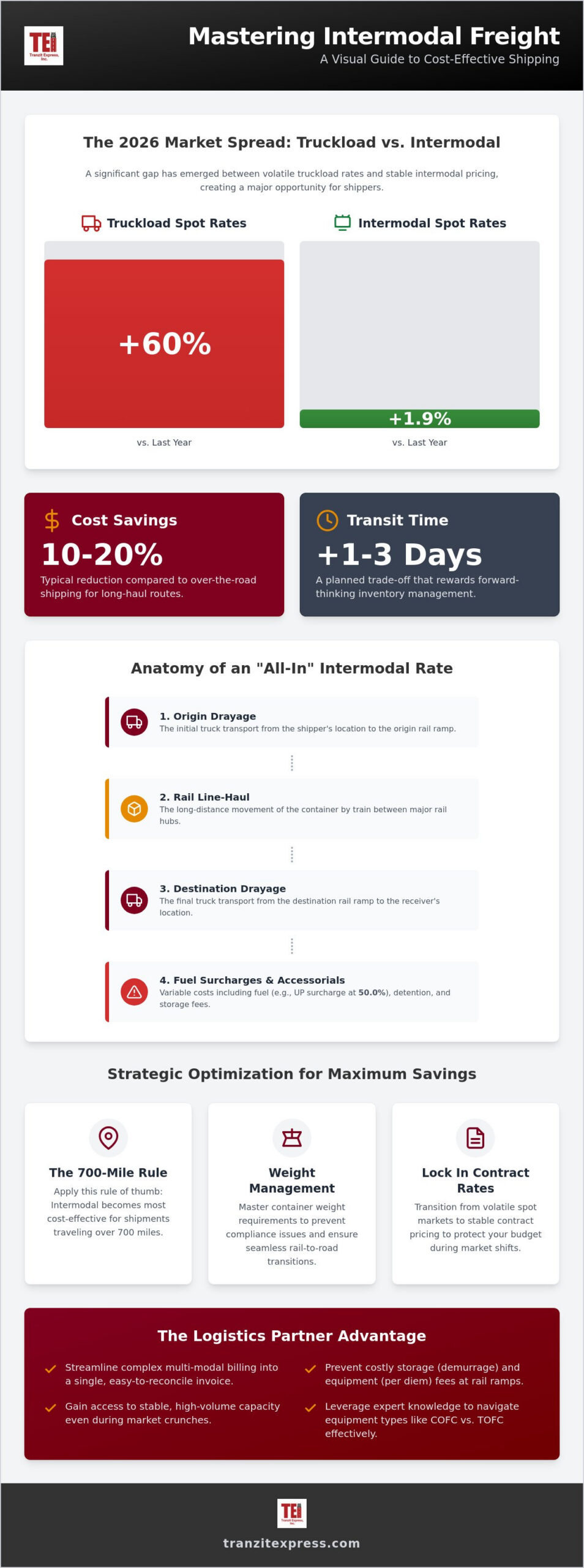
Choosing intermodal often results in a cost reduction of 10% to 20% compared to traditional over-the-road shipping. This financial benefit comes with a planned trade-off in timing, as rail transit typically adds one to three days to the total delivery schedule. It’s a strategic choice that rewards forward-thinking shippers who can plan their inventory cycles around rail efficiency. Intermodal rates are a composite of three distinct service legs: the origin drayage, the rail line-haul, and the destination drayage.
The 2026 Logistics Landscape
As we move through July 2026, the logistics market is experiencing a significant capacity crunch. Truckload spot rates have surged to 60% above year-ago levels, while intermodal spot rates have remained relatively stable with only a 1.9% increase. This widening spread makes rail an essential hedge against rising costs. National infrastructure improvements have also bolstered rail reliability, allowing it to compete more effectively with expedited truck services on many lanes. For a deeper look at how these systems integrate, you can consult The Definitive Guide to Intermodal Transportation Solutions in 2026. By partnering with an experienced broker, you can manage these complexities with the confidence that your freight is in dependable hands.
The Components of an All-In Intermodal Freight Rate
To manage a logistics budget effectively, you must look past the surface price. An “all-in” rate is not a single, static number. Instead, it’s a carefully coordinated combination of moving parts. Each component reflects a different stage of the journey, and understanding how these costs interact is essential for maintaining a predictable shipping spend. When we analyze intermodal freight rates, we break them down into four primary categories: the rail line-haul, drayage, fuel surcharges, and accessorial fees.
The rail line-haul serves as the foundation of your quote. This covers the long-distance movement of your container between major rail ramps. While this is often the most stable part of the bill, the other variables require more active management. For instance, rail fuel surcharges operate on a different logic than standard trucking indices. As of July 2026, the Union Pacific monthly intermodal fuel surcharge reached 50.0%. This highlights why shippers need a partner who provides clear visibility into these shifting percentages. Beyond fuel, accessorial charges like detention, chassis splits, or rail storage fees can quickly accumulate if your logistics provider doesn’t prioritize proactive communication.
COFC vs. TOFC: Impact on Equipment Pricing
Equipment type significantly influences your total cost. Container-on-Flatcar (COFC) is the modern industry standard, offering high-volume efficiency and better stacking capabilities on the train. In contrast, Trailer-on-Flatcar (TOFC) involves moving a standard highway trailer on a railcar. While TOFC is useful for specialized freight that cannot be easily transloaded, it often comes with a higher price tag due to its lower density. Regional equipment availability at specific ramps can also cause rates to fluctuate, making it vital to monitor local equipment pools regularly.
Understanding Drayage Economics
Drayage is the short-haul trucking required at both the origin and destination. It’s often the most volatile part of the equation. In July 2026, the National Drayage Spot Market Index rose 7.8% year-over-year, reflecting tighter capacity at major ports and inland hubs. The “drayage radius,” or the distance from your facility to the rail ramp, is the biggest variable in your rate. A facility located 50 miles from a ramp will always enjoy more competitive pricing than one 150 miles away. If you find these multi-layered costs confusing, you may want to review our intermodal drayage services FAQ guide to better understand how these fees are structured and how to avoid common accessorial charges. Strategic lane planning that minimizes these “first mile” and “last mile” distances is the most effective way to protect your long-haul budget from unnecessary drayage spikes.
Market Dynamics: Analyzing the Intermodal-to-Truckload Spread
The relationship between truckload and rail pricing, often called “the spread,” is the primary driver of intermodal demand. When the cost of over-the-road transport climbs, rail becomes an increasingly attractive alternative for long-haul lanes. In July 2026, we are seeing a dramatic widening of this gap. While truckload spot rates have surged 60% over the last year, intermodal freight rates on the spot market have remained remarkably stable, rising only 1.9%. This environment allows shippers to significantly reduce their spend by shifting volume to the rails, provided they understand the timing of these market shifts. For a comprehensive ROI framework to guide your modal conversion decisions, our analysis of intermodal vs truckload shipping provides the strategic comparison you need to make confident routing choices.
Class I railroad volumes provide the data necessary to predict these movements. With U.S. intermodal volume up 3.4% year-to-date, it’s clear that the market is already reacting to the truckload capacity crunch. June 2026 saw approximately 2.40 million TEUs in containerized imports, an 8.2% increase from the previous year. This influx of cargo, driven partly by shippers front-loading imports to avoid potential tariff increases, puts significant pressure on rail ramps. These dynamics make Q3 and Q4 peak seasons particularly critical for rate negotiation. During these months, securing contract rates early can protect your budget from the seasonal spikes that often hit the spot market as capacity tightens.
How Truckload Capacity Dictates Intermodal Demand
The national supply chain often uses rail as a relief valve when over-the-road capacity becomes scarce. When driver shortages or regulatory changes limit the number of available trucks, shippers naturally migrate toward intermodal solutions to keep their goods moving. This transition doesn’t happen instantly. Intermodal rates generally lag behind truckload spot market trends by 30 to 60 days. This delay gives proactive shippers a window of opportunity to adjust their routing strategies before rail pricing catches up to the broader market demand. It’s a predictable rhythm that allows for methodical planning rather than reactive decision-making.
Navigating the Spot Market in 2026
Success in the spot market requires more than just looking for the lowest number on a screen. It demands a data-driven approach that identifies lane-specific savings without sacrificing service reliability. Chasing the absolute lowest rate can often lead to missed appointments or equipment shortages, which eventually result in costly storage fees. The stability of your supply chain depends on the quality of the intermodal trucking companies you choose to handle your drayage. By prioritizing dependable partnerships over temporary price dips, you ensure your cargo moves through the rail network with the consistency your customers expect.
Strategic Optimization: How to Lower Your Intermodal Costs
Optimization is not just about finding a lower number; it’s about building a process that resists market volatility. While external forces influence intermodal freight rates, your internal shipping habits often dictate the final bill. By applying industry-proven standards, you can secure the stability and savings that rail is designed to provide. This requires a methodical look at your network to identify where rail offers a genuine advantage over traditional trucking.
One of the most effective ways to lower costs is through lead time planning. Providing at least a 48-hour advanced booking allows your logistics partner to secure equipment and drayage capacity before rates spike due to last-minute demand. Additionally, lane consolidation can significantly reduce your spend. By grouping shipments near major rail hubs like Chicago, Atlanta, or Dallas, you minimize the drayage distance, which is often the most expensive portion of the move on a per-mile basis. Utilizing professional rail logistics can help you identify these consolidation opportunities within your existing supply chain.
Weight management is another critical, yet frequently overlooked, factor. Because intermodal containers and their chassis are heavier than standard over-the-road trailers, your cargo weight should generally stay under 42,500 pounds. Exceeding this limit can lead to overweight fines or the need for specialized equipment, both of which will inflate your total costs. Staying within these limits ensures a seamless transition between the road and the rail.
The 700-Mile Threshold and Beyond
The cost-savings of rail are often neutralized on short hauls. On a 400-mile lane, the fuel and labor for two drayage legs can exceed the cost of a single direct truckload. However, on transcontinental lanes, such as those moving from the West Coast to the Midwest, the savings become significant. A lane is typically considered “intermodal-friendly” if it exceeds the 700-mile threshold and originates within a 50-mile radius of a major rail ramp. Analyzing your lanes through this lens helps you prioritize the shipments that offer the maximum return on investment.
Mitigating Accessorial and Hidden Fees
Proactive communication is your best defense against “per diem” and rail storage charges. These fees accumulate quickly when a container sits at a terminal longer than the allotted free time. A “no-touch” strategy, where cargo is properly blocked and braced at the origin, also reduces the risk of damage claims and extra handling costs during the rail journey. You should always verify ramp hours and terminal congestion before dispatching drayage to ensure a smooth, on-time pickup. If you are ready to stabilize your shipping budget, request a comprehensive rate review from our team today.
The Broker Advantage: Why Partnership Leads to Better Rates
While digital platforms offer instant data, they often lack the institutional knowledge required to resolve real-world disruptions. Navigating intermodal freight rates effectively requires more than just a software interface; it demands a veteran’s perspective. At Tranzit Express Inc., we leverage over 25 years of industry experience to guide our clients through the complexities of rail carrier networks. This deep institutional knowledge allows us to anticipate market shifts and secure capacity even when the national supply chain feels most constrained.
A reliable freight broker acts as your single point of contact, consolidating the often-confusing multi-modal billing into a clear, manageable process. This role is especially critical when managing drayage compliance. We vet every carrier in our network to ensure they meet high standards for insurance, safety, and reliability. This rigorous vetting process protects your cargo and reduces the likelihood of unexpected delays that can lead to costly terminal storage fees. By prioritizing professional communication and proactive tracking, we provide the order and security needed to manage your logistics with peace of mind.
Stability in a Complex Market
We believe in the value of a steady hand. Tranzit Express Inc. prioritizes long-term B2B partnerships over simple, one-off transactions. This collaborative approach means we’re invested in your success, acting as an extension of your own team. When rail delays or port congestion occur, our specialists step in to manage the exceptions, significantly reducing the administrative burden on your staff. Our goal is to provide a sense of stability, ensuring that your promises to your customers are fulfilled regardless of market volatility.
Getting Started with an Intermodal Quote
Securing a dependable rate starts with accurate information. To provide you with the most precise intermodal freight rates, our specialists will need the origin and destination zip codes, the total weight of the cargo, and a clear description of the commodity type. During your initial consultation, we’ll review your current lanes to determine where rail efficiency can be most effectively applied. We’ll help you identify the “sweet spots” in your network and provide a transparent look at the “all-in” rate structure. If you’re ready to bring consistency and order to your long-haul shipping, contact Tranzit Express Inc. for a dependable intermodal freight quote today.
Securing Stability in Your 2026 Logistics Strategy
Mastering the complexities of intermodal freight rates is no longer just a cost-saving exercise; it’s a fundamental strategy for supply chain resilience. By understanding the interplay between rail line-hauls and drayage economics, you’ve gained the tools to identify the most efficient lanes in your network. Remember to prioritize the 700-mile threshold and maintain strict weight limits to ensure your shipments move without interruption. These practical adjustments create a foundation of predictability that protects your budget from the volatility of the spot market.
Success in this complex environment requires a partner who acts as a steady hand at the wheel. Tranzit Express Inc. brings over 25 years of logistics experience and national US coverage across all Class I railroads to every shipment. We pride ourselves on A+ rated professional B2B communication that keeps you informed and reduces administrative stress. When you’re ready to optimize your long-haul strategy, Request a Dependable Intermodal Freight Quote from Tranzit Express Inc. today. We look forward to building a lasting partnership that keeps your freight moving forward with confidence.
Frequently Asked Questions
What is the typical cost difference between intermodal and truckload freight?
Intermodal shipping typically offers a 10% to 20% cost reduction compared to over-the-road trucking on long-haul lanes. In July 2026, this gap has widened significantly as truckload spot rates have risen 60% year-over-year while intermodal freight rates on the spot market increased by less than 2%. This spread makes rail a highly effective tool for shippers looking to stabilize their budgets amidst trucking capacity shortages.
How long is a typical intermodal freight rate valid?
Spot market quotes are generally valid for seven to 14 days, though high volatility can shorten this window. Contract rates are typically negotiated for a full year, providing a steady hand for your long-term budgeting. Given the current market dynamics, locking in a contract rate during Q3 or Q4 can protect your business from the seasonal capacity shifts that often drive up pricing at the end of the year.
Are fuel surcharges higher for intermodal than for trucking?
Rail fuel surcharges often appear higher as a percentage, but they’re applied to a lower base rate than trucking. For example, the Union Pacific monthly intermodal fuel surcharge reached 50.0% in July 2026. While this percentage seems substantial, the total dollar amount often remains lower than truckload fuel costs because trains are significantly more fuel-efficient per ton-mile than individual trucks.
What is the “700-mile rule” in intermodal shipping?
The 700-mile rule suggests that intermodal becomes the most cost-effective option for hauls exceeding 700 miles. On shorter distances, the cost of origin and destination drayage often offsets the savings gained from the rail line-haul. By focusing your rail strategy on transcontinental lanes or hauls over this threshold, you ensure the maximum return on your logistics investment.
Can intermodal freight rates include door-to-door service?
Yes, most providers offer all-in door-to-door quotes that cover every leg of the journey. This structure includes the initial truck pickup, the rail transport, and the final delivery to your customer’s dock. Working with a broker simplifies this process by providing a single point of contact for multi-modal billing, which reduces the administrative burden on your internal team.
How do rail strikes or terminal congestion affect intermodal rates?
Disruptions like terminal congestion or strikes don’t always change the base rate immediately, but they frequently trigger accessorial fees. These might include rail storage charges or per diem fees for containers that sit idle past their allotted free time. Proactive communication from your logistics partner is essential during these times to reroute freight or adjust pickup schedules before these costs accumulate.
What commodities are best suited for intermodal freight pricing?
Non-perishable consumer goods, electronics, and retail inventory are ideal for intermodal shipping. These commodities benefit from the cost-savings of rail without being overly sensitive to the additional one to three days of transit time. It’s a dependable solution for shippers who can plan their inventory cycles in advance to leverage the efficiency of national Class I railroads.
Is intermodal shipping cheaper for heavy-weight cargo?
Intermodal is generally not the cheaper option for heavy-weight cargo due to stricter equipment weight limits. Most intermodal containers have a maximum cargo weight of 42,500 pounds to remain compliant with road weight laws when on a chassis. Exceeding these limits can lead to overweight fines or require specialized equipment, which will quickly increase your intermodal freight rates compared to a standard 45,000-pound truckload.