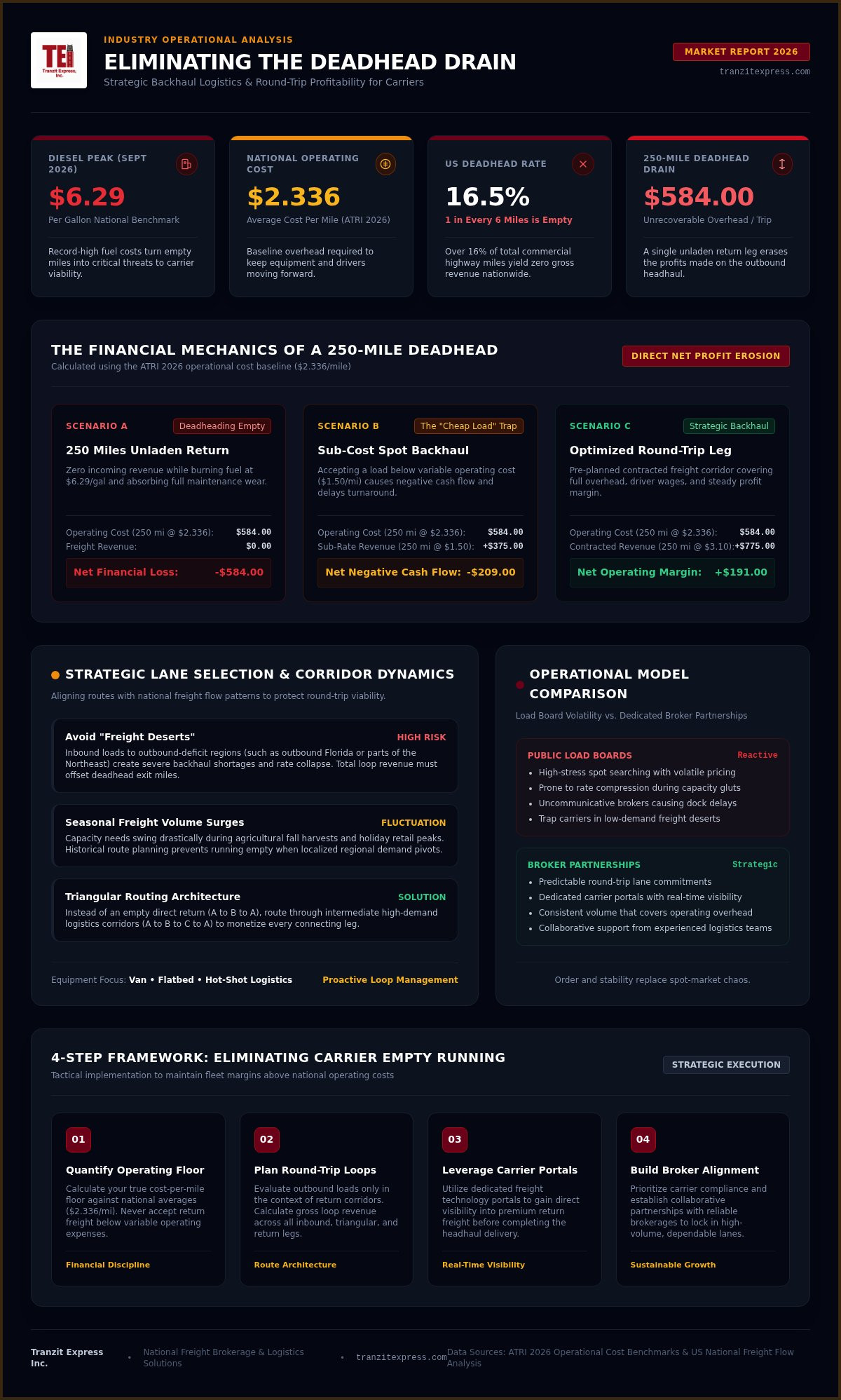
With diesel prices reaching $6.29 per gallon in September 2026, every empty mile your truck travels is no longer just a missed opportunity; it’s a direct threat to your business’s survival. Finding consistent backhaul freight opportunities for carriers has become the defining factor between a profitable quarter and an operational loss. You’ve likely felt the sting of high fuel costs eating into your margins while wasting valuable hours searching for return loads from brokers who don’t communicate. It’s frustrating to watch your hard-earned revenue vanish into unrecoverable overhead while nearly one out of every six miles driven across the United States yields zero revenue.
We understand that you need more than just a load board; you need a steady hand to help manage your lanes. This guide will show you how to eliminate those deadhead miles and secure professional, profitable backhaul freight through strategic planning and dependable brokerage partnerships. We’ll explore how to leverage dedicated carrier portals, utilize triangular routing, and build long-term relationships to keep your wheels turning with purpose and order.
Key Takeaways
- Learn to quantify the true cost of “deadheading” and how to strategically eliminate empty miles to protect your profit margins.
- Identify high-demand corridors and backhaul freight opportunities for carriers by aligning your routes with national freight flows across the United States.
- Understand the benefits of shifting from volatile load boards to professional brokerage partnerships that offer consistent volume and clear communication.
- Discover how leveraging technology, such as a dedicated carrier portal, can provide the real-time visibility and efficiency required to secure premium return loads.
- Build a foundation for long-term revenue by prioritizing carrier compliance and fostering collaborative relationships with experienced industry veterans.
Understanding Backhaul Freight and Eliminating the Deadhead Drain
In the logistics industry, a backhaul is the return journey of a truck from its original destination back to its point of origin. While it sounds simple, managing these return legs effectively is often what separates a thriving fleet from one struggling to stay afloat. In the 2026 market, where diesel prices have surged to $6.29 per gallon, the luxury of deadheading has become a liability that few can afford. Proactive load searching is no longer optional; it’s a core survival strategy. Identifying consistent backhaul freight opportunities for carriers ensures that your equipment remains productive throughout every mile of the trip.
The Financial Impact of Empty Miles
The true cost of dead mileage and empty running extends far beyond the fuel gauge. When you calculate the national average operational cost of $2.336 per mile, every unladen mile erodes your bottom line. According to the ATRI 2026 report, a single 250-mile deadhead leg costs a carrier roughly $584 in unrecoverable overhead. Industry data suggests that nearly 16.5% of total miles driven are empty. It’s a heavy drain on resources. Reducing this percentage by even a small margin can significantly increase annual net profit. Efficient routing also minimizes the environmental footprint of your fleet, aligning operational excellence with modern sustainability expectations across the United States.
Why ‘Cheap’ Backhauls Are a Myth in Strategic Logistics
There’s a common misconception that taking any load, regardless of the rate, is better than moving empty. However, taking a backhaul that pays below your variable operating cost actually results in negative cash flow. It’s a trap. Strategic backhaul freight opportunities for carriers involve finding loads that cover more than just the fuel and driver wages. Professional brokers who value long-term partnerships understand that reliable return-leg capacity is vital for keeping national supply chains moving. By securing consistent lanes, you stabilize your revenue and move away from a reactive, high-stress mindset. This shift allows you to view the return leg as a strategic anchor for your business rather than a desperate afterthought. We believe that professional planning provides the order needed in a complex industry.
Strategic Lane Selection: Identifying Profitable Backhaul Corridors
Successful carriers don’t view return legs as an afterthought; they see them as the strategic anchor of their annual profitability. Identifying consistent backhaul freight opportunities for carriers requires a deep understanding of national freight flows across the United States. While a high-paying headhaul might look attractive on paper, it loses its value if it drops you into a “freight desert” where return loads are scarce or underpriced. Achieving round-trip profitability means calculating the total revenue of the entire loop against your operational overhead.
According to ATRI’s operational cost benchmarking study, total operational costs have climbed to $2.336 per mile. This reality makes regional market knowledge indispensable. For instance, seasonal shifts like the fall harvest or the holiday retail surge can dramatically shift capacity needs. A lane that was profitable in July might become a financial drain in November if you aren’t prepared for these fluctuations. We recommend using historical data to predict availability and partnering with a broker who understands these rhythmic shifts in the market.
High-Volume vs. High-Margin Corridors
Carriers often face a choice between high-volume lanes with quick-turnaround loads and high-margin corridors that require more specialized handling. While high-volume lanes offer predictability, they are often the first to see rate compression during capacity gluts. Conversely, high-margin freight requires more planning but protects your bottom line. Avoiding freight deserts, such as outbound Florida or parts of the Northeast, is essential. By analyzing market trends, you can position your fleet in areas where demand for backhaul freight opportunities for carriers remains steady regardless of broader economic cooling.
Equipment-Specific Opportunities: Van, Flatbed, and Hot-Shot
Your equipment type dictates your backhaul strategy. For example, Flatbed Shipping often provides more lucrative return options than standard dry van due to the specialized nature of the cargo. Construction and industrial cycles often create unique demand patterns that flatbed carriers can exploit for higher margins. Similarly, Hot Shot Trucking offers speed-to-market advantages for urgent, smaller loads that larger fleets can’t accommodate. Even intermodal transportation can play a role in a diversified strategy, providing a steady hand when spot market volatility peaks. If you’re looking for order in these complex lanes, exploring our carrier solutions can help you find the right balance for your fleet.
Load Boards vs. Broker Partnerships: Which Yields Consistency?
Many carriers begin their search for return loads on public digital platforms. While these tools offer immediate visibility, they often lead to a “race to the bottom” where linehaul rates are squeezed by automated bidding. Relying solely on these boards can make it difficult to find stable backhaul freight opportunities for carriers. To understand the broader context of these lanes, carriers can consult the Bureau of Transportation Statistics Freight Analysis Framework, which highlights the massive imbalances in commodity flows across the United States. These imbalances create the very gaps that a strategic partnership helps fill.
The Limitations of Purely Digital Load Boards
Digital boards are often faceless and transactional. Carriers frequently encounter hidden subscription fees or find themselves exhausted by constant bidding wars against hundreds of other trucks. There’s also a significant lack of accountability. If a shipper cancels a load at the last minute, an algorithm won’t help you find a replacement or negotiate a dry-run fee. It’s nearly impossible to build a professional reputation on a platform where you’re just a DOT number in a database. This faceless environment creates a sense of disorder that can be draining for modern fleets.
The Benefits of Dedicated Brokerage Relationships
Working with an experienced freight broker provides a level of security that software simply cannot match. A broker acts as a steady hand at the wheel, offering access to “private” loads that are never posted to public boards. These loads are often reserved for loyal carrier partners who have proven their reliability over time. Priority dispatching becomes a natural benefit of these long-term relationships, ensuring your trucks stay moving even when the spot market tightens.
Communication serves as a vital currency in this industry. When a problem arises at a loading dock, talking to a knowledgeable human beats interacting with an automated bot every time. Brokers also provide critical risk mitigation by vetting shippers and ensuring that carriers are paid promptly. This professional oversight reduces the stress of logistics management and allows you to focus on the road. By fostering these collaborative relationships, you secure the consistent backhaul freight opportunities for carriers that lead to predictable revenue and reduced empty miles.
Practical Steps to Secure Premium Backhaul Freight
Securing high-quality freight starts with foundational excellence. If your safety ratings aren’t impeccable, you’ll be excluded from premium lanes before you even submit a bid. Compliance isn’t just about following rules; it’s about proving you are a low-risk, high-reward partner. Beyond safety, equipment versatility is a major asset in a fluctuating market. Carriers who maintain trailers capable of handling diverse cargo, or those who operate specialized equipment like flatbeds and hot-shot rigs, often find more frequent backhaul freight opportunities for carriers. By ensuring your fleet meets these high operational standards, you position yourself as a dependable choice for complex logistics needs across the United States.
Leveraging the Carrier Portal for Efficiency
Efficiency in the modern market relies on technology that simplifies the match between capacity and demand. A dedicated carrier portal acts as your primary tool for managing return legs. Within these portals, you can set up automated alerts for your preferred return corridors. This proactive approach ensures you’re notified the moment a load becomes available, rather than spending hours manually refreshing a screen. It’s about bringing order to a process that can often feel chaotic.
Speed is also a vital factor in your cash flow. Uploading bills of lading and other documentation directly through the portal speeds up the payment cycle and reduces administrative friction. By analyzing portal data, you can track which lanes provide the best margins, allowing you to refine your strategy based on actual performance rather than guesswork. This level of organized professionalism reduces the stress of daily operations and provides a clear path toward long-term growth. Ready to streamline your return legs? Access our carrier portal today to find your next load.
The Role of Professional Communication
While technology provides the platform, professional communication builds the relationship. Dispatchers and brokers value carriers who provide proactive updates. If you’re stuck at a receiver or facing a weather delay, a clear, declarative report allows the broker to manage the shipper’s expectations. This transparency reduces anxiety throughout the supply chain and establishes you as a steady hand at the wheel. Providing updates through professional channels ensures that every stakeholder has the information they need to keep the process moving forward.
Being the carrier who communicates clearly often means you’ll get the first call when premium backhaul freight opportunities for carriers arise. Reliability is a currency in this industry. When you consistently fulfill your promises, you move from being a one-time contractor to a preferred partner. This transition is essential for securing the consistency needed to thrive in a competitive landscape.
Partnering with Tranzit Express for Reliable National Solutions
With over 25 years of industry experience, Tranzit Express Inc. serves as a steady hand for carriers navigating the complexities of the national market. We understand that stability is the foundation of a successful fleet. Our national reach allows us to provide van freight services across the United States, ensuring that you have access to consistent volume regardless of your home base. By prioritizing long-term partnerships over simple transactions, Tranzit Express Inc. helps you secure the backhaul freight opportunities for carriers that reduce operational stress and provide a sense of order in a complex industry.
Our dedicated Carrier Portal Access provides a streamlined gateway to these opportunities. It’s designed to eliminate the wasted time and frustration often associated with traditional load searching. Instead of chasing unreliable leads, you can find loads that fit your specific routes and schedules. This organized approach to logistics allows you to focus on safe driving while Tranzit Express Inc. handles the complexities of load matching. We believe that a professional partnership should reduce your burden, not add to it.
A Comprehensive Range of Solutions
We offer more than just standard dry van loads. Our network includes specialized opportunities for Flatbed Shipping and Hot-Shot Loads, as well as Intermodal Transportation for carriers seeking flexible routing on return legs. This diversity ensures that regardless of your equipment type, there’s a place for your fleet in our system. Additionally, our expert logistics management for shippers creates a steady pipeline of demand, directly resulting in more reliable backhaul freight opportunities for carriers.
Joining the Tranzit Express Inc. Network
Becoming a part of the Tranzit Express Inc. network is a straightforward process designed for qualified motor carriers who value professionalism. We’re committed to transparent communication and on-time payment, recognizing that your cash flow is the lifeblood of your business. Our onboarding process is thorough yet efficient, ensuring that we maintain high standards across our entire network. Our 25-year history is built on the success of our carrier partners. By choosing to work with Tranzit Express Inc., you’re aligning your fleet with a veteran broker that values your contribution to the national supply chain. We provide the security and expert guidance needed to turn every return leg into a profitable, dependable journey.
Securing Your Fleet’s Future with Strategic Partnerships
Maximizing revenue in 2026 requires more than just finding any available load; it demands a shift from reactive searching to proactive, strategic planning. By eliminating deadhead miles and focusing on high-value corridors, you protect your margins against rising operational costs. We’ve explored how consistent backhaul freight opportunities for carriers are best secured through professional relationships rather than the uncertainty of public spot boards. A reliable partnership provides the order and security necessary to thrive in this complex industry.
With over 25 years of logistics excellence and a national shipping network, Tranzit Express offers the stability your fleet deserves. Our streamlined Carrier Portal simplifies the logistics management process, allowing you to focus on the road while we maintain the steady flow of your return legs. It’s time to move beyond the stress of empty miles and embrace a more predictable way of doing business.
Join the Tranzit Express Carrier Network and find your next load today.
We’re ready to act as the steady hand at the wheel for your business. Let’s turn your empty miles into consistent, predictable earnings together.
Frequently Asked Questions
What is the difference between a headhaul and a backhaul?
A headhaul is the primary shipment that takes a truck away from its home base, typically commanding the highest market rate. In contrast, a backhaul is the return trip back toward the carrier’s origin. While headhauls generate the bulk of revenue, finding reliable backhaul freight opportunities for carriers is essential for covering the operational costs of the return leg. Balancing these two components ensures that every mile driven contributes to the fleet’s overall profitability.
How do backhaul freight opportunities help small trucking companies?
Backhaul loads are vital for small carriers because they eliminate the financial drain of driving empty. When a small company secures a paying load for the return trip, they can cover high fuel costs and driver wages that would otherwise be unrecoverable overhead. This strategic approach stabilizes cash flow and allows smaller fleets to compete effectively by ensuring their equipment remains productive across every mile of a national route.
Why should I use a freight broker instead of a public load board for backhauls?
Public load boards often result in a race to the bottom where rates are squeezed by automated bidding and lack of accountability. A professional freight broker like Tranzit Express provides a steady hand by offering access to private loads and dedicated lanes that never reach public boards. Brokers also offer the reassurance of human communication and a 25-year history of industry expertise, helping to resolve on-the-road issues that algorithms cannot handle.
Does Tranzit Express offer backhaul loads for hot-shot truckers?
Yes, we provide a wide range of specialized loads specifically for hot-shot truckers across the United States. Our 25 years of experience include a deep understanding of the unique speed-to-market requirements of smaller, urgent shipments. Whether you operate a van, flatbed, or hot-shot rig, our network offers consistent backhaul freight opportunities for carriers to keep your equipment moving profitably. We prioritize reliable communication to ensure these time-sensitive loads are handled with professional care.
How do I access the Tranzit Express carrier portal?
You can access our dedicated carrier portal directly through the Tranzit Express website. This secure platform is designed to provide streamlined access to our national shipping network. Once registered, you can set up alerts for your preferred lanes, upload documentation instantly to speed up payment, and view available loads in real-time. It’s a professional tool built to reduce administrative stress and bring order to your daily logistical planning.
Can I find intermodal backhaul opportunities through a broker?
Absolutely, we offer intermodal transportation solutions as part of our comprehensive logistics management. Intermodal backhauls can provide a stable and cost-effective alternative to traditional over-the-road lanes, especially during periods of high fuel volatility. By partnering with a broker who understands rail and road integration, you can access a broader range of routing options. This flexibility is key to maintaining consistent revenue and reducing empty miles in a fluctuating national market.
What documents are needed to start hauling backhaul freight?
To begin hauling with us, you’ll need to provide standard industry documentation to ensure compliance and safety. This includes your active Motor Carrier (MC) or USDOT authority, a valid W-9 form, and proof of insurance coverage that meets our professional standards. We also require a signed carrier agreement. Once these documents are verified through our portal, you can begin accessing our national network of van, flatbed, and specialized hot-shot opportunities.
How does a broker ensure I get paid for a backhaul load?
We act as a dependable intermediary by vetting every shipper in our network before a load is ever assigned. This process includes rigorous credit checks and performance reviews to ensure financial reliability. We value the success of our carrier partners, which is why we prioritize transparent communication and prompt payment cycles. Our 25-year history is built on the trust we’ve established by ensuring our carriers are compensated fairly and on time for every mile.