With national diesel prices reaching a record $6.285 per gallon this September, the margin for error in your supply chain has effectively disappeared. You likely feel the pressure of rising spot rates and the constant worry that a single communication breakdown could derail a critical shipment. The choice between Landstar vs non-asset broker often seems like a trade-off between sheer scale and personalized accountability. We know you’re looking for a partner who answers the phone at any hour and keeps their word on pricing.
This article helps you discover the critical differences between massive agent-based networks and dedicated non-asset brokers to find the most reliable fit for your freight. We’ll explore how these different models manage specialized equipment like hot-shots or flatbeds, maintain carrier compliance under new FMCSA rules, and provide the steady reliability your business deserves. By the end, you’ll have a clear framework for securing consistent rates and reliable capacity in a tightening market.
Key Takeaways
- Understand the structural differences between Landstar vs non-asset broker to determine which model provides the stability your supply chain requires in a volatile market.
- Learn why a massive network of independent agents can lead to inconsistent service and how a centralized partner ensures a steady hand for every shipment.
- Discover how dedicated shipper portals and direct communication lines reduce the risk of delays and simplify the management of specialized van, flatbed, or hot-shot freight.
- Identify the true cost of logistics beyond the initial quote, focusing on how carrier compliance and reliable capacity protect your reputation and budget.
- Gain a clear framework for selecting a partner that offers long-term accountability rather than just transactional scale.
Defining the Models: Landstar vs. Traditional Non-Asset Brokers
Choosing the right logistics framework requires understanding how your freight actually moves from point A to point B. Shippers often face a choice between an asset-light giant and a traditional intermediary, which leads to the central debate of a Landstar vs non-asset broker. A common misconception is that larger networks own their fleets, but both models primarily operate without a massive corporate-owned asset base. The true distinction lies in how they manage accountability, execute communication, and structure their internal networks to handle your capacity needs.
Relying on a massive corporate brand doesn’t automatically guarantee a seamless shipping experience. When evaluating a Landstar vs non-asset broker, consistency comes down to operational execution rather than total network size. Shippers frequently discover that managing freight through a single, dedicated team yields better day-to-day visibility than working with a fragmented network of independent sales agents.
What is an Asset-Light Network?
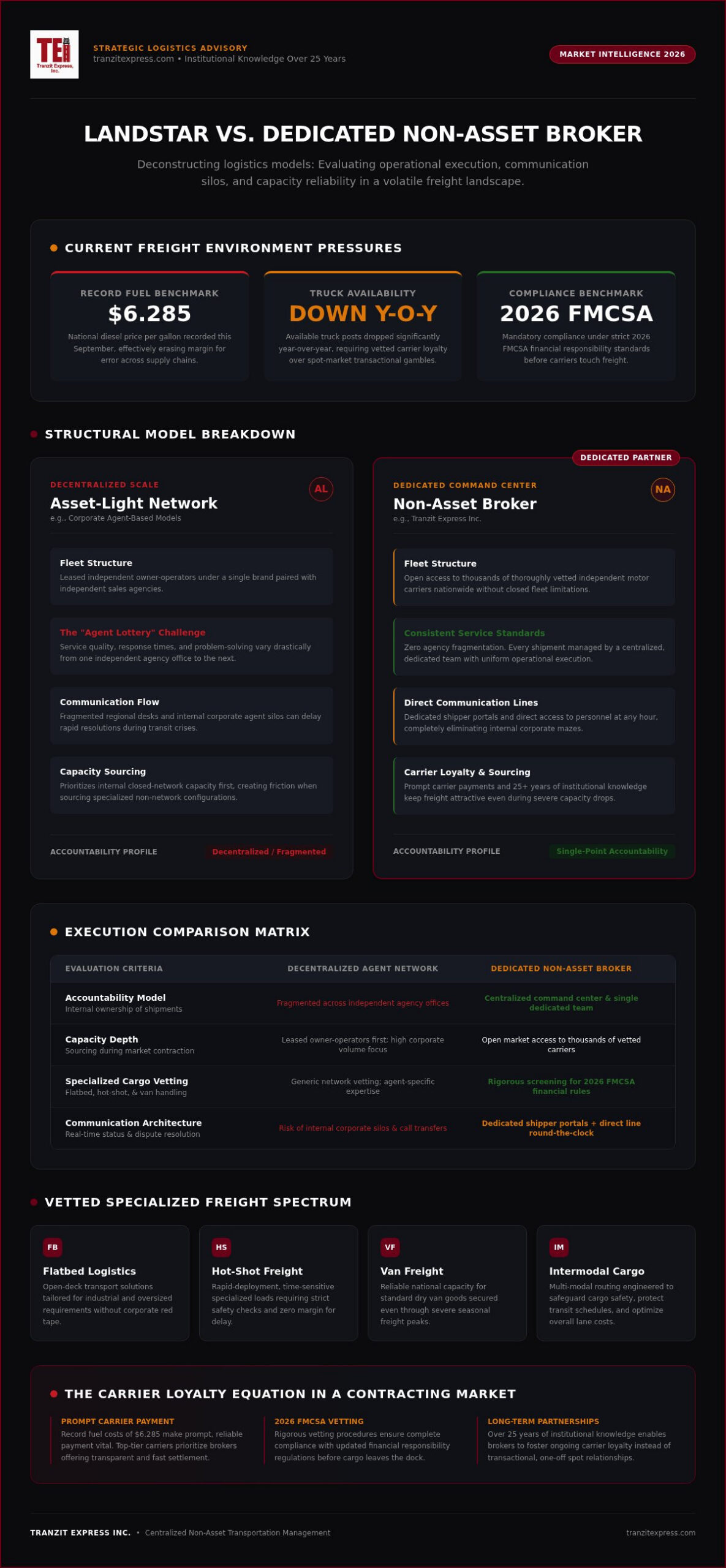
Asset-light networks often rely heavily on independent owner-operators leased to the company. This capacity is paired with an extensive network of independent agents who operate as separate business entities under a corporate umbrella. While this structure offers vast scale, it introduces operational variability. Because each agent operates independently, your customer service experience, response times, and problem-solving efficiency can vary significantly from one agency office to the next.
The Core of the Non-Asset Brokerage
A traditional freight broker utilizes a centralized operational model to maintain a steady hand over your entire supply chain. Instead of relying on a closed network of leased owner-operators, a non-asset broker like Tranzit Express Inc. doesn’t limit your options and maintains relationships with thousands of thoroughly vetted independent motor carriers nationwide. This centralized approach removes internal agent silos, providing shippers with direct communication and consistent service standards. This flexibility becomes incredibly valuable when sourcing specialized equipment, ensuring you receive highly reliable flatbed freight services USA or hot-shot solutions without navigating an internal corporate maze.
Reliability and Capacity: Navigating Market Volatility
A common assumption in logistics is that a larger network naturally translates to higher truck availability. However, in a market defined by supply contraction rather than demand surges, sheer volume doesn’t solve the problem. In the debate of Landstar vs non-asset broker, the real value lies in who can actually secure a truck when available truck posts have dropped significantly year-over-year. A dedicated partner with over 25 years of institutional knowledge understands how to navigate these shortages by prioritizing long-term carrier loyalty over one-off transactional gains.
Success in 2026 requires more than just a large database. With national diesel prices hitting record highs of $6.285 per gallon, carriers are more selective about the brokers they work with. A seasoned broker acts as a steady hand, ensuring that your freight remains attractive to high-quality carriers who value prompt payment and clear communication. This level of professional stability is often lost in massive, decentralized networks where the focus is on volume rather than the nuances of your specific supply chain needs.
Capacity During Tight Markets
Finding a truck is simple; finding the right truck at a sustainable rate is where the challenge begins. Centralized brokers leverage deep industry roots to source reliable van freight services even during seasonal peaks. This is particularly vital for specialized loads like hot-shot or intermodal freight, where a generic vetting process isn’t enough to ensure cargo safety. We focus on a rigorous selection process that ensures every carrier meets the latest 2026 FMCSA financial responsibility standards before they ever touch your freight.
Consistency Across National Lanes
Large agent-based models often suffer from what shippers call the ‘Agent Lottery.’ Your service quality depends entirely on which individual agent handles your account, leading to fragmented service across different regions. The legal definition of a freight broker emphasizes their role as an intermediary, but a professional partner acts as a centralized command center for your logistics. Reliable capacity is the intersection of vetted carriers and expert oversight. By maintaining a single point of contact, you avoid the communication breakdowns that lead to hidden fees and rate volatility. If you’re tired of the uncertainty, you can explore a more dependable partnership that prioritizes order over chaos.
Accountability and Communication: The Shipper’s Experience
When a shipment encounters an unexpected delay on the road, the structure of your logistics partner’s network suddenly becomes highly visible. In the framework of a Landstar vs non-asset broker, true accountability depends entirely on who takes ownership of the problem. Massive agent networks often route your concerns through a decentralized web of independent sales offices, and they don’t always provide immediate answers when timelines slip. A traditional non-asset broker operates with a unified team, ensuring that the professional who booked your load is the same person who resolves any transit issues.
This direct connection forms the basis of a reliable B2B partnership. Instead of leaving shippers to wonder about the status of their high-stakes freight, a dedicated broker employs a proactive approach to communication. This steady hand at the wheel provides order during complex situations, ensuring you receive timely updates before minor delays turn into costly supply chain disruptions.
Direct Access and Portal Technology
Modern logistics requires a delicate balance between digital tools and human expertise. Utilizing a sophisticated shipper portal provides immediate access to real-time tracking, documentation, and lane history. However, technology should empower transparency rather than replace personal service. While digital platforms streamline everyday operations, they work best when backed by an experienced coordinator who answers your call directly to resolve real-world challenges on the dock.
Carrier Vetting and Compliance
Ensuring cargo safety goes far beyond checking a motor carrier’s active authority. Professional non-asset brokers manage risk by implementing multi-layered vetting processes for their extensive carrier pools, addressing a common gap where larger networks rely on automated, hands-off clearings. This rigorous evaluation includes verifying safety ratings, confirming active cargo insurance coverage, and monitoring compliance with the latest 2026 FMCSA guidelines, such as strict electronic logging device enforcement rules. By maintaining these exceptionally high standards, a dependable broker shields your business from liability, ensuring every carrier assigned to your van, flatbed, or hot-shot freight is fully compliant and deeply reliable.
Cost Efficiency: Beyond the Initial Quote
Cost efficiency in logistics isn’t just about finding the lowest number on a screen. With van linehaul spot rates averaging $2.96 per mile this September, every cent counts toward your bottom line. However, the true expense of a shipment includes the potential for delays, cargo claims, and the high price of a lost customer relationship. When analyzing a Landstar vs non-asset broker, the difference often comes down to how each partner manages their internal margins and commissions. A massive network with thousands of independent agents must account for multiple layers of compensation, which can sometimes inflate the final price you pay.
A professional non-asset broker focuses on long-term value by stabilizing your logistics spend through diverse shipping methods. For instance, integrating intermodal transportation solutions can significantly reduce costs for long-haul lanes without sacrificing reliability. By negotiating for total value rather than just the lowest initial quote, you secure a partner who prioritizes the safety of your freight and the punctuality of your deliveries.
Rate Volatility in Large Networks
Agent-based models can suffer from price fluctuations because individual agents often compete against each other for the same carrier capacity. This internal competition can lead to inconsistent quotes and unexpected rate hikes during market surges. A centralized broker provides a more composed approach to market pricing, leveraging 25 years of experience to offer steady rates even when diesel prices hit record highs. You can request a stable freight quote to see how a consistent partnership protects your budget.
Maximizing ROI Through Specialized Equipment
Choosing the right equipment is a primary driver of cost efficiency. Sometimes, a full 53-foot trailer isn’t necessary, and utilizing hot shot trucking can be a more strategic way to move smaller, time-sensitive loads without paying for unused space. By optimizing routing and selecting the most appropriate equipment for each lane, you reduce waste and improve your overall return on investment. Logistics value is measured by on-time delivery and stress reduction.
The Verdict: Which Partner Fits Your Strategy?
Choosing between a Landstar vs non-asset broker isn’t merely a choice of vendors; it’s a choice of how much order you want in your supply chain. If you have a massive internal team to manage hundreds of individual agent relationships, a giant network provides scale. However, for most professional shippers, the decentralized nature of these networks leads to communication gaps and inconsistent service levels. A centralized non-asset broker offers a dependable partnership where one team is responsible for every mile of transit, ensuring that accountability never gets lost in a corporate maze.
In a year where national diesel averages have hit record highs of $6.285 per gallon, you can’t afford a partner who learns on the fly. A deep understanding of what a freight broker does reveals their true value: they act as a strategic buffer between your budget and market volatility. Vetting a provider for 2026 requires looking past their truck count and into their compliance history, carrier relationships, and ability to pick up the phone when it matters most.
A Decision Framework for Shippers
Your decision should be based on the specific needs of your operation rather than marketing promises. Before signing your next contract, evaluate these three pillars of your logistics strategy:
- Load Volume and Frequency: Consistent lanes require a partner who can secure reliable capacity without constant rate renegotiation or “agent lottery” volatility.
- Communication Requirements: Determine if your team has the time to chase updates or if you require a steady hand who provides proactive information via a secure shipper portal.
- Freight Complexity: High-value or specialized loads, such as hot-shots or flatbeds, need the rigorous vetting and institutional knowledge that only a focused brokerage provides.
The Tranzit Express Inc. Advantage
With 25 years of industry experience, Tranzit Express Inc. has weathered every market cycle with a composed and professional approach. We prioritize the fulfillment of promises over marketing hype, ensuring that your van, flatbed, or intermodal freight is handled with excellence. Our team provides the security of a seasoned veteran, reducing your stress through organized professionalism and clear, declarative communication. When you’re ready to move beyond the uncertainty of massive agent networks, partner with a broker who values your peace of mind.
Securing Your Supply Chain for the Road Ahead
Success in today’s logistics environment requires more than just a large database of trucks. It demands a partner who provides order in a complex industry. When deciding between Landstar vs non-asset broker, the choice often rests on your need for accountability. While massive networks offer scale, a dedicated non-asset broker provides the steady hand necessary to manage specialized flatbed and hot-shot loads with precision. You deserve a partner who eliminates the agent lottery and replaces it with clear, professional communication.
Managing the record-high diesel prices and tightening capacity of 2026 is easier when you have 25 plus years of industry stability on your side. By leveraging a national network of vetted carriers and a centralized operational model, you ensure that your freight remains a priority rather than just another transaction. It’s time to trade market volatility for the security of a long-term partnership. If you’re ready to stabilize your logistics spend and protect your cargo safety, you can Request a Reliable Freight Quote Today. We look forward to helping you move forward with confidence.
Frequently Asked Questions
Is Landstar a freight broker or a trucking company?
Landstar is an asset-light logistics provider that primarily functions through a network of independent agents and owner-operators, known as Business Capacity Owners. While they don’t own a corporate fleet in the traditional sense, they manage a vast network of leased equipment. This differs from a pure non-asset broker who sources capacity from a wider, independent carrier market. Understanding this distinction is vital when comparing a Landstar vs non-asset broker for your supply chain.
Do non-asset brokers own any equipment at all?
By definition, non-asset brokers don’t own the trucks or trailers used to transport your freight. Instead, they focus their resources on logistics management, carrier vetting, and technology. This lack of equipment ownership allows them to remain neutral and flexible, sourcing the best possible carrier for your specific lane rather than trying to fill their own empty backhauls. This model prioritizes the shipper’s needs over the necessity of keeping specific trucks moving.
How do I know if a non-asset broker is reliable?
Reliability is often proven by longevity and transparency. Look for a partner with at least 25 years of industry experience and a clean record with the FMCSA. A dependable broker maintains a $75,000 surety bond and strictly follows the 2026 financial responsibility rules. You should also look for a partner who provides a dedicated shipper portal and has a history of clear, proactive communication during every stage of transit.
Can a non-asset broker handle hot-shot and specialized loads?
Yes, professional brokers often specialize in complex freight like hot-shot loads and flatbed shipping. Because they aren’t limited to a specific internal fleet, they can source specialized equipment from a vast national network of vetted carriers. This flexibility ensures you find the right trailer type for time-sensitive or oversized cargo without the constraints of a single-carrier network, providing a steady hand for even the most difficult shipments.
Why do rates vary so much between different freight agents?
Rates fluctuate because individual agents within large networks often operate as independent businesses with their own margin requirements. They also compete for the same carrier capacity, which can drive prices up during market surges. A centralized non-asset broker tends to offer more consistent pricing because they manage their carrier relationships and margins through a unified operational team, reducing the volatility often found in decentralized agent-based models.
What is the benefit of using a broker over going direct to a carrier?
Brokers provide a single point of accountability and access to thousands of carriers, which a single trucking company cannot offer. They handle the time-consuming tasks of vetting, insurance verification, and tracking across multiple lanes. This partnership reduces your administrative burden and provides a steady hand to manage disruptions that a single carrier might not be equipped to handle, especially during times of capacity contraction.
How does intermodal shipping fit into a non-asset brokerage model?
Intermodal transportation is a key component of a comprehensive brokerage strategy, especially for long-haul lanes. Brokers coordinate the transition between truck and rail, leveraging relationships with railroads and drayage providers. This approach provides a cost-effective alternative to long-haul van freight, helping shippers stabilize their logistics spend while maintaining reliable transit times. It’s an essential tool for any shipper looking to optimize their national supply chain strategy.
What should I look for in a shipper portal for 2026?
A modern shipper portal should offer real-time visibility, electronic documentation, and lane history analytics. In 2026, it’s essential that these platforms integrate seamlessly with your workflow while providing constant access to tracking data. However, the best portals are those that supplement, rather than replace, direct access to a professional logistics coordinator. You want a digital tool that provides order without losing the personal touch of a dependable B2B partnership.