
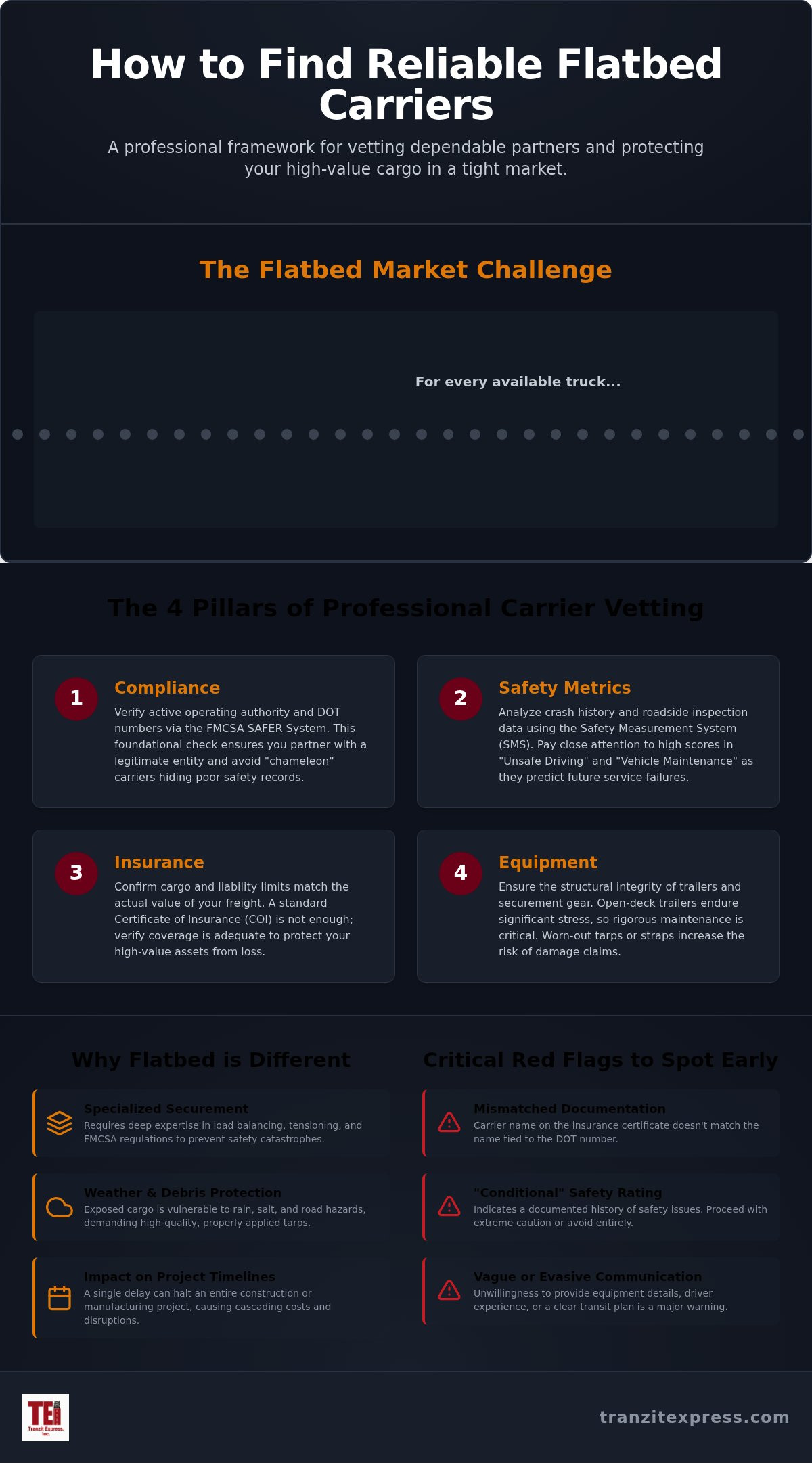
With a national flatbed load-to-truck ratio exceeding 70 loads for every available truck in early 2026, the margin for error in your logistics planning has never been thinner. You’ve likely experienced the anxiety of wondering if a carrier will show up on time or if they possess the expertise to secure your high-value cargo properly. It’s a common frustration in a tight market, where the pressure to move freight often clashes with the need for rigorous safety standards. Understanding how to find reliable flatbed carriers is no longer just a logistical task; it’s a critical strategy to protect your bottom line and your professional reputation.
We agree that your cargo deserves more than a “best effort” approach. This article provides a professional framework for identifying and vetting dependable partners who value stability as much as you do. You’ll learn how to navigate modern compliance requirements, such as the latest FMCSA safety ratings and English language proficiency enforcement. We’ll also provide a clear vetting checklist to ensure your shipments arrive on time and without damage claims. By the end of this guide, you’ll have the tools to move from a place of uncertainty to one of quiet confidence in your transportation choices.
Key Takeaways
- Understand why flatbed freight requires specialized securement and weather protection standards that go far beyond basic dry van requirements.
- Discover how to find reliable flatbed carriers by utilizing a rigorous vetting framework that includes FMCSA compliance and safety metric analysis.
- Evaluate the efficiency of broker-managed networks compared to direct carrier sourcing to reduce your internal administrative burdens.
- Learn to spot critical red flags in carrier documentation and communication styles before your high-value cargo is ever loaded.
- Leverage the stability of a seasoned logistics partner to ensure on-time delivery and consistent performance in a tightening market.
The Unique Challenges of Flatbed Freight Reliability
Flatbed logistics is inherently more complex than standard van transport. When you are researching how to find reliable flatbed carriers, it’s vital to recognize that reliability goes beyond a truck showing up on time. It encompasses the carrier’s ability to protect cargo that is fundamentally exposed. Unlike dry vans, a Flatbed truck leaves high-value machinery or raw materials vulnerable to rain, road salt, and debris. Proper load securement is a legal requirement under FMCSA regulations, not a matter of preference. If a driver fails to apply the correct tension to a strap or chooses the wrong gauge of chain, the result isn’t just a delay; it’s a potential safety catastrophe.
Drivers in this sector require a higher level of technical expertise than those hauling enclosed freight. They must understand weight distribution and the structural limits of their trailers. A truly reliable carrier is defined by their capacity to match the specific load with the correct equipment, ensuring every piece of cargo remains stable throughout the journey. This specialized skill set is what separates a professional operation from a high-risk gamble.
Why Traditional Vetting Falls Short for Flatbeds
Standard vetting processes often rely on broad safety ratings that don’t account for the nuances of open-deck shipping. A carrier might have a clean record for general freight but lack experience with the specific securement needs of oversized or heavy-haul loads. Open-deck trailers endure significant structural stress, making rigorous equipment maintenance more critical than it is for enclosed trailers. Selecting the cheapest option frequently results in subpar tarping or worn-out securement tools, which increases the risk of damage claims. Reliability in this field requires a deeper look at a carrier’s specific history with specialized equipment.
The Impact of Transit Delays on Specialized Projects
Flatbed cargo is typically destined for construction sites, infrastructure projects, or manufacturing plants. These locations operate on rigid schedules where equipment and labor are coordinated weeks in advance. A single late delivery can halt an entire project timeline, leading to cascading costs. Utilizing professional flatbed freight services USA helps maintain supply chain momentum by ensuring that carriers are vetted for punctuality and equipment readiness. When you prioritize a steady hand at the wheel, you protect the rhythm of your operations and avoid the stress of project-stopping delays.
The 4 Pillars of Professional Carrier Vetting
Establishing a rigorous vetting process is the most effective way to mitigate risk. When you’re determining how to find reliable flatbed carriers, you must look past the initial quote and focus on verifiable data. A professional framework relies on four specific pillars that create a comprehensive view of a carrier’s operational health:
- Compliance: Verifying active authority and operating status via federal databases.
- Safety Metrics: Analyzing crash history and roadside inspection data.
- Insurance: Matching cargo and liability limits to the actual value of your freight.
- Equipment: Ensuring the structural integrity of trailers and securement gear.
Verification begins with the FMCSA SAFER System. You must confirm that the carrier’s operating authority is active and that their DOT number matches their legal business name. This step prevents the use of “chameleon” carriers who change names to hide poor safety records. It’s a foundational check that ensures you’re working with a legitimate, law-abiding entity rather than a high-risk operation.
Decoding Safety Ratings and SMS Data
The Safety Measurement System (SMS) serves as the primary tool for evaluating carrier performance based on roadside inspection results and crash data. A “Satisfactory” rating indicates the carrier is in full compliance, while a “Conditional” rating suggests a history of safety issues that require caution. You should pay close attention to the BASICs, specifically “Unsafe Driving” and “Vehicle Maintenance.” High scores in these categories often predict future service failures. Our team at Tranzit Express Inc. maintains a vetted carrier network to ensure these metrics are monitored daily, protecting your cargo from preventable risks.
Insurance: Beyond the Certificate of Insurance (COI)
Standard liability insurance isn’t enough for specialized flatbed loads. You need to verify that the cargo policy limits actually match the replacement value of your freight. It’s also vital to ensure the policy doesn’t exclude specific commodities like steel, machinery, or building materials. Professional brokers manage this complexity by requiring updated documentation directly from insurance agents. This level of oversight provides the stability you need when moving high-stakes shipments across the country.
The final pillar involves equipment standards. Reliable carriers invest in modern trailers and high-quality securement gear like heavy-duty chains and weather-resistant tarps. Ask about the average age of their fleet and their internal maintenance schedules. Well-maintained equipment is less likely to suffer structural failure under the stress of heavy open-deck loads. When you prioritize these standards, you learn how to find reliable flatbed carriers who treat your cargo with the same level of care that you do.
Carrier-Direct vs. Broker-Managed: Evaluating Your Strategy
When you are determining how to find reliable flatbed carriers, the choice often comes down to a balance between internal resources and external partnerships. Sourcing carriers directly allows for a close relationship with specific drivers, but it requires significant administrative hours for vetting and daily management. For many businesses, the hidden costs of managing claims and compliance manually outweigh the perceived savings of bypassing a middleman. A reliable freight broker acts as a professional buffer, absorbing market volatility and providing a steady hand when capacity tightens.
A broker-managed strategy provides access to a pre-vetted, national network that an individual shipper simply cannot build alone. Monitoring safety records through FMCSA’s CSA Program is a continuous requirement, not a one-time task. While a single carrier might have five trucks available, a broker can tap into thousands of vetted options. This ensures your freight moves even when your primary driver is unavailable. This structural stability is essential for maintaining a sense of order in a complex industry.
The Administrative Advantage of Partnership
Partnership-driven logistics reduces the daily stress of transportation management. Brokers handle the repetitive tasks that keep projects on schedule, such as conducting check calls and providing real-time tracking updates. Accessing specialized equipment like step-decks or Removable Goosenecks (RGNs) becomes much simpler through a broad network. Instead of calling dozens of carriers to find one specific trailer type, you rely on a centralized portal to streamline the entire documentation process. This efficiency allows your team to focus on core operations while we manage the logistical details.
Scalability for National Logistics
Direct relationships often struggle to keep pace when shipping volumes spike or when routes expand across state lines. A single carrier may excel on a local lane but lack the authority or equipment to handle multi-state projects. Utilizing professional logistics management for shippers ensures consistent service levels regardless of the destination. This scalability is vital for protecting your project timelines. Whether you’re moving one load or fifty, a broker-managed network provides the flexibility to adapt to your changing needs without compromising on safety or reliability.
Red Flags: How to Spot Unreliable Carriers Early
Identifying red flags early is a fundamental skill when learning how to find reliable flatbed carriers. Beyond the data points found in federal databases, behavioral cues during the initial interaction provide deep insight into a carrier’s operational culture. Communication gaps are often the first sign of trouble. If a dispatcher is slow to return calls or provides evasive answers about their equipment location, it’s a strong indicator that visibility will remain poor once your freight is in transit. A dependable partner prioritizes clarity and promptness from the very first interaction.
Inconsistent documentation is a critical warning sign that requires immediate investigation. You should verify that the legal business name on the insurance certificate matches the operating authority precisely. Mismatched names or addresses often signal a “chameleon” operation attempting to bypass previous safety violations. Additionally, be wary of rates that sit significantly lower than the August 2026 national average of $2.83 per mile. When a quote seems too good to be true, the carrier is likely cutting corners on insurance coverage, driver wages, or essential equipment maintenance.
Vetting the Quote Process
A professional carrier seeks to understand the technical requirements of the load rather than just the destination. They will ask specific questions about exact dimensions, weight distribution, and the necessary securement tools like heavy-duty chains or weather-resistant tarps. If a carrier agrees to a load without inquiring about loading dock heights or tarping needs, they likely lack the specialized knowledge required for flatbed freight. Professionalism in this industry is defined by a commitment to safety over the desire to simply close a transaction.
Operational Warning Signs
Modern logistics demands transparency through technology. Carriers that refuse to use real-time tracking or provide consistent status updates pose a significant risk to your project timeline. In an environment where Electronic Logging Devices (ELDs) are strictly enforced, there is no excuse for a lack of visibility. You should also watch for signs of unauthorized double-brokering, where your load is passed to a third party without your consent. Utilizing a secure carrier portal allows you to verify that you are working with legitimate, pre-vetted partners. If you want to ensure your high-value cargo is handled by professionals who value consistency, request a flatbed shipping quote from the team at Tranzit Express Inc. today.
Tranzit Express: Your Steady Hand in Flatbed Logistics
Tranzit Express Inc. brings over 25 years of industry experience to every shipment we manage. We understand that mastering how to find reliable flatbed carriers is the difference between a successful project and a costly operational delay. Our legacy is built on a foundation of stability and trust, acting as a steady hand for shippers who require consistent results in a volatile market. We don’t just move freight; we provide a comprehensive oversight system that filters out unreliable carriers before they ever reach your loading dock. This proactive approach ensures that your logistics strategy remains orderly and efficient.
Our vetting process exceeds standard industry requirements by a significant margin. We verify current FMCSA safety ratings and conduct deep-dive compliance checks to ensure every driver in our network meets our high standards for excellence. This methodical approach reduces the daily stress of logistics, giving you the security of knowing your high-value cargo is in professional hands. By maintaining a vetted network of carriers, we provide the quiet confidence you need to manage complex national routes without fear of cargo damage or carrier ghosting.
A Partnership Built on Stability
We view every load as a collaborative project rather than a simple transaction. A one-off shipment doesn’t account for the complexities of specialized flatbed routing or the technical requirements of oversized freight. Our team uses its deep institutional knowledge to anticipate challenges before they arise, ensuring on-time delivery and cargo integrity. By prioritizing clear, professional communication, we eliminate the guesswork and anxiety often associated with open-deck shipping. You aren’t just hiring a broker; you’re securing a long-term partner dedicated to your success. Our focus remains on fulfilling promises rather than chasing marketing hype.
Streamlining Your Supply Chain Today
Modern logistics requires more than just experience; it requires the right tools to maintain visibility. We leverage advanced technology to provide transparent reporting and real-time tracking for every shipment. Through our Shipper Portal, you can access your national freight data, track active loads, and request quotes with ease. This level of organization ensures that your supply chain remains efficient and purposeful, regardless of the complexity of your shipping lanes. When you work with us, you gain access to a streamlined process that prioritizes the ease of the customer experience.
Request a reliable flatbed quote from Tranzit Express today.
Securing Your Logistics Future with Confidence
Navigating the complexities of open-deck shipping requires a commitment to rigorous standards and clear communication. By focusing on the vetting pillars and remaining vigilant for operational red flags discussed throughout this guide, you move from a place of uncertainty to one of professional control. Mastering how to find reliable flatbed carriers is the first step toward a more stable supply chain where cargo damage and transit delays are no longer the norm. A professional partnership allows you to leverage expert compliance oversight and advanced tracking technology to protect your high-value freight.
At Tranzit Express Inc., we bring over 25 years of veteran logistics experience to every load we manage. Our team maintains rigorous national carrier compliance standards to ensure that every driver in our network is a steady hand at the wheel. We prioritize professional communication and real-time tracking so you never have to guess about the status of your shipment. It’s time to replace logistical stress with the order and security of a seasoned industry partner. Partner with a dependable flatbed expert; contact Tranzit Express Inc. for a quote. We look forward to helping you move your business forward with peace of mind.
Frequently Asked Questions
What is the most important document to check when finding reliable flatbed carriers?
The most critical document to verify is the carrier’s Certificate of Insurance (COI) alongside their active Motor Carrier (MC) authority. For flatbed shipping, you must ensure the cargo insurance specifically covers the commodity you are moving, such as heavy machinery or building materials. A standard policy may have exclusions that leave your high-value freight unprotected. Verifying these documents directly with the insurance agent provides an extra layer of security for your investment.
How do I verify a flatbed carrier’s safety record?
You can verify a carrier’s safety record by accessing the FMCSA’s Safety and Fitness Electronic Records (SAFER) system. This public database provides a snapshot of their safety rating, inspection history, and crash data. Pay close attention to the Safety Measurement System (SMS) scores in categories like vehicle maintenance and cargo securement. High scores in these areas often indicate a higher risk of service failures or roadside delays during transit across the country.
Does a higher freight rate always mean a more reliable carrier?
A higher freight rate doesn’t guarantee reliability, but a rate significantly below the national average is often a warning sign. Low-cost providers may cut corners on insurance coverage, driver training, or equipment maintenance. Understanding how to find reliable flatbed carriers involves balancing fair market pricing with a carrier’s proven performance history. Consistency and safety usually command a professional rate that reflects the technical expertise required for complex open-deck transportation.
What insurance limits should a flatbed carrier have for specialized cargo?
Most professional flatbed carriers maintain at least $1 million in auto liability and $100,000 in cargo insurance. However, specialized or oversized loads often require much higher limits to cover the full replacement value of the freight. It is essential to match the policy’s cargo limit to the specific value of your shipment. We recommend requesting an additional insured endorsement to ensure your interests are fully protected in the event of a cargo claim.
What is the difference between a flatbed carrier and a flatbed broker?
A flatbed carrier owns the physical trucks and trailers used to transport goods. In contrast, a flatbed broker acts as a professional intermediary that matches shippers with a network of pre-vetted carriers. Brokers provide a significant advantage by managing the administrative burden of compliance, tracking, and communication. This partnership offers greater scalability and access to specialized equipment that a single carrier-direct relationship often cannot provide during periods of peak market demand.
Can I track my flatbed shipment in real-time?
Yes, modern logistics technology allows for real-time tracking of your flatbed shipments. Through our Shipper Portal, you gain full visibility into the location and status of your freight from pickup to delivery. This transparency is achieved through integration with the driver’s Electronic Logging Device (ELD) or mobile tracking applications. Consistent updates reduce the need for manual check calls and provide the peace of mind that your project remains on its designated timeline.
What happens if a flatbed carrier damages my cargo?
If damage occurs, you must note the specific issues on the Bill of Lading (BOL) at the time of delivery and take detailed photographs. The next step involves filing a formal cargo claim with the carrier’s insurance provider. Having a professional broker manage this process is beneficial, as they act as a liaison to ensure all documentation is submitted correctly. Prompt reporting is vital, as most carriers have strict windows for filing damage claims after delivery.
How often should a carrier’s compliance be re-vetted?
Carrier compliance should be monitored continuously rather than on a periodic basis. Safety ratings, insurance expirations, and operating authority status can change overnight. A professional logistics partner uses automated systems to re-verify these data points every time a load is assigned. This ongoing oversight is a core part of how to find reliable flatbed carriers and maintain a secure supply chain. Regular auditing prevents the use of carriers who have recently fallen out of compliance.