
The idea that a middleman only adds cost without adding value is a common misconception in the shipping industry. When you look at a freight quote, it’s natural to ask: how do freight brokers make money? For many shippers, the concern isn’t the payment itself, but the fear of hidden fees or a lack of transparency regarding what the carrier actually receives. You need to know that your budget is securing a reliable truck and a professional driver, rather than just disappearing into a black hole of administrative markups.
We understand that every dollar in your logistics budget must be justified. In this guide, you’ll discover the mechanics behind freight brokerage revenue and why the broker’s margin is an investment in your supply chain’s long-term reliability. We’ll provide a clear look at the “spread,” explain the heavy lifting that happens behind the scenes to ensure carrier compliance, and show how 25 years of industry experience helps us turn complex shipping hurdles into a seamless, predictable process for your business. By the end, you’ll see how a veteran broker functions as a steady hand at the wheel of your operations.
Key Takeaways
- Understand the mechanics of the “spread” and why a broker’s gross margin represents operational coverage rather than pure profit.
- Learn how do freight brokers make money by absorbing the administrative burdens of carrier vetting, insurance monitoring, and compliance.
- Discover why specialized loads and market volatility require nuanced margin structures to ensure your freight remains a priority for reliable carriers.
- Evaluate the total cost of ownership by comparing a broker’s volume advantage against the high internal overhead of managing carrier relationships.
- See how 25 years of institutional knowledge and advanced digital portals transform simple transactions into a secure, long-term logistics partnership.
The Mechanics of Freight Brokerage Revenue: Understanding the Spread
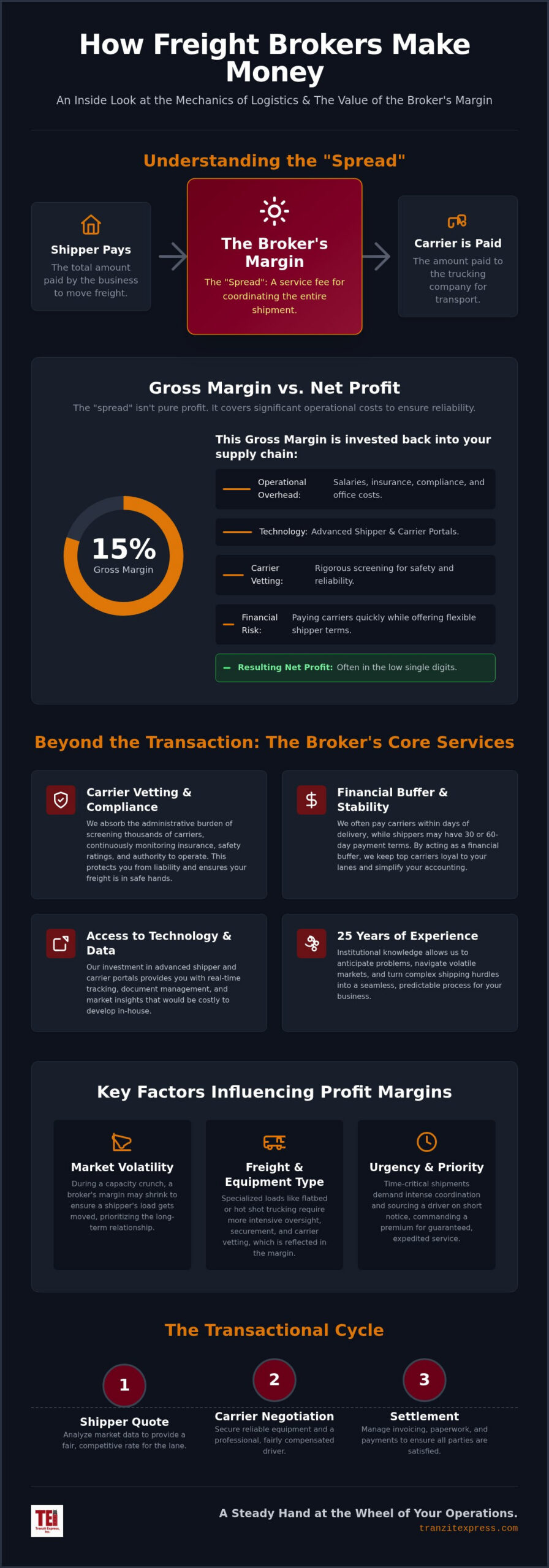
A Freight broker acts as the primary coordinator in a complex supply chain. When businesses ask how do freight brokers make money, the answer lies in the “spread.” This term refers to the difference between the total amount a shipper pays for a load and the amount the broker pays the carrier to transport it. The freight broker margin is the service fee for matching capacity to demand. While it might look like a simple markup, it represents the professional oversight required to keep a supply chain moving smoothly without interruption.
It’s vital to distinguish between gross margin and net profit. If a broker secures a 15% spread on a shipment, that doesn’t mean they’re pocketing 15% as pure profit. That margin covers the cost of advanced Shipper and Carrier portal access, rigorous carrier vetting, insurance premiums, and the specialized staff who manage your freight. After these operational expenses are paid, the actual net profit is often much lower, typically in the single digits. We view this margin as an investment in reliability and peace of mind for the shipper.
One of the most overlooked roles of a veteran broker is acting as a financial buffer. In many cases, a broker pays the carrier shortly after delivery, even if the shipper’s payment terms are 30 or 60 days. This ensures carriers remain satisfied and willing to work on your lanes, while you maintain your internal cash flow. We take on the financial risk and the administrative burden of collections, providing a layer of security that a direct-to-carrier relationship often lacks. This stability is why long-term partnerships are so valuable in a volatile market.
How the Transactional Cycle Works
The process begins with a shipper quote, where we analyze current market data to provide a fair rate for the lane. Next comes carrier negotiation, where we secure reliable equipment, such as van or flatbed services, at a competitive price that ensures the driver is fairly compensated. Finally, the settlement process handles the movement of funds. We manage the invoicing and payments, ensuring every party is satisfied and the paperwork is handled with professional precision.
Margin vs. Commission: Clearing Up the Terminology
In many conversations about how do freight brokers make money, the word “commission” is used incorrectly. For an independent brokerage, revenue is generated through the margin on each load. A commission, however, usually refers to the percentage of that margin paid to an individual freight agent as their salary. Understanding this distinction helps shippers see the difference between the company’s operational revenue and the incentives of the person handling their account. Transparency in these numbers builds the foundation of a dependable B2B partnership.
Key Factors That Influence Broker Profit Margins in 2026
The logistics market is rarely static. It fluctuates based on supply, demand, and the specific requirements of the cargo being moved. When evaluating how do freight brokers make money, it’s essential to recognize that the “spread” isn’t a fixed number. It shifts based on external variables. For instance, market volatility plays a significant role in a broker’s take. During a capacity crunch, a broker often reduces their margin to ensure a shipper’s load actually moves, prioritizing the long-term relationship over a short-term profit. Conversely, contract rates provide a predictable baseline that protects both the shipper and the broker from sudden price spikes.
The type of equipment required also dictates the margin structure. Moving standard dry van freight is relatively straightforward, but flatbed freight services USA demand a much higher level of oversight. These loads often involve specialized securement and more intensive carrier vetting to ensure safety and compliance. Similarly, when a shipment is time-critical, the premium on hot shot trucking reflects the intense coordination required to source a driver at a moment’s notice. Every transaction is documented according to federal Broker Record-Keeping Requirements, which ensures that the financial details of the shipment are preserved for transparency and accountability.
Supply and Demand Dynamics
Capacity crunches are a primary driver of rate changes. When trucks are scarce, brokers work harder to secure equipment, often narrowing their own margins to keep freight moving for their partners. Seasonality also plays a role. Seasonal surges, such as those occurring during agricultural harvests or major holiday periods, can drastically reduce available capacity in specific areas, driving rates upward. Fuel surcharges are another factor; while these are typically passed through to the carrier, a broker must manage the administrative burden of calculating these fluctuating energy costs accurately for every mile driven.
Specialized Handling Requirements
Coordinating intermodal transportation requires more administrative “touches” than a simple road haul. Managing the handoff between rail and truck involves complex scheduling that justifies a different margin structure. High-value cargo or oversized loads also increase the broker’s workload. These shipments require increased insurance coverage, specific permits, and specialized routing. This level of detail is exactly why many shippers prefer a reliable logistics partner to handle the complexities of modern freight rather than attempting to manage it all in-house.
The complexity of a lane also influences the final cost. High-volume national corridors are easier to cover, whereas remote locations or “deadhead” zones require more effort to entice a carrier. When you ask how do freight brokers make money, remember that the fee covers the expertise needed to solve these geographic and logistical puzzles before they impact your bottom line.
Beyond the Transaction: What Your Broker’s Margin Actually Covers
While the financial “spread” defines the revenue, the real value for a shipper lies in the operational infrastructure that margin supports. When you analyze how do freight brokers make money, it’s helpful to view the margin as an outsourced operations budget. This fee funds the critical, labor-intensive tasks that keep your freight moving safely across the country. It isn’t just about matching a load to a truck; it’s about the continuous oversight required to ensure that every carrier hauling your goods is fully compliant and professionally vetted.
Rigorous carrier vetting is one of the most significant expenses covered by the broker’s margin. We don’t just look for an empty trailer. Our team verifies that every carrier has valid operating authority and active insurance policies that meet our high standards. We also monitor safety ratings and FMCSA records daily. This human-led process protects your business from the risks of working with “fly-by-night” operators. By the time a truck arrives at your dock, it’s already passed a comprehensive screening process that most internal shipping departments don’t have the time or resources to perform themselves.
Technology is another cornerstone of modern logistics. A portion of the brokerage margin is reinvested into tools like shipper portal logistics. These platforms provide real-time tracking and transparency, allowing you to see exactly where your cargo is without making a single phone call. Beyond software, the margin covers administrative oversight. We handle the complex management of Bills of Lading (BOLs), invoicing, and the tedious process of claims resolution. When a delay happens, we’re the ones on the phone resolving the issue so you can stay focused on your core business.
Risk Mitigation and Insurance
A veteran broker acts as a professional shield against carrier liability issues. We maintain the required surety bonds and carry contingent cargo insurance to provide an extra layer of protection for your high-value shipments. If a shipment goes off-course or equipment fails, we take on the responsibility of “making it right.” This financial and legal buffer is a key reason why businesses wonder how do freight brokers make money; they’re paying for a partner who absorbs the risks inherent in national transportation.
Communication and Coordination
Logistics never sleeps, and neither does a dependable brokerage. Our margin funds 24/7 tracking and the professional dispatchers who bridge the gap between shipper expectations and the reality of the road. We act as a single point of contact, translating complex transit data into actionable updates for your team. If you want to learn more about the day-to-day mechanics of this role, you can read our guide on what does a freight broker do to see how these duties create a more efficient supply chain.
Freight Broker vs. Carrier Pricing: Evaluating the Total Cost of Ownership
Choosing between a direct carrier and a professional brokerage isn’t just about comparing the line-haul rate on a single load. Shippers must evaluate the total cost of ownership, which includes the internal resources required to manage transportation. While some shippers initially wonder how do freight brokers make money, they quickly realize that the margin is often offset by the significant reduction in internal labor costs. Managing one consolidated invoice from a broker is significantly more efficient than auditing, processing, and paying dozens of separate carrier accounts every week. This administrative simplicity allows your team to focus on production and sales rather than chasing paperwork.
The volume advantage is another critical factor. A veteran broker leverages relationships with thousands of carriers across the country, providing access to competitive rates that a single shipper might not secure on their own. This network also provides essential scalability. During seasonal spikes or holiday surges, a single carrier’s capacity is finite. If their trucks are full, your freight sits. A broker, acting as a steady hand at the wheel, can quickly pivot to another vetted carrier in their network to keep your supply chain moving. This flexibility ensures that your operations never grind to a halt due to a lack of equipment.
The hidden cost of going “direct” often manifests in the time required to manage a private fleet or a growing carrier list. When you manage carriers in-house, you take on the full burden of vetting, insurance monitoring, and daily tracking. This requires dedicated staff and specialized software. By partnering with an experienced broker, you essentially outsource these high-stakes responsibilities. If you are looking to streamline your operations, you can request a consultation for our logistics services to see how we reduce your daily administrative load.
Direct Carrier Limitations
Working directly with a carrier often means being limited by their specific assets. A carrier focused on van freight services cannot assist you when a project requires flatbed shipping or specialized hot-shot loads. Furthermore, many carriers have preferred geographic lanes where they are most efficient. If your shipping needs expand into new regions, you are forced to start the vetting process over again. A broker provides national reach and a diverse equipment pool, removing these geographic and operational restrictions from your growth strategy.
The Efficiency of Bundled Services
Utilizing logistics management for shippers significantly reduces overhead by bundling multiple services under one professional umbrella. Instead of communicating with five different dispatchers for five different loads, you have a single point of contact who understands your business’s unique requirements. This collaborative approach moves the relationship from a simple transaction to a long-term partnership. When you consider how do freight brokers make money, remember that the fee covers the institutional knowledge and advanced portals that provide a sense of order in a complex, multi-modal industry.
Partnering for Success: How Reliable Brokerage Drives Long-Term ROI
The true value of a logistics partnership isn’t found in a single transaction, but in the cumulative efficiency gained over years of consistent service. While it’s helpful to understand how do freight brokers make money through the margin, the real focus for any growth-oriented business should be the return on that investment. A dependable broker acts as an extension of your own team, providing a level of strategic planning that moves beyond simply finding a truck for a load. This collaborative approach turns your shipping department from a cost center into a competitive advantage by reducing delays and ensuring your customers receive their goods exactly as promised.
At Tranzit Express Inc., our approach is built on the quiet confidence that comes from 25 years of industry experience. We don’t rely on the high-energy marketing hype often seen in the logistics sector. Instead, we provide the steady hand at the wheel that shippers need during volatile market cycles. By prioritizing the success of every shipment, we build the trust required for a long-term B2B partnership. This longevity allows us to develop deep institutional knowledge of your specific lanes and cargo requirements, ensuring a seamless experience every time you move freight.
Transparency is the bedrock of this trust. We utilize advanced technology, including specialized Shipper and Carrier portals, to keep all parties informed throughout the transit process. These tools allow you to track the value you’re receiving in real-time, providing clear visibility into the status of your van, flatbed, or intermodal shipments. When you look at how do freight brokers make money, you should see that revenue being reinvested into these communication systems. This focus on clear, data-driven updates eliminates the stress of the unknown and provides a sense of order in a complex global industry.
Choosing a Broker with Longevity
Financial stability in a brokerage is a critical safeguard for your cargo. A broker with an established history has the resources to maintain surety bonds and ensure carriers are paid promptly, which keeps the best drivers returning to your lanes. This longevity also leads to superior problem-solving. When weather events or mechanical issues occur, a veteran team knows exactly how to reroute shipments and manage expectations to minimize the impact on your bottom line. Experience isn’t just a number; it’s the ability to maintain excellence when the unexpected happens.
Next Steps for Your Supply Chain
Improving your logistics ROI starts with an honest evaluation of your current shipping spend versus the quality of service you receive. If you are experiencing frequent delays, a lack of communication, or inconsistent carrier quality, it may be time to transition to a more dependable model. We invite you to see the difference that a quarter-century of expertise can make for your business. You can contact Tranzit Express Inc. for a dependable freight partnership today and discover how our team provides the stability your supply chain deserves.
Building a Resilient Logistics Strategy
Understanding how do freight brokers make money is the first step toward building a more transparent and efficient shipping strategy. We’ve explored how the broker’s margin isn’t a hidden cost; it’s a necessary investment in carrier vetting, financial security, and specialized technology. By outsourcing the administrative burden of national logistics, your business gains the freedom to focus on growth while we manage the complexities of the road. A veteran broker provides the stability needed to navigate market volatility with confidence.
With over 25 years of dependable logistics experience, Tranzit Express Inc. offers a steady hand at the wheel for your most critical shipments. Our national reach across all US states ensures that your cargo moves efficiently, whether you require specialized Van, Flatbed, or Hot-Shot equipment. We’re committed to providing a sense of order in a complex industry through clear communication and proven results. It’s time to move toward a more organized and predictable supply chain.
Request a Professional Freight Quote from Tranzit Express Inc. and secure the reliability your business deserves.
Frequently Asked Questions
Is it cheaper to work with a freight broker or a carrier?
Working with a freight broker is often more cost-effective when you consider the total cost of ownership. While a direct carrier might occasionally offer a lower line-haul rate on a specific lane, the broker provides a volume advantage and removes the internal salary costs associated with vetting and tracking. By consolidating multiple carrier relationships into one partnership, you reduce administrative overhead and gain access to a wider pool of equipment.
What is a standard freight broker commission or margin in 2026?
While margins vary based on the specific requirements of the load, a typical gross margin in 2026 often falls between 15% and 20%. This figure represents the spread between what the shipper pays and the carrier receives. It is important to remember that this is not pure profit; it covers the operational costs of advanced portals, contingent insurance, and the daily labor of compliance monitoring.
How do I know if a freight broker is taking too much money?
Transparency and market benchmarking are the best ways to evaluate a broker’s fee. If you’re wondering how do freight brokers make money fairly, look for those who provide clear data through digital portals. A reputable broker with decades of experience will justify their margin through consistent on-time delivery, rigorous carrier vetting, and the absence of hidden accessorial charges that can inflate direct carrier costs.
Do freight brokers get paid if the load isn’t delivered?
Freight brokers typically only earn their revenue once a load is successfully delivered and the paperwork is processed. If a shipment is cancelled or fails to deliver due to carrier error, the broker doesn’t collect their margin. In fact, a dependable broker spends significant time and resources resolving these transit issues and managing claims to protect the shipper’s financial interests and ensure the supply chain remains intact.
What services are included in a freight broker’s fee?
A broker’s fee covers a comprehensive range of logistical services that extend far beyond simple load matching. This includes verifying carrier authority, monitoring safety ratings, and providing real-time tracking through specialized portals. Additionally, the margin funds the administrative labor of managing Bills of Lading, processing carrier payments, and providing a single point of contact for all your national shipping needs, which reduces your internal stress.
Can a freight broker help me save money on specialized loads like hot-shot or flatbed?
Brokers offer significant savings on specialized freight by leveraging a national network of flatbed and hot-shot carriers. Finding these specialized assets on your own can be time-consuming and expensive. A broker’s institutional knowledge helps secure the right equipment at market-competitive rates while ensuring the carrier meets all safety and permit requirements, preventing the costly fines or delays common with specialized hauling.
How does a freight broker ensure the carrier gets paid fairly?
Reliable brokers maintain strong carrier relationships by ensuring drivers are paid competitive market rates and settled promptly. Because brokers handle the billing and collections process, they often pay the carrier before they receive funds from the shipper. This financial stability keeps high-quality carriers in the broker’s network, which directly benefits the shipper by ensuring a steady supply of dependable equipment for every lane.
Why do some freight brokers charge higher margins than others?
Variations in margins usually reflect the level of service and risk management being provided. A broker handling complex intermodal or high-value flatbed loads requires more intensive oversight and higher insurance limits than one moving standard dry van freight. When analyzing how do freight brokers make money, remember that a higher margin often funds the “steady hand” and veteran expertise required to navigate high-stakes logistics without disruption.