
Many shippers assume that owning the trucks is the only way to guarantee a load arrives on time, but in a 2026 market where spot rates for flatbeds have reached $2.70 per mile, that rigid approach can actually stall your growth. You’ve likely felt the sting of a provider who goes silent the moment a deadline nears or tells you their fleet is booked solid right when your demand spikes. It’s exhausting to manage a supply chain when you’re constantly guessing about capacity or uncovering hidden fees that weren’t in the original quote.
This guide will clarify the asset-based carrier vs broker debate so you can stop reacting to logistics fires and start building a stable, scalable shipping strategy. We’ll show you how to find a partner that offers the security of a veteran hand while maintaining the flexibility your business needs to thrive. You’ll learn the critical differences between physical asset control and network management, specifically as they apply to van, flatbed, and intermodal freight. By the end, you’ll have a clear framework for selecting a partner that reduces your daily stress and provides the transparency you deserve in a complex industry.
Key Takeaways
- Identify the core differences between fleet ownership and network management to ensure your 2026 logistics strategy is built on a foundation of reliability.
- Compare the asset-based carrier vs broker models to see how direct equipment control balances against the need for scalable, national capacity during peak seasons.
- Learn how a single point of professional contact can streamline diverse shipping needs across van, flatbed, and intermodal freight.
- Establish a decision framework based on your specific volume patterns and specialization requirements, such as hot-shot routing and national coverage.
- Understand why 25 years of industry stability and transparent communication are the most effective tools for reducing supply chain stress and hidden costs.
Defining the Landscape: Asset-Based Carrier vs. Broker
The 2026 logistics market is defined by a rebalancing of supply and demand. Capacity is tightening as carrier exits and a persistent driver shortage limit the number of trucks on the road. This environment makes the choice between an asset-based carrier vs broker a critical decision for your supply chain’s stability. While direct fleet ownership offers predictability on fixed lanes, the flexibility of a network-based approach provides the scalability needed to handle seasonal spikes or unexpected growth without the burden of equipment maintenance.
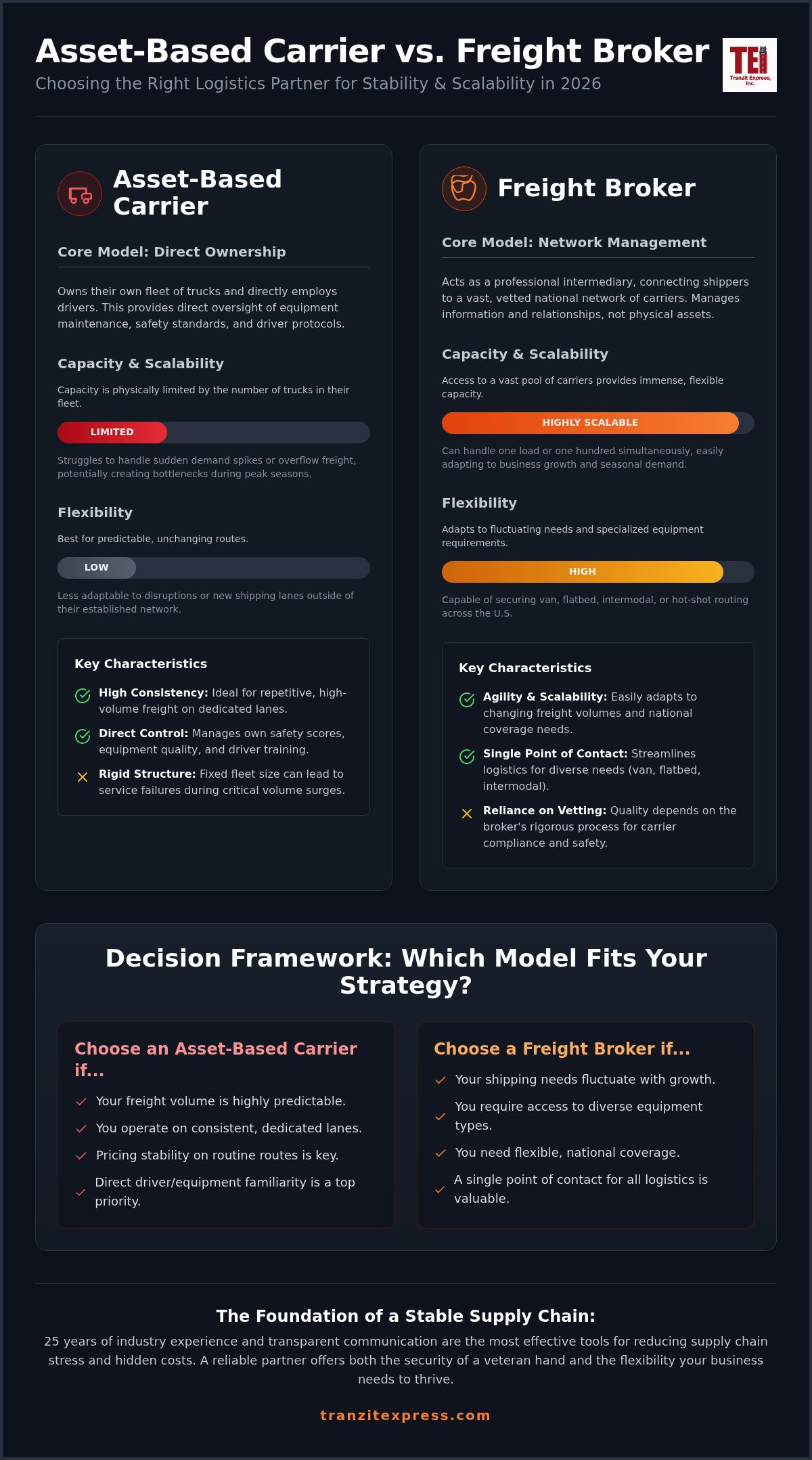
An asset-based carrier owns its equipment and employs its drivers directly. This model provides direct oversight of maintenance and safety standards. It’s a functional solution for consistent, high-volume freight where the routes rarely change. However, these providers are bound by their physical fleet size. If their trucks are already committed, they can’t help you with overflow. This rigidity can create bottlenecks during peak seasons when you need to move more freight than your primary carrier’s yard can hold.
A freight broker acts as a professional bridge between your business and a national network of vetted carriers. They focus on managing information and relationships rather than physical assets. This allows for immense scalability across the United States. Whether you need to move a single van load or dozens of flatbed shipments, a broker can tap into a vast pool of capacity. A clear understanding of what does a freight broker do helps shippers see the value in this flexibility. They handle the complex task of vetting carriers for compliance and safety, ensuring your freight is in dependable hands regardless of the carrier on the paperwork.
The Core Mechanics of Asset-Based Shipping
These providers maintain direct oversight of their operations. They manage their own safety scores and ensure their drivers follow specific protocols. This structure is excellent for consistency on dedicated lanes. If you have the same load moving from point A to point B every Tuesday, a dedicated asset fleet provides a sense of routine. The trade-off is a physical ceiling. When disruptions occur or your volume doubles overnight, an asset-based provider may struggle to find additional equipment outside their own fleet, leading to service failures during critical periods.
The Core Mechanics of Freight Brokerage
Brokers leverage deep industry relationships to match freight with the right equipment at the right time. This involves a rigorous process of vetting carriers for insurance coverage, safety ratings, and historical performance. The primary advantage is the ability to handle one load or one hundred loads simultaneously because the broker isn’t constrained by a fixed number of trucks. This makes them a vital partner for businesses with fluctuating needs or those requiring specialized equipment like flatbeds or intermodal routing. By comparing the asset-based carrier vs broker models, it becomes clear that brokers offer the agility required to navigate a volatile market with a steady hand.
The Strengths and Limitations of Asset-Based Carriers
Asset-based carriers offer a sense of security through tangible ownership. When you see the same company logo on every tractor-trailer that enters your facility, it creates a predictable environment. This model is built on direct control. The carrier manages their own fleet maintenance and driver hiring, which often leads to a high degree of equipment consistency. The FMCSA provides an official distinction between movers and brokers that highlights how these entities operate under different regulatory frameworks. Understanding the asset-based carrier vs broker dynamic is essential for shippers who value consistency but also need to recognize where a fixed fleet might fall short.
When Assets Excel: High-Volume Consistency
For manufacturing plants with steady daily outputs, asset carriers are often the first choice. They provide a routine that simplifies facility management. Drivers become familiar with specific loading docks and safety protocols, which can be vital for sensitive cargo or high-security sites. Asset-based reliability is a direct result of a company owning the physical trucks and employing the drivers who operate them. This familiarity reduces the chance of communication breakdowns during the loading process. Pricing is typically more stable on these repetitive routes because the carrier isn’t bidding on the open market for every load. It’s a steady way to move freight when your volume is as predictable as the sunrise.
The Capacity Ceiling: Why Assets Can Struggle
The primary challenge with the asset model is the physical limit of the fleet. If a carrier owns 50 trucks and all 50 are on the road, they can’t help you with your 51st load. This “No Trucks Available” scenario is common during seasonal surges or when a region faces sudden disruptions like severe weather. Most asset-based providers also focus on specific geographic footprints to keep their drivers close to home terminals. If your shipments need to move outside their preferred lanes, you might face significantly higher rates or outright service refusals.
If your freight needs change, an asset carrier may not have the right equipment ready. You might have a steady van contract but suddenly require specialized flatbed shipping for a one-time project. Maintaining a single fleet of diverse equipment is expensive and difficult for most carriers. This is where the asset-based carrier vs broker comparison becomes most apparent. A broker can pivot between equipment types instantly, whereas an asset carrier is tied to what is currently parked in their yard. If you are looking for a reliable logistics partner to bridge these gaps, a balanced approach is often the most secure path forward.
The Strategic Advantage of a Reliable Freight Broker
Choosing a partner in the 2026 freight market requires looking beyond the physical truck. While asset carriers focus on maintaining their own equipment, a reliable broker focuses on the strategic orchestration of your entire supply chain. This distinction is the core of the asset-based carrier vs broker debate. A broker provides a single point of contact that manages thousands of vetted carriers, effectively removing the administrative burden from your team. This centralized approach simplifies logistics management for shippers, ensuring that whether you’re moving a standard load or a complex project, the process remains consistent and professional.
Brokers also serve as a vital layer of protection. They assume the responsibility of verifying carrier insurance, safety ratings, and historical performance. Instead of your team spending hours checking data, a broker handles the vetting process to ensure every carrier meets high service standards. They also possess deep market intelligence. By seeing national freight trends in real time, a broker can advise on cost-saving routing and timing that a regional asset carrier might miss. This level of insight acts as a steady hand at the wheel, providing order and predictability in an often volatile industry.
Scalability: Moving Beyond Fleet Limitations
Capacity needs rarely stay flat. When your business faces a sudden surge in demand, an asset-based carrier vs broker comparison reveals a clear winner in terms of agility. A broker can source additional equipment across the United States without being slowed down by fleet maintenance cycles or driver shortages. This scalability allows you to transition seamlessly between high-quality van freight services and specialized flatbed needs. Whether your freight is heading to a major metro area or a remote rural site, a broker’s national reach ensures your cargo moves without delay.
Technology and Transparency in 2026
Modern logistics thrives on clear information. Professional brokers invest in dedicated Shipper Portals that provide real-time tracking and instant access to digital documentation. This transparency reduces the stress of the unknown, allowing logistics managers to focus on high-level strategy rather than chasing down status updates. Clear, proactive communication is the hallmark of a dependable partner. The broker acts as the steady hand coordinating complex national movements, ensuring every stakeholder is informed and every promise is fulfilled with quiet confidence.
Decision Framework: Which Model Fits Your 2026 Strategy?
Choosing between an asset-based carrier vs broker involves evaluating your internal administrative capacity and your freight’s volatility. If you have consistent lanes with high volume, an asset carrier might provide the routine you need. However, if your needs vary by week or season, managing dozens of individual carrier relationships can quickly overwhelm a small logistics team. A broker acts as a single point of professional contact, consolidating your communication and assuming the burden of safety compliance. This reduces your risk exposure and ensures that cargo liability is managed by experts who vet every driver in the network. This level of oversight is particularly important as the FMCSA increases enforcement on existing regulations in 2026.
Load-Specific Considerations
Certain freight types demand the agility that only a broker-led network can provide. For instance, hot shot trucking requires immediate equipment availability that a fixed fleet often can’t guarantee. Similarly, if your goal is to reduce long-haul costs, a broker can integrate intermodal transportation solutions into your supply chain, coordinating between rail and truck providers seamlessly. When your freight requires flatbed freight services USA, the ability to tap into a national pool of specialized trailers ensures you aren’t waiting for a regional fleet to finish a maintenance cycle. Capacity needs rarely stay flat, and having access to varied equipment types is essential for maintaining momentum.
The ‘Hybrid’ Approach: Why Most Shippers Use Both
Most resilient supply chains in 2026 utilize a hybrid model. They assign asset carriers to their primary, high-volume “core” lanes while leveraging a broker for “flex” capacity. This strategy prevents service failures when your primary carrier hits their capacity ceiling. With the U.S. freight market forecast to grow by approximately 2.3% in 2026, having a scalable partner becomes a competitive advantage. A veteran broker provides the stability needed for a national distribution network, acting as a buffer against market volatility. By diversifying your partner list, you ensure your business isn’t dependent on a single company’s fleet. This balanced method allows for steady growth and reduced operational stress, positioning your company to handle unexpected market shifts with confidence.
If you’re ready to stabilize your shipping operations with a partner who understands the nuances of the asset-based carrier vs broker landscape, contact Tranzit Express today to discuss a tailored solution for your freight.
Tranzit Express: 25 Years of Dependable Logistics Partnerships
The decision between an asset-based carrier vs broker often comes down to who you can trust when the market becomes unpredictable. With over 25 years of industry experience, Tranzit Express Inc. has navigated decades of economic shifts and capacity crunches with a composed, professional approach. We’ve built our reputation on being a steady hand at the wheel for businesses that require national solutions without the stress of managing a fragmented supply chain. Our longevity isn’t just a number; it’s a mark of stability that ensures your freight is handled with the same care and precision we’ve provided for a quarter-century. In an industry where providers often come and go, our established presence offers a level of security that helps our partners plan for the future with confidence.
Our commitment to excellence is reflected in our dedicated Shipper and Carrier Portals. These digital tools provide the real-time transparency that modern logistics managers demand, offering clear documentation and status updates at every milestone. We understand that in high-stakes B2B partnerships, silence is a source of anxiety. That’s why we prioritize professional, proactive communication at every stage of the journey. By choosing a partner with a deep institutional knowledge of the national freight market, you gain a level of security that goes beyond simple fleet ownership. We bridge the gap in the asset-based carrier vs broker debate by providing the reliability of a veteran fleet manager with the limitless scalability of a national network.
A Veteran Approach to National Shipping
We view every load as an opportunity to strengthen a long-term partnership rather than a one-off transaction. This philosophy drives our meticulous coordination across all modes, including Van Freight Services, Flatbed Shipping, Hot-Shot Loads, and Intermodal Transportation. Our team manages the complexities of routing and scheduling so you can focus on your core business goals. Whether you’re shipping across the country or managing a specialized project, our national reach and personalized service model provide a sense of order in a complex industry. We act as your advocate, ensuring that every carrier in our network adheres to the highest standards of safety and reliability. This veteran perspective allows us to anticipate challenges before they disrupt your schedule, maintaining the momentum your business requires.
Your Next Step Toward Seamless Logistics
Moving toward a more dependable logistics strategy shouldn’t be a complicated process. Our professional portal makes it easy to request a quote and begin the onboarding process with minimal friction. We take on the heavy lifting of carrier compliance, verifying insurance and safety records so you don’t have to risk your cargo’s security or your company’s reputation. This thorough vetting process is central to our mission of reducing operational stress for our clients. If you’re ready to move away from the limitations of rigid capacity and toward a scalable, reliable solution, we invite you to partner with Tranzit Express for reliable national logistics. Our team is ready to provide the professional guidance and consistent results your business deserves.
Securing Your Supply Chain for 2026 and Beyond
Selecting the right partner in the asset-based carrier vs broker landscape isn’t about choosing one model over the other; it’s about choosing the level of flexibility your growth requires. While asset carriers provide routine on dedicated lanes, a reliable broker offers the scalability to handle seasonal surges and specialized freight without equipment constraints. By prioritizing a partnership built on transparent communication and digital visibility, you can reduce the administrative burden on your team and focus on high-level strategy. It’s about finding order in a complex market.
Tranzit Express Inc. brings over 25 years of industry expertise to your logistics planning. Our national carrier network and transparent Shipper and Carrier Portals provide the security needed to navigate the 2026 market with a steady hand. Don’t let rigid capacity limits stall your momentum. You deserve a partner who values consistency and fulfillment as much as you do. Request a Dependable Freight Quote from Tranzit Express today and experience the difference that a veteran professional makes for your business. We’re ready to help you move forward with confidence.
Frequently Asked Questions
Is it more expensive to use a freight broker than an asset-based carrier?
Using a broker isn’t necessarily more expensive. While brokers earn a margin for their services, they often access lower rates by leveraging backhaul opportunities and national network efficiencies. They also reduce your internal administrative costs by handling carrier vetting and communication. When comparing an asset-based carrier vs broker, the broker’s ability to source competitive bids from a vast pool of carriers often results in a more cost-effective solution for varied shipping needs.
How do brokers ensure the safety and compliance of the carriers they use?
Brokers ensure compliance through a rigorous vetting process that includes verifying motor carrier authority and safety ratings. They check insurance certificates to confirm active coverage and monitor federal records for any changes in status. This continuous oversight protects your business from the risks associated with unqualified drivers. By assuming this administrative burden, a professional broker provides a layer of security that ensures every load meets high service standards and regulatory requirements.
Can a freight broker handle specialized loads like hot-shot or flatbed freight?
Yes, a reliable broker can source equipment for any load type, including van, flatbed, hot-shot, and intermodal transportation. Their national reach allows them to find specialized trailers that an asset carrier with a limited fleet might not have available. This flexibility is a key advantage in the asset-based carrier vs broker dynamic. Whether you have an oversized shipment or a time-sensitive delivery, a broker matches your specific cargo with a vetted carrier equipped for the job.
What happens if a carrier fails to show up for a load booked through a broker?
If a carrier fails to show up, the broker immediately activates their network to find a replacement. This is a significant benefit of the broker model. Unlike an asset-based carrier that’s limited by its own fleet size, a broker has access to thousands of alternative carriers across the United States. They handle the stressful task of rescheduling and coordination, ensuring your freight stays on schedule and your customer deadlines are met without costly interruptions.
Why should I choose a broker with 25+ years of experience over a digital startup?
Experience provides a level of stability that digital startups often lack. A broker with 25 years of industry experience has navigated multiple market cycles and understands the complexities of carrier relationships. This institutional knowledge allows for more dependable routing and problem-solving. While technology is important, the steady hand of a veteran professional ensures your logistics strategy is grounded in proven results rather than marketing hype or unproven software algorithms that haven’t been tested by time.
Do freight brokers provide real-time tracking for national shipments?
Modern brokers provide real-time tracking through dedicated Shipper Portals. These platforms offer instant visibility into the location of your national shipments and provide access to digital documentation. This transparency reduces the stress of the unknown and allows your team to focus on high-level strategy. Professional brokers prioritize clear communication, ensuring you receive regular status updates without having to chase down information from multiple drivers or dispatchers across different companies during the transit process.
Is a freight broker liable for my cargo if it gets damaged during transit?
Liability for damage typically lies with the motor carrier, but the broker acts as a vital facilitator during the claims process. A professional broker verifies that every carrier in their network carries adequate cargo insurance before a load is assigned. If damage occurs, the broker assists you with the necessary documentation and communication to resolve the claim with the carrier’s insurance provider. This support provides a sense of order and security during a difficult situation.