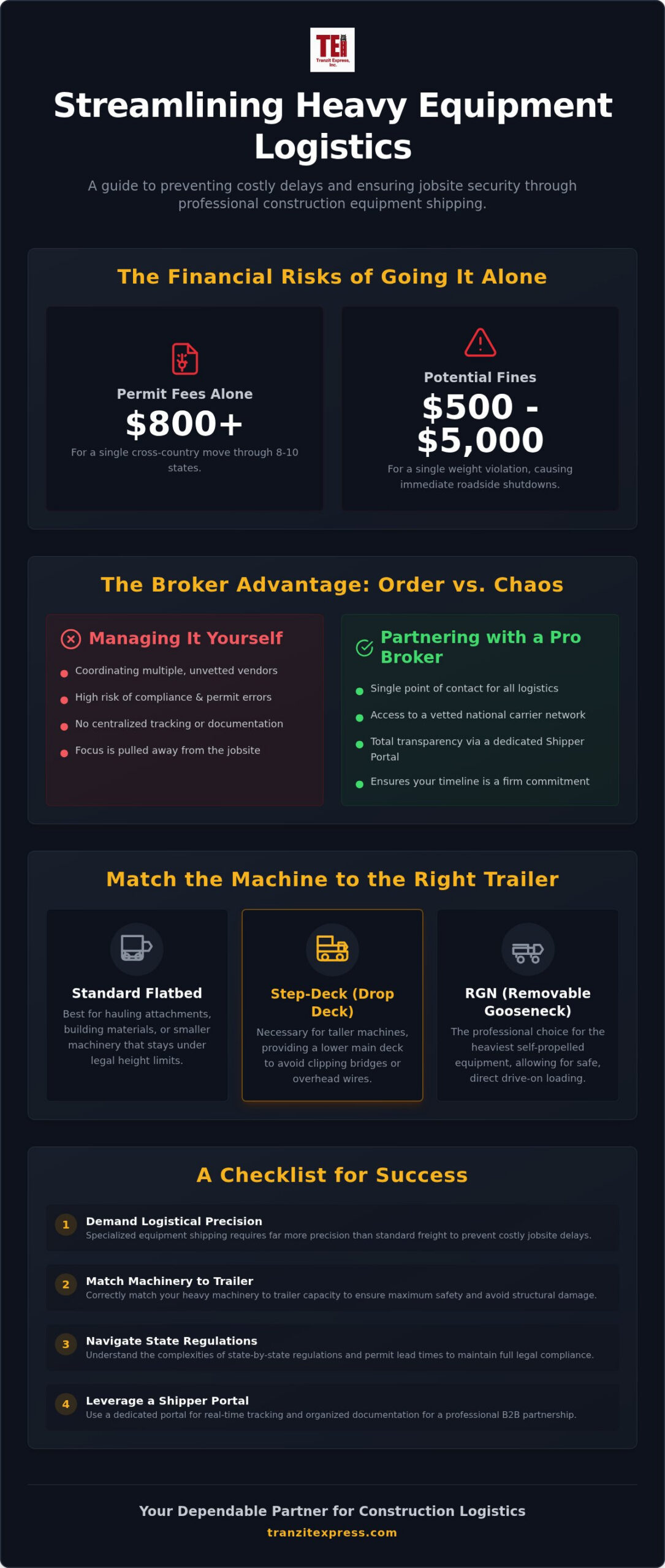
Did you know that a single cross-country move through eight to ten states can add up to $800 in permit fees alone? It’s a staggering figure that doesn’t even account for potential fines, which can range from $500 to $5,000 for a single weight violation. For most project managers, managing these variables feels like a second job that pulls focus away from the actual construction site.
We understand that the logistics of heavy machinery often feels like a constant battle against hidden costs and shifting state regulations. You need a partner who views your jobsite timeline as a firm commitment, not a loose suggestion. By utilizing professional construction equipment shipping services, you can move away from the stress of coordinating multiple vendors and instead rely on a disciplined, methodical approach to transport.
This guide will show you how to streamline your heavy machinery moves through expert logistics, precise trailer selection, and compliance-first brokerage. We’ll explore the essential steps for verifying carrier insurance and navigating state-specific permit lead times to ensure peace of mind. You’ll discover how a single point of contact and predictable scheduling can provide the order and security your high-stakes projects require.
Key Takeaways
- Understand why specialized construction equipment shipping services require higher logistical precision than standard freight to prevent costly jobsite delays.
- Learn how to match your heavy machinery to the correct trailer capacity to ensure maximum safety and avoid structural damage during transit.
- Navigate the complexities of state-by-state regulations and permit requirements to maintain full legal compliance across every mile of your route.
- Follow a practical preparation checklist to streamline the loading process and protect your high-value assets from environmental or transit-related risks.
- Discover how a dedicated shipper portal provides the real-time tracking and organized documentation needed for a professional B2B logistics partnership.
Navigating the Complexities of Construction Equipment Shipping Services
Heavy haul logistics in the construction sector involves far more than simply finding a large truck. It’s the specialized transport of machinery that exceeds standard legal limits for weight, height, or width. When you’re moving bulldozers, articulated haulers, or crane components, you’re dealing with Oversize Load Regulations that vary significantly across state lines. Standard carriers often lack the specialized trailers or the deep understanding of permit requirements needed to move these assets without incident.
At Tranzit Express, we’ve spent over 25 years acting as a steady hand for companies that can’t afford a breakdown in their supply chain. High-stakes jobsite moves require a partner who prioritizes order over urgency. Our national shipping capabilities ensure that whether your machinery is moving across a single state or the entire country, the process remains consistent and predictable. We focus on reducing the administrative burden so your team can stay focused on the build.
The Challenges of Jobsite Logistics
Managing the transition between project phases requires precise timing. If a paver arrives too early, there may be no room to park it; if it arrives late, an entire crew sits idle. Coordinating with site foremen is essential, especially when loading space is restricted by existing structures or active work zones. Additionally, environmental factors like soft terrain or unpredictable weather can complicate the arrival of heavy machinery. A professional approach to construction equipment shipping services accounts for these variables well before the wheels start turning.
Why a Professional Broker is Your Best Asset
Relying on a professional broker provides access to a vetted national network of carriers who specialize in open-deck and flatbed routing. This removes the “noise” of dealing with multiple unverified vendors. Instead of managing a dozen phone calls, you have a single point of contact. This centralized communication, combined with our dedicated Shipper Portal for real-time tracking, ensures total transparency. Our institutional knowledge of logistics management allows us to anticipate delays, such as permit processing times or pilot car availability, ensuring your equipment reaches the jobsite on schedule.
Selecting the Right Equipment and Trailer for Your Load
Selecting the correct trailer is the foundation of successful construction equipment shipping services. It’s not simply a matter of finding a deck that’s long enough. You must account for the machine’s weight, dimensions, and center of gravity to ensure transport stability. When machinery isn’t matched correctly to trailer capacity, the risks include structural failure, dangerous load shifts, and catastrophic damage to expensive assets. This technical alignment is a core component of our flatbed freight services USA, where we prioritize safety over simple convenience.
Weight distribution is another critical factor that impacts both safety and legality. A load that’s poorly balanced can lead to axle weight violations, even if the total gross weight is within limits. These oversights often result in immediate roadside shutdowns and heavy fines. Adhering to the Federal Highway Administration Permit Guidelines requires a disciplined approach to how machinery sits on the deck. A stable load doesn’t just protect the equipment; it protects the carrier and the public, ensuring the move proceeds without administrative delays.
Flatbed vs. Step-Deck vs. RGN Trailers
Standard flatbeds are functional for hauling attachments, buckets, or smaller machinery that stays under legal height limits. However, when a machine’s height threatens to clip overhead wires or bridges, a step-deck trailer is often necessary. Also known as a drop deck, it provides a lower platform for the main load. For the heaviest self-propelled equipment, the Removable Gooseneck (RGN) is the professional choice. It allows the front of the trailer to detach so machinery can be driven directly onto the deck, which is significantly safer than using steep ramps.
Matching Common Machinery to Transport Solutions
Excavators and dozers almost always require RGN trailers due to their immense weight and the need for ground-level loading. Reliable construction equipment shipping services rely on this level of detail to prevent the mechanical failures that occur when equipment is forced onto the wrong trailer type. When moving cranes or boom lifts, the logistics become more complex. You have to manage boom-rest requirements and ensure the total length doesn’t trigger additional escort needs. For smaller, high-priority assets like skid steers or forklifts, hot-shot loads offer a more agile solution. These smaller trailers can often reach jobsites with tighter access points more efficiently than a full-sized rig.
Our team uses 25 years of institutional knowledge to guide these decisions, acting as a steady hand for your most complex moves. If you’re looking for a partner who values order and precision, you can learn more about our approach to logistics management and how we protect your fleet.
Compliance, Permits, and Safety Standards in Heavy Haul
The legal landscape of heavy haul transport is defined by a complex patchwork of state and federal regulations. While a load might be compliant in one jurisdiction, crossing a state line often introduces entirely new requirements for permits, travel times, and escort vehicles. This administrative complexity is why expert logistics management is a non-negotiable part of professional construction equipment shipping services. It’s the difference between a machine arriving on schedule and one that is impounded at a weigh station due to a missing permit.
Beyond the permits themselves, safety standards often dictate the use of pilot cars and escorts for significantly oversized loads. These vehicles act as a buffer, alerting the driver to upcoming hazards and ensuring the public remains safe. Maintaining high standards for insurance and carrier liability is equally vital. We don’t just look for a carrier with a truck; we look for a partner with a proven safety record and the appropriate coverage to protect your investment throughout its journey across the country.
Navigating Oversize and Overweight Regulations
When a piece of machinery exceeds standard dimensions, it may fall into the “Superload” category. These loads require extensive route planning to account for bridge heights, weight limits on specific roads, and even the turning radii of tight intersections. Timing is another critical factor. We suggest initiating permit applications at least 7 to 10 business days before your move. This lead time helps avoid the rush fees and potential jobsite downtime that occur when paperwork is filed at the last minute and processing delays occur.
The Importance of Carrier Compliance Vetting
Vetting a carrier goes beyond checking a box. It involves verifying active DOT authority and safety ratings to ensure the operator is qualified for heavy haul tasks. Our vetting process aligns with OSHA Equipment Safety Standards, focusing on carriers who demonstrate a commitment to rigorous maintenance and securement protocols. We monitor carrier performance continuously, ensuring that the steady hand we promise is backed by a network of reliable, high-performing professionals. This disciplined approach provides the peace of mind that your machinery is in safe, compliant hands at every mile.
Best Practices for Preparing Your Machinery for Transport
Preparation is the final hurdle before your machinery begins its journey. While we handle the complex logistics and carrier vetting, the shipper plays a vital role in site safety and asset protection. Thorough preparation ensures that construction equipment shipping services proceed without mechanical issues or regulatory fines. It’s about creating a predictable environment for the carrier, which minimizes the risk of damage and keeps your jobsite timeline intact. A disciplined approach at the loading site reflects the professional standards of your entire operation.
Communication protocols for the loading day should be established well in advance. Everyone involved, from the site foreman to the transport driver, needs to understand the sequence of events. This reduces the administrative noise and confusion that often leads to delays. By following a methodical checklist, you provide the “steady hand” necessary to move expensive assets with confidence and order.
Securing and Cleaning Your Equipment
Begin by cleaning the machinery thoroughly. Removing excess mud and debris isn’t just about aesthetics; it prevents road hazards and ensures the actual weight matches the permit specifications. Loose debris falling from a trailer can lead to significant liability and safety risks for other drivers. Once clean, you must secure all moving parts. This includes locking down booms, buckets, and cabs to prevent any shifting during transit. For specific loads, you may need to disconnect batteries or drain certain fluids to comply with transport regulations. These small steps act as a primary safeguard for your high-value investment.
Managing Pick-up and Jobsite Logistics
Loading day requires clear organization and a logical flow. You must confirm that the pick-up location has the necessary infrastructure, such as a loading dock or sufficient flat ground for an RGN trailer to deploy its ramps. We recommend having a qualified operator present to drive self-propelled machinery onto the trailer. This reduces the risk of loading accidents and ensures the equipment is positioned perfectly for the weight distribution requirements we discussed earlier.
Documentation is your best defense against potential claims. Before the carrier arrives, capture high-quality photos and videos of the machinery from every angle. Focus on existing wear, glass condition, and attachment points. This creates a verified baseline of the equipment’s state before it leaves your control. If you’re ready to move your fleet with a partner who values this level of detail, you can request a quote to get started. Reliable documentation and clear site logistics ensure a seamless transition from the jobsite to the road.
Tranzit Express: Your Dependable Partner for Construction Logistics
Tranzit Express Inc. has spent more than 25 years refining the way heavy machinery moves across the country. We’ve built our reputation on the quiet confidence that comes from deep institutional knowledge and a commitment to stability. When you choose our construction equipment shipping services, you aren’t just hiring a truck; you’re entering into a high-level B2B partnership designed to reduce stress and provide a sense of order. We understand the high stakes of construction logistics, where every hour of downtime impacts your bottom line. Our goal is to act as a reliable extension of your team, ensuring that your fleet is managed with the professional care it deserves.
A Steady Hand at the Wheel
Our commitment to on-time delivery is backed by reliable routing and a vetted network of professional carriers. We focus on the specific needs of contractors and project managers who require a steady hand at the wheel for their most complex moves. This B2B focus allows us to deliver better outcomes than transactional platforms because we prioritize long-term relationships over simple volume. Our philosophy is rooted in reducing complexity. We handle the permit lead times and carrier vetting discussed in previous sections so you can stay focused on the build. It’s a methodical approach that ensures your machinery reaches the jobsite exactly when the project phase demands it.
Technology That Supports Your Workflow
While we value personal, reassuring communication, we also provide the digital tools necessary for modern project management. Our dedicated Shipper Portal allows you to access cargo tracking and shipment history at any time. This technology simplifies the administrative burden by centralizing your billing and documentation in one secure location. You’ll find several key features designed for project efficiency:
- Real-time tracking to monitor your machinery’s progress across state lines.
- Digital document storage for easy access to permits, BOLs, and insurance certificates.
- Historical data access to help you analyze past shipping timelines for future project bidding.
This portal doesn’t replace our human expertise; it enhances it, giving you direct access to our seasoned logistics specialists whenever you need support. Requesting a dependable quote for your next project is a straightforward, logical process. We provide clear, functional information that helps you plan your jobsite timelines with precision. By combining 25 years of experience with a results-oriented approach, we ensure that your construction fleet is always where it needs to be, exactly when you need it there.
Secure Your Next Jobsite Move with Confidence
Moving heavy machinery is a disciplined process that requires more than just a truck. It demands a thorough understanding of trailer capacity and a proactive approach to state-by-state permit regulations. By focusing on detailed site preparation and utilizing professional construction equipment shipping services, you protect your high-value assets and keep your project timelines predictable.
Tranzit Express brings over 25 years of industry expertise to every haul. Our dedicated national carrier network and specialized routing ensure your equipment arrives exactly when it’s needed. We provide the steady hand and clear communication required to manage the complexities of heavy haul logistics without the administrative burden. You can rely on our on-time delivery guarantee to keep your crew working and your projects on track.
Ready to streamline your next project? Request a Dependable Construction Equipment Shipping Quote today. We’re here to ensure your move is handled with the precision and order your business deserves.
Frequently Asked Questions
What is considered ‘heavy equipment’ for shipping purposes?
Heavy equipment generally includes any machinery used in construction, farming, or industrial projects that exceeds standard vehicle dimensions or weight. For transport purposes, this typically refers to excavators, bulldozers, cranes, and articulated haulers. Most logistics providers categorize a load as heavy haul if it exceeds 80,000 pounds gross weight or 8.5 feet in width. These machines require specialized open-deck trailers to move safely across the national highway system.
How much does it cost to transport construction equipment nationwide?
The cost of nationwide transport depends on several variables, including the distance, machinery dimensions, and current fuel rates. Oversized loads often incur additional expenses for state permits, pilot cars, and specialized trailers like RGNs. While standard freight has more predictable rates, heavy haul moves are quoted based on the total logistical requirements. We recommend requesting a specific quote to account for the unique compliance needs of your project’s route and timeline.
Do I need special permits for shipping an excavator or bulldozer?
Yes, you will likely need permits if your excavator or bulldozer exceeds legal height, width, or weight limits. Most large construction machinery is considered an oversize load under federal and state guidelines. Because permit requirements vary by state, professional construction equipment shipping services handle the application process for you. This includes coordinating with state DOTs to ensure your route is approved for the machine’s specific dimensions before the wheels turn.
How do I choose between a flatbed and an RGN trailer?
Your choice depends on the machinery’s weight and how it needs to be loaded. Standard flatbeds are efficient for smaller attachments or machinery that can be lifted or driven up ramps. However, heavy self-propelled equipment like dozers often requires a Removable Gooseneck (RGN) trailer. RGNs allow the front to detach so the machine can be driven directly onto the deck, providing a lower center of gravity and much safer loading for high-value assets.
What happens if my equipment is oversized or overweight?
When equipment exceeds legal limits, it triggers a mandatory compliance process involving specialized permits and often escort vehicles. Failure to secure these can result in immediate roadside shutdowns and fines ranging from $500 to $5,000 per violation. Logistics specialists manage these complexities by planning routes that avoid low bridges or weight-restricted roads. This disciplined oversight ensures your machinery moves without administrative delays or the risk of legal impoundment.
Is my construction equipment insured during transport?
Yes, all qualified carriers in our network must maintain active cargo insurance to protect your investment. At Tranzit Express, we go beyond the basic minimums by vetting every carrier’s safety ratings and insurance limits before dispatch. This verification process provides peace of mind that your machinery is covered against transit-related damage. We recommend reviewing the specific coverage limits for high-value machinery through our shipper portal to ensure your project’s requirements are met.
How long does it typically take to arrange a heavy haul shipment?
Arranging a heavy haul move typically takes between 7 to 10 business days. This lead time is necessary to secure the appropriate trailers and process the required state permits for oversized loads. While some standard moves can be coordinated faster, specialized construction equipment shipping services require a more methodical approach to route planning. Starting the process early prevents jobsite downtime and ensures that all compliance documentation is in order before the scheduled pick-up.
Can you ship construction equipment to remote jobsites?
Yes, we specialize in delivering machinery to various jobsites across the United States, including those in remote areas. Our national carrier network includes operators experienced in navigating the challenging terrain and limited access points often found at new construction sites. We coordinate closely with site foremen to confirm loading capabilities and ground conditions. This level of communication ensures that your machinery reaches its destination safely, regardless of how far it is from a major highway.