
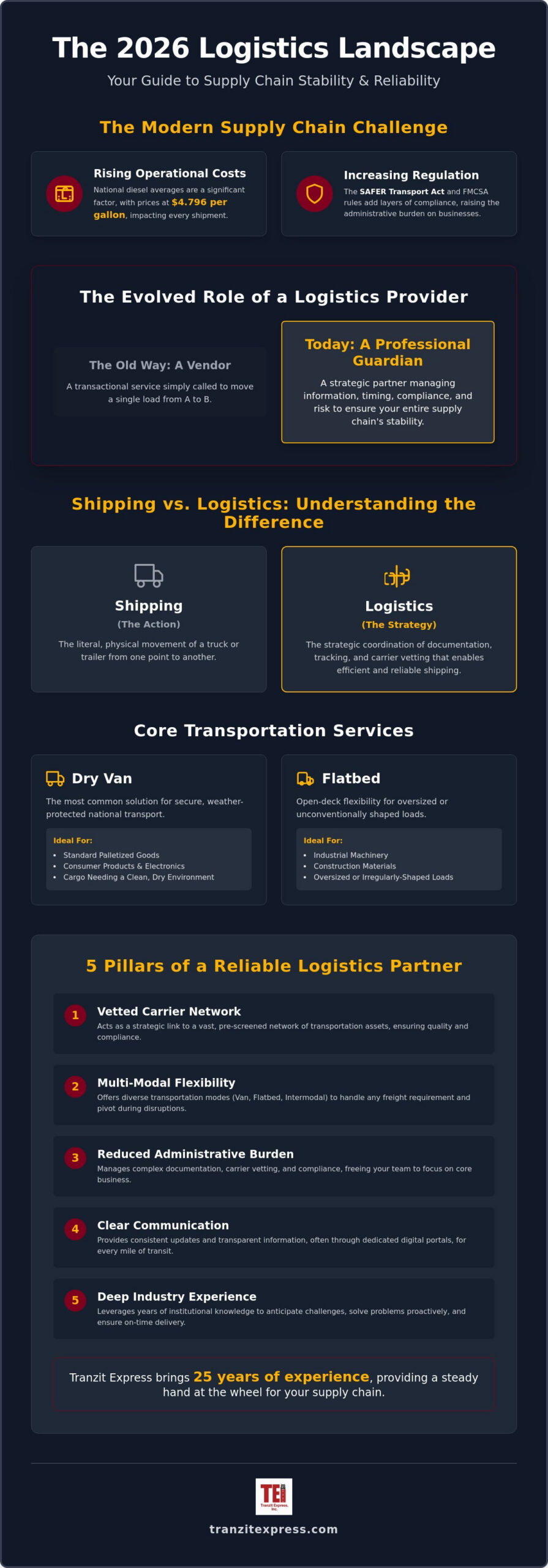
In 2026, a logistics provider is no longer just a vendor you call to move a load; they’re the professional guardian of your supply chain’s stability. With national diesel averages at $4.796 per gallon and the SAFER Transport Act shifting the industry toward USDOT identifiers, the margin for error has never been thinner. You’ve likely felt the frustration of unreliable carriers causing late deliveries or the heavy administrative weight of tracking compliance and fluctuating freight costs. It is a significant burden to carry when your focus should be on your core business.
We believe you deserve a steady hand at the wheel to restore order to your operations. This guide explains how a professional logistics provider streamlines your supply chain, reduces shipping risks, and ensures on-time delivery across the United States. You will learn how a dedicated partnership reduces your daily stress and provides access to a vetted carrier network. We’ll preview the essential functions of modern freight management, from coordinating van and flatbed loads to using digital portals for clear communication during every mile of transit.
Key Takeaways
- Understand how a professional logistics provider acts as a strategic link to stabilize your supply chain and manage complex carrier networks.
- Identify the core transportation modes, including Van, Flatbed, and Intermodal services, that offer the flexibility required for modern freight requirements.
- Learn the practical differences between freight brokers and 3PLs to choose a partnership model that effectively reduces your administrative burden.
- Discover the five essential pillars for evaluating partner reliability to ensure your cargo is handled with consistent care and clear communication.
- Explore how 25 years of industry experience and dedicated portal access provide the steady hand needed for dependable, on-time delivery performance.
Understanding the Role of a Logistics Provider in 2026
At its core, a logistics provider acts as the strategic link between your facility and a vast network of transportation assets. In the current market, this role has evolved far beyond simply finding a truck to haul a load. It’s about the comprehensive management of information, timing, and regulatory compliance. As we move through 2026, the complexity of the American supply chain requires more than just reactive booking; it demands a proactive approach to ensure that freight moves without friction despite rising diesel costs and tightening federal oversight.
Many businesses are shifting away from managing their own freight in-house because the administrative burden has become overwhelming. Between tracking the latest FMCSA broker financial responsibility rules and verifying carrier compliance with the SAFER Transport Act, the risk of a single mistake is too high. By partnering with an expert, you gain a professional guardian who manages these details on your behalf. This shift allows your team to focus on production and sales while a seasoned expert maintains the steady flow of your goods across the country.
The Difference Between Shipping and Logistics
It is helpful to distinguish between the physical act of shipping and the broader discipline of logistics. Shipping is the literal movement of a van or flatbed from point A to point B. Logistics, however, is the strategic coordination that makes that movement possible. A professional Third-party logistics (3PL) partner oversees the complex documentation, real-time tracking, and carrier vetting that prevent transit delays before they happen. When you work with a logistics provider, you aren’t just buying space on a trailer; you’re investing in the oversight that ensures your cargo arrives on time and in good condition.
Why a Dependable Partnership Matters
In an industry where market fluctuations are the only constant, a transactional approach to freight often leads to service failures. Moving toward a long-term partnership provides the stability needed to weather these changes. We’ve seen how a “steady hand at the wheel” can resolve issues that would otherwise stall a supply chain. With over 25 years of experience, we’ve learned that deep institutional knowledge is the best tool for problem-solving. This experience allows us to anticipate challenges, such as regional capacity crunches or shifting ELD enforcement rules, and adjust routes accordingly. A dependable partner doesn’t just report a problem; they provide a solution that protects your bottom line and your reputation with your customers.
Core Services Offered by a National Logistics Provider
A national logistics provider serves as a single point of contact for a diverse range of transportation needs. This centralized approach is vital for distribution efficiency. Instead of managing multiple relationships with niche carriers, you can rely on one partner to select the most appropriate mode for each specific shipment. This variety ensures that whether you are moving standard palletized goods or oversized industrial equipment, the cargo is handled with the correct equipment and expertise. According to the official definitions from the Council of Supply Chain Management Professionals, managing these various components is what separates true logistics management from simple freight hauling.
Having multiple modes under one roof allows for a more fluid response to supply chain disruptions. If a primary route faces a capacity crunch, a versatile provider can pivot between van, flatbed, or intermodal solutions without forcing you to restart the procurement process. This flexibility is the hallmark of a “steady hand” at the wheel, providing you with a sense of security even when market conditions are volatile.
Dry Van and Flatbed Shipping Solutions
Dry van freight services are the most common solution for secure, weather-protected national transport. These enclosed trailers are ideal for consumer goods, electronics, and any cargo that requires a clean, dry environment. However, not all freight fits within four walls. For industrial machinery, construction materials, or oddly shaped loads, flatbed freight services USA provide the necessary open-deck flexibility. Managing these loads requires specialized routing and a deep understanding of securement protocols to ensure safety during transit across the United States. Choosing between open-deck and enclosed shipping is a strategic decision that impacts both your budget and your cargo’s safety. Working with a knowledgeable flatbed load broker ensures that equipment selection, permit requirements, and securement standards are handled correctly from the start.
Intermodal and Hot-Shot Freight
For long-haul shipments where cost efficiency is the priority, intermodal transportation solutions offer a reliable alternative to traditional over-the-road trucking. By combining rail and truck transport, businesses can reduce their carbon footprint and lower freight costs on routes exceeding 1,000 miles. Conversely, when speed is the only factor that matters, hot shot trucking provides a solution for time-sensitive, smaller loads that need to move immediately. A professional logistics provider evaluates these options against your specific timeline to find the most efficient path forward. This methodical mode selection process ensures that your freight moves at the speed your business requires, without unnecessary expenses or delays.
Freight Broker vs. 3PL: Choosing the Right Logistics Model
Choosing the right model for your freight management often comes down to the balance between fixed assets and operational flexibility. While some providers focus on owning their own trucks, a broker-based logistics provider acts as an agile coordinator. This model is particularly effective in 2026, as shippers face truckload spot rates that are 60% higher than they were in July 2025. By leveraging a broker’s network, you aren’t limited to a single fleet’s capacity or geographic constraints. Instead, you gain access to a vetted pool of carriers that can scale with your seasonal peaks without increasing your fixed overhead.
A common concern for shippers is whether adding a broker to the chain increases costs. In reality, a seasoned provider often reduces the total cost of ownership by preventing expensive service failures and securing competitive rates through high-volume carrier relationships. They handle the complex administrative tasks, from verifying the new FMCSA ELD enforcement rules to ensuring every carrier in the network is compliant with the SAFER Transport Act. This level of oversight provides a layer of security that is difficult to maintain with an in-house team that has other primary responsibilities.
The Freight Broker Advantage
The primary strength of a broker lies in their ability to provide a “steady hand” during market volatility. To understand the full scope of this role, it’s helpful to look at what does a freight broker do to protect your cargo. They don’t just book trucks. They vet every motor carrier for insurance, safety ratings, and financial stability. This is especially critical since the January 16, 2026, implementation of the FMCSA Broker Financial Responsibility Rule, which tightened requirements for broker surety bonds. A professional broker ensures that your freight is moved by qualified professionals who meet the highest industry standards.
When to Outsource Your Logistics Management
Many businesses reach a tipping point where their internal staff can no longer keep up with the demands of carrier coordination. If your team is spending hours on the phone chasing late deliveries or struggling with complex compliance paperwork, it’s time to consider a professional partnership. The transition from self-shipping to managed logistics often results in a significant reduction in administrative errors and transit delays. Evaluating the ROI of this move isn’t just about the freight rate. It’s about the value of your team’s time and the consistency of your delivery performance. When you find a partner who values your cargo as much as you do, you can stop fighting fires and start focusing on growth.
How to Evaluate a Logistics Provider for Reliability
Evaluating a logistics provider based solely on their gross revenue or the size of their fleet is a common pitfall for shippers. While high turnover suggests a large operation, it doesn’t guarantee that your specific cargo will receive the attention it requires. Reliability is not a marketing claim; it’s the result of methodical processes that ensure every carrier in the network meets strict safety and financial standards before they ever touch your freight. A professional logistics provider reduces your administrative burden by acting as a high-level filter, only presenting options that have already cleared a rigorous vetting process.
A trustworthy partnership is built on five essential pillars: deep institutional experience, transparent carrier vetting, accessible technology, proactive communication, and the ability to scale. We identify the most dependable partners as those who offer a steady hand during market volatility rather than those who simply offer the lowest spot rate. In an era of increased regulatory oversight, the quality of your provider’s internal audits is your primary defense against supply chain disruptions.
Carrier Vetting and Compliance Standards
Carrier compliance is the systematic verification of a motor carrier’s operating authority, insurance coverage, and safety performance history to ensure they meet federal and internal standards. This process is critical for reducing shipper liability. A professional provider doesn’t just check a box; they continuously monitor the safety ratings and insurance validity of every carrier in their network. By managing this administrative oversight, they protect your business from the risks associated with unqualified or underinsured operators. This level of diligence ensures that your cargo is always in the hands of professionals who value safety as much as you do.
Communication and Technology Portals
Modern freight management requires 24/7 visibility to maintain a sense of order. In the logistics industry, “no news” is often a sign of poor coordination rather than a smooth transit. You should expect real-time updates through dedicated shipper and carrier portals that provide a clear view of your freight’s progress. This transparency is especially important when choosing the right flatbed shipping broker, as open-deck loads often involve complex routing and specialized handling. For a deeper understanding of the equipment precision and safety compliance requirements unique to open-deck freight, reviewing a comprehensive flatbed load broker FAQ for shippers can help you ask the right questions before committing to a partner. A provider who invests in proprietary portals demonstrates a commitment to clear, dependable communication. To see how a dedicated partnership can stabilize your national freight operations, you can request a freight quote from our experienced team today.
Building a Dependable Future with Tranzit Express Inc.
Tranzit Express Inc. represents the steady hand at the wheel that every shipper requires in a complex market. Since our founding in 1999, we’ve focused on providing a sense of security through consistent, high-level B2B partnerships. We don’t just act as a transactional logistics provider; we function as a professional guardian of your supply chain’s stability. Our approach is built on the quiet confidence of a seasoned industry veteran, prioritizing the fulfillment of promises over marketing hype. We’ve spent over 25 years refining our processes to ensure that your freight moves with precision and order.
Clear, professional communication is the cornerstone of our service model. We believe that a successful partnership depends on transparency and the seamless flow of information from pickup to delivery. By integrating our deep institutional knowledge with reliable technology, we reduce the stress associated with national freight management. Our team is dedicated to maintaining high standards, ensuring that every load is managed with the care and excellence your business deserves.
A National Reach with a Personalized Touch
Whether your cargo requires Van Freight Services, Flatbed Shipping, Hot-Shot Loads, or Intermodal Transportation, our reach extends across the entire United States. We specialize in the complex routing required for Flatbed and Intermodal movements, providing the expert oversight necessary to prevent transit delays. Our veteran team acts as your primary point of contact, offering a level of personalized attention that is often lost in larger, more aggressive brokerages. You’ll find that starting a professional partnership is a straightforward process, beginning with a clear and accurate freight evaluation.
Our commitment to excellence is reflected in the long-term relationships we maintain with our clients. We understand that your reputation depends on on-time delivery performance, and we take that responsibility seriously. By choosing a partner with a proven track record, you gain access to a vetted carrier network and specialized routing solutions that protect your bottom line. We prioritize stability, ensuring that your supply chain remains resilient regardless of market fluctuations.
Next Steps for Your Supply Chain
Moving your freight management to a dependable partner like Tranzit Express Inc. is the first step toward reducing your administrative burden. We’ve simplified the transition process to ensure that your operations continue to run smoothly without interruption. You can gain immediate visibility into your shipments through our proprietary Shipper Portal Access, which provides real-time tracking and organized documentation for every load. This digital toolset is designed to provide order and clarity, allowing you to monitor your freight with ease.
If you’re ready to find a more reliable way to manage your national shipping, we invite you to contact our team for a comprehensive logistics evaluation. We’ll review your current routing and cargo requirements to identify opportunities for increased efficiency and reduced risk. You can visit our portal to begin the process or speak with one of our experts about your specific needs. We look forward to providing the steady hand your business needs to thrive in 2026 and beyond.
Securing Your Supply Chain for the Future
Navigating the complexities of national freight requires more than just a truck; it requires a strategic partner who understands the nuances of regulatory compliance and market fluctuations. By choosing a professional logistics provider, you transition from reactive shipping to a managed, orderly process that protects your bottom line. We have explored how specialized routing for flatbed and intermodal loads, combined with transparent carrier vetting, reduces your administrative burden and ensures consistent delivery performance.
With 25+ years of dependable logistics experience, Tranzit Express Inc. provides the national coverage and institutional knowledge your business deserves. Our advanced Shipper and Carrier portals offer 24/7 visibility, ensuring you are never left in the dark regarding your cargo’s status. It’s time to bring a steady hand to your freight operations.
Request a reliable logistics quote from Tranzit Express Inc. today to see how a dedicated partnership can streamline your supply chain. We are ready to help you build a more resilient and predictable future for your business.
Frequently Asked Questions
What is the difference between a logistics provider and a freight forwarder?
A logistics provider typically acts as a strategic coordinator that manages the movement of freight through a vast network of carriers without necessarily taking possession of the goods. In contrast, a freight forwarder often consolidates smaller shipments into larger loads and may take physical responsibility for the cargo during the consolidation process. While both aim to move freight efficiently, a provider like Tranzit Express Inc. focuses on the high-level orchestration of national transportation modes like van, flatbed, and intermodal.
How does a logistics provider help reduce my overall shipping costs?
A logistics provider reduces costs by leveraging high-volume carrier relationships and historical data to secure competitive rates that individual shippers often can’t access alone. They also eliminate the hidden costs of service failures by matching every load with the most efficient equipment and route. By optimizing your transportation strategy, they help you avoid the premium prices associated with the volatile spot market, which saw rates rise significantly over the last year.
Is it better to use a logistics provider or work directly with carriers?
Using a logistics provider is generally superior for businesses that value flexibility and risk mitigation over the limitations of a single fleet. Working directly with carriers ties your capacity to that specific company’s availability and requires you to manage all compliance, vetting, and tracking in-house. A professional provider offers a single point of contact for a massive network, ensuring you always have a “steady hand” to manage your freight regardless of market conditions.
What should I look for in a logistics provider’s carrier vetting process?
You should prioritize a provider that performs continuous, real-time monitoring of carrier insurance, safety ratings, and federal operating authority. A dependable process ensures that every carrier complies with the latest standards, such as the 2026 FMCSA ELD enforcement rules. This level of administrative oversight is critical for reducing your company’s liability and ensuring your freight is handled by qualified motor carriers who meet high safety benchmarks.
Can a logistics provider handle specialized loads like oversized equipment?
Yes, a seasoned provider possesses the institutional knowledge required to manage the specialized routing and securement protocols for oversized or sensitive equipment. This often involves coordinating flatbed shipping or specialized routing that accounts for weight limits and height restrictions across different states. Expert management ensures these complex loads arrive safely and on time, preventing the costly delays often associated with non-standard cargo.
How do tracking portals improve the logistics experience for shippers?
Tracking portals improve the experience by providing 24/7 visibility and a centralized location for all shipping documentation. Instead of spending time on the phone for status updates, you can access real-time data through a dedicated Shipper Portal to see exactly where your freight is in transit. This transparency allows you to plan your warehouse operations with precision and provides a sense of order in an otherwise complex industry.
What are the benefits of intermodal transportation within a logistics strategy?
Intermodal transportation provides significant cost efficiency and reliable capacity for long-haul shipments exceeding 1,000 miles. By combining rail and truck transport, you can reduce your exposure to fluctuating diesel prices, which reached a national average of $4.796 per gallon in July 2026. It’s an excellent strategy for maintaining a consistent supply chain while lowering your carbon footprint and managing transportation budgets more effectively.
How quickly can a logistics provider secure a hot-shot load for urgent freight?
A professional provider can typically secure a hot-shot load within a few hours by utilizing a pre-vetted network of expedited carriers. These carriers use smaller, more agile vehicles that are often ready for immediate dispatch near major industrial centers. This rapid response is essential for time-critical shipments that can’t wait for standard transit schedules, ensuring your most urgent freight reaches its destination without delay.