
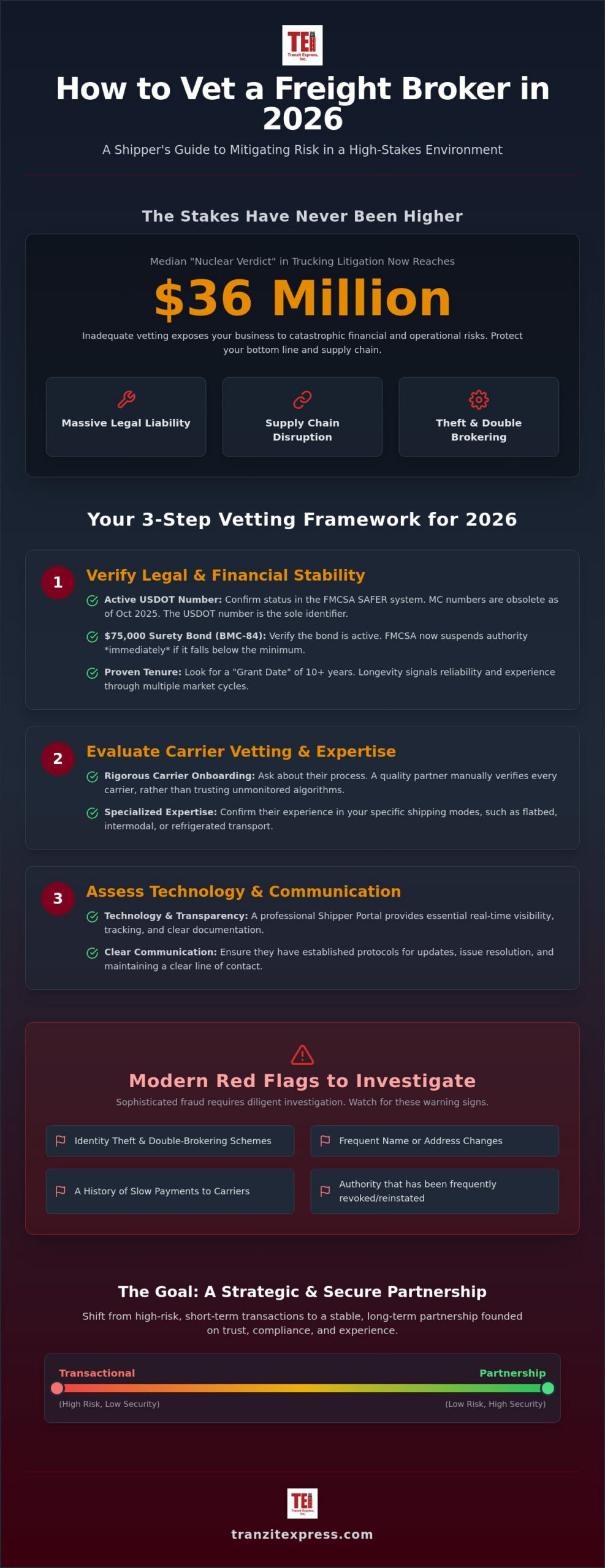
With the median nuclear verdict in trucking litigation now reaching $36 million, the risk of choosing the wrong logistics partner has never been more personal for your bottom line. You already know that a single shipment gone wrong can disrupt an entire supply chain and expose your company to massive legal liability. Learning how to vet a freight broker properly is no longer just a best practice; it’s a vital safeguard for your business. It’s exhausting to manage the constant threat of cargo theft or the anxiety of a carrier accident while trying to keep your operations moving on schedule.
This guide provides a rigorous, multi-step process designed for the high-stakes environment of 2026. We’ll help you navigate the latest FMCSA changes, such as the elimination of MC numbers and the stricter $75,000 surety bond enforcement rules. You’ll learn a repeatable system for verifying credentials, operational integrity, and financial stability. We’ll preview the specific documentation you need to see and the red flags that signal a broker’s authority is at risk, giving you the confidence to build a secure, long-term partnership that prioritizes the safety of your cargo.
Key Takeaways
- Verify the broker’s active USDOT authority and $75,000 surety bond to ensure financial protection against service disruptions.
- Discover how to vet a freight broker by evaluating their specific carrier onboarding standards and expertise in specialized modes like flatbed or intermodal shipping.
- Utilize a professional Shipper Portal to gain real-time visibility and maintain clear communication throughout the transit process.
- Identify modern red flags such as identity theft and double-brokering fraud to protect your cargo from sophisticated criminal schemes.
- Shift your logistics strategy from short-term transactions to stable partnerships built on a foundation of rigorous carrier compliance and decades of industry experience.
The Critical Importance of Freight Broker Vetting in 2026
Vetting a freight broker is more than a simple administrative task; it’s a comprehensive risk-mitigation strategy that protects every shipment you release. In the current 2026 logistics environment, the industry faces sophisticated challenges including identity theft and double-brokering fraud. To understand the stakes, you must look beyond a basic understanding of what a freight broker is and evaluate the operational depth they bring to your organization. While the FMCSA requires a license to operate, a license alone doesn’t guarantee integrity or reliability. Learning how to vet a freight broker involves distinguishing between a company that merely holds authority and a qualified partner that manages your freight with the same care you do. This process aligns with our broader what does a freight broker do framework, which emphasizes accountability at every stage of the shipping process.
Why Basic Compliance is No Longer Enough
The rise of digital freight matching has created a landscape where speed often overrides security. While automated systems move loads quickly, they also increase the need for manual verification to catch fraudulent actors who exploit digital loopholes. Working with a broker who lacks sufficient bonding or insurance leaves your cargo vulnerable to claims that the broker cannot cover. Due diligence serves as the primary defense against supply chain disruption. Relying on a seasoned veteran means choosing a partner who verifies every carrier manually rather than trusting an unmonitored algorithm. This steady approach ensures that the “hands at the wheel” are qualified and verified before your freight ever leaves the dock.
The Impact of Poor Vetting on Your Bottom Line
The financial consequences of inadequate vetting are often hidden until a crisis occurs. You might face cargo delays that stall your production lines or legal liabilities stemming from carrier accidents. One of the most severe risks is double-payment, where a shipper pays a fraudulent broker but remains legally obligated to pay the carrier who actually moved the load. These disruptions create a ripple effect that touches every part of your business. Beyond the direct costs, your brand reputation with end-customers depends on consistent delivery. A vetted broker ensures your shipments arrive as promised by maintaining the highest carrier compliance freight broker standards. Mastering how to vet a freight broker is the only way to secure your revenue and your professional standing in the marketplace.
Verifying Legal Authority and Financial Stability
Checking a potential partner’s credentials is your first line of defense against logistical failure. As of October 1, 2025, the FMCSA officially eliminated the use of Motor Carrier (MC) numbers for identification purposes. All operating authority is now consolidated under the USDOT number, which serves as the sole identifier for brokers and carriers alike. When you are learning Verifying Legal Authority, your first step must be to enter this USDOT number into the SAFER system to ensure their status is listed as “Active.” This modern consolidation helps prevent “double-dipping” and makes it easier to track a company’s true operational history.
Financial stability is the next pillar of a secure partnership. Every broker is federally mandated to maintain a $75,000 surety bond (Form BMC-84) or trust fund (Form BMC-85). Under the strict rules that took effect in January 2026, the FMCSA now suspends a broker’s authority almost immediately if their bond dips below this minimum. Beyond the bond, you should analyze the broker’s credit score through industry reporting tools. A history of slow payments to carriers is a significant red flag. It often precedes a total service collapse or, worse, carriers seeking payment directly from you because the broker defaulted. Knowing how to vet a freight broker requires looking past the sales pitch and into these hard financial truths.
Decoding the FMCSA Safer System
Tenure is a powerful indicator of reliability. When reviewing a broker’s snapshot, look for a “Grant Date” that goes back at least a decade. Companies with 10 or more years of steady authority have survived multiple market cycles and regulatory shifts. Be extremely cautious if you see frequent name changes or address shifts on official filings. These “reincarnated” entities often change their identity to hide past safety violations or legal judgments. A professional, long-standing partner will have a clear and consistent paper trail that reflects their commitment to the industry.
Insurance and Contingent Cargo Coverage
Never accept a PDF certificate of insurance at face value. Digital fraud is sophisticated in 2026, and a forged document is easy to create. You should request an ACORD Certificate of Insurance and then call the insurance agent listed on the document to verify the policy is active and the premiums are paid. It’s also vital to distinguish between standard liability and contingent cargo insurance. While the carrier carries primary insurance, contingent cargo coverage acts as a safety net for the shipper. It provides protection if the carrier’s policy is voided due to a technicality or a driver’s negligence. For high-value van or flatbed freight, ensure your broker maintains robust contingent coverage to protect your bottom line. If you need a partner with a transparent and verified history, the team at Tranzit Express offers the stability of 25 years in the industry.
Evaluating Carrier Vetting Processes and Specialized Expertise
A freight broker acts as the critical link between your dock and the destination. However, the integrity of your supply chain is only as strong as the carriers the broker selects to move your goods. When you are determining how to vet a freight broker, you must look beyond their own credentials and scrutinize their internal onboarding standards. A professional partner should have a transparent, rigorous process for qualifying every trucking company they hire. This ensures that the high standards you expect are maintained throughout the entire journey, regardless of the equipment type or the complexity of the route.
The Broker’s Internal Carrier Compliance Standards
Ask specifically about the tools a broker uses to monitor their network in real-time. Dependable brokers often utilize automated monitoring systems that cross-reference the FMCSA Licensing and Insurance database to catch status changes instantly. You need to know if they have “hard-stop” criteria, such as refusing to work with carriers that hold “Conditional” or “Unsatisfactory” safety ratings. A secure broker also takes active steps to prevent double-brokering by verifying that the carrier actually owns and operates the equipment they claim to have. This level of oversight is a hallmark of a seasoned industry veteran who prioritizes cargo security over quick margins.
Matching Broker Expertise to Your Equipment Needs
Generalist brokers often struggle when faced with the complexities of flatbed freight services USA. Open-deck logistics require a deep understanding of securement requirements, oversized permits, and specialized routing. If your broker doesn’t understand these nuances, you might face unexpected delays or safety issues. Similarly, time-sensitive hot shot trucking loads require a broker who can move with precision and maintain constant contact with the driver. When assessing how to vet a freight broker, ask about their specific experience with your primary freight mode to ensure they aren’t learning on your time.
The value of a specialized partner becomes even clearer when discussing flatbed freight rates or the transitions required for intermodal transportation. An expert broker knows the difference between a simple road haul and the logistical choreography required for intermodal rail. They should be able to explain the benefits of various routing options and provide a sense of order in a complex market. Choosing a partner with 25 years of experience means you are working with someone who has already mastered these vetting steps across all 48 states, providing the steady hand at the wheel that your business deserves.
Assessing Technology, Transparency, and Communication
Technology should provide a sense of order in the often chaotic world of logistics. When you are evaluating how to vet a freight broker, the quality of their digital infrastructure is a direct reflection of their operational maturity. A modern broker shouldn’t just promise visibility; they should provide the tools that make that visibility a reality for your team. This transparency reduces the administrative burden on your staff and allows you to manage your supply chain with data rather than guesswork. A professional partnership thrives when information flows freely and accurately between both parties. In a market where spot rates and tariff pressures create constant uncertainty, understanding why an experienced freight broker still matters in 2026 is essential before entrusting your freight to any digital-first platform.
The Role of a Modern Shipper Portal
A robust Shipper Portal is no longer a luxury. It’s a fundamental requirement for efficient shipping. These platforms provide real-time tracking that significantly reduces the need for “where is my truck” phone calls, allowing your team to focus on higher-value tasks. Beyond tracking, a portal should offer 24/7 access to your entire shipping history, including digital copies of Bills of Lading (BOLs) and Proof of Delivery (POD) documents. Advanced technology should enhance professional communication by providing a single source of truth, rather than replacing the personal accountability of your broker.
Communication Standards and Problem Resolution
The true test of a broker occurs when something goes wrong. Mechanical breakdowns, weather delays, and port congestion are inevitable in this industry. An experienced broker remains a steady hand at the wheel during these disruptions. You should ask about their specific protocols for handling delays. Do they notify you immediately with a recovery plan, or do you have to hunt them down for an update? A dedicated account representative who understands your business is far more valuable than a generic call center where you’re just another ticket number. Professional, composed communication during a crisis is the clearest sign of a seasoned logistics veteran.
Transparency must also extend to the financial side of the relationship. A dependable broker provides clear, all-in quotes that eliminate the frustration of hidden fees or unexpected surcharges. They should be able to explain their documentation management process, ensuring that invoicing is accurate and backed by the necessary paperwork. This methodical approach to business builds the trust required for a long-term relationship. If you are looking for a partner that combines high-tech visibility with high-touch service, you can request a quote from Tranzit Express to see our professional standards in action.
How a broker handles information is just as important as how they handle your freight. By prioritizing transparency and testing the “human element” of their service, you ensure that your cargo is in capable hands. This final layer of vetting completes the picture of a reliable logistics partner who is prepared for the challenges of the 2026 market.
Building a Long-Term Partnership with Tranzit Express
Selecting a logistics partner is a decision that defines the stability of your entire supply chain. While learning how to vet a freight broker is a necessary skill for any professional shipper, the ultimate goal is to find a partner whose internal standards are so high that you no longer have to worry about the details of every individual shipment. Tranzit Express Inc. brings a 25 year legacy of dependable national logistics to every relationship. We provide a steady hand at the wheel, offering comprehensive solutions for van freight, flatbed shipping, intermodal transportation, and time-sensitive hot-shot loads across all 48 states. Our approach shifts the focus from a single transaction to a high-level B2B partnership where your peace of mind is our primary objective.
Transparency is the foundation of trust in 2026. This is why we provide direct access to our specialized Shipper Portal, allowing you to monitor your freight in real-time and access all necessary documentation without delay. By maintaining the highest carrier compliance freight broker standards, we ensure that your cargo is always in the hands of a verified, professional driver. We’ve spent over two decades refining our processes to protect your brand reputation and your bottom line.
The Tranzit Express Vetting Standard
We vet our carriers with a level of rigor that exceeds federal requirements, so you don’t have to manage the risk yourself. Our internal 5-point check includes a deep dive into safety records, insurance longevity, and equipment ownership. We don’t just check a box; we build relationships with carriers who share our commitment to excellence. You’ll experience consistent communication from the moment of pickup until the final on-time delivery. This methodical approach reduces shipping disruptions and provides the order you need in a complex industry. We act as your advocate, ensuring that every carrier meets our strict internal benchmarks before they ever touch your freight.
Ready to Experience Professional Logistics?
The choice between a broker and a carrier is often debated, but as we explore in our guide on the freight broker vs carrier dynamic, the real value lies in the experience and the network of the partner you choose. A seasoned broker like Tranzit Express offers the flexibility of a national network combined with the institutional knowledge of a veteran team. We understand how to vet a freight broker because we’ve mastered every step of the process over the last 25 years. We invite you to move beyond the anxiety of carrier selection and step into a partnership built on proven results and professional integrity.
If you’re ready to secure your supply chain with a partner that values reliability above all else, we’re here to help. Our team is prepared to handle your most challenging loads with the composure and expertise that only decades of experience can provide. Request a Reliable Freight Quote from Tranzit Express today and discover the difference that a professional logistics partnership makes for your business.
Securing Your Supply Chain with Proven Expertise
Mastering the rigorous process of how to vet a freight broker is the most effective way to safeguard your cargo and your professional reputation. By verifying legal authority, confirming financial stability, and scrutinizing internal carrier compliance, you transition from simple transactions to a resilient logistical partnership. It’s about more than just checking a license; it’s about ensuring your broker has the specialized knowledge and technological transparency required to manage complex van, flatbed, or intermodal shipments without disruption. As the myth of the instant logistics expert continues to unravel in today’s volatile market, the institutional knowledge of a veteran broker becomes your most reliable competitive advantage.
Tranzit Express Inc. offers the peace of mind that comes with 25+ years of industry experience and national coverage across all 48 states. We maintain A+ rated carrier compliance standards and provide full visibility through our professional shipper portal, acting as a steady hand for your distribution needs. You don’t have to navigate the risks of the 2026 market alone. Partner with a Vetted Logistics Expert at Tranzit Express to bring order and reliability to your next shipment. We look forward to building a dependable future together.
Frequently Asked Questions
How do I check a freight broker’s license for free?
You can check a freight broker’s license for free by visiting the FMCSA SAFER website or the Licensing and Insurance portal. Simply enter the broker’s USDOT number to view their current operating status and insurance filings. This public database is the most reliable tool when you’re learning how to vet a freight broker because it provides real-time data directly from federal regulators.
What is the difference between an MC number and a DOT number for a broker?
Historically, MC numbers represented operating authority while USDOT numbers identified the business entity. However, as of October 1, 2025, the FMCSA officially phased out MC numbers. All brokers, carriers, and forwarders are now identified solely by their USDOT number. This consolidation makes it easier for shippers to track a partner’s safety and authority history through a single, unified identifier.
What insurance should a freight broker have to protect my cargo?
While brokers aren’t federally mandated to carry cargo insurance, a professional partner should maintain Contingent Cargo and Errors & Omissions policies. These provide a vital safety net if a carrier’s primary insurance is voided or insufficient. When you evaluate how to vet a freight broker, always ask for an ACORD certificate and call the listed agent to confirm the policies are active and paid.
What are the red flags of a fraudulent freight broker?
Red flags include a very recent authority grant date, frequent changes to the business name, or a lack of a physical commercial address. Be wary of brokers who use generic email services rather than a corporate domain. In 2026, the most dangerous red flag is a broker whose surety bond has been recently suspended or drawn down, as this indicates severe financial instability.
How much is a freight broker surety bond, and why does it matter to me?
A freight broker must maintain a $75,000 surety bond or trust fund to operate legally. This matters to you because it ensures there are funds available if the broker fails to pay their carriers or fulfill contractual obligations. Under the 2026 enforcement rules, any dip below this $75,000 threshold results in an almost immediate suspension of the broker’s authority to move freight.
Can I use a broker for specialized freight like hot-shot or flatbed loads?
You certainly can, but you should choose a broker with specific expertise in open-deck or time-sensitive logistics. Specialized modes like flatbed and hot-shot shipping require deep knowledge of securement regulations, oversized permits, and specific equipment capabilities. A generalist broker may not understand the nuances of these loads, which can lead to safety risks or unexpected delays at the dock.
How do I verify a broker’s payment history with carriers?
You can verify a broker’s payment history by using industry-standard credit reporting services like Ansonia, BlueBook, or the TIA Watchdog. These platforms provide a “days-to-pay” average based on real data from carriers. A broker with a consistent history of prompt payments is far more likely to have a loyal, high-quality carrier network that will prioritize your shipments during capacity crunches.
Why should I choose a broker with 20+ years of experience over a digital startup?
A broker with 20 or more years of experience offers a level of stability and institutional knowledge that a digital startup simply cannot match. While new tech is helpful, it doesn’t replace the “steady hand” needed to navigate complex regulatory shifts or market volatility. Veteran brokers have built deep, trusted relationships with carriers over decades, ensuring your cargo is handled by proven professionals rather than unverified algorithms.