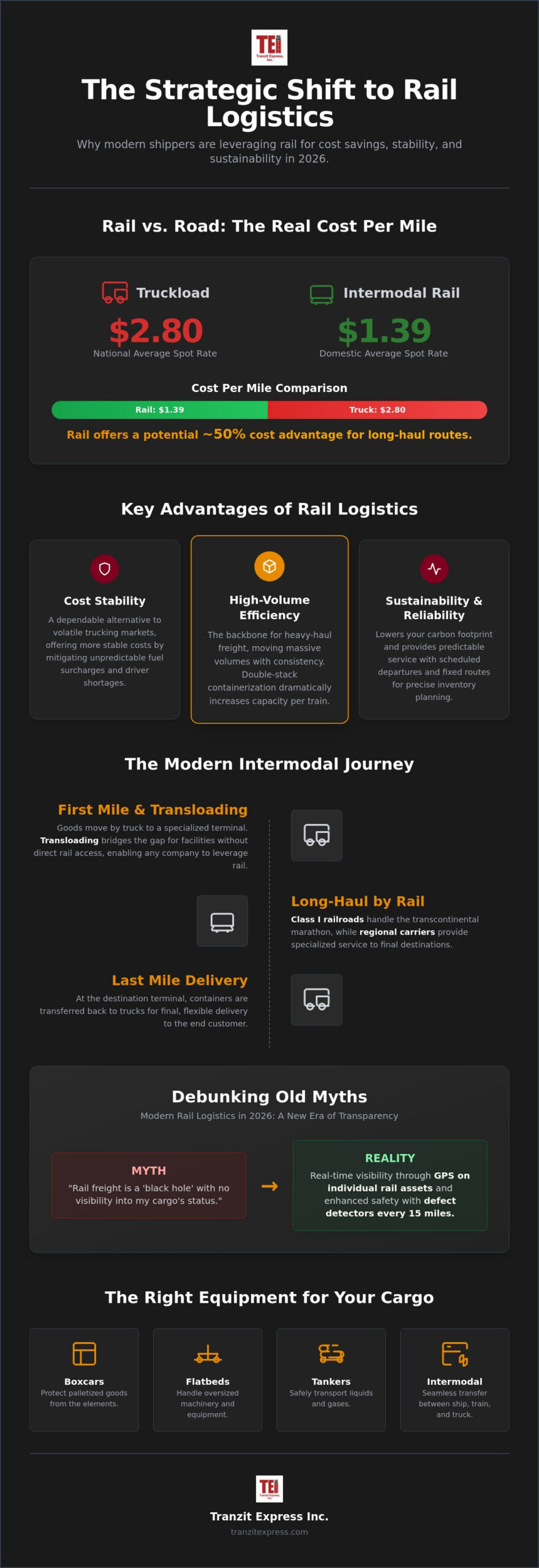
Did you know that as of early 2026, domestic intermodal spot rates averaged $1.39 per mile, while national truckload rates remained significantly higher at $2.80? For many shippers, the decision to integrate rail logistics into their national strategy is no longer just an alternative; it’s a necessary step toward long-term financial stability. You’ve likely felt the sting of unpredictable fuel surcharges and the growing pressure to meet corporate sustainability goals. These challenges can make the coordination of a complex supply chain feel overwhelming, especially when you’re managing multiple carriers across vast distances.
We understand that your primary goal is to find a sense of order in a volatile market. In this guide, you’ll discover how a structured approach to rail can reduce your long-haul transportation costs and lower your carbon footprint while maintaining the dependable service your business demands. We’ll explore how to transform your shipping process into a reliable partnership that provides clear visibility into your cargo’s status. By the end of this article, you’ll have a practical roadmap for streamlining your operations and securing a more predictable future for your freight.
Key Takeaways
- Learn how rail logistics serves as the dependable backbone for heavy-haul freight while integrating seamlessly into your national supply chain.
- Evaluate the significant cost-per-ton-mile advantages of rail to improve your long-term transportation ROI on long-haul routes.
- Identify the differences between Class I railroads and regional carriers to optimize your routing and cargo handling.
- Gain practical strategies for overcoming visibility challenges and managing the complexities of multi-carrier interchanges.
- Discover the value of a seasoned partnership in providing the steady hand needed to coordinate complex freight movements with confidence.
What is Rail Logistics and How Does it Support Modern Shipping?
Rail logistics is the strategic management and movement of freight across the national railway network. While some might view it simply as a method for hauling bulk commodities, it has evolved into a sophisticated engine for modern commerce. Understanding What is Rail Logistics requires looking beyond the tracks to see its role as the backbone of our national heavy-haul infrastructure. It provides a sense of order for companies that need to move massive volumes of goods with consistency. Today’s network isn’t just for coal or grain anymore. It’s a diversified system carrying everything from electronics to retail apparel across the continent.
For many businesses, rail serves as a predictable alternative to the often volatile road transport markets. While trucking is essential for flexibility, it’s frequently subject to sudden price swings and capacity crunches. By contrast, the rail system operates with a quiet confidence, offering a steady hand for your long-haul needs. It allows for a more methodical approach to supply chain planning, where stability and trust are the primary drivers of success.
The Evolution of Intermodal Freight Solutions
The rise of intermodal freight has changed how we think about long-distance transport. Modern containers move seamlessly between ocean vessels, trains, and trucks without the need to handle the actual cargo. In North America, the use of double-stack containerization has dramatically increased the capacity of every single train, allowing for a more streamlined flow of goods. This efficiency is a core part of our Intermodal Transportation offerings. While rail handles the long-haul marathon, you can learn more about how trucks manage the initial and final stages in our complete guide to van freight services.
Why Shippers are Returning to the Rails in 2026
Current market conditions in 2026 have created a high demand for high-volume, long-distance efficiency that only rail can provide.
Trucking markets often face volatile fuel prices and a persistent shortage of qualified drivers, which leads to unpredictable surcharges for shippers. These factors make it difficult to maintain a consistent budget. Rail logistics offers a more composed alternative where costs are generally more stable over long distances. Scheduled departures and fixed routes provide a level of reliability that helps businesses plan their inventory with greater precision. It’s a practical choice for those who value fulfillment over marketing hype and want a partner that understands the deep institutional knowledge required for national distribution.
The Mechanics of Rail Freight: From Transloading to Delivery
The journey of a rail shipment is a methodical process that prioritizes consistency and order. It begins at the origin, moves through the long-distance line-haul, and concludes at the final destination. This national network is maintained by a hierarchy of carriers that work in tandem to ensure your cargo reaches its goal. Class I railroads handle the massive transcontinental routes, while regional short-line carriers provide the specialized service to specific industrial zones. For a deeper look at this structure, the U.S. Freight Rail Network Overview provides excellent context on how these entities collaborate to move national freight safely.
Efficiency in rail logistics depends heavily on using the right equipment for the specific requirements of your cargo. Boxcars protect palletized goods from the elements, flatbeds handle oversized machinery, and tankers safely transport liquids. In 2026, the adoption of advanced tracking technology has removed the old “black hole” perception of rail. Shippers now enjoy real-time visibility through GPS integrations on individual rail assets and the deployment of defect detectors every 15 miles as suggested by the Railway Safety Act of 2026. This level of transparency ensures you always know the status of your cargo, providing the security you need for high-stakes logistics.
Transloading: Bridging the Gap for Non-Rail Facilities
Transloading is a practical solution for businesses that don’t have direct rail access at their facility. By moving freight from a truck to a railcar at a specialized terminal, you can access the cost benefits of rail without investing in on-site infrastructure. This process effectively bridges the gap, allowing any company to integrate rail into their supply chain regardless of their physical location. It’s a seamless transition that expands your reach across the national network while keeping your operations lean and purposeful.
Intermodal vs. Carload Shipping
Choosing between intermodal and carload shipping depends on your specific volume and freight type. Carload shipping is often the preferred choice for high-volume users moving single commodities in bulk. Intermodal transportation solutions, however, offer greater flexibility for standard palletized freight by using containers that switch easily between modes. For the drayage portion of this journey, choosing the right intermodal trucking companies is essential to maintain the integrity of your schedule. If you’re ready to bring a steady hand to your freight operations, our Shipper Portal Access provides the visibility and order your business demands.
Rail vs. Road: Calculating the Real Cost and ROI
Deciding between rail and road transport is often a matter of finding the right balance for your specific freight needs. While trucking offers undeniable speed, rail logistics provides a level of cost stability that’s difficult to match over long distances. As of July 2026, national truckload spot rates have remained elevated at approximately $2.80 per mile. In contrast, domestic intermodal spot rates sit significantly lower at $1.39 per mile. This cost-per-ton-mile advantage allows businesses to stretch their budgets further, especially when moving large volumes across the country. To fully understand how these pricing structures compare and how to leverage them effectively, our guide on intermodal freight rates provides a clear framework for making informed decisions.
It’s helpful to view rail as a marathon rather than a sprint. While a truck might deliver a load in two days, a rail shipment may take four or five. However, this trade-off comes with much less exposure to the volatile spot market. Rail pricing is methodical and predictable, offering a sense of security for your long-term financial planning. Additionally, the structured environment of rail transport often leads to a lower risk of cargo damage. The movement is more consistent and less prone to the sudden stops or road hazards common in highway travel, ensuring your goods arrive in the condition you expect.
The 500-Mile Rule: When to Switch to Rail
Industry veterans often look to the 500-mile mark as the threshold for transitioning from road to rail. Once a shipment exceeds this distance, the efficiencies of the railway network become undeniable. Data from the Association of American Railroads indicates that trains can move one ton of freight approximately 500 miles on just a single gallon of fuel. This incredible efficiency makes a hybrid strategy essential for modern supply chains. By blending the flexibility of our Van Freight Services for shorter hauls with the heavy-lifting power of rail for the long-haul, you create a more resilient and cost-effective logistics model.
Sustainability and ESG Goals in 2026
Meeting corporate sustainability goals has become a top priority for leadership teams in 2026. Choosing rail is one of the most effective ways to lower your carbon footprint, as rail transport typically produces 75% fewer greenhouse gas emissions than trucking. This environmental advantage helps your company comply with increasingly strict regulations while positioning your brand as a responsible partner in the B2B space. It’s a practical, results-oriented way to demonstrate your commitment to excellence. Integrating rail into your operations provides a steady hand for both your budget and your environmental impact.
Overcoming Common Challenges in Rail Logistics
While the transition to rail offers a sense of security for your budget, it’s natural to have questions about the complexities of the tracks. For years, some shippers viewed rail as a “black hole” where visibility disappeared once the cargo left the terminal. Managing the movement of goods across different Class I railroads requires a methodical approach, especially during interchanges where one carrier hands off a shipment to another. With the proposed merger of Union Pacific and Norfolk Southern in 2026, these handoffs are becoming more streamlined, but they still require the steady hand of a seasoned professional to ensure nothing is lost in the shuffle.
Physical safety is another practical concern. Because rail cars experience different forces than trucks, proper blocking and bracing are essential to prevent shifting during transit. Using high-quality dunnage and following a structured loading plan ensures that your freight remains secure throughout its long-haul journey. Clear communication between your team and the terminal staff is the most effective way to prevent unnecessary delays. When everyone is on the same page, the entire process moves with the quiet confidence that defines a high-level logistics partnership.
Managing Demurrage and Storage Fees
Demurrage is a fee charged by railroads when a car is held beyond the allotted “free time” for loading or unloading. These costs can quickly erode your ROI if your facility isn’t prepared for the arrival. To protect your budget, it’s important to have a proactive plan in place. Consider this brief checklist for maintaining order at your siding:
- Monitor car arrival schedules daily through your carrier portal.
- Coordinate your labor teams to ensure prompt loading and unloading.
- Pre-schedule drayage services to move containers as soon as they’re released.
- Verify “last free day” notices to prioritize specific car movements.
A dependable broker monitors these timelines on your behalf, acting as a safeguard against idle time and unexpected expenses.
Ensuring Visibility Across the Network
Modern technology has effectively closed the visibility gap that once existed between rail and road. In 2026, the widespread use of GPS and RFID sensors on rail assets allows for real-time tracking across the entire national network. You no longer have to guess where your shipment is located. By utilizing a centralized shipper portal, you can access clear status updates and predictive arrival times. This level of transparency provides the peace of mind you need to manage your inventory levels with precision. If you’re ready to experience this level of control in your supply chain, you can get started with our Shipper Portal Access today to see how we bring order to rail logistics.
Partnering with a Veteran Rail Logistics Broker
Managing the intricacies of rail logistics independently often requires handling a maze of tariffs, interchange rules, and multi-carrier scheduling. It’s a task that can quickly become an administrative burden, pulling your focus away from your core business operations. A veteran broker acts as the “steady hand” in these complex moves, providing the stability and trust you need to move freight with confidence. Our 25 years of institutional knowledge allows us to anticipate challenges before they arise, ensuring your cargo stays on track across the national network. We prioritize clear results.
We leverage established relationships with Class I railroads to secure the capacity and routing your business demands. Instead of managing separate contracts and communication channels for each leg of a journey, you benefit from a single point of contact. This collaborative approach simplifies the process of moving goods through interchanges and diverse territories. It provides a sense of order and predictability that’s essential for high-stakes logistics, especially when your supply chain spans the entire continent. You don’t have to manage the fragmentation of the rail network alone.
The Tranzit Express Advantage: Reliable Communication
At Tranzit Express, we position ourselves as a veteran guide for our clients. We understand that the primary goal of any logistics partnership is to reduce stress and provide clear, actionable information. Our team manages the heavy lifting of documentation and regulatory compliance, allowing you to focus on growth. This includes the critical role of a freight broker in vetting carriers and maintaining high standards of excellence. We prioritize clear communication above all else, ensuring you’re never left wondering about the status of your shipment.
Simplifying Your National Logistics Strategy
Integrating rail into your broader supply chain doesn’t have to be a complicated endeavor. We look at your entire network to determine where rail or Intermodal Transportation can offer the greatest ROI. Our process is methodical and logical, starting with a comprehensive review of your freight lanes. We then integrate these moves with our other core offerings, such as Van Freight Services or Flatbed Shipping, to create a seamless door-to-door solution. If you’re ready to bring a more composed and efficient approach to your shipping, we invite you to request a reliable intermodal quote today. Let us provide the steady hand your national logistics strategy deserves.
Securing a More Predictable Future for Your Freight
Integrating rail into your national supply chain is a strategic move toward long-term stability and environmental responsibility. By leveraging the cost-per-ton-mile advantages of the railway network, you can protect your budget from the volatility of the trucking market. This transition allows you to meet corporate sustainability goals while maintaining the high standards of excellence your customers expect.
Successfully managing rail logistics requires a partner who understands the nuances of the tracks and the complexities of multi-carrier coordination. Tranzit Express brings over 25 years of national logistics experience to every shipment, offering comprehensive intermodal transportation solutions and transloading coordination. We prioritize reliable communication and on-time delivery standards to ensure your cargo moves with purpose and order.
You don’t have to navigate these complexities alone. Partner with a veteran logistics expert for your next rail shipment to secure a more efficient future for your freight. We look forward to building a long-term partnership that supports your business goals with the steady hand of an industry veteran.
Frequently Asked Questions
Is rail logistics slower than trucking?
Yes, rail transport is typically slower than trucking because it operates on fixed schedules and involves complex terminal processing. While a truck might complete a long-haul move in two to three days, a similar rail move could take five to seven days. However, this trade-off provides greater cost stability and reduced exposure to the volatile spot market. It’s a methodical choice for shippers who prioritize budget predictability over immediate speed.
Do I need my own railroad tracks to use rail freight?
No, you don’t need a private rail siding at your facility to access the benefits of the network. Many businesses utilize transloading, which is the process of moving freight from a truck to a railcar at a specialized terminal. This allows any company to integrate rail into their supply chain regardless of their physical location. We coordinate the initial drayage to ensure your goods reach the rail network seamlessly and professionally.
What is the minimum distance for rail logistics to be cost-effective?
The industry standard for cost-effectiveness typically begins at the 500-mile mark. Beyond this distance, the fuel efficiency and high-volume capacity of rail begin to significantly outperform traditional truckload shipping. As of early 2026, intermodal spot rates were approximately $1.39 per mile, nearly half the price of national truckload rates. This makes rail an ideal choice for transcontinental moves where the primary goal is reducing long-haul transportation costs without sacrificing reliability.
Can rail logistics handle time-sensitive or “hot shot” loads?
Rail is generally not suited for “hot shot” or emergency loads due to its scheduled nature and terminal handling times. For truly time-sensitive freight, our Hot-Shot Loads or Van Freight Services are more appropriate choices. However, some shippers use rail for their baseline inventory while reserving trucks for urgent needs. This balanced strategy ensures you have a steady hand at the wheel for both routine and critical shipments.
What is transloading and how does it work?
Transloading is the methodical transfer of goods between different modes of transport, such as from a flatbed truck to a center-beam railcar. This process occurs at dedicated terminals equipped with specialized machinery for heavy-haul freight. It allows shippers to bypass the need for direct track access while still benefiting from the lower costs of long-distance rail. It’s a practical solution that bridges the gap between your warehouse and the national railway.
How do I track my freight when it is on a train?
You can track your freight in real-time through our Shipper Portal Access, which integrates data from GPS and RFID sensors on individual rail assets. In 2026, the visibility gap between rail and road has effectively closed, providing clear status updates as your cargo moves across the network. This level of transparency allows you to manage your inventory with confidence and provides a sense of security throughout the entire shipping process.
What types of goods are best suited for rail transport?
Rail is exceptionally well-suited for heavy, bulky, or high-volume goods that aren’t strictly time-critical. This includes building materials, machinery, palletized consumer goods, and industrial commodities. Because trains can carry much heavier loads than a standard semi-truck, rail is the backbone of national heavy-haul infrastructure. Whether you’re moving flatbed freight or standard van loads, rail logistics provides a consistent and dependable solution for large-scale distribution.
Is rail logistics more sustainable than trucking?
Yes, rail logistics is significantly more sustainable, producing approximately 75% fewer greenhouse gas emissions than traditional trucking. This is largely due to the extreme fuel efficiency of locomotives, which can move one ton of freight 500 miles on a single gallon of fuel. Choosing rail helps your business meet corporate ESG goals and comply with modern environmental regulations. It’s a responsible choice that reflects a commitment to both excellence and long-term stability.