
Is the direct route always the safest path for your cargo? While many shippers believe working directly with a trucking company is the only way to ensure accountability, the choice between a freight broker vs carrier is actually about balancing physical assets with strategic flexibility. You’re likely familiar with the stress of a tightening market where finding an available van or flatbed feels like a constant hurdle. It’s natural to worry about hidden fees or whether a partner has the necessary $75,000 bond to remain compliant under the strict FMCSA standards enforced since January 2026.
We understand that a reliable supply chain requires more than just a truck; it requires a partnership built on transparency and proven results. This guide will help you understand the fundamental differences between these two roles so you can streamline your logistics with total confidence. You’ll learn exactly when to leverage a broker’s network and when to go direct, providing a clear framework for lower stress and consistent, on-time deliveries. We will also examine how recent legal shifts regarding broker liability for negligent hiring impact your vetting process in the current market.
Key Takeaways
- Distinguish between the physical equipment ownership of motor carriers and the strategic network coordination provided by freight brokers.
- Understand the critical differences in liability and insurance coverage to protect your cargo and ensure regulatory compliance.
- Identify the specific high-volume lanes where a direct relationship with a carrier offers the most stability and direct communication.
- Evaluate the freight broker vs carrier dynamic to leverage brokers for seasonal spikes and complex needs like intermodal or flatbed shipping.
- Develop a balanced logistics framework that combines the strengths of both partners to achieve reliable, on-time deliveries with less stress.
Defining the Roles: What is a Freight Broker vs. a Carrier?
To build a resilient supply chain, you must first understand the legal and operational foundations of your partners. Both entities require specific operating authority from the Federal Motor Carrier Safety Administration (FMCSA). While their shared objective is the successful delivery of your goods, the methods they use to achieve that goal are fundamentally different. One provides the physical equipment and labor, while the other provides the strategic coordination and network access. Choosing between a freight broker vs carrier is not about finding a “better” option; it is about selecting the right tool for your specific logistical challenge.
The Motor Carrier: The Physical Execution
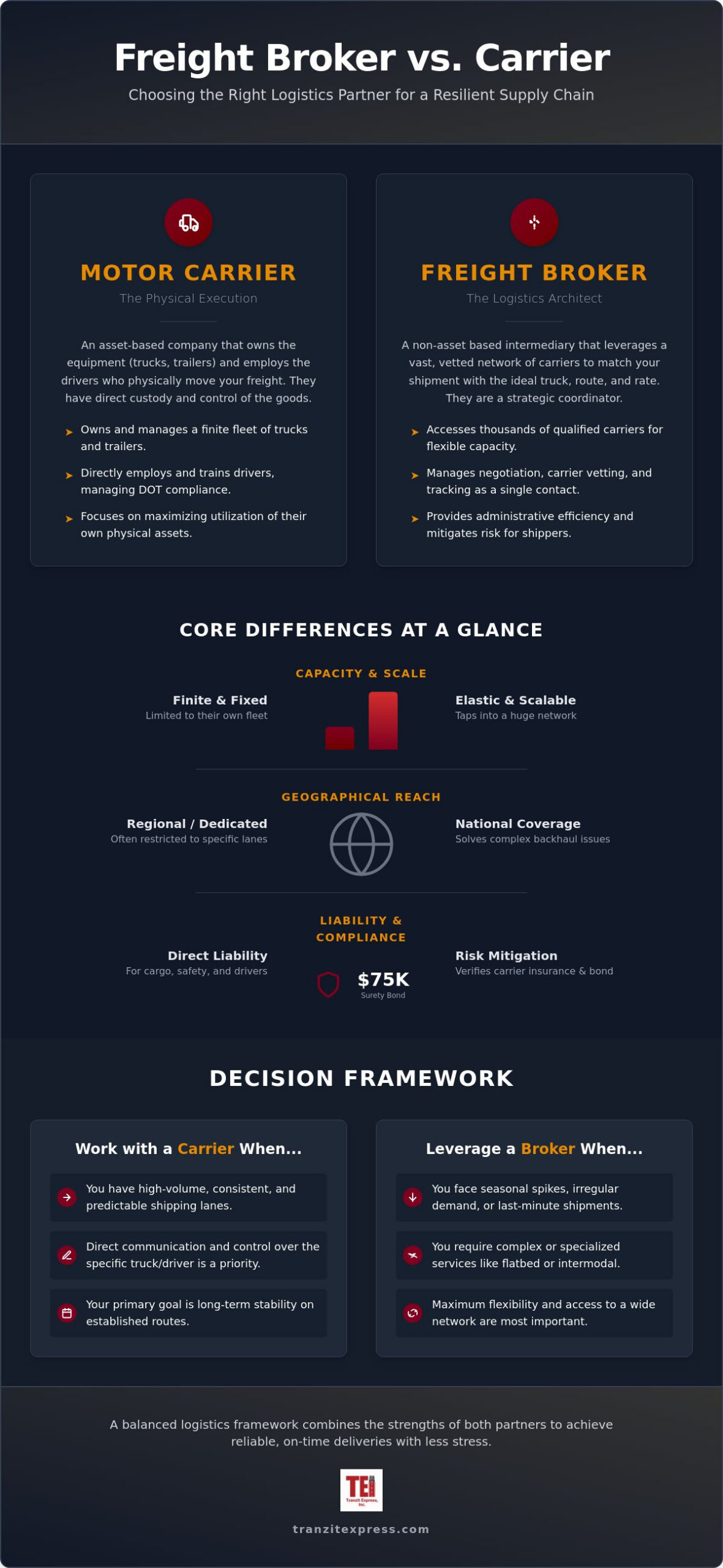
A motor carrier is an asset-based company that owns the equipment and employs the drivers who move your freight. Their world is defined by high overhead and constant maintenance. They must manage fuel costs, driver retention, and rigorous Department of Transportation (DOT) compliance. Because they rely on their own fleet, their capacity is finite. If a carrier owns twenty trucks and all are currently under load, they cannot accept your shipment until one of those assets becomes available. This model provides deep control over the specific vehicle and driver assigned to your cargo. A motor carrier is the party with the physical custody and control of the goods from the moment of pickup until the final delivery is completed.
- Asset Management: Carriers focus on maximizing the utilization of their own trucks and trailers.
- Direct Labor: They are responsible for driver training, safety ratings, and hours-of-service monitoring.
- Limited Reach: A carrier’s service area is often restricted by where their trucks are physically located or where they have established backhaul routes.
The Freight Broker: The Logistics Architect
A freight broker acts as a professional intermediary. They are typically non-asset based, which means they do not own the trucks that perform the haul. Instead, they leverage a vast network of thousands of vetted carriers to find the best match for your lane, equipment needs, and budget. When you ask What is a Freight Broker?, the answer lies in their role as a strategic coordinator. They manage the complexities of rate negotiation, carrier procurement, and multi-stop tracking so you don’t have to.
The primary advantage of a broker is elasticity. If your regular carrier is at capacity, a broker can quickly tap into their database to find another qualified motor carrier. Understanding what does a freight broker do reveals a focus on risk mitigation and administrative efficiency. They act as a single point of contact, providing a layer of protection by verifying carrier insurance and safety scores before a single pallet is loaded. Under current regulations, brokers must also maintain a $75,000 surety bond to ensure financial responsibility, providing an added level of security for the shippers they represent.
This architectural approach allows brokers to handle irregular shipping patterns and seasonal spikes that might overwhelm a single asset-based carrier. They provide the order and consistency required to manage complex movements across various modes, including van freight, flatbed, and intermodal transportation.
Core Differences in Responsibility, Liability, and Scale
Understanding the operational scope of a freight broker vs carrier is vital for long-term planning. While a carrier offers a direct, one-to-one relationship, a broker provides a one-to-many capability that’s essential for scaling businesses. This difference is most apparent when looking at how each entity handles geographical limitations and the heavy burden of regulatory compliance. By choosing the right partner, you aren’t just moving freight; you’re delegating specific risks and administrative tasks to experts who can handle them with precision.
Geographical Reach and Capacity
Most motor carriers operate within specific regions or dedicated lanes to keep their equipment near maintenance terminals and home bases. This means their capacity is geographically fixed. If you need to move a load outside their standard lanes, you’ll likely face higher rates or simple unavailability. Brokers, however, maintain national coverage. They solve the backhaul problem by identifying carriers who are already in your area and need a load to return to their home base. This efficiency often translates to more competitive pricing and better equipment availability across various regions. As discussed in recent insights on digital freight brokerages, the ability to aggregate data across thousands of independent fleets has transformed how shippers access capacity in a tight market.
Carrier Compliance and Risk Management
Risk management is another area where the two roles diverge significantly. Under the Carmack Amendment, a motor carrier is generally liable for the actual loss or injury to the property they transport. However, a broker adds a secondary layer of protection through contingent cargo insurance. This insurance acts as a backstop if the carrier’s primary policy fails to cover a claim. Managing these details requires rigorous carrier compliance freight broker protocols. A professional broker takes on the administrative burden of verifying insurance certificates, safety ratings, and FMCSA authority before every shipment. This process shields the shipper from potential legal pitfalls, including negligent hiring claims which have seen increased scrutiny following recent court rulings. You can manage these complex relationships more effectively through our Shipper Portal Access, which provides a centralized view of your logistics network.
Ultimately, the administrative burden of vetting carriers and managing paperwork falls on the broker. This allows your team to focus on core operations rather than tracking down insurance renewals or verifying USDOT numbers. While a direct carrier relationship is excellent for consistent, high-volume lanes, the scale and risk-mitigation capabilities of a broker provide a necessary safety net for a modern supply chain.
When to Work Directly with a Carrier
Direct relationships with motor carriers often serve as the bedrock for established shipping operations. When evaluating the freight broker vs carrier dynamic, the direct-to-asset model is most effective for lanes with high frequency and predictable patterns. If your business moves the same volume from the same origin to the same destination every week, a direct contract provides a level of stability that spot-market solutions cannot match. This approach allows you to build a deep rapport with the people physically handling your goods, ensuring they understand your specific facility requirements and loading preferences.
Security is another primary driver for choosing the direct route. For highly sensitive or proprietary cargo, many shippers prefer the “asset-based” security of knowing exactly whose hands are on the wheel. You have a direct line of communication with the dispatcher or the driver, which can reduce anxiety during high-stakes deliveries. Additionally, removing the brokerage margin in these steady lanes can lead to noticeable cost savings. However, these savings only materialize if your internal team has the capacity to manage the relationship without increasing your own administrative overhead.
The Benefits of Dedicated Capacity
Dedicated lanes are the crown jewel of the carrier model. By committing consistent volume to a single fleet, you become a “shipper of choice.” This partnership encourages the carrier to prioritize your loads even when capacity tightens elsewhere in the market. Consistent volume also leads to predictable pricing. In a stable market, contract rates with a carrier protect your budget from the sudden spikes often seen in the spot market. Over time, this reliability creates a seamless flow of goods that feels less like a series of transactions and more like an extension of your own warehouse operations.
Limitations of the Direct-to-Carrier Model
While the direct model offers stability, it lacks the elasticity required for modern, fluctuating markets. The most significant risk is the “single point of failure.” If a carrier’s truck breaks down or a driver falls ill, that specific asset is removed from the equation, and your shipment sits idle. Unlike a broker who can quickly pivot to another fleet, a direct carrier relationship leaves you vulnerable to their specific fleet limitations.
Scaling also becomes a significant hurdle. If your shipping needs suddenly double during a peak season, a small or mid-sized carrier likely won’t have the extra equipment to support you. Managing twenty different carriers to cover twenty different lanes requires a massive amount of administrative time. You must track twenty sets of insurance renewals, process twenty different payment streams, and maintain twenty points of contact. For many growing businesses, the time-cost of managing these individual relationships quickly outweighs the potential savings of bypassing a broker.
When a Freight Broker is Your Strategic Advantage
A freight broker offers a level of strategic elasticity that an asset-based carrier simply cannot match. While we’ve discussed the stability of direct carrier relationships for consistent lanes, the reality for most businesses involves seasonal spikes and irregular shipping patterns. This is where the freight broker vs carrier debate shifts in favor of the intermediary. A broker doesn’t just find a truck; they provide a buffer against market volatility and act as a single point of coordination for multiple modes of transport. Many successful shippers now adopt a hybrid approach, using carriers for their “bread and butter” lanes while relying on a broker to manage the overflow and specialized needs.
Flexibility in Specialized Shipping
When your cargo requires more than a standard dry van, a broker’s network becomes indispensable. Sourcing specialized equipment like flatbed freight services USA often requires searching through thousands of smaller, independent fleets that don’t have large marketing budgets. Brokers also excel at sourcing hot shot trucking for those urgent, time-sensitive shipments that require a smaller vehicle and a faster turnaround. This ability to aggregate niche services simplifies the broader scope of logistics management for shippers, turning a chaotic procurement process into a single, professional conversation. Instead of vetting a new carrier for every unique load, you rely on the broker’s pre-vetted pool of professionals.
The Broker as a Buffer Against Market Volatility
The spot market is notoriously unpredictable. Rates can fluctuate based on weather, diesel prices, or regional demand. A broker uses historical data and real-time market tracking to predict these changes, often securing capacity before rates peak. Perhaps most importantly, a broker acts as a rescue service. If your primary carrier fails to show up for a critical pickup, a broker can tap into their vetted network to find a replacement within hours. This “load rescue” capability prevents costly downtime at your facility or your customer’s dock.
Modern technology plays a vital role here. Through integrated tracking and reporting portals, you gain visibility into every shipment without having to call multiple dispatchers. This centralized data allows you to analyze performance across Van, Flatbed, and Intermodal modes in one place. If you’re ready to add this layer of security to your operations, you can access our Shipper Portal to see how we streamline the vetting and tracking process for our partners. This approach reduces the administrative noise and lets you focus on high-level supply chain strategy while we handle the tactical execution.
Decision Framework: Choosing the Right Path for Your Business
Selecting the ideal logistics partner requires an honest assessment of your internal resources and external market demands. The freight broker vs carrier decision is rarely a permanent choice; rather, it is a strategic shift based on your current operational needs. Most sophisticated shippers find that a balanced portfolio approach provides the highest level of security. By utilizing asset-based carriers for high-volume, repetitive lanes and professional brokers for specialized or fluctuating needs, you create a supply chain that is both stable and elastic.
Experience remains the most valuable currency in this industry. A partner who has navigated multiple market cycles understands how to maintain capacity when trucks are scarce and rates are volatile. This institutional knowledge allows for a proactive approach to problem-solving, ensuring that minor disruptions don’t escalate into costly delays. In a market where truckload spot rates and new FMCSA financial rules are reshaping the competitive landscape, working with an experienced freight broker provides a critical edge that no algorithm can replicate. As you finalize your logistics strategy, use the following framework to determine which path best supports your business goals.
Evaluating Your Logistics Needs
Before committing to a specific model, consider these three critical questions regarding your daily operations:
- Is your freight volume consistent or seasonal? If your lanes are predictable year-round, direct carrier contracts offer excellent stability. If you experience surges or irregular patterns, a broker’s network is essential to handle the overflow.
- Do you have the internal staff to manage carrier compliance? Managing insurance renewals, safety ratings, and FMCSA authority is a full-time responsibility. If your team is already stretched thin, delegating this vetting process to a broker reduces your legal risk.
- Are you shipping specialized loads that require diverse equipment? If your needs shift between van freight, flatbed, and intermodal transportation, a single carrier likely won’t have the assets to cover every move. A broker provides a single point of contact for all equipment types.
The Tranzit Express Difference: 25 Years of Dependability
With 25 years of industry experience, Tranzit Express Inc. acts as a steady hand at the wheel for our partners. We’ve built our reputation on the quiet confidence that comes from deep institutional knowledge and a commitment to clear, honest communication. Our goal is to reduce the complexity of your logistics, providing a sense of order in an often-chaotic industry. We prioritize the fulfillment of our promises over marketing hype, focusing on the results that keep your supply chain moving forward.
Transparency is the foundation of a successful partnership. Through our dedicated Shipper Portal Access, you gain real-time tracking and comprehensive reporting that allows you to manage your freight with total confidence. This technology, combined with our disciplined carrier vetting process, ensures that your cargo is always in safe hands. We invite you to request a quote from our team today to see how a professional brokerage can streamline your logistics and provide the consistency your business deserves.
Securing Your Supply Chain for the Long Term
Building a resilient logistics strategy requires a deep understanding of the unique strengths offered by each partner. Whether you prioritize the direct control of asset-based carriers or the strategic elasticity of an intermediary, the goal remains the same: consistent, on-time delivery. Deciding between a freight broker vs carrier isn’t about finding a single permanent solution. Instead, it’s about creating a balanced portfolio that leverages dedicated capacity for stable lanes and a broad network for seasonal fluctuations and specialized needs.
Tranzit Express Inc. brings over 25 years of industry experience to every shipment, acting as a steady hand at the wheel for your business. We maintain a national network of vetted carriers and provide dedicated Shipper and Carrier Portals to ensure total transparency and ease of use. Our team focuses on reducing your stress through clear communication and proven results. When you’re ready to experience a higher standard of logistics partnership, we invite you to Request a Dependable Freight Quote from Tranzit Express. We look forward to helping you move your business forward with confidence and security.
Frequently Asked Questions
Is it cheaper to use a freight broker or a carrier?
The answer depends on your specific shipping volume and lane consistency. Carriers often provide lower rates on high-volume, repetitive lanes because you’re working directly with the asset owner. However, brokers can be more cost-effective for irregular shipments by finding backhaul opportunities that a single carrier might miss. Shippers also save on internal administrative costs associated with carrier vetting and compliance management when they partner with a broker.
Do freight brokers carry their own insurance for my cargo?
Brokers carry contingent cargo insurance rather than primary cargo insurance. The motor carrier is the primary liable party for cargo damage under the Carmack Amendment. A broker’s contingent policy acts as a secondary layer of protection if the carrier’s insurance is insufficient or denied. This setup provides an extra level of security for the shipper, ensuring that claims are handled professionally even in complex situations.
Can a freight broker own their own trucks?
Yes, an entity can hold both brokerage and motor carrier authority. These companies are often referred to as asset-based brokers. This hybrid model allows the company to move freight on their own equipment when available while utilizing their brokerage network to handle overflow or specialized lanes. It offers the stability of an asset-based provider with the flexibility of a traditional freight broker vs carrier dynamic.
How do I know if a freight broker is legitimate?
You can verify a broker’s legitimacy through the FMCSA’s Licensing and Insurance system using their MC or USDOT number. A legitimate broker must maintain a $75,000 surety bond or trust. As of January 2026, the FMCSA immediately suspends the authority of any broker whose bond falls below this mandatory threshold. Checking for a history of consistent, professional communication and industry longevity is also a reliable indicator of a dependable partner. For a complete, step-by-step process, review our guide on how to vet a freight broker to ensure you’re applying the most rigorous standards available in 2026.
What happens if a carrier fails to pick up a load booked through a broker?
A professional broker immediately initiates a load rescue process to find a replacement carrier. Because brokers maintain relationships with thousands of vetted fleets, they can typically secure a new truck within hours to minimize downtime. This responsiveness is a significant advantage over working directly with a single carrier. A broker has the network depth to absorb equipment failures or driver delays without disrupting your entire supply chain.
Why do some shippers prefer working directly with carriers?
Shippers often prefer direct carrier relationships for dedicated lanes where volume is high and schedules are fixed. This model allows for direct communication between the shipper’s dock and the carrier’s dispatcher, which can be beneficial for highly proprietary or sensitive cargo. It also builds deep familiarity between the driver and the facility staff, leading to faster loading times and a more seamless integration into the shipper’s daily workflow.
Can a broker handle intermodal and rail freight?
Yes, many brokers specialize in intermodal transportation by coordinating moves between trucks and rail providers. This is a core capability for brokers who provide a comprehensive range of solutions for long-haul shipments. By managing the drayage at both ends of the rail journey, a broker simplifies what would otherwise be a complex multi-stage process. This allows the shipper to benefit from the cost savings of rail with the ease of a single point of contact.
What is the standard commission or margin for a freight broker?
Broker margins vary based on the complexity of the load and current market conditions. These margins cover the costs of carrier vetting, load tracking, and administrative compliance. It’s important to remember that this fee represents the value of the broker’s network and the risk mitigation they provide. A professional partner prioritizes transparent communication regarding these costs to build a long-term relationship based on trust rather than just the lowest transaction price.