
What if you could secure dependable drivers and guaranteed trailers without taking on the heavy balance-sheet liabilities of an in-house fleet? Securing dedicated truckload capacity across your core freight lanes eliminates the constant gamble of the spot market, giving you committed equipment and consistent service where it matters most.
Shippers know firsthand how quickly unpredictable spot spikes and sudden tender rejections can stall warehouse docks, inflate operating costs, and strain customer relationships. You need stability on your primary commercial lanes, but purchasing assets and managing driver compliance isn’t the only path to operational control. Dedicated freight partnerships deliver predictable capacity and established transit routines without fleet overhead.
Discover how dedicated truckload capacity stabilizes freight operations, eliminates rate volatility, and protects mission-critical supply chain lanes. In this guide, we break down the mechanics of broker-managed dedicated networks, carrier vetting standards, and actionable strategies to build lasting operational certainty.
Key Takeaways
- Securing dedicated truckload capacity guarantees predictable driver and equipment availability, shielding core distribution lanes from spot market volatility.
- Broker-managed dedicated models deliver the operational consistency of an in-house fleet without the heavy capital expenditure, equipment maintenance, or asset liability.
- Contracted freight agreements stabilize your operating margins and protect customer service levels by virtually eliminating costly tender rejections.
- Rigorous carrier compliance vetting safeguards your supply chain with qualified, safe drivers across high-frequency commercial lanes.
- Modern shipper portal integration streamlines tracking and load documentation, giving your team complete operational visibility across dry van, flatbed, and intermodal modes.
What Is Dedicated Truckload Capacity and Why Does It Matter?
At its core, dedicated truckload capacity assigns committed equipment and professional drivers exclusively to a shipper’s recurring, high-volume freight lanes. Unlike transactional logistics models where loads compete for available drivers every week, a dedicated program reserves physical capacity specifically for your operational network. In standard truckload shipping, companies often depend on open routing guides that collapse as market conditions tighten. Establishing dedicated capacity insulates your operations from sudden volatility, guaranteeing reliable trailers, consistent dock appointments, and steady freight velocity across national supply chains.
The Core Mechanics of Dedicated Freight Allocation
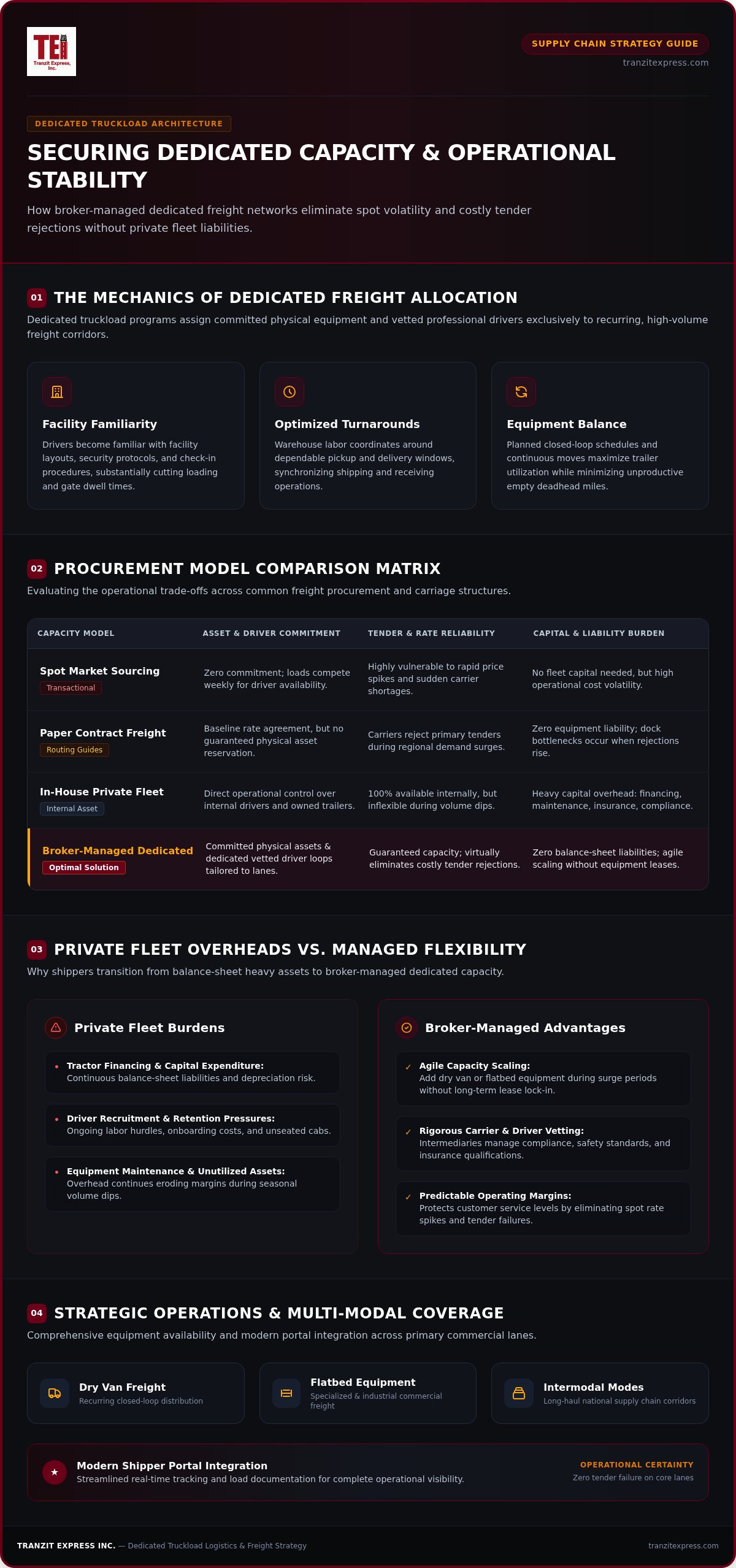
Dedicated freight programs function on predictable, closed-loop schedules. Vetted drivers and recurring trailers move across established commercial corridors, turning irregular transit into synchronized runs. This consistency delivers tangible dockside advantages:
- Facility familiarity: Drivers become familiar with your facility layout, security protocols, and check-in procedures, substantially cutting loading and gate dwell times.
- Optimized dock turnarounds: Warehouse operations run smoothly because shipping and receiving teams coordinate labor around dependable pickup and delivery windows.
- Efficient equipment balance: Planned round trips and continuous moves keep trailers utilized while minimizing unproductive empty miles.
Dedicated Capacity vs. Spot Market and Contract Freight
Freight procurement broadly splits into three models: spot market sourcing, paper contract freight, and dedicated partnerships. The spot market offers short-term agility for unplanned surges, but it leaves operating margins vulnerable to rapid pricing swings and carrier shortages.
Standard annual contract rates establish baseline expectations, yet they don’t guarantee 100 percent tender acceptance. When regional demand surges, carriers in standard routing guides frequently reject primary tenders to chase higher transactional returns elsewhere. Securing dedicated truckload capacity solves this vulnerability by pairing contracted volume commitments with guaranteed physical assets, ensuring your mission-critical freight moves without delay.
Comparing Capacity Models: Private Fleet vs. Broker-Managed Dedicated
When high-volume shippers evaluate transportation strategies, the conversation often narrows to an artificial choice: build an internal fleet or rely entirely on third-party carrier contracts. While an in-house fleet offers direct control, it introduces heavy capital commitments and operational risks. At the same time, dedicated contract carriage often binds businesses to rigid, multi-year minimums that don’t adjust when production cycles fluctuate. Broker-managed dedicated truckload capacity provides a balanced alternative, offering dependable asset commitment paired with true operational flexibility.
The Hidden Overheads of In-House Private Fleets
Operating a private fleet demands continuous administrative and capital investment. Shippers must manage tractor financing, maintenance schedules, insurance premiums, and commercial regulatory compliance. Recent U.S. Bureau of Labor Statistics truck transportation data illustrates ongoing labor pressures in commercial driving, making recruitment, onboarding, and retention constant operational hurdles. Whenever seasonal demand shifts or weekly volume dips, the overhead on unutilized tractors and unseated cabs continues to erode your bottom line.
The Strategic Flexibility of Broker-Managed Capacity
Broker-managed dedicated capacity delivers the consistency of a private fleet without the balance-sheet liabilities. Experienced freight intermediaries coordinate vetted motor carriers to establish dedicated loops tailored precisely to your recurring lane profiles. If you are curious about how these partnerships operate behind the scenes, exploring what does a freight broker do clarifies how intermediaries engineer continuous coverage.
This managed approach unlocks distinct operational advantages for shipping teams:
- Agile capacity scaling: Add dry van or flatbed equipment during surge periods without taking on long-term equipment leases.
- Carrier compliance protection: Your partner manages active motor carrier safety records, operating authorities, and insurance filings.
- Reduced administrative strain: Dispatch coordination, tracking updates, and exceptions are handled proactively, freeing internal staff to focus on production.
By securing dedicated truckload capacity through an experienced logistics provider, shippers gain contractual equipment availability while keeping their overhead light. If you are reviewing your primary freight lanes this quarter, partnering with an established team like Tranzit Express provides the steady coordination your network needs to maintain predictable velocity.
Operational and Financial Advantages for High-Volume Shippers
For high-volume distribution networks, operational consistency directly impacts profitability. When shipments arrive late, retailers issue steep chargeback fines, dock doors sit idle, and production schedules stall. Establishing dedicated truckload capacity transforms irregular logistics into a synchronized rhythm. Regular carrier appointments streamline warehouse loading, shorten facility dwell times, and protect customer relationships with dependable on-time delivery metrics.
Mitigating Freight Rate Volatility and Protecting Margins
Unpredictable rate fluctuations place immense pressure on transportation budgets. According to American Trucking Associations industry data, trucking moves the vast majority of domestic freight tonnage across a highly fragmented carrier market, leaving transactional spot users vulnerable to market swings. Implementing contracted dedicated truckload capacity eliminates these unexpected cost spikes.
With stable contracted lane rates, finance leaders can forecast transportation expenditures accurately without buffering for sudden spot surges. Internal logistics personnel also spend less time running daily spot load boards, allowing them to focus on broader supply chain improvements. For a deeper breakdown of cost-control workflows, our resource on logistics management for shippers outlines practical margin-protection strategies.
Equipment Flexibility: Van, Flatbed, and Intermodal Solutions
Dedicated capacity isn’t limited to a single trailer type. A comprehensive dedicated program accommodates diverse commodity requirements across multiple transport modes:
- Dry van networks: Shippers can establish dedicated enclosed trailer routes through the complete guide to van freight services to handle palletized, high-velocity consumer goods and retail products.
- Specialized open-deck freight: When moving heavy industrial machinery or oversized cargo, integrating flatbed freight services USA ensures qualified open-deck equipment is consistently staged for specialized loading.
- Rail-highway optimization: For balanced, long-haul freight corridors where cost efficiency is paramount, blending highway movements with intermodal transportation solutions delivers predictable transit times while optimizing overall spend.
How to Evaluate and Select a Dedicated Capacity Partner
Selecting the right logistics intermediary to manage your dedicated truckload capacity requires structured vetting beyond basic freight pricing. To protect your supply chain from service disruptions, follow a methodical five-step evaluation framework during provider onboarding:
- Analyze lane history and specs: Audit your recurring lane volume, seasonal volume surges, and distinct equipment parameters before initiating commitments.
- Scrutinize safety compliance: Review carrier safety metrics, operating authority verification methods, and active liability insurance coverage.
- Assess tracking technology: Ensure the provider offers direct shipper portal access for real-time freight tracking and digitized document retrieval.
- Evaluate partner longevity: Look for experienced freight intermediaries with a multi-decade track record of market stability and reliable service.
- Confirm contingency protocols: Clarify how the partner handles emergency rerouting or temporary capacity spikes when volume unexpectedly expands.
Essential Carrier Compliance and Safety Standards
Rigorous carrier vetting forms the foundation of risk mitigation in any dedicated freight program. Your partner must actively review motor carrier safety ratings, verify active operating authorities, and enforce commercial liability minimums. Drivers assigned to your recurring freight lanes must comply strictly with Department of Transportation Hours of Service mandates and federal safety clearinghouse requirements. Aligning with an experienced team that brings over 25 years of carrier vetting expertise shields your enterprise from compliance risks while keeping your cargo in safe hands.
Technology, Tracking, and Transparent Communication
Modern dedicated programs rely on seamless digital connectivity paired with responsive human dispatch. An intuitive shipper portal centralizes bills of lading, delivery confirmations, and invoicing, eliminating the administrative friction of scattered email threads. Automated status notifications keep warehouse coordinators updated on trailer arrivals so docks operate at peak efficiency. When weather delays or unexpected transit issues occur, seasoned dispatch specialists step in with immediate solutions rather than automated excuses.
If you are ready to stabilize your high-frequency distribution corridors with qualified motor carriers and clear operational visibility, partner with Tranzit Express to build a dedicated capacity strategy engineered around your operational schedule.
Building a Dependable Dedicated Strategy with Tranzit Express
Establishing dependable freight operations requires more than transactional load matching. It demands a steady, experienced partner who understands the high stakes of scheduled commercial shipping. Tranzit Express delivers structured, tailored solutions that provide reliable dedicated truckload capacity across primary national shipping lanes. Instead of forcing rigid corporate conversions or leaving your distribution network vulnerable to spot volatility, our team engineers dedicated freight programs designed around your distinct volume profile and scheduling needs.
Proven National Network Backed by 25 Years of Expertise
With over 25 years of logistics management and freight brokerage experience, Tranzit Express acts as a dependable extension of your internal logistics team. Decades of institutional knowledge allow us to anticipate market shifts, navigate disruptions, and maintain equipment commitments across major commercial corridors.
Our dedicated operations support a versatile range of transportation modes:
- Dry van freight: Enclosed, secure transportation for retail, packaged goods, and manufacturing components.
- Flatbed shipping: Open-deck solutions tailored for industrial equipment, construction materials, and specialized loads.
- Hot-shot loads: Rapid, dedicated transit for time-sensitive, mission-critical shipments requiring fast turnaround.
- Intermodal transport: Cost-effective long-haul rail integration that stabilizes continuous nationwide supply chains.
Every motor carrier in our national network passes thorough compliance vetting. We verify active operating authority, safety records, and insurance coverage before dispatch, ensuring that only qualified, professional drivers manage your freight.
Streamlined Implementation and Portal Visibility
Transitioning recurring lanes into a dedicated program is straightforward and organized. Our logistics specialists evaluate your historic lane frequency, volume rhythms, and facility requirements to stage qualified carriers on predictable loops. This consultative approach secures your needed capacity without the friction of complex organizational overhauls.
Operational visibility remains central throughout the life of the partnership. Through our centralized Shipper Portal, your logistics personnel gain immediate access to digital load tracking, bills of lading, and verified delivery receipts. Automated status milestones keep your team informed, while dedicated dispatch specialists coordinate daily transit details with responsive communication. You get the stability of an attentive partner and the precision of modern freight tracking.
Take the uncertainty out of your recurring shipping lanes. Begin building a stable, cost-controlled logistics network by contacting Tranzit Express Inc. to discuss your dedicated capacity requirements today.
Take Control of Your Core Lanes with Committed Freight Capacity
Unpredictable freight markets don’t have to dictate your supply chain performance or compromise operating margins. Securing dedicated truckload capacity provides the operational stability of a private fleet while eliminating equipment financing, maintenance overhead, and driver recruitment stress. By locking in vetted carriers and consistent schedules across recurring lanes, your distribution docks run on time and customer commitments stay protected.
Operational peace of mind comes from working with a team you can trust. Backed by over 25 years of nationwide freight brokerage experience, Tranzit Express protects your cargo through rigorous motor carrier safety vetting and centralized online shipper portal tracking. You maintain total visibility over load documentation and transit milestones while seasoned dispatch specialists ensure your equipment arrives as scheduled.
It’s time to replace spot-market uncertainty with steady, dependable execution. Partner with Tranzit Express Inc. to secure dependable dedicated truckload capacity and establish reliable freight routines across your core commercial corridors.
Frequently Asked Questions
What is dedicated truckload capacity in commercial freight shipping?
Dedicated truckload capacity is an operational arrangement where specific trailers, tractors, and qualified drivers are reserved exclusively for a shipper’s recurring freight lanes. Instead of securing trucks load by load on the spot market, dedicated capacity guarantees predictable equipment availability on fixed schedules. This protects high-volume distribution channels against capacity crunches, stabilizes transportation spending, and ensures reliable dock door timing.
When should a shipper transition from spot freight to dedicated capacity?
Shippers should consider transitioning when a freight corridor moves multiple loads per week on a predictable schedule. If tender rejection rates begin driving up costs, delaying retail deliveries, or congesting warehouse docks, the spot market is no longer efficient. Dedicated agreements provide guaranteed coverage, insulate your supply chain from sudden price spikes, and establish standardized appointment routines that keep loading facilities moving smoothly.
Can dedicated truckload capacity accommodate flatbed and specialized freight?
Yes, dedicated capacity extends across various freight modes beyond standard dry van trailers. High-volume industrial and construction shippers frequently establish dedicated programs for flatbed shipping, step-deck trailers, and hot-shot loads. Securing committed flatbed equipment ensures qualified drivers with proper securement expertise are consistently staged for your freight, preventing loading delays associated with specialized open-deck equipment shortages.
How does a broker-managed dedicated fleet differ from dedicated contract carriage?
Traditional dedicated contract carriage typically requires rigid multi-year agreements with asset carriers, locking you into fixed tractor commitments regardless of volume shifts. A broker-managed dedicated program curates qualified motor carriers specifically around your lane schedules without balance-sheet liabilities. You receive identical driver consistency and on-time performance while retaining the flexibility to scale trailer commitments up or down as market demands change.
What happens if our freight shipment volume fluctuates under a dedicated agreement?
Experienced freight partners build operational flexibility into dedicated service agreements to absorb seasonal peaks and unexpected production shifts. If volume surges unexpectedly, your logistics coordinator taps vetted surge capacity across identical lanes to maintain transit times. Conversely, if volume drops, broker-managed networks rebalance routes efficiently, ensuring you aren’t penalized by idle equipment costs or unseated fleet overhead.
How do freight brokers verify carrier compliance for dedicated logistics programs?
Professional brokers maintain rigorous compliance protocols to protect shipper cargo. This process includes continuous validation of active federal operating authority, commercial auto liability coverage, and safety rating scores. For dedicated freight lanes, intermediaries also verify driver safety records, commercial licensing status, and Department of Transportation Hours of Service compliance, ensuring only thoroughly vetted, qualified motor carriers represent your brand.
Is dedicated truckload capacity cost-effective for mid-sized commercial shippers?
Securing dedicated truckload capacity is often highly cost-effective for mid-sized shippers moving freight across consistent regional or national corridors. While private fleets require massive capital investment in tractors, maintenance, and insurance, dedicated freight programs eliminate those fixed liabilities entirely. Shippers gain predictable contracted pricing, avoid spot market rate volatility, and eliminate expensive late-delivery retailer chargebacks without inflating internal overhead.