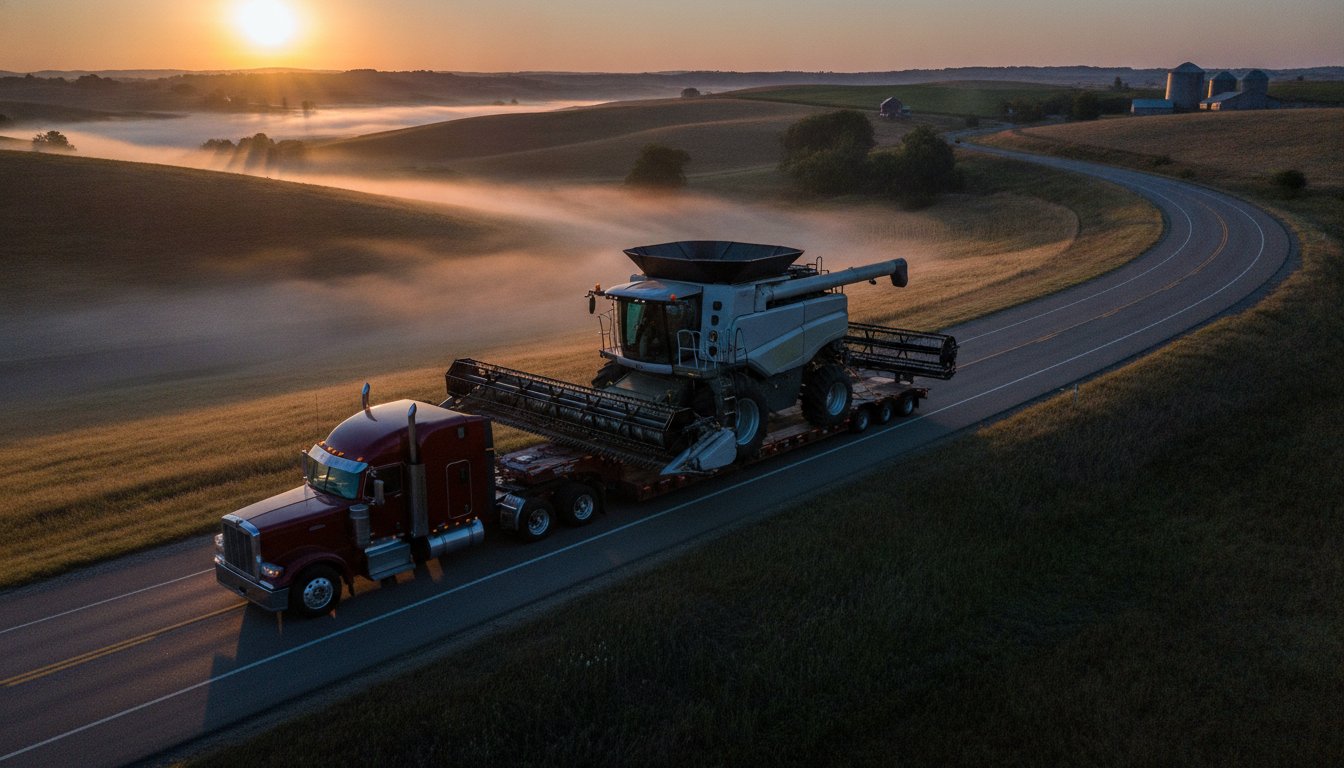
Imagine standing at the edge of a ready field in October, watching the weather turn while your new harvester sits on a trailer three states away because of a permit delay. It’s a scenario that keeps many producers awake at night, especially when agricultural equipment shipping involves more than just a truck and a trailer. Moving these massive assets requires a level of precision that standard freight simply doesn’t demand. You need a logistics plan that accounts for every inch of width and every dollar of your investment.
We understand that your machinery is the heartbeat of your operation, and the anxiety over potential damage or hidden escort fees is real. You deserve a process that’s as steady and reliable as the equipment you’re moving. This professional guide will show you how to master the complexities of national logistics by focusing on transparent pricing and proactive compliance. We’ll examine the 2026 regulatory landscape, including updated Section 232 tariff impacts and specific permit requirements, to ensure your next shipment arrives exactly when the soil is ready.
Key Takeaways
- Identify the most efficient transport modes for your machinery, from standard flatbeds to specialized Removable Gooseneck (RGN) trailers.
- Learn why rigorous carrier vetting is the foundation of secure agricultural equipment shipping, protecting your high-value assets from transit risks.
- Use a professional preparation checklist to ensure your equipment meets interstate agricultural inspection standards and is ready for open-deck transport.
- Understand the 2026 regulatory landscape to manage permit costs and avoid delays during critical planting and harvest windows.
- Discover the advantages of a long-term logistics partnership that prioritizes clear communication and a “steady hand” approach to national freight.
Navigating the Complexities of Agricultural Equipment Shipping
Agricultural equipment shipping is a highly specialized logistics field that extends far beyond the requirements of standard palletized freight. It demands a meticulous understanding of non-standard dimensions, complex weight distribution, and the specific state-by-state permits needed for interstate transit. High-value machinery, such as self-propelled sprayers and advanced combines, represents a massive capital investment for any farm or dealership. Moving these assets involves managing physical risks that could lead to structural damage or costly regulatory fines if handled by an unvetted carrier. Professional logistics providers don’t just book a truck; they engineer a transport plan that protects the integrity of the machine.
Understanding the High Stakes of Ag Logistics
In the agricultural sector, timing isn’t just a preference; it’s a requirement for survival. A shipping delay during the narrow window of a harvest can result in financial losses that ripple through an entire season. This is why effective logistics management for shippers is essential. It replaces the anxiety of uncertainty with a dependable framework designed for safety. Moving various types of agricultural equipment requires more than just a trailer. It demands a “steady hand at the wheel” to coordinate pilot cars, bridge weight limits, and specific route clearances. A professional freight broker acts as the vital bridge between your farm’s operational needs and the specialized carrier capacity required for these oversized moves.
Seasonal Demands and Capacity Challenges
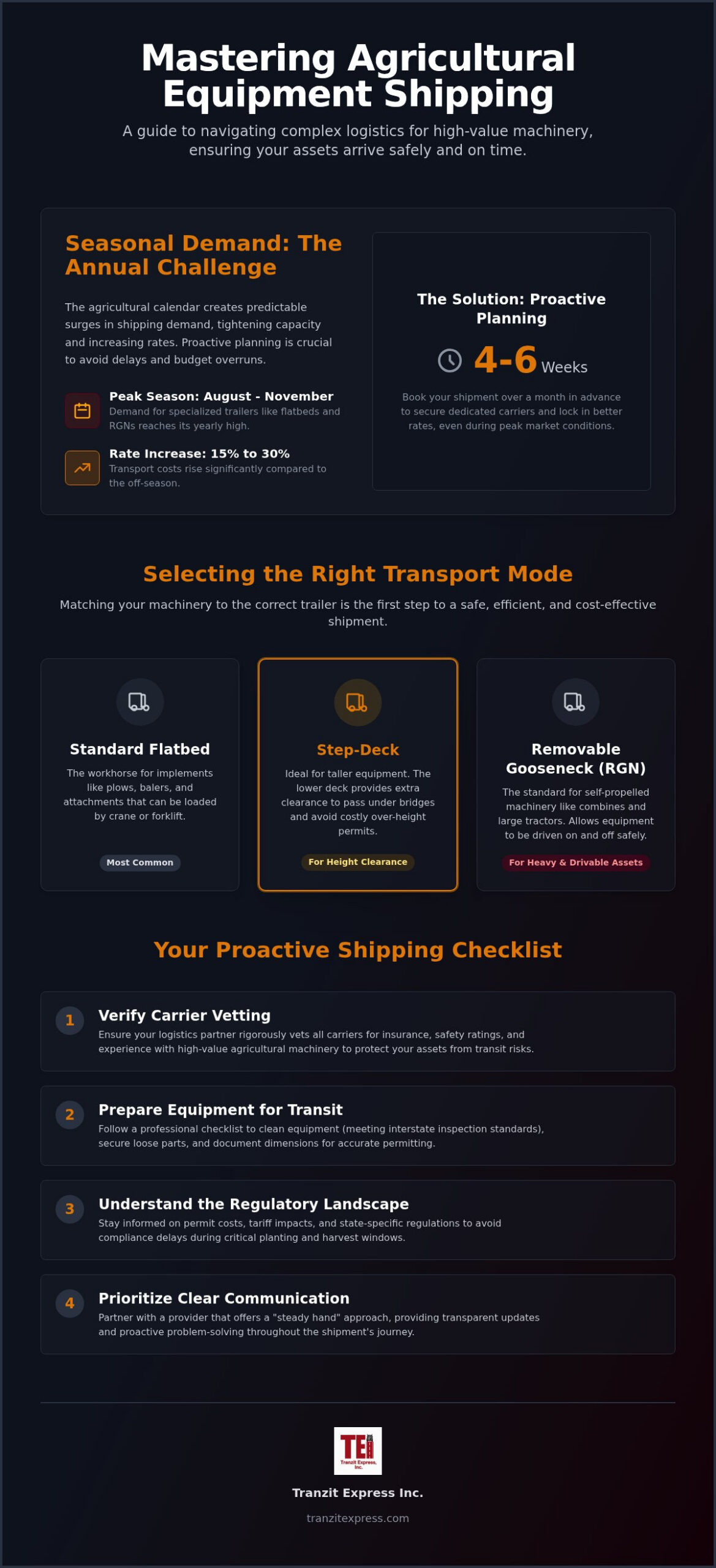
The agricultural calendar dictates the rhythm of the national logistics market. From August to November, the demand for flatbeds and RGN trailers reaches a predictable peak. Industry data shows that transport rates during these months often rise 15% to 30% compared to the winter off-season. This surge frequently leaves unprepared shippers struggling to find reliable trucks as capacity tightens across the country. We recommend pre-planning your agricultural equipment shipping needs at least four to six weeks in advance. This proactive approach allows a seasoned broker to secure dedicated equipment even when the market is at its most volatile. By locking in a carrier early, you avoid the stress of last-minute bookings. You ensure your machinery is on-site and operational before the first seed is planted or the first acre is harvested, maintaining the order your business depends on.
Selecting the Right Transport Mode for Farm Machinery
Successful agricultural equipment shipping begins with a precise match between the machine’s physical dimensions and the trailer’s technical capabilities. Choosing the wrong deck height or weight capacity doesn’t just inflate costs; it introduces unnecessary safety risks for high-value assets. Shippers must evaluate the trade-offs between speed, cost, and clearance requirements before committing to a specific transport mode. A “steady hand” approach involves verifying that every load sits at the optimal height to clear regional infrastructure while remaining within legal weight limits. Precise planning for agricultural equipment shipping helps avoid hidden costs and ensures a seamless delivery.
Flatbed and Specialized Open-Deck Solutions
Standard flatbed freight services USA are the primary choice for implements like plows or balers that can be loaded via forklift or crane. However, when height becomes a factor, step-deck trailers provide a lower center of gravity. This lower deck height allows taller equipment to clear bridges without the need for expensive over-height permits. For self-propelled machinery like combines or heavy tractors, a Removable Gooseneck (RGN) is the standard requirement. Its front-loading ramp allows equipment to be driven directly onto the trailer, providing a safer and more efficient loading process. Implementing Cost-effective shipping strategies often relies on these specific equipment choices to minimize permit fees and maximize transit efficiency across state lines.
Expedited Transport for Smaller Implements
While many logistics providers focus solely on massive machinery, smaller implements and attachments require a more tailored approach. For tractors or attachments weighing less than 20,000 pounds, expedited small-load transport is an excellent strategic choice. These smaller trailers offer a nimble alternative to full-sized flatbeds, often providing faster transit times for critical repair parts or small mowers that need to move between regional locations quickly. It’s a practical solution that ensures you aren’t paying for unused space on a 53-foot trailer. If you aren’t sure which trailer configuration is right for your specific move, you can consult with the experts at Tranzit Express Inc. to find a dependable solution.
The Critical Role of Carrier Vetting and Compliance
Vetting a carrier for agricultural equipment shipping requires more than a cursory glance at an Motor Carrier (MC) number. In 2026, the technical complexity and sheer scale of modern machinery mean that a single oversight can lead to roadside impoundment or an uninsured loss. A professional vetting process looks for specific experience in hauling oversized farm loads and ensures the carrier understands the unique securement points of high-value assets. This “reassuring standard” of a broker-managed program acts as a shield against the chaos of unvetted capacity. While some may question the service fee, the depth of risk mitigation provided by a veteran broker offers a level of security that a simple load board transaction cannot match.
Verifying Insurance and Safety Ratings
High-value combines and advanced sprayers often require cargo insurance limits that far exceed the standard $100,000 policy held by general freight carriers. We verify that every carrier in our network maintains coverage appropriate for the specific machinery being moved. Beyond insurance, we analyze FMCSA safety data to ensure a “steady hand” is behind the wheel. Understanding what does a freight broker do reveals the depth of this background work. We maintain active compliance files and monitor for recent violations or changes in safety ratings that could jeopardize your agricultural equipment shipping schedule. This methodical oversight ensures that only the most dependable professionals handle your investment.
Managing Oversize Permits and Escort Requirements
Moving wide agricultural loads across state lines is a regulatory jigsaw puzzle that changes at every border. Most farm equipment is classified as an oversized load when it exceeds 8.5 feet in width, 13.6 feet in height, or a gross weight of 80,000 pounds. Navigating these rules requires specific overweight or over-dimensional permits, which typically cost between $50 and $300 per state. If a load exceeds 14 feet in width, pilot car escorts become a legal necessity, adding an estimated $1.50 to $3.00 per mile to the total cost. A seasoned broker coordinates these moving parts by securing permits and scheduling escorts in advance. This proactive planning prevents costly roadside delays and ensures your machinery moves through every jurisdiction with organized professionalism.
Strategic Planning: Preparing Your Equipment for Transit
The success of agricultural equipment shipping depends heavily on the preparation performed before the trailer ever arrives at the farm. While a broker manages the routing and permits, the shipper maintains control over the physical state of the machinery. A methodical approach to preparation ensures that the load is safe for open-deck transport and compliant with strict interstate regulations. One often overlooked step is the thorough cleaning of all machinery. Removing soil and plant debris is essential to meet agricultural inspection standards, which are designed to prevent the spread of invasive species across state lines. A clean machine prevents unnecessary roadside inspections and demonstrates a professional standard of care.
Physical Preparation and Loading Safety
Preparing a machine for the road requires a focus on stability and protection. Shippers should secure or remove any loose parts, such as toolboxes or extra chains, that could shift during transit. Lowering headers and folding outriggers to their narrowest configuration is vital for staying within the dimensions specified on your permits. If your machinery features large glass surfaces, consider using protective covers to guard against road debris. Accurate measurements are the foundation of this process. Even a two-inch discrepancy can turn a legal load into a violation. Shipping height is the measurement from the ground to the highest point once loaded on the trailer. Verifying this figure before the driver departs ensures the load will safely clear every bridge on the assigned route.
Documentation and Logistics Coordination
Clear communication and organized paperwork act as the “steady hand” that guides a shipment to its destination. The Bill of Lading (BOL), state-specific permits, and insurance certificates must be accurate and readily available for the driver. Utilizing shipper portal logistics allows for the seamless sharing of these documents between the farm, the broker, and the carrier. This transparency reduces the risk of administrative delays at the point of loading. We also recommend providing the driver with detailed instructions for the loading and unloading sites, including any specific gate codes or terrain challenges. If you are ready to move your machinery with a partner who values this level of detail, you can request a freight quote today to begin your planning process.
Effective coordination involves a three-way dialogue. The broker confirms the carrier’s arrival time, the farm ensures the equipment is staged and ready, and the driver verifies the securement points. This structured flow of information minimizes downtime and keeps the focus on a safe, on-time delivery. By following these preparation steps, you reduce transit stress and ensure your equipment is ready for the field the moment it reaches its destination.
Partnering with a Seasoned Freight Broker for National Success
Mastering the logistics of heavy farm machinery requires more than just finding an available truck; it requires a collaborative relationship built on trust and proven results. In an industry where a single missed deadline can disrupt an entire planting cycle, the value of a professional partner cannot be overstated. Choosing a broker who specializes in agricultural equipment shipping means you’re gaining a “steady hand at the wheel” to manage the technical and regulatory hurdles that often stall less experienced providers. This partnership model shifts the focus from a simple transaction to a comprehensive logistics strategy designed for long-term operational security.
The Tranzit Express Advantage: 25 Years of Stability
With over 25 years of industry experience, Tranzit Express Inc. offers a level of institutional knowledge that provides immediate peace of mind. Over two decades of B2B logistics have taught us that every load is unique, requiring a custom approach to routing and equipment matching. Our national reach ensures that whether you’re moving a single tractor or an entire fleet of harvesters across state lines, you have access to a vetted network of specialized carriers. We prioritize a composed and dependable emotional style, avoiding the high-energy hype of modern startups in favor of the quiet confidence that comes from thousands of successful deliveries. This stability is the foundation of our service, ensuring that our clients feel secure throughout the entire transit process.
Streamlining Communication via Portals
One of the primary causes of stress in high-stakes logistics is the “black hole” feeling that occurs when communication breaks down. We address this directly by providing dedicated Shipper Portal Access, which centralizes tracking and documentation in one intuitive location. This technology doesn’t replace our commitment to personal service; rather, it enhances it by providing real-time transparency. You can verify the status of your agricultural equipment shipping at any time, ensuring that all parties stay informed from the initial pickup to the final delivery. Reliable communication reduces the administrative burden on your team and allows you to focus on your core farming operations with confidence.
Our methodical approach to national freight ensures that every detail, from permit coordination to final securement, is handled with professional precision. We don’t just move machinery; we provide a sense of order in a complex industry. If you are looking for a dependable partner to manage your next equipment move, the next step is simple. Request a reliable agricultural equipment shipping quote today and experience the difference that 25 years of expertise can make for your operation.
Securing Your Harvest with a Dependable Logistics Strategy
Success in agricultural equipment shipping isn’t found in the lowest rate, but in the precision of the plan. We’ve explored how selecting the correct transport mode and maintaining rigorous carrier vetting standards protect your machinery from unnecessary transit risks. From the initial cleaning of equipment to the final coordination of state-specific permits, every step requires a methodical approach that prioritizes safety over speed. This proactive preparation ensures that your equipment arrives ready for the field, exactly when the seasonal window opens.
Tranzit Express Inc. brings the “steady hand” you need for these complex national moves. With 25+ years of industry experience, our national open-deck specialists and A+ rated carrier network ensure your high-value assets are handled with consistent excellence. We treat every load as a high-level B2B partnership rather than a simple transaction. Our goal is to reduce your stress and provide a sense of order in a complex industry through institutional knowledge and reliable communication.
If you’re ready to move your fleet with a professional who values stability and clear communication, Request a Professional Agricultural Shipping Quote today. We look forward to helping you keep your operation moving forward with the confidence and security you deserve.
Frequently Asked Questions
Do I need special permits to ship a wide tractor across state lines?
Yes, you typically need oversized permits if your tractor exceeds 8.5 feet in width. These regulations vary significantly from state to state, so a separate permit is required for every jurisdiction the load traverses. As a national broker, we coordinate these legal requirements in advance to prevent roadside delays. Most permits for wide agricultural equipment shipping cost between $50 and $300 per state, depending on the specific dimensions and weight of your load.
How much insurance coverage is standard for agricultural equipment transport?
Standard cargo insurance for general freight is often $100,000, but this is frequently insufficient for modern agricultural machinery. High-value assets like combines or self-propelled sprayers often require specialized policies with much higher limits to ensure full protection. We verify that every carrier in our network carries coverage that matches the replacement value of your specific equipment. This verification process is a critical part of our professional vetting standards to protect your capital investment.
Can a freight broker handle the coordination of pilot cars and escorts?
Yes, coordinating pilot cars and escorts is a core part of our specialized logistics management services. When a load exceeds 14 feet in width, most states legally require escort vehicles to ensure public safety on narrow roads or bridges. We manage the scheduling of these third-party pilot services and integrate them into the primary transport plan. This comprehensive oversight ensures that the driver, the escorts, and the permits are all synchronized before the machinery leaves your farm.
What is the difference between an RGN and a standard flatbed for ag loads?
The primary difference lies in the loading process and the deck height of the trailer. A standard flatbed is a versatile trailer that requires a ramp, crane, or forklift for loading. In contrast, a Removable Gooseneck (RGN) trailer allows the front of the trailer to detach, creating a ramp so machinery can be driven directly onto the deck. RGNs also sit lower to the ground, which is essential for clearing bridges when shipping tall equipment.
How far in advance should I book shipping for harvest equipment?
We recommend booking your agricultural equipment shipping at least four to six weeks in advance, especially during the peak harvest window from August to November. National demand for flatbeds and RGN trailers spikes during these months, which can reduce available capacity. Planning ahead allows us to secure a dependable carrier and obtain all necessary permits without the stress of last-minute market volatility or higher seasonal rate increases that often occur during the busy season.
What happens if my equipment is damaged during national transit?
If damage is discovered, you must document the specific issues on the Bill of Lading (BOL) immediately upon delivery before the driver leaves the site. You should also take clear photographs of the machinery while it is still on the trailer to provide evidence for the claim. Our team then steps in to facilitate the claims process between you and the carrier’s insurance provider. We maintain detailed compliance files to ensure every carrier remains accountable for their results.
Are agricultural implements subject to specific cleaning requirements for transport?
Yes, thorough cleaning is essential for any machinery moving across state lines to prevent the spread of invasive species. Interstate agricultural inspection standards require equipment to be free of soil, seeds, and plant debris. Failure to clean your implements can result in significant delays or fines at state border checkpoints. We advise all shippers to pressure wash their machinery before the carrier arrives to ensure a smooth, compliant transit process that meets all national standards.
How does a hot shot load differ from a standard flatbed for farm machinery?
A hot shot load typically involves a medium-duty truck and a smaller trailer, making it ideal for loads under 20,000 pounds. Standard flatbeds use much larger Class 8 semi-trucks and are better suited for heavier machinery. Hot shot services often provide faster transit for smaller implements or critical repair parts because they are more nimble in regional traffic. This mode is a cost-effective alternative when you don’t need the full capacity of a 53-foot trailer.