
What if the most effective way to gain total control over your supply chain was to step away from the daily administrative burden of carrier vetting? In 2026, the logistics environment has become increasingly complex, with new USDOT identifier mandates and the suspension of de minimis thresholds adding layers of compliance to every shipment. For many shippers, the primary benefits of outsourcing freight management lie in transforming this complexity into a predictable, scalable asset. You likely already feel the strain of finding reliable capacity for specialized loads or the frustration of fragmented communication. Partnering with a seasoned expert allows you to shift those operational risks and high overhead costs onto a steady hand.
We understand that your goal isn’t just to move goods, but to do so with absolute certainty and order. This article explores how a strategic partnership provides you with immediate access to a vetted national network of specialized carriers, including van freight, flatbed, and hot-shot services. You’ll discover how integrated shipper portals provide the real-time visibility you’ve been missing while stabilizing your shipping costs against market volatility. This overview examines how a methodical approach to outsourced logistics creates a more resilient and professional operation for your business.
Key Takeaways
- Learn how transitioning from tactical shipping to strategic logistics oversight creates a more resilient and scalable supply chain.
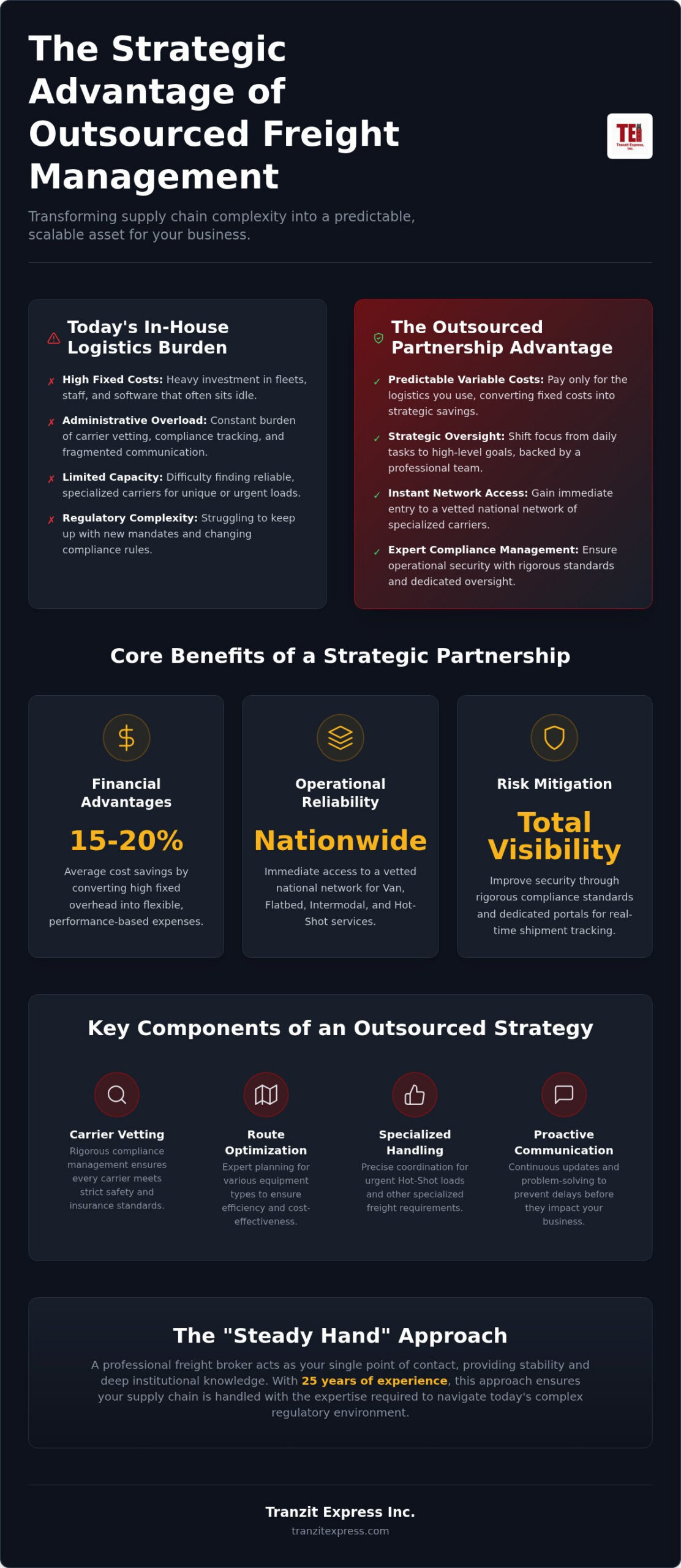
- Discover the primary financial benefits of outsourcing freight management, including the conversion of high fixed overhead into predictable, performance-based savings.
- Gain immediate access to a national network of specialized capacity, such as flatbed and intermodal services, without the administrative burden of carrier vetting.
- Improve operational security through rigorous compliance standards and dedicated portals that provide real-time visibility into every shipment.
- Understand why a “steady hand” approach backed by 25 years of experience offers the stability required to navigate today’s complex regulatory environment.
What is Outsourced Freight Management?
At its core, outsourced freight management is a collaborative B2B partnership where a business entrusts its shipping operations to a specialized logistics provider. This isn’t just about moving a single load from point A to point B. Instead, it represents a fundamental shift from tactical, day-to-day shipping tasks to high-level strategic oversight. Understanding What is Outsourced Freight Management? requires looking at how a logistics partner integrates with your existing business goals to provide stability. When you delegate these responsibilities, you’re not losing control; you’re gaining a professional ally that ensures your supply chain remains orderly and efficient.
A professional freight broker serves as the essential intermediary in this relationship. They provide the steady hand at the wheel that ensures your cargo moves without requiring you to manage dozens of individual carrier contracts. In 2026, national businesses are moving away from maintaining large, in-house logistics departments because the administrative burden of tracking regulatory changes and managing carrier relationships has become too heavy for most companies to handle alone. One of the primary benefits of outsourcing freight management is the ability to shed these internal stressors while maintaining a high standard of excellence.
The Role of a Professional Freight Broker
A professional broker acts as your single point of contact for a vast national network of carriers. They handle the exhaustive administrative oversight that usually bogs down in-house teams, including the management of complex documentation and real-time shipment tracking. This allows your team to focus on core business functions while the broker manages the full logistics lifecycle. The relationship between a broker and a shipper is a collaborative partnership designed to ensure long-term operational stability. By leveraging a provider with 25 years of experience, you ensure that your logistics process is handled with deep institutional knowledge.
Key Components of an Outsourced Strategy
A comprehensive outsourced strategy involves more than just booking trucks. It includes a structured approach to every phase of the shipment. Key components include:
- Carrier Vetting: Rigorous compliance management to ensure every driver meets safety and insurance standards.
- Route Optimization: Expert planning for various equipment types, including Van Freight Services, Flatbed Shipping, and Intermodal Transportation.
- Specialized Handling: Precise coordination for urgent Hot-Shot Loads that require immediate attention.
- Proactive Communication: Continuous updates and problem-solving to prevent delays before they impact your bottom line.
This methodical approach ensures that your freight moves through a streamlined process, reducing the risk of errors and providing you with a sense of security in a complex industry.
Financial Advantages: Converting Fixed Costs into Strategic Savings
Maintaining an internal logistics department requires a heavy investment in infrastructure that often remains underutilized. For many organizations, the benefits of outsourcing freight management become clear when they analyze the sheer volume of fixed costs tied to private fleets and in-house staff. By transitioning to a managed model, you convert these rigid expenses into flexible, usage-based variable costs. Industry research indicates that shippers typically achieve average cost savings of 15 to 20 percent by leveraging the expertise and carrier relationships of a third-party provider. This shift allows you to pay only for the capacity you use, rather than maintaining assets that sit idle during market lulls.
Beyond the obvious line items, hidden costs often drain a company’s resources. These include expensive software licenses for transportation management systems, ongoing training for regulatory compliance, and high insurance premiums. When you partner with a seasoned broker, these expenses are absorbed into a professional shared infrastructure. This shared model significantly reduces the per-load administrative costs for your business, providing a more economical path to high-level logistics. It’s a methodical way to achieve a leaner operation without sacrificing the quality or safety of your shipping.
Reducing Administrative and Labor Overhead
Building a dedicated logistics team involves significant recruitment and retention costs. Salaries, benefits, and the time required to manage an entire department can distract from your core business objectives. Outsourcing eliminates the need for this internal labor overhead entirely. Instead of managing a payroll for dispatchers and procurement specialists, you gain access to a team with 25 years of industry experience. This partnership provides the stability of a steady hand at the wheel while lowering the overall cost of carrier procurement. If you’re looking to streamline your financial operations, you can explore our shipper solutions to see how professional management simplifies your budget.
Scalability During Peak Seasons
Market volatility and seasonal surges often force in-house departments into a cycle of reactive hiring or equipment leasing. These temporary solutions are rarely cost-effective and often lead to inconsistent service levels. A strategic logistics partner allows you to handle these surges with ease. You can access additional capacity through a national network without the need for capital investment or temporary staff. This scalability is particularly valuable when expanding into new regions. It allows you to test new markets without the financial risk of establishing a local footprint or purchasing new equipment. Avoiding the cost of idle equipment during slow periods ensures your capital remains available for other strategic priorities.
Enhancing Operational Reliability for Specialized Shipments
Managing specialized equipment requires a level of oversight that many in-house departments struggle to maintain. One of the key benefits of outsourcing freight management is gaining immediate access to a diversified national carrier pool without the administrative burden of individual carrier vetting. It’s about ensuring your cargo is always matched with the correct equipment, whether you need standard van freight or complex multi-modal routing. By leveraging professional logistics management for shippers, you gain a partner who understands the nuances of complex routing and on-time delivery requirements.
When you consider the benefits of outsourcing freight management, the ability to maintain high service standards for specialized cargo stands out as a primary driver for long-term partnership. It provides a sense of order in an industry where specialized capacity is often difficult to secure reliably.
Managing Van and Flatbed Freight with Ease
Choosing between a standard trailer and open-deck equipment involves more than just looking at the dimensions of the cargo. It requires a deep understanding of weight distribution, securement protocols, and safety compliance. Flatbed shipping specifically demands a higher level of driver expertise to ensure that open-deck loads remain secure throughout the journey. Without a steady hand at the wheel, these loads can quickly become a liability due to shifting regulations and the physical demands of the cargo. Our guide to flatbed freight services USA provides a comprehensive look at how we manage these specialized requirements. A professional broker ensures that every carrier in the network meets these rigorous standards, providing you with a sense of security for your most challenging shipments.
The Strategic Use of Hot-Shot and Intermodal Solutions
Efficiency in 2026 often depends on using the right mode of transport for the specific distance and deadline. For time-sensitive, smaller loads that can’t wait for a full truckload, hot shot trucking offers a nimble solution that bypasses the delays of traditional hubs. Conversely, intermodal transportation solutions provide a cost-effective way to handle long-haul shipping by combining rail and road transport.
A methodical broker acts as a supportive guide, helping you navigate the transition between rail and road without the typical logistical headaches. This mode optimization offers several operational advantages:
- Mode Neutrality: Selecting the best path based on cost and speed rather than equipment availability.
- Reliable Capacity: Tapping into rail networks when road capacity tightens during peak seasons.
- Reduced Stress: Handling the complex hand-offs between different transportation modes with deep institutional knowledge.
This level of strategic coordination transforms logistics from a source of daily friction into a streamlined, professional process that supports your long-term growth.
Mitigating Risk through Compliance and Visibility
Security in logistics is not merely about locking a trailer; it is about the methodical verification of every partner in your supply chain. One of the critical benefits of outsourcing freight management is the transfer of liability and vetting responsibility to an expert who maintains a constant watch on regulatory changes. In 2026, the shift to USDOT numbers as the primary carrier identifier has streamlined compliance monitoring, but it still requires dedicated oversight to prevent fraud. A professional broker ensures that every shipment is handled by a carrier that meets high safety and insurance standards, reducing the likelihood of cargo theft or damage.
Real-time visibility has evolved from a luxury into a standard requirement for maintaining an orderly operation. Without the right technology, shippers often feel a loss of control once a load leaves the dock. By leveraging a broker’s established infrastructure, you gain access to sophisticated tracking tools without the high cost of purchasing and maintaining in-house software. This transparency restores confidence, allowing you to provide accurate updates to your own customers while maintaining a sense of order in a complex industry.
Carrier Compliance and Vetting Standards
The vetting process involves a deep dive into a carrier’s motor carrier authority, current safety ratings, and specific insurance limits. We maintain a rigorous, up-to-date database of qualified carriers who have proven their reliability over time. A broker protects shippers from the legal and financial liability of inadvertently using non-compliant or under-insured carriers through continuous monitoring of their credentials. This proactive approach ensures that your cargo is never at risk due to administrative oversight or expired documentation. It provides the peace of mind that comes from knowing a seasoned veteran is managing the details.
The Power of Shipper and Carrier Portals
Centralized digital platforms have fundamentally changed how communication flows between shippers and brokers. Dedicated Shipper Portal Access allows you to view real-time tracking, request rate quotes, and retrieve historical data with a few clicks. This 24/7 access to shipment documentation ensures that you are never left in the dark regarding the status of your freight. Instead of making multiple phone calls to track a single load, you can see the entire process through a single, transparent interface. This level of digital orchestration ensures that communication remains clear and purposeful at every stage. If you are ready to gain better visibility into your operations, you can access our shipper portal solutions to begin streamlining your logistics today.
Choosing a Long-Term Logistics Partner: The Tranzit Express Advantage
Picking a logistics partner is one of the most consequential decisions a supply chain manager makes. While many modern startups promise disruption through unproven algorithms, there’s no substitute for the quiet confidence of a seasoned industry veteran. One of the greatest benefits of outsourcing freight management is the peace of mind that comes from a steady hand at the wheel. Tranzit Express Inc. brings 25 years of institutional knowledge to every shipment, ensuring that your operations remain orderly even when the market becomes volatile. We prioritize reliable communication over marketing hype, focusing on the fulfillment of promises rather than flashy trends.
The transition from an in-house logistics department to a trusted B2B partnership is a methodical process. It isn’t about giving up control. It’s about gaining a professional ally who understands the weight of your commitments. By shifting the administrative burden to our team, you free your internal resources to focus on growth and product development. This collaborative approach ensures that your supply chain isn’t just a cost center, but a strategic asset that supports your long-term business goals.
Experience as a Foundation for Trust
Institutional knowledge is the silent engine that keeps a supply chain moving during a disruption. When a route is blocked or capacity suddenly tightens, experience allows a broker to find a solution before the delay impacts your bottom line. Many shippers have grown weary of flashy technology that lacks the human expertise to handle real-world problems. Stability matters more than unproven software. Understanding what a freight broker does involves recognizing that they act as your advocate, risk manager, and problem-solver. We’ve spent over two decades refining our processes to ensure that every load is handled with a high standard of excellence and a sense of professional order.
A Dependable National Network
A dependable national network ensures you never have to worry about finding reliable capacity, regardless of the load type. Whether you’re moving standard van freight or need the specific requirements of flatbed or hot-shot loads, you need a partner who understands the equipment. We’ve spent 25 years building relationships with a vetted carrier pool across the United States. This consistency is a core value that translates directly into on-time delivery for your customers. We don’t just find a truck; we find the right truck for your specific cargo needs. If you’re ready to experience the ease of a professional partnership, we invite you to request a quote and see how a steady hand can streamline your logistics.
Building a Resilient Logistics Partnership
The transition to a managed transportation model is a strategic move that provides your business with a sense of order in an increasingly complex industry. By converting high fixed overhead into flexible variable costs and gaining immediate access to a national network of specialized carriers, you position your organization for sustainable growth. The benefits of outsourcing freight management extend from rigorous carrier compliance to the real-time transparency provided by dedicated shipper portals.
With 25+ years of industry-leading experience, Tranzit Express Inc. acts as the steady hand at the wheel, ensuring your van, flatbed, and intermodal shipments are handled with deep institutional knowledge. Our national carrier network coverage and centralized portals are designed to reduce your stress and provide a seamless logistical experience. If you’re ready to move away from administrative burdens and toward professional stability, we invite you to Request a Reliable Freight Quote from Tranzit Express Inc. today. We look forward to becoming the dependable partner your business deserves.
Frequently Asked Questions
What are the main benefits of outsourcing freight management?
Reducing overhead, mitigating risk, and accessing specialized capacity are the primary advantages. The benefits of outsourcing freight management include converting high fixed administrative costs into variable expenses that scale with your volume. This partnership provides a steady hand to manage carrier vetting and shipment tracking. By leveraging a broker’s established network, you gain the stability needed to navigate market fluctuations without the stress of managing an in-house logistics department.
How much can a company save by outsourcing logistics?
Shippers typically see average cost savings between 15% and 20% when they transition to a managed logistics model. These savings come from eliminating the salaries, benefits, and training costs associated with a full in-house team. You also avoid the capital investment required for private fleets or expensive transportation software. By utilizing a broker’s economies of scale, you secure more competitive rates that are often unavailable to individual shippers managing their own procurement.
Does outsourcing freight management mean I lose control over my shipments?
Outsourcing actually increases your control by providing better visibility and data than most in-house departments can maintain. You don’t lose oversight; you gain a dedicated professional who handles the tactical execution while you focus on strategic decisions. Through dedicated shipper portals, you have 24/7 access to real-time tracking, documentation, and historical spend data. This transparency ensures you’re always informed about your cargo’s status without being bogged down by manual tracking tasks.
How does a freight broker ensure carrier compliance?
A professional broker uses a methodical vetting process to verify motor carrier authority, safety ratings, and insurance limits. In 2026, this involves monitoring the new USDOT primary identifier system to reduce fraud and ensure compliance. We maintain an up-to-date database of qualified carriers, protecting you from the liability of using non-compliant drivers. This rigorous oversight ensures every load meets high safety standards, providing a level of security that’s difficult to replicate in-house.
What is the difference between a 3PL and a freight broker?
While the terms are often used interchangeably, a freight broker specifically acts as the intermediary between a shipper and a carrier to move goods. A 3PL often provides a broader range of supply chain services, though many brokers, like Tranzit Express, offers comprehensive logistics management. We focus on matching your specific cargo with the right equipment while providing administrative oversight. Our goal is to provide a reliable partnership that simplifies the movement of van, flatbed, or intermodal freight.
Can an outsourced provider handle specialized freight like hot-shot or flatbed loads?
Yes, an experienced provider with deep institutional knowledge is often better equipped to handle specialized loads than an in-house team. We manage the unique requirements of flatbed shipping, ensuring proper securement and safety compliance for open-deck cargo. For time-sensitive shipments, we coordinate hot-shot loads using a national network of nimble carriers. This specialized expertise ensures that even your most complex shipments are handled with the same professional order as standard van freight.
What technology should I expect when outsourcing my freight?
You should expect centralized digital platforms that streamline communication and provide real-time transparency. This includes dedicated shipper and carrier portals where you can request quotes, track shipments, and access documentation. Modern logistics management also utilizes data-driven orchestration and AI-enhanced telematics to optimize routes and predict potential delays. These tools provide a sense of order in a complex industry, allowing you to manage your supply chain with the quiet confidence of a veteran.
Is outsourcing logistics suitable for small to mid-sized businesses?
Small to mid-sized businesses often gain the most from the benefits of outsourcing freight management. It allows smaller organizations to access the same national carrier networks and sophisticated technology as large corporations without the massive upfront investment. This level playing field enables SMBs to scale their operations efficiently and enter new markets with confidence. A trusted logistics partner provides the steady hand necessary for smaller teams to manage growth without being overwhelmed by administrative overhead.