Could a simple misunderstanding of industry titles be the primary reason your supply chain costs are climbing? Many shippers assume these roles are interchangeable, but choosing between a freight broker vs freight forwarder can be the difference between a seamless delivery and a logistical headache. In an environment where diesel prices have reached $5.45 per gallon and FMCSA regulations have tightened around financial security, the stakes for your national shipping have never been higher.
It’s frustrating to manage multiple carriers while worrying about cargo damage or the risk of late deliveries. You deserve a shipping process that prioritizes reliability and clear communication over empty promises. This guide will clear the confusion by explaining how these partners differ in liability, asset management, and tactical agility. We’ll examine the legal distinctions and practical benefits of each so you can choose a partner that offers lower rates through better negotiation and a steady hand at the wheel for your domestic freight. By the end, you’ll have the clarity needed to build a dependable, long term partnership that brings order to your 2026 logistics strategy.
Key Takeaways
- Distinguish the legal and operational roles of a freight broker vs freight forwarder to align your logistics strategy with the right level of liability and cargo oversight.
- Identify why domestic shipments requiring specialized equipment, such as flatbeds or hot-shot loads, are best served by the tactical agility of a freight broker.
- Learn how a vetted carrier network and a “steady hand” approach can protect your supply chain from hidden costs and the risks of cargo damage.
- Discover how leveraging decades of industry expertise and transparent portal technology can streamline your communication and lower freight rates through professional negotiation.
Defining the Roles: What Is a Freight Broker vs. Freight Forwarder?
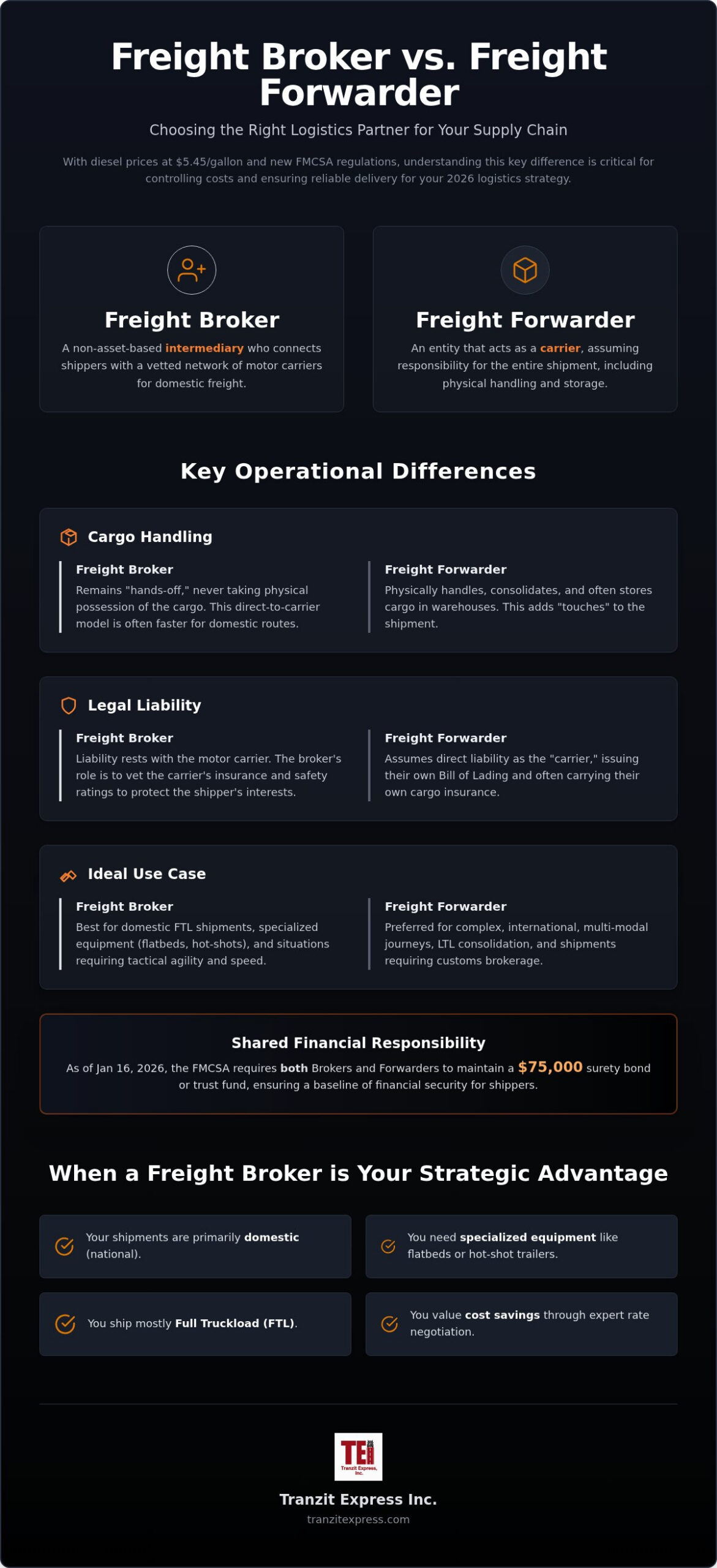
Understanding the fundamental differences in Freight company roles is the first step toward a more efficient supply chain. At its heart, the debate of freight broker vs freight forwarder isn’t about which is “better,” but which fits your specific operational needs. A broker acts as a specialized intermediary, using deep industry knowledge to match your freight with the most reliable motor carriers. Conversely, a forwarder manages the entire logistics chain, often including the physical handling and storage of goods. Both roles are essential, yet they serve very different purposes in the movement of cargo.
For your 2026 logistics budget, this distinction is vital. With national average diesel fuel prices reaching $5.45 per gallon as of August 2026, every decision impacts your bottom line. Choosing the wrong partner can lead to hidden costs or liability gaps that disrupt your cash flow. By identifying which professional aligns with your goals, you can secure a more predictable and cost-effective shipping process.
The Core Responsibilities of a Freight Broker
Freight brokers are non-asset-based professionals who focus on domestic logistics. They facilitate the relationship between you and a vetted motor carrier without ever taking physical possession of your cargo. Their value lies in tactical agility. They oversee the movement of goods, negotiate competitive rates, and ensure carrier compliance with federal rules, such as the 2026 FMCSA financial responsibility requirements. This approach is particularly effective for specialized needs like flatbed freight services USA, where routing expertise is essential. Brokers act as a steady hand, managing the details of the shipment while you maintain control over the broader supply chain.
The Core Responsibilities of a Freight Forwarder
A freight forwarder takes a different approach by acting as both the shipper to the carrier and the carrier to the customer. They often provide warehousing and consolidation, meaning they physically handle your cargo. Forwarders are typically the preferred choice for complex, multi-modal international journeys. They manage the heavy lifting of international customs brokerage and specialized documentation. While they provide a comprehensive solution, the added layers of service often come with a higher price point compared to the streamlined domestic focus of a broker. Because they often issue their own Bill of Lading, they assume a higher degree of legal liability for the goods in their possession.
Key Differences in Legal Liability and Cargo Handling
While basic definitions separate these two roles, the legal and physical realities are where the choice of freight broker vs freight forwarder truly impacts your risk management. Forwarders typically issue their own Bill of Lading, positioning themselves as the “carrier” in the eyes of the law. This means they assume direct liability for the cargo while it’s in their network. Brokers, however, facilitate the contract between you and the actual motor carrier. Under the FMCSA financial responsibility rule that took effect on January 16, 2026, both entities must maintain a $75,000 surety bond or trust fund. This regulation ensures a baseline of financial security, yet the path to recovering losses differs based on who holds the paperwork.
Cargo handling also varies significantly between the two. Brokers remain “hands-off,” focusing on the logistical coordination of Full Truckload (FTL) shipments. This direct-to-carrier model is often faster for domestic routes because it eliminates extra stops. Forwarders frequently use warehouses to consolidate smaller loads, which is helpful for international Less Than Truckload (LTL) freight but adds more “touches” to your cargo. If your shipment requires specialized domestic equipment like flatbeds or hot-shot trailers, a broker’s ability to source specific assets quickly is a distinct advantage.
Who Is Liable for Your Cargo?
When you partner with a broker, the primary protection for your goods comes from the motor carrier’s insurance policy. A seasoned broker acts as a steady hand by vetting these policies to ensure they’re active and sufficient for your specific load. Forwarders may carry their own cargo insurance since they take physical possession of the goods. A broker’s primary responsibility is to meticulously verify carrier insurance and safety ratings to safeguard your interests before the wheels ever turn. This level of oversight provides a sense of security that is essential in a high-stakes industry.
Physical Involvement and Consolidation
Brokers are the preferred choice for domestic shipments that require speed and specialized routing. Because brokers don’t stop to consolidate freight in a central hub, the transit time is usually shorter and more predictable. Forwarders rely on a “hub-and-spoke” model. This is efficient for international consolidation but can introduce delays in a purely national context. If your priority is a streamlined domestic move, a broker provides the tactical agility to source equipment without the complexity of a warehouse stay. You can track these movements with ease through our Shipper Portal Access, ensuring total transparency throughout the journey.
When to Choose a Freight Broker for National Shipping
If your supply chain operates primarily within the United States, the decision between a freight broker vs freight forwarder often leans toward the broker for tactical reasons. Brokers provide a level of “on-demand” capacity that is difficult for asset-heavy forwarders to maintain. Because they aren’t limited by their own fleet or warehouse locations, they can pivot quickly to meet shifting demands. This agility is essential when you face tightening capacity or sudden spikes in load-to-truck ratios, which reached a national average of 9.61 for vans in August 2026. Choosing a broker allows you to tap into a wider pool of equipment without being tethered to a single carrier’s availability.
The Advantage of Domestic Agility
A broker’s strength lies in their ability to source specialized equipment exactly when you need it. Whether you require refrigerated units for sensitive cargo or hot-shot loads for time-critical deliveries, a broker taps into a national network of vetted motor carriers. This model is why van freight services are most efficiently managed through a brokerage. You aren’t waiting for a specific company truck to become available; instead, you’re accessing the best available driver currently in your lane. This approach reduces wait times and keeps your cargo moving without the unnecessary delays often found in rigid asset-based models.
Navigating Complex Domestic Routing
It’s a common misconception that brokers only handle simple point-to-point shipments. In reality, a seasoned partner provides comprehensive logistics management for shippers that includes complex project coordination. This often involves arranging intermodal transportation solutions to balance cost and speed across rail and road networks. Coordinating multiple carriers for a single project requires a steady hand and constant communication, tasks that are streamlined through professional brokerage tools. Our experience ensures that even the most intricate domestic routes are handled with the quiet confidence of an industry veteran.
Transparency shouldn’t be a luxury in modern logistics. A reliable broker provides a dedicated shipper portal, allowing you to access real-time tracking and digital documentation at any hour. This level of visibility reduces the stress of managing national shipping and ensures that every stakeholder remains informed. By leveraging a broker’s massive network and technological infrastructure, you achieve a level of efficiency that protects your 2026 budget from the rising operational costs, such as the $5.45 per gallon diesel average, currently challenging the industry. This partnership focuses on long-term reliability, ensuring your promises to your own customers are always kept.
Debunking the ‘Middleman’ Myth: How Brokers Add Value
A common misconception in the freight broker vs freight forwarder debate is the idea that brokers are simply “middlemen” who add unnecessary costs. This perspective overlooks the significant infrastructure required to maintain a secure and efficient supply chain. In reality, a professional broker acts as a shield for your business. We provide a vetted network of motor carriers, which is essential for reducing the risk of fraud or “double brokering” in an increasingly complex market. By leveraging volume-based negotiation, a broker often secures rates that an individual shipper could not access alone. This collaborative approach turns a simple transaction into a long term partnership built on trust and results.
Administrative relief is another critical benefit that seasoned brokers provide. We manage the entire lifecycle of a shipment, from carrier compliance and insurance verification to final payment and paperwork. This allows your team to stay focused on core operations rather than getting bogged down in the minutiae of carrier management. With over 25 years of experience, Tranzit Express provides the “steady hand” necessary to navigate the unexpected challenges of the road with quiet confidence.
The Hidden Costs of ‘Going Direct’
Attempting to manage carriers directly often reveals hidden expenses that far outweigh a broker’s service fee. The time cost of vetting hundreds of individual carriers for active insurance and high safety ratings is immense. Without a dedicated partner, you also face a higher risk of cargo theft or abandonment when working with unvetted “one-truck” operations. Considering the FMCSA recorded over 1,200 non-payment complaints against brokers in 2023, the value of a financially stable partner with a proven bond is clear. A broker’s role is essentially a form of logistics insurance that provides peace of mind for your national shipping needs.
Carrier Compliance and Safety Standards
Professional brokers don’t just find trucks; they monitor carrier safety scores and insurance renewals daily. It’s vital to have a partner who understands what does a freight broker do to protect your brand from the liabilities of non-compliant carriers. This constant oversight ensures that every driver hauling your freight meets the highest industry standards for excellence and consistency. A broker’s true product is reliability, not just a truck. To see how our vetted network can bring order to your logistics, you can explore our Shipper Portal Access for total transparency.
Choosing Tranzit Express as Your Reassuring Logistics Partner
When you’re finalizing the choice between a freight broker vs freight forwarder for your 2026 logistics plan, the decision ultimately rests on who can best protect your supply chain. Tranzit Express Inc. brings more than 25 years of industry experience to every shipment we manage. We’ve seen the market shift through various regulatory cycles and economic climates, and we’ve remained a constant, dependable partner for businesses across the nation. Our focus isn’t on marketing hype; it’s on the quiet, methodical fulfillment of the promises you make to your customers. We provide the stability you need in an industry that’s often characterized by volatility and complexity.
We offer a comprehensive suite of domestic solutions designed to meet the specific demands of modern commerce. Whether your cargo requires standard Van Freight Services or specialized flatbed freight services USA, our team coordinates every detail with precision. We also manage Intermodal Transportation and Hot-Shot Loads, ensuring that you always have the right equipment for the job. Our national network of vetted motor carriers is the result of decades spent building professional relationships based on mutual respect and consistent results.
A Steady Hand at the Wheel
Our long term carrier relationships are the foundation of the service we provide to our shippers. Because we work with a vetted network of professionals, we can offer a level of reliability that asset-heavy forwarders often struggle to match during peak seasons. We focus on reducing the daily stress of logistics by acting as your dedicated representative on the road. The Tranzit Express promise is simple: we provide a dependable, results-oriented approach that brings order to your shipping process. You can rely on our institutional knowledge to navigate challenges before they become disruptions, keeping your budget on track and your cargo moving forward.
Get Your National Freight Moving Today
Transparency is a core value of our partnership model. Through our dedicated Shipper Portal Access, you can monitor your shipments in real time and access all necessary documentation with a few clicks. This technology, combined with our specialized hot shot trucking expertise, ensures that even your most urgent loads are handled with care. If you’re ready to experience the difference that a veteran “steady hand” makes, our streamlined online portal makes it easy to request a quote and start the process.
Don’t let the complexities of the freight market slow your business down. Choose a partner that values clear communication and proven excellence above all else. Partner with Tranzit Express Inc. for your next shipment and discover how our 25+ years of experience can help you achieve a more efficient, cost-effective domestic supply chain.
Securing Your Supply Chain for 2026 and Beyond
Choosing between a freight broker vs freight forwarder is a strategic decision that defines the long-term efficiency of your domestic supply chain. While forwarders offer broad international solutions, a broker provides the tactical flexibility and specialized equipment necessary for national success. By leveraging a broker’s vetted network, you minimize the risk of fraud and ensure every shipment meets rigorous safety and compliance standards.
Tranzit Express Inc. brings over 25 years of industry-leading experience to your logistics strategy. Our national network of vetted carriers and specialized expertise in flatbed and hot-shot routing ensure your freight is managed with the quiet confidence of a veteran. We prioritize clear communication and dependable results to reduce your operational stress and bring order to complex lanes.
Ready to streamline your shipping process with a partner you can trust? Request a Dependable Freight Quote from Tranzit Express today to secure your cargo’s future. We’re here to help your business reach its destination with excellence and consistency.
Frequently Asked Questions
Is a freight broker more expensive than a freight forwarder?
Brokers are typically more cost-efficient for domestic full truckload shipments. Because they don’t maintain physical warehouses or handle international customs, their overhead is lower. You pay for the logistical coordination and the carrier’s rate, often benefiting from the broker’s volume-based negotiation power. This makes the freight broker vs freight forwarder choice clear for businesses looking to maximize their national shipping budget without paying for unused global services.
Can a freight broker handle international shipments?
Most freight brokers specialize in domestic transportation within the United States. While forwarders are designed for complex international journeys involving air or ocean freight, brokers focus on the tactical agility of road and rail networks. Tranzit Express prioritizes national excellence, ensuring that your van, flatbed, or hot-shot loads stay on schedule across the country. We provide a steady hand for domestic routes where forwarders might introduce unnecessary complexity.
Do freight brokers own their own trucks and equipment?
Freight brokers are non-asset-based, meaning they don’t own the trucks or trailers used for transport. Instead, they act as a professional intermediary, matching your cargo with a qualified motor carrier from their vetted network. This model offers you greater flexibility and “on-demand” capacity. You aren’t limited by a single company’s fleet availability, which is crucial when national load-to-truck ratios tighten as they did in August 2026.
What happens if my cargo is damaged during a brokered shipment?
If damage occurs, the motor carrier’s insurance is the primary protection for your goods. A dependable broker plays a vital role by verifying that every carrier in their network maintains active, sufficient cargo insurance before the load is assigned. Should a claim arise, your broker provides administrative support and guidance to resolve the issue with the carrier. This oversight ensures a sense of security and order when things go wrong on the road.
How do I know if a freight broker is legitimate and bonded?
You can verify a broker’s legitimacy through the Federal Motor Carrier Safety Administration (FMCSA) database. Every legitimate broker must maintain a $75,000 surety bond or trust fund under the rules that went into effect on January 16, 2026. This financial security protects shippers and carriers alike. A professional partner will always be transparent about their MC number and bonding status to provide the reassurance you need for a long-term partnership.
Why should I use a broker instead of calling a carrier directly?
Using a broker saves you the significant time and risk associated with vetting individual carriers. A broker manages insurance renewals, safety scores, and payment terms, allowing you to focus on your core business. We leverage a massive carrier network to find the best rates and equipment, such as specialized flatbeds or hot-shot trailers. This administrative relief and professional negotiation often result in a more reliable and cost-effective shipping process than going direct.
What is the role of a Bill of Lading in a brokerage transaction?
The Bill of Lading (BOL) serves as the legal contract of carriage and a receipt for your goods. In a brokerage transaction, the BOL is typically issued by the motor carrier, though the broker ensures all details are accurate and documented. This document is essential for tracking and liability purposes. It outlines the destination, cargo description, and shipping terms, providing a clear paper trail that ensures order and accountability throughout the domestic journey.
How does intermodal transportation work with a freight broker?
Intermodal transportation involves moving freight using multiple modes, such as rail and truck, within a single journey. A broker coordinates the entire process, including the drayage trucks that move the cargo to and from the rail yards. This method is often more cost-effective for long-haul national shipments. By managing these complex hand-offs, a broker provides a seamless door-to-door solution that leverages the efficiency of the U.S. rail network without the administrative burden.