
A well-drafted freight broker contract for shippers is less about legal fine print and more about the quiet confidence that your supply chain won’t collapse when a claim arises. You’ve likely felt the sting of uncertainty when a carrier’s insurance isn’t what it seemed; or perhaps you’ve faced the stress of a cargo damage claim where no one wants to take responsibility. It’s a common frustration in an industry that can feel chaotic without a steady hand at the wheel.
We understand that your primary goal is order and reliability. This guide will show you how to structure a contract that protects your cargo, ensures strict carrier compliance, and builds a dependable long-term partnership. You’ll gain a clear understanding of essential clauses that reduce your financial risk and provide a blueprint for a scalable logistics operation. We’ll also cover the critical 2026 FMCSA financial responsibility rules, including the $75,000 bond mandate, to ensure your partners are fully compliant and your freight remains secure. By the end, you’ll have the tools to turn a standard agreement into a pillar of your business stability.
Key Takeaways
- Define the broker’s responsibilities clearly to eliminate operational “noise” and ensure consistent carrier vetting and documentation.
- Discover how to structure a freight broker contract for shippers that emphasizes long-term value and operational transparency.
- Secure your cargo with “double-layered” protection by aligning carrier insurance with strict broker oversight and clear indemnification clauses.
- Shift from simple transactions to scalable partnerships by negotiating for real-time visibility and firm performance expectations.
- Apply veteran industry insights from over 25 years of experience to simplify your documentation and ensure your logistics remain orderly.
Understanding Freight Broker Contracts for Shippers
A freight broker contract for shippers serves as the fundamental architecture of a professional logistics relationship. It is a legally binding agreement between you, the cargo owner, and a licensed property broker. While it may seem like a standard administrative task, this document is actually the primary tool for reducing the daily “noise” and friction that often plague supply chains. By establishing firm expectations from the start, you create a sense of order that protects your business from the unpredictability of the open market.
These professional relationships are governed nationally by the Federal Motor Carrier Safety Administration (FMCSA). The FMCSA ensures that brokers maintain specific financial standards, such as the $75,000 bond mandate that remains a critical compliance pillar in 2026. At Tranzit Express, we view these contracts through our “steady hand” philosophy. They provide a clear framework that transforms a complex, high-stakes industry into a manageable and predictable process for our partners.
Broker vs. Carrier: Why the Contract Differs
It’s vital to recognize that a Freight broker acts as an intermediary rather than the entity physically moving the goods. Because they arrange transportation instead of performing it, the contract focus shifts significantly. A carrier agreement deals with equipment and driving hours, but a broker contract emphasizes oversight, carrier vetting, and regulatory compliance. You aren’t just paying for a truck; you’re paying for the broker’s ability to verify that the truck is safe, insured, and operated by a reputable company. For a deeper look into these specific roles, see our guide on What Does a Freight Broker Do?
The Benefits of Formalizing Your Logistics Partnership
Formalizing your relationship through a written freight broker contract for shippers provides stability that verbal agreements simply cannot match. It ensures consistency in service levels even when market capacity fluctuates or rates become volatile. You gain pre-negotiated protocols for load tracking and communication, which prevents the stress of “blackout” periods where you don’t know the status of your cargo. This structure creates a reliable framework for logistics management for shippers, allowing you to focus on your core business while your broker manages the operational details with veteran expertise.
Essential Clauses Every Shipper-Broker Agreement Must Include
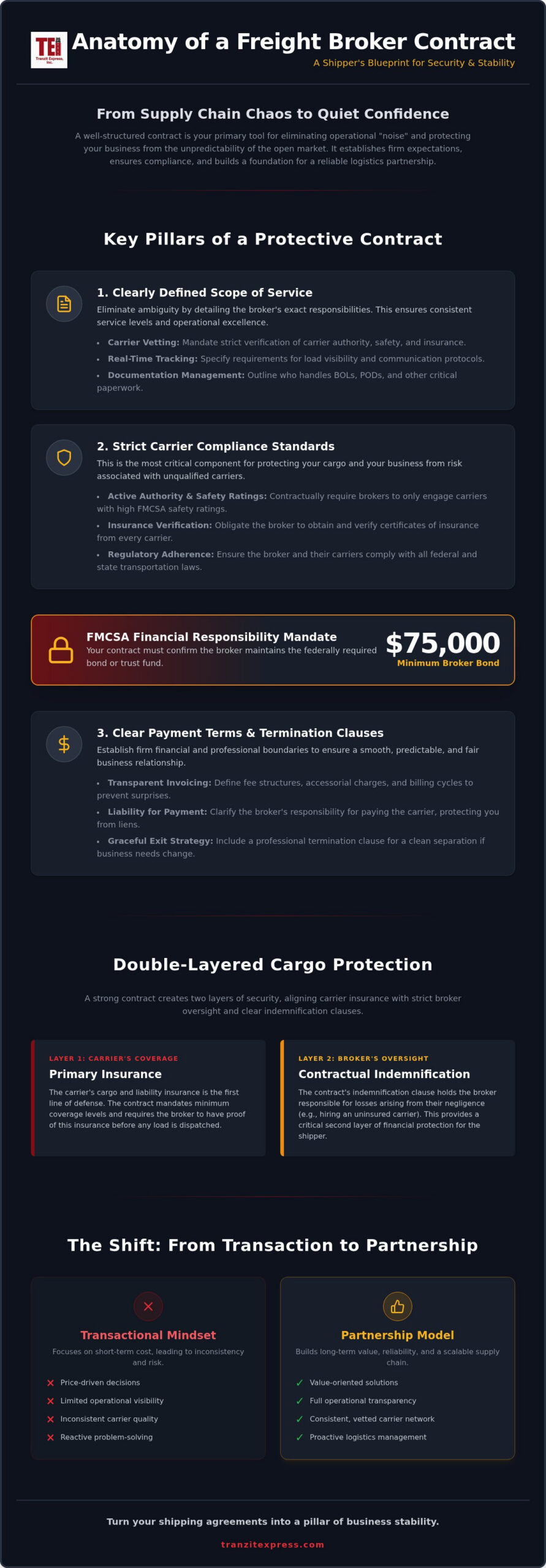
A functional freight broker contract for shippers is more than a list of legal protections; it is a roadmap for operational excellence. To maintain a steady hand over your logistics, the agreement must clearly define the scope of service. This includes the broker’s responsibility for vetting carriers, providing real-time tracking, and managing the mountain of documentation that accompanies every load. Without these specifics, “service” becomes a vague term that leads to frustration when expectations aren’t met.
Carrier compliance standards are perhaps the most critical component. In light of the 2026 FMCSA financial responsibility rules, your contract should mandate that the broker only works with carriers who possess active authority and high safety ratings. It must also confirm that the broker themselves maintains the required $75,000 bond or trust fund. Verifying these details protects you from the risk of working with undercapitalized or unsafe operators. If you’re looking for a partner who prioritizes these standards, you can explore our approach to shipper partnerships.
Payment terms and termination clauses provide the financial and professional boundaries of the relationship. Transparent invoicing ensures you aren’t hit with unexpected fees, while clear payment cycles protect you from carrier liens. A professional termination clause allows either party to exit the partnership gracefully if business needs change, ensuring that a shift in strategy doesn’t result in a legal stalemate.
Defining Service Standards for Specific Load Types
Every load has unique requirements that the contract must reflect. For instance, flatbed freight services USA require specific language regarding tarping, securing, and specialized equipment. If your business relies on time-sensitive hot shot trucking, the contract should outline response times and expedited handling protocols. For complex intermodal transportation solutions, the agreement needs to address the transitions between rail and road to ensure accountability remains clear at every handoff.
Volume Commitments and Rate Transparency
Negotiating volume commitments requires a balance between loyalty and flexibility. Many shippers use a “Right of First Refusal” clause, which gives your preferred broker the first opportunity to move a load without locking you into a rigid, restrictive cage. This allows for scalability as your volume grows. To maintain order, every individual load must be accompanied by a clear rate confirmation document. This practice ensures that the broad terms of your freight broker contract for shippers are applied accurately to every transaction, providing total transparency from pickup to delivery.
Navigating Risk: Indemnification and Insurance Requirements
Managing risk is the cornerstone of a stable logistics strategy. In a freight broker contract for shippers, the indemnification clause is the primary mechanism for determining who pays when something goes wrong. Put simply, indemnification is a promise where one party agrees to compensate the other for losses or damages caused by their own actions. For a shipper, this means ensuring the broker takes responsibility for errors in vetting or oversight, while the carrier remains responsible for the physical transit of the goods.
We advocate for a “double-layered” protection model. This approach relies on the carrier’s primary insurance as the first line of defense, backed by the broker’s rigorous oversight. You should always require a Certificate of Insurance (COI) that covers both cargo and general liability. A veteran broker maintains a comprehensive “Carrier Packet” for every provider they use; this file serves as documented proof that the carrier is compliant, authorized, and adequately insured before your freight ever touches their trailer.
Minimum Insurance Standards for National Freight
Standard cargo insurance typically starts at a minimum of $100,000 per shipment. If you are moving high-value goods, your freight broker contract for shippers should specify when additional coverage is required. This is also where you protect your business from “Vicarious Liability,” which is the legal theory that a shipper can be held responsible for a carrier’s road accident. A well-structured contract clearly separates your business from the carrier’s operational risks. In 2026, standard industry practice typically limits a broker’s direct liability to the total freight charges of the specific shipment unless specific negligence in the vetting process is proven.
Claims Management Protocols
When cargo damage occurs, the resulting stress often stems from a lack of clear procedure. Your agreement should establish a reporting timeline that aligns with the Carmack Amendment, which generally allows shippers up to nine months to file a formal claim for loss or damage. While the broker does not usually pay the claim directly, their role is to act as a steady facilitator between you and the carrier’s insurance adjuster. By pre-defining dispute resolution steps in your contract, you ensure that disagreements are handled through logical, professional channels rather than becoming a source of operational chaos. This methodical approach to claims allows you to maintain focus on your customers while the administrative process moves toward a resolution.
Strategic Negotiation: Moving from Transactions to Partnership
Negotiation for a freight broker contract for shippers often stalls at the price per mile. While cost is a factor, focusing solely on the lowest rate can lead to service failures that cost far more in the long run. A strategic contract shifts the focus toward “best total value,” which includes reliability, safety, and proactive communication. We believe a partnership should be built on transparency, which is why we offer access to a shipper portal for real-time tracking and documentation. This level of visibility ensures that the expectations set in the contract are actually met in the field.
A high-level agreement should also include clauses for continuous improvement. These provisions reward brokers for maintaining high on-time delivery percentages and efficient problem-solving. By writing professional communication standards into the agreement, you ensure that your team receives timely updates without having to chase them down. This methodical approach reduces the stress of daily logistics and reinforces the “steady hand” philosophy that keeps a supply chain moving smoothly. If you are ready to move beyond simple transactions, contact Tranzit Express Inc. today to discuss a partnership built on stability.
Leveraging Technology for Contractual Accountability
Digital tools have transformed how we maintain order in the logistics industry. Using a dedicated portal reduces the heavy lifting of manual paperwork and minimizes human error in contract fulfillment. Automated load tenders and electronic Bills of Lading (eBOL) provide a clear trail of activity, ensuring that every load complies with the terms of your freight broker contract for shippers. This digital framework also prioritizes data privacy. Your sensitive supply chain information stays protected by modern security protocols, ensuring that your strategic data doesn’t fall into the wrong hands.
Building Flexibility into the Agreement
The freight market is rarely static, so your contract shouldn’t be either. A well-crafted agreement allows you to manage both “Contract” rates for your steady lanes and “Spot Market” loads for seasonal surges within a single document. This versatility prevents the need for constant renegotiation. To avoid billing surprises, the contract should clearly define provisions for fuel surcharges and accessorial fees like detention or layovers. This clarity prevents disputes and fosters a mutual partnership mindset. When both parties understand the financial boundaries, they can focus on the primary goal: seamless delivery.
Why Experience Matters: How Tranzit Express Inc. Simplifies Your Shipping
Tranzit Express Inc. has spent over 25 years acting as a steady hand in the American logistics landscape. We’ve seen the industry evolve through various market cycles, yet our core philosophy remains the same: provide security and order in a complex marketplace. When our veteran team reviews a freight broker contract for shippers, we apply decades of institutional knowledge to ensure the document is practical and functional. We don’t just focus on the legal checkboxes; we focus on the “how to” of daily operational success. Our goal is to ensure that your paperwork facilitates movement rather than creating hurdles.
By leveraging our national network of vetted carriers, we provide consistent results for van freight services and specialized loads alike. Our experience allows us to simplify the documentation process for you, removing the administrative burden from your team. We believe that a professional freight broker contract for shippers should be the foundation of a more secure and predictable logistics future. It’s about building a framework where expectations are clear and results are repeatable.
Dependable Communication as a Contractual Standard
Our commitment to excellence starts with proactive communication. We don’t wait for you to ask for an update. Instead, our team provides regular status reports and ensures that on-time delivery isn’t just a goal, but a standard. Our dedicated portals offer the transparency that modern shippers demand, giving you real-time access to your shipment data without the need for endless phone calls. This methodical approach to information delivery is designed to reduce your stress. Working with a firm that values long-term B2B relationships means you have a partner who’s invested in your growth, not just the next transaction.
Get Started with a Veteran Logistics Partner
Beginning a partnership with Tranzit Express is a straightforward process designed for efficiency. You can start by requesting a quote through our website, where our team will assess your specific needs and volume requirements. Our onboarding process is logical and purposeful, focusing on integrating your requirements into our proven compliance and vetting systems. We take the guesswork out of carrier selection by maintaining rigorous standards that exceed basic regulatory mandates. Choosing a veteran partner means choosing stability. Partner with Tranzit Express Inc. for reliable national shipping today.
Secure Your Logistics with a Professional Partnership
A well-structured freight broker contract for shippers is the primary defense against the unpredictability of national logistics. By defining clear service standards and maintaining rigorous insurance oversight, you transform your supply chain from a series of stressful transactions into a predictable, scalable asset. This document ensures that every load, whether it’s van freight or a complex intermodal move, is handled with the same level of care and accountability you expect for your business.
Tranzit Express Inc. brings over 25 years of institutional logistics knowledge to every partnership. With national coverage and A+ rated carrier compliance standards, we act as the steady hand that provides order in a complex industry. We invite you to Request a Reliable Freight Quote from Tranzit Express Inc. and experience the difference that veteran expertise makes. We look forward to helping you build a more dependable and professional logistics future where your cargo is always in safe hands.
Frequently Asked Questions
What is the difference between a shipper-broker agreement and a broker-carrier agreement?
A shipper-broker agreement establishes the professional relationship between the cargo owner and the broker, focusing on oversight, carrier vetting, and administrative duties. In contrast, a broker-carrier agreement governs the relationship between the broker and the motor carrier physically moving the freight. While the former focuses on compliance and transparency for the shipper, the latter focuses on equipment specifications and transit times. Both are essential pillars of an orderly national supply chain.
Is a freight broker liable for cargo damage under a standard contract?
Under standard industry practices, a freight broker isn’t directly liable for physical cargo damage because they don’t take possession of the goods. Instead, the motor carrier’s cargo insurance serves as the primary source of recovery. However, a broker can be held liable if they were negligent in vetting the carrier. A strong freight broker contract for shippers clarifies these boundaries and outlines how the broker will facilitate the claims process with the carrier’s adjuster.
How often should a freight broker contract for shippers be reviewed?
We recommend reviewing your logistics agreements at least once every twelve months to account for market shifts and regulatory updates. For instance, the 2026 FMCSA financial responsibility rules require brokers to maintain a $75,000 bond; your contract should reflect these current standards. Regular reviews ensure your insurance requirements remain adequate for your current cargo values and that your operational protocols still align with your long-term business goals.
Can a shipper work with multiple brokers, or is the contract usually exclusive?
Most contracts are non-exclusive, allowing you to maintain relationships with multiple providers to ensure coverage across different lanes or equipment types. While exclusivity isn’t standard, many shippers prefer to focus their volume with a few trusted partners to gain better service levels and rate stability. This approach allows you to leverage the specific expertise of different brokers while maintaining the flexibility to scale your shipping operations as needed.
What insurance documents should I request from a freight broker before signing?
Before signing, you should request the broker’s Certificate of Insurance (COI) for both general liability and cargo, as well as proof of their $75,000 FMCSA bond. It’s also vital to see a sample of their carrier vetting packet. This documentation proves the broker has the financial stability and professional oversight required to protect your interests. Checking these documents upfront reduces your financial risk and ensures you’re partnering with a compliant, veteran firm.
What happens if a broker fails to pay the carrier for my shipment?
If a broker fails to pay, the carrier might legally seek payment directly from the shipper, even if you’ve already paid the broker. To prevent this, a robust freight broker contract for shippers should include a clause stating that payment to the broker constitutes payment to the carrier. This protects your business from double-payment risks and potential freight liens, ensuring that the financial transaction remains orderly and professional at all times.
Does a freight broker contract need to be signed for every individual load?
You don’t need to sign a full contract for every shipment. Instead, you sign a Master Service Agreement once to establish the overarching legal and operational framework. For individual loads, you use a Rate Confirmation document that specifies the cost, equipment, and pickup details for that specific transaction. This two-tiered system provides the legal security of a long-term partnership while maintaining the speed and efficiency required for daily logistics management.
What are accessorial charges and how should they be handled in the contract?
Accessorial charges are additional fees for services beyond standard dock-to-dock transit, such as detention, layovers, or re-consignment. Your contract should clearly define these fees and the specific triggers for each charge to avoid billing surprises. By establishing these rates upfront, you maintain order in your budget and ensure that both the broker and the carrier are fairly compensated for their additional time and resources during the shipping process.