
Did you know that accessorial charges can inflate your total shipping costs by as much as 40%? For many logistics managers, these unexpected line items feel like random penalties that disrupt an otherwise stable budget. You’ve likely felt the frustration of an unpredictable invoice or the confusion of trying to decipher complex industry jargon while your margins shrink. At Tranzit Express, we believe that accessorial fees in freight explained shouldn’t be a source of stress, but rather a manageable part of a disciplined shipping strategy.
We understand that you value predictability and clear communication above all else. This guide leverages 25 years of industry experience to help you master the complexities of specialized service requirements. You’ll learn how to identify hidden costs and manage documentation to ensure your freight spend remains consistent. We’ll walk through the specific 2026 rate increases for services like liftgates and detention, providing you with the tools to minimize errors and build more transparent, long-term partnerships with your carriers.
Key Takeaways
- Understand that accessorials are specialized service requirements rather than random penalties, allowing for more precise budget control and predictable freight spend.
- Identify equipment and location-based charges early by auditing your facilities for dock height, forklift availability, and specialized equipment needs.
- Get accessorial fees in freight explained with a focus on administrative costs like re-weighs and re-classes, which are often preventable through accurate documentation.
- Utilize tools like a shipper portal to maintain a steady hand on your logistics spend and ensure all Bill of Lading requirements are met before the carrier arrives.
- Learn how a dependable logistics partner vets carrier fee schedules to act as your advocate and protect your margins from unexpected cost escalations.
Defining Accessorial Fees in Modern Freight Logistics
Accessorial fees are essentially any charges that fall outside the standard scope of dock-to-dock transportation. While a base rate covers the physical movement of goods, these additional line items account for the extra labor, equipment, or administrative time required to complete a specific delivery. Understanding Modern Freight Logistics requires a clear view of how these variables impact your bottom line. Having accessorial fees in freight explained simply means recognizing that every unique requirement of a shipment has an associated cost.
Transparency in these costs is a hallmark of a professional B2B relationship. When a carrier performs a service that isn’t part of the standard transit, they’re dedicating more resources to your shipment than originally quoted. This makes mastery of these fees essential for effective logistics management for shippers. By identifying these needs upfront with a steady hand at the wheel, you can avoid the budget overruns that often follow a delivery. When you have accessorial fees in freight explained by a veteran broker, you gain the clarity needed to forecast your total spend accurately.
The Three Pillars of a Freight Quote
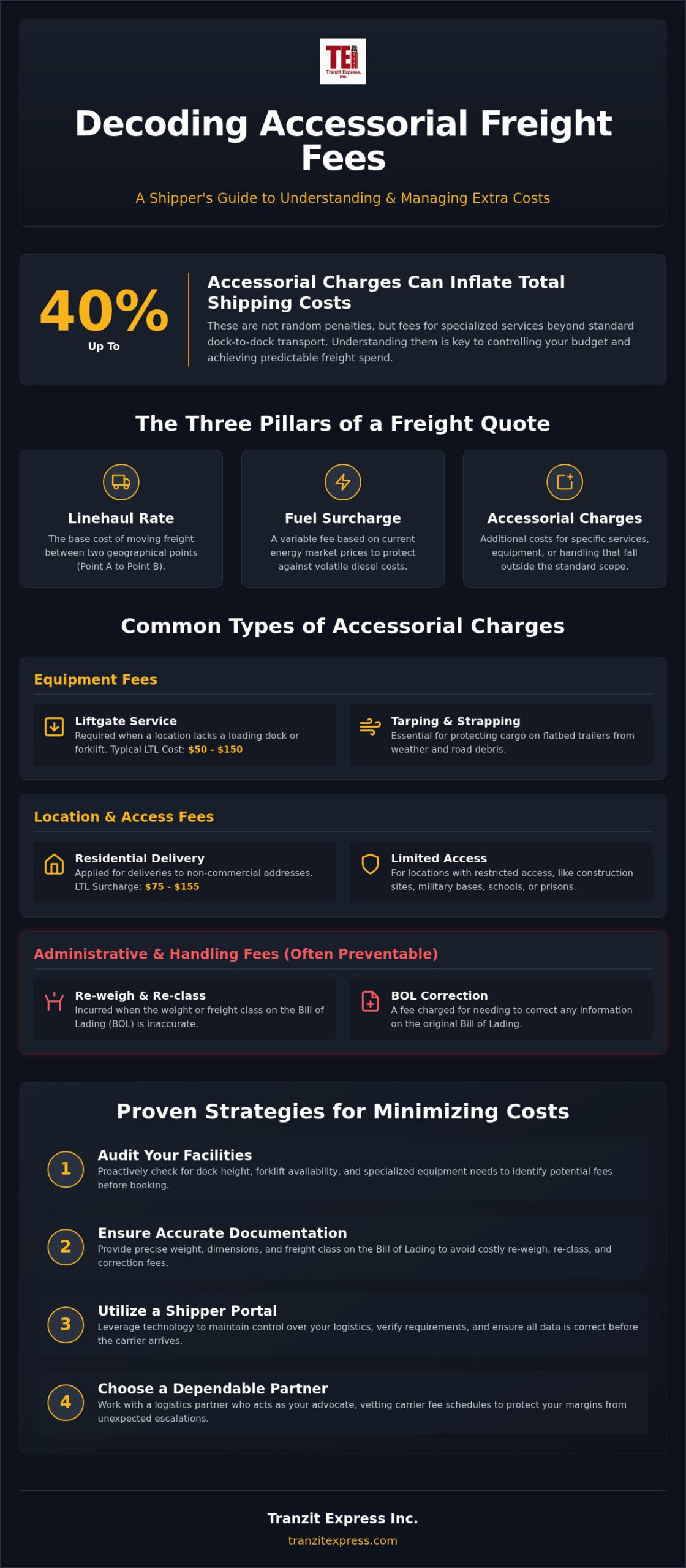
A transparent freight invoice typically rests on three distinct pillars that provide a sense of order to your billing. The linehaul rate is your base cost; it represents the primary expense of moving freight between two geographical points. Next is the fuel surcharge, which is a fluctuating fee based on current energy markets to protect carriers from volatile diesel prices. Finally, accessorial charges encompass the variable costs associated with specific service needs. These might include liftgate requirements, residential delivery, or inside pickup services. Seeing these broken out clearly ensures you don’t pay for services you don’t actually use.
Why Carriers Charge for Specialized Accommodations
Carriers aren’t looking to penalize shippers with extra fees. Instead, they’re looking to maintain operational efficiency and recover costs. When a driver is delayed at a facility, it creates a lost opportunity cost that ripples through their entire schedule. Detention fees compensate for this lost time. Similarly, specialized equipment like liftgates or flatbeds requires significant capital investment and ongoing maintenance. If documentation on a Bill of Lading is inaccurate, it causes administrative disruptions that the carrier must offset through correction fees. These charges ensure that the carrier can continue to provide high standards of service without compromising their own operational stability.
Common Types of Accessorial Charges Every Shipper Should Know
Freight bills rarely consist of a single, static number. Most shipments require specific accommodations that fall outside a standard dock-to-dock move. When you have accessorial fees in freight explained by a veteran partner, you can anticipate these costs before they hit your invoice. Carriers categorize these charges based on the extra equipment, time, or specialized access required to complete the job safely and efficiently. Understanding common types of accessorial charges allows you to prepare your facilities and your budget for the road ahead.
Equipment Fees: Liftgates and Tarping
Equipment-based fees are among the most frequent additions to a freight bill. A liftgate service is necessary whenever an origin or destination lacks a traditional loading dock or a forklift. In 2026, industry data shows this service typically costs between $50 and $150 for LTL shipments. For those utilizing flatbed freight services USA, tarping and strapping are critical for protecting cargo from the elements. These are not just administrative extras; they represent the physical labor and specialized gear required to ensure your freight arrives in pristine condition. You might also encounter charges for specialized trailers like step-decks or removable goosenecks (RGNs) if your cargo is over-dimensional.
Location and Access Challenges
Where your freight is going matters as much as what is being shipped. Residential delivery surcharges often add $75 to $155 to an LTL invoice because neighborhoods present navigation challenges for large trucks. Similarly, limited access fees apply to locations like schools, construction sites, and military bases where security or tight spaces slow down the carrier. These fees typically range from $75 to $300 or more per shipment. If a driver must move freight beyond the immediate loading area, inside delivery fees between $75 and $200 often apply. Being proactive about these site conditions helps maintain a steady hand on your logistics spend.
Time is a carrier’s most valuable asset. Detention fees occur when a driver is delayed at a facility through no fault of their own, with 2026 rates often reaching $75 per hour after a brief grace period. Specialized freight, such as hazardous materials or high-value electronics, often incurs unique charges that you should negotiate upfront. Having accessorial fees in freight explained helps you spot these line items before they disrupt your cash flow. If you’re managing complex loads, reviewing our guide to flatbed freight services USA can help you identify which specialized equipment fees might apply to your next shipment.
The Impact of Administrative and Handling Fees on Your Budget
Administrative fees are often the most preventable costs in a shipping budget. These charges arise when carriers must manually intervene because the information provided doesn’t align with the physical reality of the load. To keep your budget predictable, you must treat the Bill of Lading (BOL) as the legal contract that dictates all downstream fees. When accessorial fees in freight explained are viewed through the lens of data accuracy, it’s clear that a steady hand at the documentation stage saves significant capital. These fees reflect the labor required to re-route a shipment or adjust a trailer’s weight distribution, rather than being arbitrary penalties.
Carriers frequently apply “Re-weigh and Re-class” fees when the weight or NMFC class on the BOL is incorrect. In 2026, address correction fees for incomplete or illegible information can cost over $20 per occurrence. Inaccurate documentation forces carriers to manually update their automated systems, which disrupts their operational rhythm. By ensuring every detail is verified before the truck arrives, you maintain the high standards of a professional B2B partnership and avoid these avoidable budget overruns. Having accessorial fees in freight explained by a veteran broker helps you spot these potential pitfalls before they impact your margins.
Preventing BOL Correction Fees
Errors in documentation are the primary driver of administrative surprises. Common mistakes include providing an incorrect NMFC class, estimated weights instead of actual scale weights, or missing contact information for the receiver. Another frequent cost is the “Notification Before Delivery” fee. This is often a separate line item, typically costing between $50 and $100, because it requires the carrier to manually schedule a specific window with the receiver. Using a professional Shipper Portal allows you to store accurate data and automate the creation of precise BOLs, which eliminates the friction that leads to manual intervention and unexpected correction charges.
Handling Fees for Non-Standard Freight
Non-standard items require more than just extra paperwork; they demand physical space and specialized care. Oversize and overlength fees apply to pallets or machinery that exceed standard dimensions. In 2026, some carriers charge between $150 and $1,000 for pieces that exceed standard length thresholds. Hazardous Materials (Hazmat) shipments also incur higher fees due to the need for specialized driver certifications and specific routing requirements. For high-value cargo, “White Glove” services provide the extra care and specialized handling needed for delicate or high-stakes items. Understanding these handling requirements during the quoting phase ensures that your freight spend remains transparent and manageable.
Proven Strategies for Minimizing Accessorial Costs in 2026
Minimizing shipping expenses requires more than just reactive auditing. Proactive management is the only way to ensure a steady hand on your logistics budget. By standardizing your operations, you eliminate the human error that typically triggers administrative penalties. Having accessorial fees in freight explained as a part of your team’s standard training ensures everyone understands the financial impact of a minor delay or a documentation error. Consulting with an experienced freight broker can help you identify hidden costs before you even book a load, providing a layer of protection for your margins.
A disciplined approach to logistics focuses on removing variables. When you provide a carrier with a clear, accurate picture of the shipment, you reduce their need to apply surcharges for specialized handling. This professional transparency builds trust and leads to more predictable freight spend. If you’re ready to streamline your shipping process and protect your bottom line, you can access our shipper portal to manage your documentation with precision.
Conducting a Facility Audit
The first step in a disciplined strategy is a thorough audit of your facilities and those of your frequent customers. You should verify whether every regular destination has a functional loading dock or if it requires a liftgate. Identifying limited access zones in your recurring delivery routes helps you quote accurately from the start. Update your internal address book with specific delivery instructions, such as security gate codes or preferred entry points, to avoid costly redelivery fees. These small details prevent the logistical friction that often results in unexpected line items on your final invoice.
Standardizing Documentation and Communication
Digital tools are essential for verifying weights and dimensions before a carrier arrives on-site. When you provide precise data, you remove the carrier’s need to perform a re-weigh or re-classification. Clear communication regarding appointment windows is equally vital for maintaining a smooth flow. Detention fees usually begin after two hours of waiting at a facility, so ensuring your team is ready for the driver’s arrival keeps your costs predictable. When accessorial fees in freight explained are treated as manageable operational data points rather than random penalties, your entire logistics chain becomes more efficient and cost-effective.
Navigating Complex Fees with a Dependable Logistics Partner
Managing a logistics budget requires more than just finding the lowest base rate. It demands a partnership with an authoritative expert who can anticipate the variables that lead to cost escalations. A seasoned freight broker acts as your advocate when unexpected charges arise, providing the steady hand needed to resolve disputes with carriers. Choosing a partner with 25 years of experience offers the stability your business needs in a volatile market. Having accessorial fees in freight explained by a veteran team ensures that you aren’t just reacting to invoices, but proactively controlling your spend through proven industry knowledge.
Reliable communication is the foundation of a successful shipping strategy. When all parties are aware of specialized needs upfront, the likelihood of a “surprise” fee drops significantly. This transparency is what separates a simple transaction from a high-level B2B partnership. We prioritize clear signposts throughout the shipping process, ensuring that every requirement is documented and every carrier is vetted for their specific fee schedules. This methodical approach reduces stress and provides a sense of order in an often chaotic industry.
The Broker’s Role in Fee Transparency
A broker’s value lies in their ability to pre-negotiate accessorial rates with a national network of qualified motor carriers. Instead of dealing with dozens of different tariff structures, you benefit from a consolidated process where all charges are presented in a single, easy-to-read invoice. This is particularly vital when managing “Hot Shot” loads or expedited freight, where specialized needs and tight timelines make fees more common. By vetting carriers for their service standards and fee transparency, a broker ensures your margins remain protected regardless of the complexity of the route.
Leveraging Technology for Cost Control
Modern logistics management relies on data to identify patterns in spending. By using a professional shipper portal, you can track historical accessorial costs and pinpoint exactly where your budget is leaking. Automated alerts for detention or missed appointments allow for real-time resolution before a minor delay turns into a major expense. This technology-driven process provides the peace of mind that comes from knowing your documentation is being handled with precision. When accessorial fees in freight explained are backed by real-time tracking and historical data, you gain the clarity needed to maintain a predictable freight spend year after year.
Securing Your Margins Through Proactive Logistics Management
Mastering your total freight spend is a matter of discipline and detail. We’ve seen how accessorial fees in freight explained through the lens of operational efficiency can transform your bottom line. By auditing your facilities and standardizing your documentation, you move from reacting to invoices to controlling your costs with confidence. These extra line items aren’t just penalties; they’re data points that allow you to refine your shipping process and build more transparent relationships with your carriers.
Tranzit Express Inc. provides the steady hand you need in a complex market. With 25 years of dependable logistics expertise and a national carrier network vetted for compliance, we prioritize transparency in every transaction. Our professional shipper portal ensures you have the tools to manage documentation and maintain a predictable budget. You don’t have to navigate these specialized requirements alone. Request a reliable freight quote and avoid hidden fees today. We look forward to providing the stability and order your supply chain deserves.
Frequently Asked Questions
What is the most common accessorial fee in freight?
Fuel surcharges and liftgate services are among the most frequent line items on a modern invoice. Liftgate fees are standard for deliveries to any location lacking a traditional loading dock or a forklift. Fuel surcharges fluctuate weekly based on national energy averages to protect carriers from market volatility. Understanding these common charges is the first step in getting accessorial fees in freight explained for your logistics team to ensure budget predictability.
Can I dispute an accessorial charge after the shipment is delivered?
Yes, you can dispute charges, but you must provide objective evidence to support your claim. This often involves submitting time-stamped photos, signed Bill of Lading notes, or GPS data from the delivery site. Carriers usually have a specific window, often 15 to 30 days, for filing a formal dispute. Working with a dependable broker simplifies this process, as they act as your advocate to resolve discrepancies directly with the carrier.
How much does a liftgate service typically cost in 2026?
In 2026, industry data indicates that liftgate services typically range from $50 to $150 per use for LTL shipments. Some carriers charge a flat fee, while others base the cost on the total weight of the freight. For parcel-level deliveries, this fee is often lower, usually falling between $25 and $75. It’s essential to confirm these rates during the quoting phase to ensure your final invoice remains consistent with your original estimate.
What is the difference between detention and demurrage?
Detention refers to the time a driver spends waiting at a facility beyond the agreed grace period, which is usually two hours. Demurrage is a fee charged for the use of a carrier’s equipment, such as a container or trailer, while it remains at a port or rail yard beyond the allotted free time. While both are time-based costs, detention focuses on the driver’s labor, whereas demurrage focuses on the physical equipment sitting idle.
Is residential delivery always considered an accessorial fee?
Yes, carriers almost always classify residential delivery as an accessorial service due to the added complexity of navigating neighborhoods. These areas often have weight restrictions, low-hanging trees, or narrow streets that require smaller trucks and extra driver attention. In 2026, these surcharges typically add $75 to $155 to a standard LTL shipment. Noting this requirement on the Bill of Lading at the start is vital for maintaining clear communication with your provider.
How can I avoid re-weigh and re-class fees on my LTL shipments?
The most effective way to avoid these fees is to use a certified scale for every pallet and verify the NMFC class before booking. Inaccurate estimates are the primary trigger for manual carrier intervention. Getting accessorial fees in freight explained means recognizing that carriers use automated dimensioners to check every load. Utilizing a professional shipper portal to store accurate product specifications ensures your documentation is precise and your billing remains transparent.
What happens if a carrier charges for a service they didn’t actually perform?
You should immediately contact your broker or the carrier’s billing department to request a correction. Proof is essential here; a signed delivery receipt that doesn’t mention the service is your strongest tool. For example, if a liftgate fee appears for a facility with a loading dock, a photo of the dock can resolve the issue. A veteran broker handles these negotiations on your behalf to protect your partnership and your margins.
Do accessorial fees apply to intermodal transportation as well?
Yes, intermodal shipments incur specific accessorials such as drayage detention, chassis splits, and storage fees at the rail ramp. These charges reflect the complex coordination required between rail and truck providers. While base rates for intermodal are often lower, the complexity of the hand-offs can lead to unexpected costs if not managed carefully. Partnering with an expert who understands these specialized loads helps you navigate these fees with a steady hand.