
As of January 16, 2026, any freight broker failing to maintain a $75,000 financial security threshold faces immediate suspension of their operating authority. This regulation isn’t just an administrative hurdle; it’s a critical safety net that changes how to vet a freight broker in a modern market. You’ve likely felt the anxiety of handing over a high-value load to a new partner, wondering if your cargo is secure or if you’re walking into a double-brokering scam. It’s a high-stakes environment where one wrong choice leads to lost revenue and broken trust.
Learning the proper verification steps is the most effective way to shield your brand from these liabilities and ensure your supply chain remains resilient. This guide provides a professional verification checklist, covering everything from FMCSA authority and the latest financial requirements to the operational markers of a steady, reliable partner. We’ll help you move from uncertainty to a state of organized, long-term security.
Key Takeaways
- Confirm a provider’s legal standing by verifying their MC and DOT numbers through the FMCSA’s SAFER system to ensure active operating authority.
- Protect your financial interests by ensuring your partner maintains the required $75,000 surety bond to guarantee carrier payments and operational stability.
- Distinguish reliable partners from high-risk operators by identifying operational “green flags” like secure, dedicated shipper portals and professional physical addresses.
- Implement a systematic 5-step framework for how to vet a freight broker to eliminate the risks of double-brokering and cargo theft.
- Build a more resilient supply chain by choosing established brokers with the institutional knowledge to handle complex van, flatbed, and intermodal freight.
Why Vetting a Freight Broker is Your First Line of Defense
Broker vetting is the systematic verification of a logistics provider’s legal authority, financial health, and safety standards. It’s more than just a background check; it’s a critical shield for your business operations. When you understand how to vet a freight broker, you’re doing more than verifying paperwork. You’re ensuring that the professional freight broker you partner with has the stability to manage your cargo through every mile of the journey. A dedicated partner acts as a steady hand, providing order in a complex national supply chain that often feels unpredictable.
Protecting cargo integrity is a primary goal of this process. Veteran brokers with decades of institutional knowledge are far less likely to fall for double-brokering scams, where unauthorized parties intercept loads. These scams don’t just delay shipments; they create massive insurance gaps and payment disputes. By prioritizing rigorous vetting, you ensure that your Van Freight Services or Flatbed Shipping needs are handled by legitimate operators who value transparency over a quick transaction.
The Financial Impact of Poor Vetting
Choosing an unvetted partner often leads to hidden costs that far exceed the initial shipping quote. Unreliable carriers may arrive late, leading to costly chargebacks from retail partners or stalled production lines. In the worst cases, cargo can be held hostage by scammers demanding extra payments before they release the trailer. Beyond these immediate losses, there’s the looming threat of legal consequences. Vicarious liability in logistics refers to the legal responsibility a shipper may bear for the actions of a broker or carrier if they are found to have been negligent in their hiring practices. A single accident involving an unvetted carrier can lead to multi-million dollar settlements that your business might be forced to share.
Reputation Management for Shippers
Your choice of logistics partner is a direct reflection of your commitment to your own customers. If a delivery arrives late or damaged because of a broker’s lack of oversight, it’s your brand that suffers the reputational blow. Maintaining national retail partnerships requires a level of consistency that only comes from disciplined vetting. Professional communication is a leading indicator of a broker’s reliability. Companies that invest in infrastructure, such as secure Shipper Portal Access, demonstrate an operational maturity that smaller, unproven startups often lack. When you know how to vet a freight broker properly, you look for these signs of stability to ensure that your supply chain remains a competitive advantage rather than a liability.
Verifying Legal Authority and Financial Security
Verifying a partner’s credentials is the most objective part of how to vet a freight broker. It starts with the FMCSA SAFER system, which is a public database that tracks the legal standing of every transportation entity in the United States. You shouldn’t take a broker’s word for their legitimacy; instead, use their Motor Carrier (MC) or Department of Transportation (DOT) number to pull their official record. A broker with 25 years of experience provides a track record that is inherently lower risk than a newly formed entity with no history of performance. This “Age of Authority” serves as a primary indicator of stability and professional endurance in a volatile market.
The FMCSA SAFER System Checklist
When you access the SAFER system, check the “Entity Type” first. It must explicitly state “Broker” to ensure they are authorized to arrange transportation rather than just operating as a carrier. Look for an “Active” status and review the history for any involuntary revocations, which can indicate past financial or compliance failures. The BMC-84 surety bond is a mandatory $75,000 financial guarantee that ensures carriers are paid even if the broker faces financial distress, protecting the shipper from double-payment claims. Since the new financial responsibility rule took effect on January 16, 2026, brokers must replenish this bond within seven business days if it ever falls below the required threshold.
Insurance and Contingent Liability
Standard carrier insurance is rarely enough to fully protect your interests. You must verify that your partner carries Contingent Cargo and General Liability insurance to cover gaps where a carrier’s policy might fail. It’s a best practice to request a Certificate of Insurance (COI) directly from the broker’s insurance agent rather than accepting a forwarded PDF, as this prevents the use of forged or expired documents. Understanding what does a freight broker do reveals that a high-level partner manages these complex insurance layers on your behalf, acting as a buffer between your cargo and potential loss.
Reliability also depends on how the broker handles their own network. A professional partner should be proactively vetting carriers to ensure only the safest drivers handle your Flatbed Shipping or Van Freight needs. This methodical approach to security is what defines a “steady hand” in logistics. If you value transparency and verified security, exploring our Shipper Portal Access can show you how we maintain these high standards for every shipment we manage.
Operational Red Flags vs. Green Flags
Beyond the legal paperwork, the daily “operational feel” of a company provides the most telling evidence of their reliability. Knowing how to vet a freight broker involves looking for specific markers of professionalism that separate established veterans from fly-by-night operators. A significant red flag is the absence of a verifiable physical office address. If a broker operates solely through generic email domains like @gmail.com or @outlook.com, they likely lack the corporate infrastructure required to manage complex claims or specialized loads. These low-cost setups are often used by temporary entities that disappear when issues arise.
Another critical warning sign is a rate that sits significantly below the current market average. In a market where carrier capacity is expected to tighten through 2026, a quote that seems too good to be true is often a lure for a double-brokering trap. These scammers underprice the load to win the bid, then hand it off to an unvetted carrier they never intend to pay. Conversely, a major green flag is a broker who can clearly articulate their own carrier qualification process. They should be able to explain how they verify safety ratings and insurance before a driver ever touches your Flatbed Shipping or Van Freight.
Communication as a Trust Signal
Reliable logistics management for shippers is built on a foundation of steady, professional communication. Does the broker answer the phone during standard business hours? If you consistently reach a voicemail or wait hours for an email reply, it’s a sign of a fragmented operation. A veteran partner provides proactive updates, ensuring you never have to chase the status of your cargo. This level of transparency reduces the stress of high-stakes shipping and builds the long-term trust necessary for a successful B2B partnership.
Technology and Transparency
Investment in modern technology is a definitive green flag that signals a long-term commitment to the industry. A professional Shipper Portal Access point isn’t just a convenience; it’s a sign of operational maturity. These tools provide real-time tracking and immediate access to digital documentation, which eliminates the friction often found in manual processes. When you’re determining how to vet a freight broker, prioritize those who offer these secure digital environments. It shows they have the capital and the expertise to protect your data and your cargo simultaneously. This “steady hand” approach to technology ensures that your supply chain remains orderly and efficient.
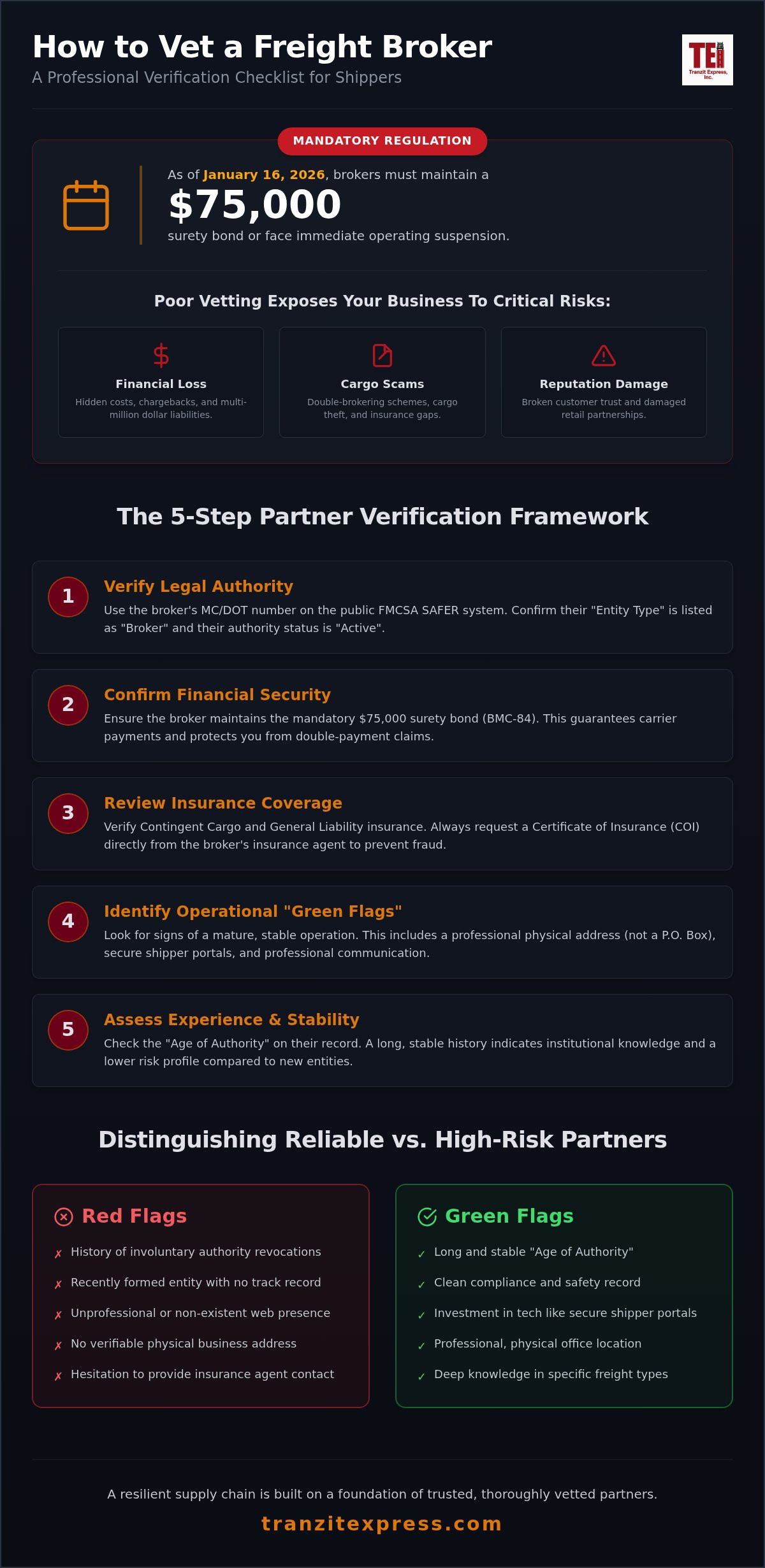
A 5-Step Framework for Vetting New Logistics Partners
Transitioning from spotting red flags to establishing a formal process is the most effective way to secure your supply chain. This 5-step framework provides a repeatable method for how to vet a freight broker, ensuring no detail is overlooked before you sign a contract. It’s about building a foundation of trust through data and direct verification.
- Step 1: Initial Research. Review the broker’s digital footprint. A professional website and a long-standing age of authority suggest a business built for longevity rather than short-term gain.
- Step 2: Document Verification. Request the MC authority letter, a current W-9, and the Certificate of Insurance. These documents should be verified directly with the issuing agencies to prevent the use of outdated or forged records.
- Step 3: Financial Check. Beyond verifying the $75,000 bond, check industry credit reports. Consistent payment history is a hallmark of a stable partner who won’t leave you vulnerable to carrier payment disputes.
- Step 4: Operational Interview. This is where you assess their specialized expertise, such as their proficiency in flatbed freight services USA, to ensure they understand your specific equipment needs.
- Step 5: Reference Check. Speak with existing clients who ship similar commodities. This provides a clear picture of how the broker performs under pressure and handles daily challenges.
The Operational Interview: Questions to Ask
A “steady hand” at the wheel will always welcome detailed questions about their internal processes. Start by asking how they verify a carrier’s safety rating before dispatching a load. You should also inquire about their protocol for handling Over, Short, and Damaged (OS&D) issues; a reliable broker has a documented claims process to minimize your financial exposure. If your needs go beyond standard van freight, ask if they have experience with specialized loads like hot shot trucking. Their answers will reveal whether they have the institutional knowledge to manage your unique logistical challenges without causing unnecessary delays.
Checking References Effectively
When you contact a reference, look for insights into the broker’s integrity rather than just a general recommendation. Ask specifically about how the broker communicates when a load is delayed; honesty during a crisis is a better indicator of reliability than a perfect record. Inquire about the consistency of their carrier pool to see if they rely on a trusted network or simply post to public load boards. A broker’s payment history with carriers directly affects your cargo’s safety because unpaid drivers might hold shipments as leverage to collect their fees. If you’re ready to move forward with a reliable logistics partnership, choosing a team that has already mastered these steps is the best way to protect your business.
Partnering with a Seasoned Professional for National Logistics
Establishing a rigorous process for how to vet a freight broker is a significant achievement for any shipping department, but the true value lies in the partner you select at the end of that journey. In a logistics landscape where market volatility is common, the stability provided by 25 years of institutional knowledge is a rare asset. Tranzit Express Inc. presents itself as a dependable veteran, offering a steady hand at the wheel for your most critical shipments. We avoid the high-energy, disruptive marketing of modern startups, choosing instead to focus on the quiet confidence that comes from thousands of successfully delivered loads.
The Tranzit Express Standard
Our methodology is built on the belief that logistics should reduce stress, not create it. We’ve spent over two decades refining our internal vetting protocols, ensuring that every carrier we assign to your Flatbed Shipping or Hot-Shot Loads meets our uncompromising safety and financial standards. This commitment to order allows us to maintain a seamless flow of goods across the country, solving complex routing issues with the efficiency that only experience provides. We prioritize long-term B2B partnerships, working alongside you to ensure your national distribution remains consistent and resilient against market shifts.
Next Steps for Your Distribution
Moving forward with a professional logistics partner should be a methodical and logical process. Once you’ve completed your research into how to vet a freight broker, the next step is to begin the onboarding process with a team that values clear communication. We offer a streamlined path to get your freight moving, starting with a comprehensive review of your specific requirements and shipping volume. This ensures that our Van Freight Services or Intermodal Transportation solutions are perfectly aligned with your business goals.
By utilizing our secure Shipper Portal Access, you gain immediate entry into a transparent shipping environment where digital documentation and real-time status updates are standard. This investment in technology is a sign of our operational maturity and our dedication to your success. It provides the peace of mind that comes from knowing your cargo is in capable hands. If you’re looking for a partner that prioritizes the fulfillment of promises over marketing hype, we invite you to reach out to our team.
Request a reliable freight quote from Tranzit Express Inc. today.
Securing Your Supply Chain for the Long Term
Mastering the process of how to vet a freight broker is the most important step you can take to protect your business from the risks of double-brokering and cargo theft. By focusing on verified legal authority, financial stability through the $75,000 bond, and the operational maturity of a secure digital portal, you move beyond simple transactions to a state of organized security. A “steady hand” approach ensures that your logistics strategy is resilient enough to withstand market shifts and capacity tightening through 2026 and beyond.
Tranzit Express Inc. brings over 25 years of industry-leading experience to every partnership. We provide secure national logistics portals for both shippers and carriers, backed by a proven track record of reliable communication and on-time delivery. Our commitment to excellence means you can focus on your core operations while we manage the complexities of the road with absolute precision. We invite you to build a more dependable future for your distribution network by choosing a partner that values order and transparency as much as you do.
Partner with a dependable freight broker-Contact Tranzit Express Inc. for a quote.
Frequently Asked Questions
What is the most important document to check when vetting a freight broker?
The Motor Carrier (MC) Authority letter is the most critical document to verify because it proves the entity is legally permitted by the FMCSA to arrange transportation. While you should also request a W-9 and insurance certificates, the MC letter confirms their official operating status. You should always cross-reference this document against the federal SAFER system to ensure the information provided matches the government’s public record.
Can I be held liable if my freight broker hires an unsafe carrier?
You can be held legally responsible for damages if a court determines you were negligent in your hiring practices. This legal concept, known as vicarious liability, penalizes shippers who fail to perform due diligence when selecting logistics partners. Rigorous vetting protects your business from these high-stakes claims by ensuring every carrier assigned to your load meets strict safety and compliance standards before they arrive at your facility.
What is a BMC-84 bond and why do brokers need it?
A BMC-84 bond is a $75,000 financial guarantee that freight brokers must maintain to ensure carriers and shippers are protected if the broker fails to pay. As of January 16, 2026, federal rules require brokers to replenish this bond within seven business days if it falls below the threshold. It serves as a vital financial safety net, providing you with recourse if a broker faces insolvency or fails to fulfill their financial obligations.
How do I know if a freight broker is double-brokering my load?
You can identify double-brokering by checking if the carrier’s name on the tractor matches the name on the rate confirmation. If a different company arrives for pickup or if the driver is confused about the shipment details, it’s a significant warning sign. Secure portals and transparent communication help prevent these scenarios by ensuring the broker maintains direct, verified control over the carrier selection process at every stage.
Is a newer freight broker less reliable than an experienced one?
A newer broker isn’t inherently unreliable, but they lack the institutional knowledge and proven track record of a seasoned industry veteran. When you learn how to vet a freight broker, you’ll find that companies with over 25 years of experience have navigated multiple market cycles and developed more resilient carrier networks. This longevity provides a level of security and professional order that unproven startups often cannot match during volatile periods.
How often should I re-vet my regular freight broker partners?
You should perform a comprehensive re-vetting of your regular partners at least once per year or whenever their insurance policies are due for renewal. Regular audits ensure their authority remains active and their financial standing hasn’t changed. Continuous monitoring is a hallmark of professional logistics management, ensuring the high standards established during the initial onboarding process are maintained throughout the duration of your long-term B2B partnership.
What should I do if a broker refuses to provide their insurance information?
If a broker refuses to provide their insurance information or a Certificate of Insurance, you should terminate the conversation immediately. Transparency is a non-negotiable requirement in high-stakes logistics. A refusal to share these details suggests they are either underinsured or operating without the necessary legal protections. A dependable partner will always provide direct access to their insurance agent to verify coverage for your Van Freight or Flatbed Shipping needs.
What is the difference between a freight broker and a freight forwarder?
A freight broker acts as an intermediary that arranges transportation, while a freight forwarder typically takes physical possession of the cargo to assemble or consolidate it. Both entities must follow federal financial responsibility rules, including the $75,000 security requirement. Understanding this distinction helps you determine how to vet a freight broker based on whether they are coordinating the move or managing the physical handling and consolidation of your goods.