
The true test of a dependable logistics partner isn’t how quickly they dispatch a load, but how consistently they settle the bill. For motor carriers, understanding the carrier payment terms freight broker partners establish is often the difference between predictable operational growth and an enterprise stalled by sudden cash shortages.
You already know the frustration of delivering freight on schedule, only to wait weeks for invoice processing while minor bill of lading discrepancies or unexpected administrative fees chip away at your margins. With operational expenses pressing on every mile, unpredictable settlement timelines create severe, unnecessary strain across your fleet.
This guide will help you master standard freight broker payment structures, streamlined invoice workflows, and partner vetting methods to ensure dependable cash flow for your trucking operations. We will examine the operational mechanics of Net terms, QuickPay options, and factoring arrangements, providing clear benchmarks to protect your revenue and build lasting, reliable partnerships.
Key Takeaways
- Understand how carrier payment terms freight broker agreements establish directly dictate your fleet’s settlement schedules and operational cash flow.
- Compare the operational advantages and working capital trade-offs between traditional Net terms, accelerated QuickPay options, and third-party freight factoring.
- Eliminate settlement disputes and administrative processing delays by establishing rigorous submission standards for delivery receipts and rate confirmations.
- Protect your revenue by evaluating broker credit scores, surety bond compliance, and financial stability before dispatching equipment.
- Leverage dedicated carrier portal tools to track invoice processing transparently and cultivate dependable, long-term logistics partnerships.
Understanding Carrier Payment Terms: How Freight Broker Compensation Works
Every successful haul relies on a clear financial agreement between the motor carrier and the brokerage. Carrier payment terms define the contractual schedule and mechanism for settling invoices after freight delivery. In day-to-day operations, the carrier payment terms freight broker contracts stipulate dictate how quickly revenue returns to your business account. Clear contractual alignment prevents cash flow bottlenecks, enabling motor carriers to manage recurring expenses like fuel, payroll, and equipment maintenance with total predictability.
What Are Carrier Payment Terms in Freight Brokerage?
Carrier payment terms represent legally binding provisions detailed within the overarching broker-carrier agreement. When contracted by a licensed freight broker, these stipulations govern the exact submission requirements, processing windows, and disbursement methods for every completed dispatch. A transparent agreement sets fixed operational milestones from the moment a shipment reaches its destination. For independent owner-operators and expanding fleets alike, structured payment schedules eliminate financial guesswork and create a dependable foundation for long-haul operations.
The Financial Cycle: From Shipper Invoicing to Carrier Settlement
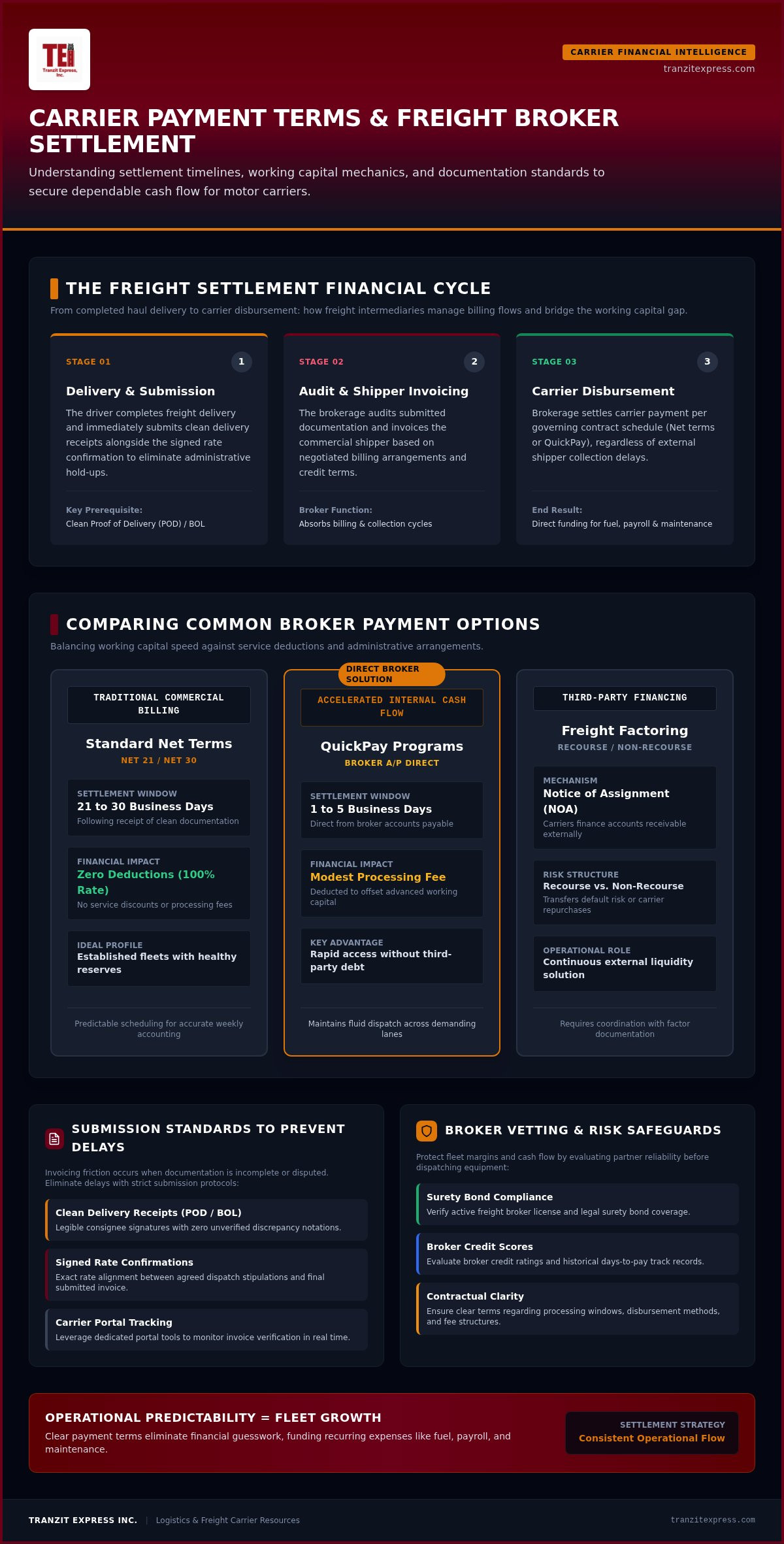
The freight payment cycle moves across a structured financial sequence designed to maintain supply chain continuity:
- Delivery and Submission: The driver completes delivery and promptly submits clean delivery receipts alongside the rate confirmation.
- Shipper Invoicing: The brokerage audits the documents and invoices the commercial shipper according to their agreed credit arrangements.
- Carrier Disbursement: The brokerage disburses payment to the motor carrier based on the governing contract timeline, regardless of external collection delays.
Shippers frequently negotiate extended billing cycles, meaning a well-capitalized freight brokerage often compensates carriers well before collecting customer funds. As detailed in our guide on what does a freight broker do, absorbing this working capital gap is a central duty of an experienced intermediary. When rate confirmations and final disbursements align seamlessly, administrative friction disappears and carriers can focus entirely on road performance.
Comparing Common Broker Payment Options: Net Terms, QuickPay, and Factoring
Selecting the right settlement structure requires balancing working capital speed against administrative costs. When reviewing the carrier payment terms freight broker partners offer, motor carriers generally encounter three primary models: standard credit terms, internal quick payment options, and third-party invoice factoring. Aligning these options with your fleet’s financial reserves ensures steady liquidity without eroding haul profitability.
Standard Net 30 and Net 21 Terms Explained
Standard terms represent traditional commercial billing, where settlement occurs 21 to 30 days after the brokerage receives clean documentation. For well-established carriers with healthy capital reserves, standard terms remain the preferred choice because they incur no service discounts or processing deductions. Predictable scheduled disbursements allow your accounting team to forecast revenue accurately across weekly operational cycles.
QuickPay Programs: Accelerating Cash Flow Direct from Brokers
QuickPay programs allow motor carriers to receive funds within one to five business days directly from the brokerage accounts payable department. To offset the cost of advancing working capital before collecting from commercial shippers, brokerages deduct a modest processing fee from the invoice total. This internal solution provides rapid access to revenue without third-party debt obligations, helping fleets maintain fluid dispatch schedules across demanding regional lanes.
Third-Party Freight Factoring and Notices of Assignment
Carriers frequently utilize independent factoring companies to finance accounts receivable. Under recourse factoring, the motor carrier assumes financial responsibility if a customer fails to pay; non-recourse arrangements transfer certain credit default risks directly to the factor. Once established, the factoring company issues a legal Notice of Assignment (NOA), directing all brokerage disbursements to the financing institution. If an unvetted intermediary defaults, carriers or their factors may eventually need to file a claim on a broker’s surety bond to recover owed revenue.
Unlike third-party factoring that controls all your receivable streams, establishing direct relationships with dependable logistics providers allows you to choose payment speeds flexibly per load. Partnering with a reliable brokerage like Tranzit Express gives motor carriers clear settlement paths and transparent load tracking, ensuring dependable revenue without unnecessary operational surprises.
Essential Documentation Required for Timely Freight Invoice Processing
Clean paperwork drives prompt freight settlements. Even under favorable carrier payment terms freight broker accounts payable teams cannot release funds until every delivery document is verified. The official clock on your payment timeline starts only when complete, legible records enter the billing system. Submitting blurry, incomplete, or unsigned receipts remains the leading cause of avoidable settlement delays across commercial shipping.
The Essential Paperwork: Rate Confirmations and Proof of Delivery
Expedited payment verification requires two core records submitted without discrepancies:
- Signed Rate Confirmation: The original agreement showing identical load numbers, agreed linehaul rates, and approved accessorial fees.
- Proof of Delivery (POD): A clean, legible Bill of Lading featuring the receiver’s full signature, printed name, date, and delivery timestamp.
Receiving docks often process dozens of trailers daily. If a consignee notes product exceptions, shortages, or damaged pallets on the delivery receipt without driver notification, billing audits halt instantly. Taking clear, well-lit digital scans directly from the cab prevents paperwork rejection and keeps your disbursement date on schedule.
Handling Accessorial Charges, Lumper Receipts, and Detention Approvals
Accessorial expenses represent a frequent point of billing friction when operational protocols aren’t strictly maintained. Securing compensation for detention, layovers, or driver assist requires real-time coordination:
- Detention Records: Written or portal-logged arrival and departure time stamps verified prior to departing the customer facility.
- Lumper Payments: Itemized, official unloading receipts showing the exact amount paid to third-party dock workers.
- Supplemental Confirmations: An updated, re-issued rate confirmation reflecting the revised total prior to final invoice submission.
Specialized handling protocols detailed in our review of dry van freight services demonstrate how strict delivery documentation protects carriers from arbitrary claim deductions. Understanding these paperwork standards mirrors the regulatory compliance enforced by the FMCSA Broker Financial Responsibility Rule, where transparent operational records provide the legal clarity needed to validate carrier payment rights across all commercial lanes.
How Motor Carriers Can Evaluate Freight Broker Credit and Financial Stability
Protecting your equipment and revenue requires vetting brokerage solvency before signing a rate confirmation. While understanding the carrier payment terms freight broker partners publish is essential, those terms are only as reliable as the financial stability backing them. Establishing a disciplined due diligence process prevents costly billing disputes and safeguards your fleet against potential insolvencies.
Verifying Operating Authority, Surety Bonds, and Credit Ratings
Evaluating financial stability starts with regulatory records and independent credit bureaus. Every legitimate broker must maintain active operating authority alongside the mandatory $75,000 surety bond or trust fund (BMC-84 or BMC-85). Check the FMCSA Licensing and Insurance portal to verify that this security remains active without pending cancellations.
Next, consult industry credit reports to review the firm’s historical performance. Look closely at these indicators:
- Credit Score Benchmarks: Scores between 87 and 100 signal low credit risk, while scores falling between 70 and 86 represent medium risk requiring closer attention.
- Days-to-Pay Averages: Confirm that historical disbursements align with the contracted timeline, ideally settling within standard 21-to-30-day windows.
- Company Longevity: Brokerages with decades of operating history demonstrate resilience through volatile freight cycles.
Recognizing Critical Warning Signs and Unreliable Payment Practices
Sudden operational changes often indicate underlying solvency pressures. Be cautious when a brokerage exhibits dramatic increases in days-to-pay metrics, sudden bond replacement notices, or unresponsive accounts payable staff. Scrutinize contractual language for “paid-when-paid” clauses, which condition your settlement on whether the shipper compensates the broker. Ethical brokerages assume customer credit risk directly rather than passing collection risks to carriers.
Leveraging Digital Carrier Portals for Real-Time Status Tracking
Modern logistics providers remove uncertainty by replacing manual phone queries with centralized technology. Dedicated carrier portal access allows dispatchers and billing managers to review invoice approval stages, upload delivery documents instantly, and confirm disbursement dates in real time.
To experience transparent freight operations backed by decades of proven financial dependability, partner with Tranzit Express for reliable dispatching and streamlined carrier portal management.
Building Sustainable Logistics Partnerships Through Dependable Payment Terms
Transportation is built on relationships where trust serves as the true operational currency. When evaluating the carrier payment terms freight broker contracts establish, professional fleets look well beyond a single invoice settlement. Predictable, friction-free payment structures transform routine transactional dispatching into durable operational partnerships. When accounts payable departments honor their commitments without delay, carriers gain the financial confidence required to commit continuous capacity across challenging market conditions.
Why Payment Predictability Benefits Shippers and Carriers Alike
Steady cash flow remains the foundation of a safe, compliant, and dependable trucking enterprise. When motor carriers receive scheduled settlements without surprise deductions or delays, they can reinvest directly into operational stability:
- Fleet Maintenance: Routine revenue supports proactive mechanical servicing, reducing costly roadside breakdowns and preserving high safety ratings.
- Driver Retention: Predictable company cash flow ensures drivers receive payroll on time, fostering long-term professional loyalty.
- Service Reliability: Financially sound carriers achieve exceptional on-time pickup and delivery percentages across demanding schedules.
Shippers benefit just as significantly from this stability. Commercial shippers depend on steady, dedicated capacity across multimodal van, flatbed, hot-shot, and intermodal freight corridors. When a brokerage treats carriers as valued partners by guaranteeing consistent settlements, qualified motor carriers prioritize those loads first, keeping national supply chains running smoothly.
Open Communication and Dedicated Support in Freight Settlements
Logistical operations rarely follow a completely predictable path. Unforeseen weather disruptions, facility delays, or documentation adjustments can complicate settlement calculations mid-transit. Navigating these exceptions requires direct human engagement rather than impersonal automated ticketing portals that leave drivers waiting for answers.
A dependable freight brokerage assigns experienced logistics coordinators who understand road realities and resolve billing questions promptly. Pairing responsive operational communication with transparent carrier portal access provides dispatchers with direct visibility into documentation review and payment releases. Clear communication removes administrative anxiety, establishing the mutual respect needed to build long-term, profitable logistics partnerships.
Strengthen Your Operations With Reliable Freight Broker Partnerships
Mastering freight finance requires disciplined paperwork habits, rigorous partner vetting, and selecting payment timelines that protect your operating margins. When motor carriers understand the carrier payment terms freight broker contracts establish, sudden cash flow bottlenecks give way to predictable revenue and steady operational growth.
A reliable logistics partner protects your hard work by delivering transparent communication and honoring every rate confirmation. Backed by over 25 years of steady, dependable nationwide logistics brokerage experience, Tranzit Express provides nationwide coverage across van, flatbed, intermodal, and hot-shot freight. Through our dedicated carrier portal access, your team enjoys real-time document submission and transparent invoice tracking that completely eliminates administrative uncertainty.
Partner with a dependable freight broker and access our dedicated carrier portal today. When your settlements arrive on time and every load is supported by experienced logistics professionals, you can focus on driving long-term success across every commercial lane.
Frequently Asked Questions
What are standard carrier payment terms in the freight brokerage industry?
Standard carrier payment terms freight broker contracts specify typically span 21 to 30 calendar days following the submission of clean delivery records. While standard Net 30 remains the industry baseline, some brokerages provide accelerated Net 15 schedules or extended terms. The settlement clock starts only after the accounts payable department logs and validates the completed Bill of Lading, signed rate confirmation, and all supporting accessorial documentation.
How does freight broker QuickPay differ from third-party factoring?
QuickPay is an internal brokerage program that disburses funds within one to five business days for a modest administrative deduction, applied on a load-by-load basis. Third-party factoring involves selling your accounts receivable to an outside financial institution under a comprehensive contract. Factoring redirects all brokerage payments to the factor via a legal Notice of Assignment, whereas QuickPay preserves a direct financial relationship between the carrier and the broker.
What happens if a freight broker fails to pay a carrier for a delivered load?
If a freight broker defaults on payment, the carrier can submit a formal claim against the broker’s mandatory $75,000 BMC-84 surety bond or BMC-85 trust fund. Federal regulations require brokers to replenish impaired financial security within seven calendar days or face authority suspension. Motor carriers also retain the legal right under transportation law to seek payment directly from the commercial shipper or consignee listed on the Bill of Lading.
Can a freight broker withhold carrier payment over minor paperwork errors?
A freight broker cannot legally withhold full carrier compensation indefinitely over trivial clerical errors, but administrative discrepancies can halt billing workflows. Incomplete delivery receipts, illegible signatures, or missing receiver date stamps prevent brokerages from invoicing their commercial customers. Submitting clean, high-resolution digital paperwork through dedicated carrier portals resolves exceptions quickly and keeps disbursements moving forward without avoidable payment deductions.
How do motor carriers check a freight broker’s credit score and payment history?
Motor carriers evaluate freight broker creditworthiness by reviewing commercial credit reporting agencies like Ansonia or TransCredit. These reporting platforms highlight average days-to-pay metrics, credit scores, and historical collection placements. Fleets should also verify active operating authority and ensure the mandatory $75,000 surety bond remains valid directly through the FMCSA Licensing and Insurance registry before accepting freight dispatch.
Is a Notice of Assignment required for every factored freight shipment?
Yes, a Notice of Assignment (NOA) is a legally binding document that factoring companies send to freight brokers before purchasing freight bills. The NOA legally instructs the brokerage to remit all current and future load disbursements directly to the factoring company. Brokers must acknowledge this assignment to avoid double-payment liability, ensuring every factored invoice processes according to the established carrier payment terms freight broker agreements outline.
How long does a freight broker have to process detention and accessorial charges?
Freight brokers typically audit accessorial charges alongside the primary linehaul invoice, provided the carrier reported the delay within designated contract windows. Most broker-carrier agreements require detention notifications within two hours of arrival, supported by validated facility timestamps. Once the broker verifies and issues an amended rate confirmation, approved accessorial amounts settle simultaneously with the linehaul balance under the load’s standard payment schedule.