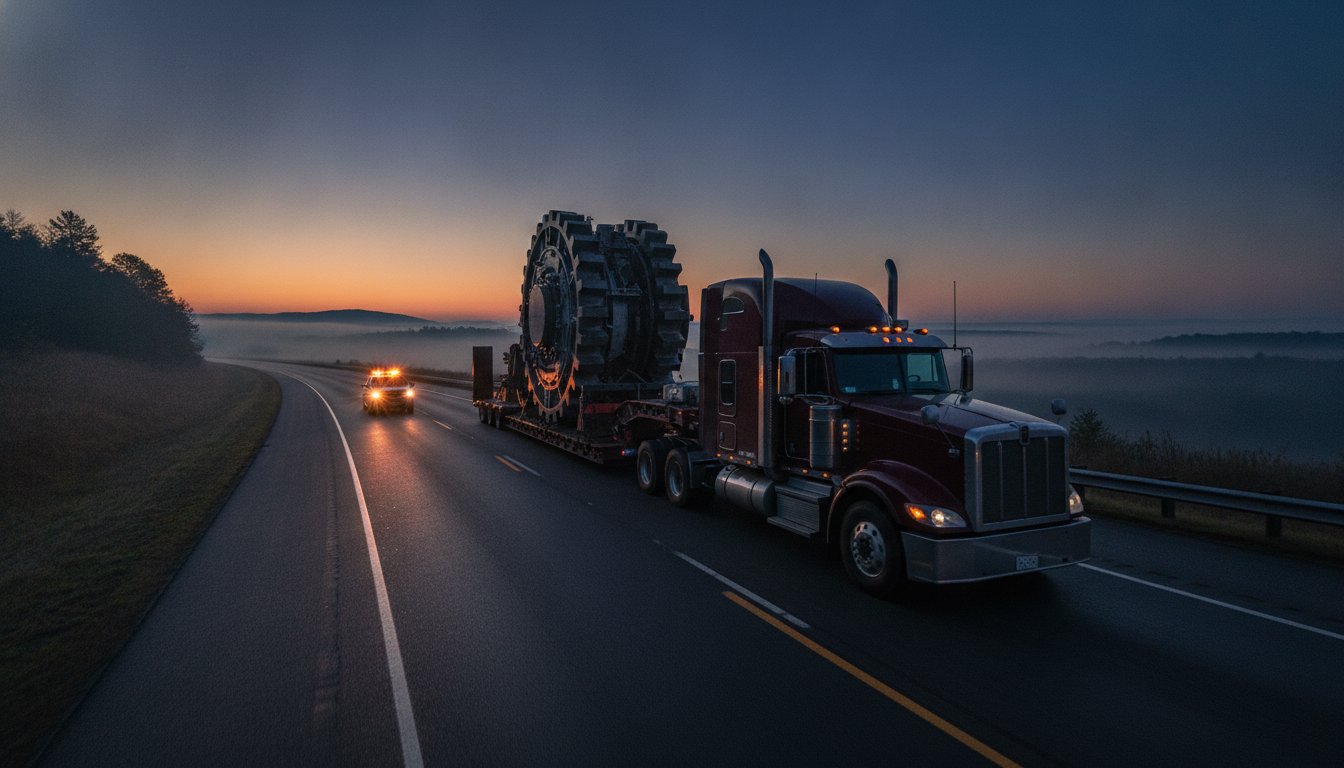
On March 5, 2026, flatbed tender rejections reached nearly 42 percent, which is a 35.5 percent increase from the previous year. This surge highlights just how volatile the market has become for shippers managing complex loads. Moving oversized flatbed freight isn’t just about finding a large truck; it’s about managing a fragmented regulatory environment where one missing permit can lead to costly delays or heavy fines. You likely feel the pressure of inconsistent state-by-state rules and the challenge of securing carriers who actually possess the specialized equipment and institutional knowledge required for heavy haul logistics.
This guide will help you master the complexities of over-dimensional shipping for 2026. We provide expert clarity on everything from legal dimension thresholds to the precise requirements for pilot cars and state-specific permits. You’ll gain a clear understanding of current legal limits, a streamlined approach to compliance, and the confidence to manage high-stakes shipments with a steady hand at the wheel. We’ll move through the essential equipment choices, permit processing timelines, and carrier compliance standards to ensure your cargo arrives safely and on schedule.
Key Takeaways
- Identify the exact 2026 legal dimension thresholds to determine if your shipment qualifies as an oversized load or a complex superload.
- Navigate the nuances of state-by-state permit regulations and learn exactly when pilot cars or police escorts become a legal requirement.
- Select the most appropriate specialized equipment for oversized flatbed freight to ensure maximum load stability and safety.
- Master cargo preparation techniques, such as precise weight distribution, to prevent axle-load violations and avoid unexpected transit delays.
- Understand how a veteran logistical partnership simplifies the administrative burden of permit scheduling and rigorous carrier vetting.
What Defines Oversized Flatbed Freight in 2026?
A shipment is classified as an Oversize load when its physical dimensions or weight exceed the standard legal limits for highway travel. In 2026, these federal and state standards remain the baseline for logistics planning. Generally, any cargo wider than 8.5 feet, taller than 8.5 feet on a standard trailer, or longer than 53 feet falls into the category of oversized flatbed freight. While these numbers seem straightforward, the transition from a standard load to an over-dimensional one immediately changes the operational requirements of the haul.
Distinguishing between a standard oversized load and a “superload” is a critical step for regulatory compliance. A standard oversized shipment might only require basic permits and amber lights. However, superloads are significantly larger, often exceeding 16 feet in width or height, and weighing over 150,000 pounds. These massive shipments demand a higher level of scrutiny, including bridge engineering studies and police escorts. Understanding these thresholds early helps avoid the shock of unexpected logistical hurdles during transit.
Legal Dimensions vs. Oversized Limits
Standard legal limits are designed to ensure safety and infrastructure protection. For most national highways, the Gross Vehicle Weight Rating (GVWR) is capped at 80,000 pounds. Even if your equipment isn’t wide or tall, exceeding this weight limit triggers overweight permit requirements. Precision is vital here. Even a few inches of rear overhang or a slight side bulge can reclassify your freight. This reclassification isn’t just a label; it dictates which roads the driver can use and what time of day they can travel. We always emphasize that “legal-to-ship” dimensions are the most cost-effective, but when your cargo exceeds them, accuracy in measurement becomes your best tool for budget control.
Common Industries Relying on Oversized Flatbeds
Several vital sectors depend on specialized heavy haul services to move the world’s most important assets. We see these requirements most often in:
- Construction: Moving massive excavators, cranes, and prefabricated bridge sections that simply cannot be broken down into smaller components.
- Energy: Transporting wind turbine blades, which can exceed 200 feet in length, and large-scale power transformers that weigh hundreds of thousands of pounds.
- Agriculture: Shipping modern combines and specialized harvesting equipment that often exceeds the 8.5-foot width limit.
Standard flatbeds are often insufficient for these items due to their deck height. Industrial machinery often requires a “step-deck” or “lowboy” trailer to keep the total height under the 13.5-foot or 14-foot clearance limits found on many bridges. Choosing the right trailer isn’t just about fitting the cargo; it’s about maintaining a low center of gravity for stability and ensuring the load stays within the legal vertical envelope of the planned route.
Navigating State Permits and Pilot Car Requirements
Transporting oversized flatbed freight across the United States is a study in regulatory variation. While the U.S. government provides a framework through Federal oversize/overweight regulations, the actual issuance and enforcement of permits remain a state-level responsibility. This creates a fragmented landscape where a load that is perfectly legal in one jurisdiction may become a restricted shipment the moment it crosses a state line. For shippers, this means that permit procurement isn’t a one-time task but a continuous process of coordination for every mile of the journey.
Permit types generally fall into three categories: single-trip, annual, and multi-state. Single-trip permits are the most common for heavy haul, covering a specific route from point A to point B. Annual permits are often reserved for loads that only slightly exceed legal limits on a recurring basis. In 2026, permit processing times remain a critical factor in project planning. We recommend submitting applications 7 to 10 business days in advance to avoid expedited fees or transit delays. During this time, state agencies review the proposed route for bridge clearances, construction zones, and weight-restricted roads.
Travel time restrictions add another layer of complexity. Most states prohibit the movement of over-dimensional loads during the night, on weekends, or during major holidays. Some metropolitan areas also enforce “curfew” hours, usually during morning and evening rush hours, to minimize traffic disruption. Failing to account for these windows can leave a driver sidelined for days, which is why a dependable logistics partnership is vital for maintaining a predictable schedule.
The Complexity of Multi-State Coordination
Inconsistent regulations mean a load legal in Tennessee might require additional permits or different signage in a neighboring state. A route survey is often mandatory for loads exceeding 14 feet in height or 12 feet in width. These surveys involve a physical drive-through of the route to identify low-hanging wires or narrow passages that aren’t listed on digital maps. Managing the approval timeline across multiple states requires a methodical approach to ensure every permit is active when the truck arrives at the border.
The Role of Escort Vehicles (Pilot Cars)
Pilot cars, also known as escort vehicles, become mandatory when a load reaches specific size thresholds, typically over 12 feet wide or 14.5 feet high. A “lead” car travels ahead of the truck to warn oncoming traffic and check clearances with a height pole. A “chase” car follows behind to prevent vehicles from passing in dangerous areas. These vehicles must be equipped with specialized amber lighting and specific signage. As of 2026, states like Florida, Texas, and Pennsylvania require pilot car drivers to hold specific certifications, making it essential to vet your escort teams as rigorously as your primary carrier.
Specialized Equipment for Oversized Flatbed Shipping
The standard 48-foot or 53-foot flatbed is the workhorse of the logistics industry, but it’s often the wrong tool for oversized flatbed freight. When cargo exceeds legal height, width, or weight limits, the trailer itself must become a specialized piece of engineering. Choosing the correct equipment isn’t just a matter of convenience. It directly impacts load stability, safety, and the specific permits required for the journey. A trailer with a lower deck height can often keep a tall load under the threshold that would otherwise require a pilot car with a height pole, effectively reducing both cost and complexity.
Matching your cargo’s weight and height to the appropriate trailer chassis is a technical requirement that demands precision. Industrial boilers, large transformers, and heavy manufacturing equipment require trailers with reinforced frames to prevent bowing under extreme stress. Beyond the trailer itself, specialized securement is the final line of defense. Heavy-duty chains, ratcheting binders, and high-capacity straps are used in combinations that exceed standard DOT requirements. This ensures that even the most awkward shapes remain immobile during transit, providing a sense of security for high-value assets.
RGN vs. Step-Deck: Which is Right for Your Load?
Choosing between a Removable Gooseneck (RGN) and a Step-Deck trailer depends largely on how the cargo is loaded and how much height clearance you need. An RGN allows the front of the trailer to be detached, creating a ramp for self-propelled machinery like excavators or bulldozers. Because the “well” of an RGN sits very close to the ground, it provides the maximum possible vertical clearance. In contrast, a Step-Deck features a raised front section and a lower main deck. While it doesn’t sit as low as an RGN, it’s more versatile for cargo that can be crane-loaded, providing an extra 20 inches of height clearance compared to a standard flatbed.
Stretch Flatbeds and Multi-Axle Trailers
For industrial components like wind turbine blades or structural steel beams, a standard trailer deck simply isn’t long enough. Stretch flatbeds can extend to accommodate these extra-long loads, though this significantly increases the turning radius and requires a highly skilled driver. When weight is the primary concern, multi-axle trailers are utilized to distribute the load across more points of contact with the road. This prevents damage to the pavement and ensures compliance with state-specific axle weight limits. Adding axles increases the complexity of the haul, but it’s the only way to safely move oversized flatbed freight that exceeds standard 80,000-pound limits.
Best Practices for Preparing Your Oversized Shipment
Success in moving oversized flatbed freight begins long before the driver arrives at your facility. It rests entirely on the accuracy of the data provided during the quoting and permitting phase. Even a minor discrepancy in the dimensions listed on a state permit can lead to an immediate stop-work order or heavy fines during a roadside inspection. Shippers must provide a detailed physical profile of the cargo. This ensures the carrier can match it with the correct equipment and obtain valid legal documentation for every state on the route.
Weight distribution is equally critical. It’s not enough to know the total weight. You must understand the center of gravity and how that weight will sit across the trailer’s axles. Overloading a single axle group can trigger a violation even if the total gross weight is within the permit’s limits. Providing a weight diagram for complex machinery helps the driver position the load correctly for maximum stability. This reduces stress on the equipment and ensures a smoother transit for sensitive industrial assets.
Clear documentation is the final piece of the preparation puzzle. The driver must carry physical or digital copies of every state permit required for the journey, alongside a detailed Bill of Lading. Ensuring these documents are ready at the time of pickup prevents unnecessary idling and keeps the project on its methodical schedule. To ensure your next high-stakes load is handled with precision, you can access our shipper portal to track carrier compliance and documentation in real-time.
Measuring Your Cargo for Permit Accuracy
Measure from the absolute widest and highest points, including small protrusions like mirrors, exhaust stacks, or bolt heads. Once you have the cargo’s height, add the height of the trailer deck. A 10 foot tall piece of equipment on a standard 5 foot flatbed deck creates a 15 foot total height. Never round down on permit applications. If a load is 12 feet 2 inches wide, it should be permitted at 12 feet 3 inches.
Site Preparation and Safety Protocols
Industrial sites often have tight corners or narrow gates not designed for a 100 foot long stretch trailer. Verify that the pickup and delivery points have enough space for these large vehicles to maneuver safely. If you are shipping non-propelled cargo, ensure that cranes or heavy-duty forklifts are on-site and rated for the specific weight. Communicating these site requirements early allows the carrier to plan their arrival without risking property damage.
Why a Reliable Freight Broker is Essential for Oversized Loads
Managing the logistics of oversized flatbed freight requires a level of oversight that goes far beyond standard transportation. It’s a high-stakes environment where a single administrative error can halt a multi-million dollar project. This is where a veteran freight broker provides value, acting as a buffer between the complexity of state regulations and your operational goals. By handling the heavy lifting of permit acquisition and pilot car scheduling, a broker allows you to focus on your core business while maintaining complete confidence in your supply chain.
A reliable partner ensures that every carrier assigned to your load has the specific heavy-haul insurance required for high-value machinery. Standard cargo insurance often falls short when dealing with over-dimensional assets. We verify that our partners maintain the appropriate coverage limits and safety ratings to protect your investment from origin to destination. This meticulous approach to compliance is a hallmark of a professional B2B partnership, providing a sense of order in a complex industry.
Vetting Carriers for Heavy Haul Expertise
Not every carrier with an open-deck trailer is qualified to move specialized loads. True heavy haul expertise involves a deep understanding of weight distribution, specialized securement, and the physical limits of the equipment. We use our 25 years of institutional knowledge to identify carriers who have a proven track record in this niche. Knowing how to vet a freight broker and their carrier network is the first step toward a successful shipment. We look for drivers who have handled similar dimensions and weights, ensuring they possess the technical skill to manage the increased turning radiuses and clearance issues discussed earlier.
Streamlining Logistics with Tranzit Express
At Tranzit Express, we provide a steady hand at the wheel for your most challenging projects. Our oversized flatbed freight solutions are built on a foundation of clear communication and technological visibility. Through our dedicated shipper portal, you can access real-time tracking and digital copies of all necessary permits. This transparency reduces the stress of high-stakes logistics and provides a clear record of compliance. Whether you’re moving construction equipment or energy infrastructure, our flatbed freight services USA network offers the national coverage and specialized expertise you need for a seamless experience. We prioritize the fulfillment of our promises, ensuring that your cargo moves through the regulatory maze with methodical precision.
Securing Your Heavy Haul Success in 2026
Moving oversized flatbed freight shouldn’t be a source of operational stress. By mastering the 2026 legal thresholds and identifying the specific equipment required for heavy haul, you’ve taken the most important step toward a successful shipment. Precision in measurement and a proactive approach to state permits ensure that your cargo moves without the threat of fines or unexpected delays. These foundational practices create a sense of order in an otherwise complex logistical environment.
At Tranzit Express, we offer the quiet confidence that comes from over 25 years of logistics excellence. Our national carrier network is rigorously vetted for technical expertise; meanwhile, our dedicated shipper and carrier portals provide the real-time visibility you need for high-stakes projects. We act as a steady hand at the wheel, managing the complex administrative burden so you can focus on your core business goals. When you’re ready to move your next over-dimensional load with a partner who values reliability above all else, we’re here to guide you.
Request a Dependable Oversized Freight Quote
We look forward to building a long-term partnership that brings consistency and excellence to your heavy haul operations.
Frequently Asked Questions
What are the standard legal dimensions for flatbed freight?
Standard legal dimensions for flatbed freight are 8 feet 6 inches in width, 8 feet 6 inches in height, and a trailer length of 48 to 53 feet. Additionally, the gross vehicle weight must not exceed 80,000 pounds. Exceeding any of these metrics transitions your shipment into the category of oversized flatbed freight, requiring specific state permits and potentially specialized equipment to maintain road safety.
How long does it take to get an oversized freight permit?
You should typically allow 7 to 10 business days for the permit approval process. While some routine permits are issued within 3 days, complex multi-state routes or superloads can take 10 days or longer. Submitting your application early helps you avoid expedited fees. It also ensures that all necessary route surveys are completed before the truck is scheduled to depart for its destination.
When is a pilot car required for an oversized load?
A pilot car is generally required when a load exceeds 12 feet in width, 14 feet 6 inches in height, or 90 to 100 feet in length. Many states mandate two pilot cars, a lead and a chase vehicle, for loads that exceed 14 feet in width. These escort vehicles are essential for alerting oncoming traffic and verifying vertical clearances in real-time to prevent bridge strikes.
Can oversized loads travel at night or on weekends?
Most states prohibit oversized loads from traveling at night, on weekends, or during major holidays to maintain public safety. Additionally, many metropolitan areas enforce curfew hours during morning and evening rush hours. These restrictions vary significantly by state, so we carefully review each permit. This ensures your driver adheres to the specific legal travel windows for every jurisdiction on the route.
What is the difference between oversized and superload freight?
The primary difference lies in the scale of the cargo and the level of regulatory scrutiny. While oversized flatbed freight exceeds standard legal limits, a superload is a massive shipment that often exceeds 16 feet in width or 150,000 pounds. Superloads require more than just basic permits. They often demand bridge engineering studies, utility coordination, and police escorts to ensure the infrastructure can support the weight.
How much does oversized freight shipping cost compared to standard?
Shipping oversized cargo is more expensive than standard flatbed freight due to several factors. You must account for the cost of state permits, pilot car fees, and specialized trailers like RGNs or stretch decks. Specialized drivers also command higher rates for their expertise. The increased fuel consumption of heavy haul equipment adds to the total investment, reflecting the higher level of coordination and risk management involved.
Do I need special insurance for shipping oversized cargo?
Yes, shipping oversized cargo often requires higher insurance limits than standard freight. Most heavy-haul shipments involve high-value industrial assets that exceed the typical 100,000 dollar cargo insurance policy. We vet every carrier in our network to ensure they carry the specialized riders and increased coverage limits necessary to protect your specific load. This provides an essential layer of security for your high-stakes logistics.
What happens if my oversized load is measured incorrectly?
If an oversized load is measured incorrectly, the state permit becomes legally void. This often results in heavy fines and an immediate stop-work order at a weigh station or roadside inspection. The driver may be forced to wait days for a new permit to be issued, leading to significant transit delays. We emphasize the importance of precise measurements from the widest and highest points to maintain regulatory compliance.