
Did you know that flatbed tender rejections reached nearly 42 percent in early 2026? In a market defined by tightening capacity and new regulatory shifts like the updated broker bond requirements, simply chasing the lowest bid is no longer a viable strategy for your supply chain. You likely feel the frustration of unpredictable accessorial fees and the silence from brokers when specialized trailers are hardest to find. Finding reliable flatbed shipping cost saving tips requires a shift from transactional bidding toward a more disciplined, long-term logistics plan.
At Tranzit Express Inc., we understand that your primary goal is to bring order to the complexity of open-deck transport. This article promises to help you master the art of reducing expenses through expert equipment matching, lane optimization, and professional brokerage partnerships that prioritize transparency. We will walk through a strategic checklist for 2026 that focuses on stabilizing your budget, leveraging portal visibility to reduce administrative burdens, and securing a steady hand at the wheel for your most complex routing needs.
Key Takeaways
- Identify the 2026 market drivers, including fuel volatility and equipment shortages, to build a more resilient and predictable logistics budget.
- Utilize professional brokerage networks to secure “backhaul” opportunities, connecting your freight with carriers seeking efficient return routes to their home terminals.
- Apply essential flatbed shipping cost saving tips such as optimizing load dimensions and choosing no-tarp options to minimize expensive accessorial fees.
- Evaluate strategic mode selections, comparing standard flatbed services with Hot-Shot or Intermodal options to find the most cost-effective fit for your specific cargo volume.
- Partner with a veteran provider like Tranzit Express Inc. to gain real-time visibility through a dedicated shipper portal and ensure on-time delivery.
Factors Driving Flatbed Shipping Costs in 2026
Flatbed shipping is a specialized logistics mode designed for cargo that cannot be loaded into a standard dry van due to its size, weight, or the need for side-access loading. To understand what is a flatbed truck and why it commands specific pricing, one must look at the unique requirements of open-deck transport. These trailers carry everything from structural steel to heavy machinery, requiring drivers who are experts in load securement and safety. For those moving specialized cargo, understanding flatbed freight services USA is the first step toward better budget management.
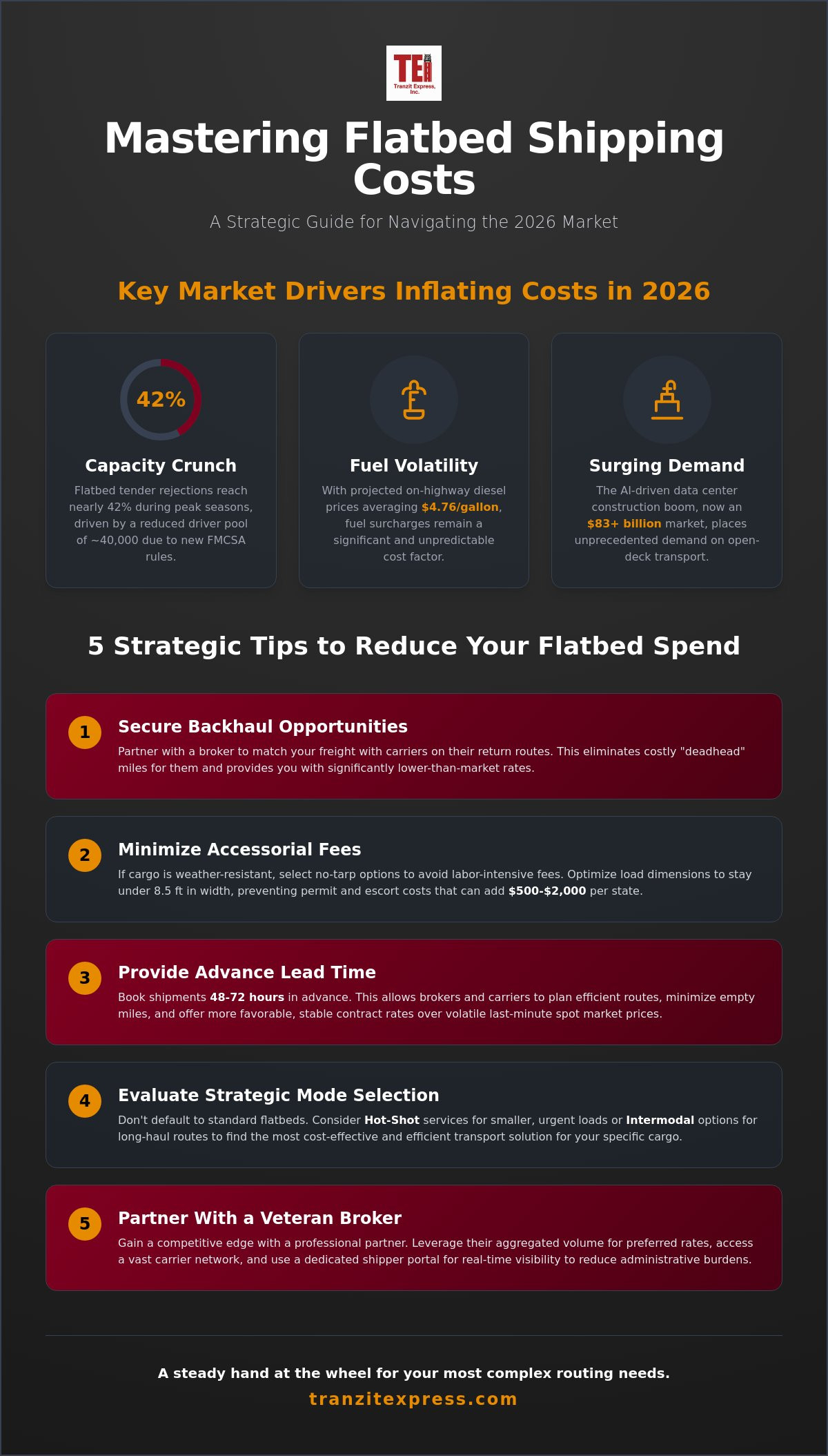
In 2026, the market is influenced by several distinct drivers. Fuel costs remain a primary concern, with the EIA projecting an average on-highway diesel price of $4.76 per gallon. Additionally, capacity has tightened due to the FMCSA Non-Domiciled CDL rule, which took effect in February 2026 and reduced the pool of eligible drivers by approximately 40,000. Demand is also being pushed to new heights by the AI-driven data center construction boom, a market now valued at over $83 billion. These factors make the search for flatbed shipping cost saving tips a priority for high-volume shippers.
Geography also plays a significant role in your final invoice through “deadhead” miles. If a carrier must travel empty for a long distance to reach your pickup location, those costs are factored into your rate. Shippers must also distinguish between the linehaul rate, which is the base price for transit, and the total landed cost. The latter includes fuel surcharges and various accessorial fees that can quickly inflate a budget if they aren’t managed with a steady hand at Tranzit Express Inc.
The True Cost of Accessorials and Specialized Equipment
Accessorials are the specific services required to protect and secure your freight. Common add-ons include tarping, strapping, and the use of corner protectors. Tarping is particularly labor-intensive for drivers and often carries a significant fee. If your cargo requires specialized trailers like Removable Goosenecks (RGNs) or Double Drops, you will pay a premium for that equipment. Oversized loads exceeding 8.5 feet in width may require state permits and escort vehicles, which can add between $500 and $2,000 per state to the total bill.
Market Capacity and Seasonal Fluctuations
National flatbed capacity follows the rhythm of the construction and infrastructure seasons. When projects ramp up in the spring, tender rejections often spike as carriers prioritize high-volume contracts. In 2026, we have seen flatbed tender rejections reach over 41 percent during peak periods. Shippers can find flatbed shipping cost saving tips by shifting away from the volatile spot market toward more stable contract rates. Providing a lead time of 48 to 72 hours often secures more favorable pricing than last-minute requests, as it allows carriers to better plan their routes and minimize empty miles.
How Professional Brokerage Expertise Secures Better Rates
While many shippers focus on individual lane prices, professional brokers look at the broader logistics ecosystem to uncover hidden efficiencies. One of the most effective flatbed shipping cost saving tips involves the “backhaul” strategy. Carriers often struggle with “deadhead” miles, where they travel empty after a delivery to reach their next load or home terminal. A seasoned broker uses their network to identify these carriers, matching your freight with a driver who is already headed in that direction. This creates a win-win scenario: the carrier covers their fuel costs, and you secure a rate significantly lower than the standard market price.
The regulatory environment also plays a quiet but powerful role in overhead. As federal agencies weigh various regulatory proposals impacting shipping costs, a professional partner acts as a buffer against volatility. By aggregating volume from a diverse client base, brokers negotiate “preferred” rates with national carriers that an individual shipper simply couldn’t access. This collective bargaining power, backed by 25 years of industry relationships, ensures that your cargo moves even when capacity is tightest. It’s about having a steady hand at the wheel when the spot market becomes unpredictable.
Operational stability is equally dependent on rigorous carrier compliance. A single delay due to an unvetted driver or expired insurance can cost thousands in lost productivity. Expert brokers maintain strict safety and insurance standards, shielding you from the financial risks of equipment failure or legal complications. This level of oversight is a cornerstone of a reliable B2B partnership, moving the focus from a simple transaction to long-term cost containment. When time-sensitive shipments are at stake, partnering with a qualified expedited freight broker adds an additional layer of protection against the costly disruptions that unvetted carriers can cause.
Leveraging Network Density for Cost Efficiency
Network density refers to the volume of freight moving through specific geographic hubs. When a broker has high density in your region, they can seamlessly match your cargo to a carrier’s existing route, reducing the need for expensive specialized pickups. This steady flow of information prevents carrier fall-offs, as drivers prefer working with brokers who provide consistent, well-organized loads. It’s a methodical approach that replaces the stress of the spot market with predictable, repeatable results.
Administrative Savings through Technology
Modern logistics tools offer more than just tracking; they provide significant administrative relief. A dedicated shipper portal reduces the labor hours spent on manual documentation and phone calls. Automated reporting helps you identify which lanes are consistently over budget, allowing for data-driven optimization. By providing “all-in” quoting, a professional broker ensures that the price you see is the price you pay, eliminating the post-delivery invoice surprises that often plague open-deck shipping. Understanding how to secure an accurate freight quote online from a vetted provider is an essential skill for any shipper looking to eliminate hidden fees and maintain budget control.
Checklist: 5 Strategic Flatbed Shipping Cost Saving Tips
Controlling your logistics spend requires a methodical approach that goes beyond simply accepting the initial quote. By implementing a structured checklist, you can eliminate waste and ensure your freight moves with the highest level of efficiency. These flatbed shipping cost saving tips are designed to help you regain order in a complex market, focusing on practical adjustments that yield measurable results.
- Optimize Load Dimensions: Keep your cargo within standard limits whenever possible. Staying under 8.5 feet in width and 13.5 feet in height prevents the need for expensive over-dimensional permits and escort vehicles.
- Utilize No-Tarp Options: If your freight is weather-resistant, such as certain raw materials or industrial components, skip the tarping request. This reduces the driver’s labor time and eliminates the associated accessorial fee.
- Consolidate for Hot-Shot Loads: For smaller or partial shipments that don’t require a full 48-foot or 53-foot trailer, consider a Hot-Shot service. This is often more cost-effective for urgent, compact loads that still require an open deck.
- Schedule Mid-Week Pickups: Plan your shipments for Tuesday through Thursday. Avoiding the Monday rush and Friday’s last-minute capacity crunch helps you stay away from the weekend premiums often found on the spot market.
- Leverage Multi-Mode Options: For long-haul routes, ask your partner about intermodal transportation solutions. Combining rail and road for non-urgent freight can significantly lower your price per mile over long distances.
Precise Equipment Matching
Using a standard 53-foot flatbed for a load that only takes up 20 feet of deck space is a common budget leak. A steady hand at the wheel means matching the equipment exactly to the cargo. For example, if your freight is too tall for a standard flatbed, a step-deck trailer allows the cargo to sit lower to the ground. This prevents the need for height permits while ensuring the load remains stable. Matching the trailer deck height to your loading dock also speeds up the process, reducing the risk of site delays.
Proactive Communication and Lead Time
Clear communication is a cornerstone of a dependable partnership. Providing flexible pickup windows can often lower your rates by 10% to 15% because it allows carriers to slot your freight into their most efficient routes. Furthermore, precise weight reporting is essential; it prevents the expensive fines and re-weighing fees that occur when a truck is found to be over the 80,000-pound gross weight limit at a scale house. By documenting every detail early, you avoid detention charges, which typically begin after just two hours of waiting at a facility. Precise data ensures a seamless experience for the driver and a predictable bill for you. When you’re ready to put these principles into action, working with a professional to obtain a reliable freight quote online ensures that the estimate you receive reflects your cargo’s true requirements and protects you from post-delivery surprises.
Strategic Mode Selection: Flatbed vs. Hot-Shot vs. Intermodal
One of the most effective flatbed shipping cost saving tips is recognizing that a standard 48-foot or 53-foot trailer isn’t always the most economical choice for every load. While flatbed freight services USA provide the backbone of open-deck logistics, specialized modes often offer a better price-per-mile for specific cargo profiles. A dependable brokerage partner uses institutional knowledge to evaluate your freight’s weight, dimensions, and urgency to select the most appropriate mode, ensuring you don’t pay for capacity you don’t use.
For long-distance hauls exceeding 1,000 miles, rail-based intermodal can slash costs compared to traditional over-the-road (OTR) shipping. Rail transport is significantly more fuel-efficient, which helps insulate your budget from the projected 2026 diesel average of $4.76 per gallon. A professional broker manages the entire multi-mode transition, including the “drayage” legs at the beginning and end of the journey, providing a seamless experience that mirrors a standard truckload delivery.
Choosing the right mode requires a steady hand at the wheel and an understanding of how different equipment impacts the final bill. To see how these strategic selections can stabilize your logistics budget, request a custom flatbed quote from our team.
Hot-Shot Trucking: The Small Load Cost Saver
When you have urgent, smaller, or partial loads, hot shot trucking is often the superior choice. This mode utilizes smaller Class 3 to 5 trucks with flatbed trailers, which are more fuel-efficient and incur lower toll costs than heavy-duty tractor-trailers. Hot-shot is particularly effective for freight weighing under 15,000 lbs. These smaller trailers offer exceptional “last-mile” efficiency in congested national hubs where larger equipment might struggle to navigate, providing a faster and more cost-effective solution for specialized cargo. For shipments where timing is critical and delays carry serious operational consequences, an expedited freight broker can provide the vetted carrier network and proactive communication needed to protect your production schedule.
Intermodal: Long-Haul Reliability and Savings
Intermodal shipping combines the cost-effectiveness of rail with the flexibility of trucking. This mode is best suited for heavy, non-urgent flatbed freight such as raw steel, lumber, or construction materials. By moving the long-haul portion of the trip via rail, shippers can achieve consistent pricing even during seasonal capacity crunches. Your brokerage partner handles the complex coordination of the drayage drivers, ensuring that the transition from rail yard to the final job site is handled with professional precision and clear communication.
Why Tranzit Express is the Reliable Choice for Flatbed Savings
Securing a competitive rate is only half the battle in open-deck logistics. The other half is ensuring that your freight actually moves on time and without hidden costs. At Tranzit Express Inc., we’ve spent over 25 years acting as a steady hand at the wheel for our clients. In a market where 2026 tender rejections have reached record highs, our institutional knowledge allows us to anticipate disruptions before they impact your bottom line. We don’t just provide a service; we build a partnership that prioritizes your peace of mind and long-term budget stability.
Transparency is a core component of our approach. Many of the flatbed shipping cost saving tips we’ve discussed, such as identifying high-cost lanes and optimizing lead times, are made easier through our dedicated shipper portal. This tool provides real-time visibility and automated reporting, allowing you to maintain control over your logistics spend without the administrative burden of manual tracking. By combining veteran expertise with modern portal access, we ensure that every shipment is handled with professional precision.
A Dependable Partnership for National Logistics
Our national carrier network is rigorously vetted for safety and compliance, which is essential given the regulatory shifts we’ve seen in early 2026. We understand the specific requirements of flatbed, step-deck, and RGN equipment, ensuring that your cargo is matched with the right trailer every time. This proactive management reduces the stress of specialized shipping. Whether you’re dealing with the complexity of oversized infrastructure components or the urgency of a smaller construction load, our team provides the consistent communication you need to keep your projects on schedule.
We don’t believe in the “one size fits all” approach found in many modern brokerage models. Instead, we focus on the human element of logistics, leveraging our deep industry relationships to secure capacity even during peak seasons. This methodical, results-oriented focus has made us a trusted partner for businesses across the country who value reliability over marketing hype.
Get Your Strategic Flatbed Quote Today
Requesting a quote should be a simple, professional process. Whether you need standard flatbed shipping, urgent hot-shot loads, or long-haul intermodal transportation, our team is ready to provide a comprehensive solution tailored to your needs. We also offer reliable van freight services for your enclosed cargo requirements. We invite you to experience the difference that 25 years of experience can make for your supply chain. Take the first step toward predictable costs and seamless routing by visiting our portal today.
Request a Reliable Flatbed Shipping Quote from Tranzit Express Inc.
Secure Your Logistics Future with Strategic Planning
Navigating the complexities of the 2026 freight market requires more than just reacting to spot rates. It demands a disciplined approach that combines equipment optimization with deep industry expertise. By implementing these flatbed shipping cost saving tips, you can move away from unpredictable fees and toward a more stable, order-driven logistics model. Whether you’re transitioning to intermodal for long-haul savings or utilizing hot-shot services for smaller loads, every decision should be backed by data. Steady hands build trust.
Tranzit Express brings over 25 years of institutional knowledge and a vetted national carrier network to every partnership. Our specialized shipper portal provides the visibility you need to eliminate administrative waste and maintain total cost control. We’re here to act as a reliable guide, ensuring your freight moves with consistency and professional excellence. When you’re ready to stabilize your supply chain and reduce the stress of open-deck transport, our team is standing by.
Request a Reliable Flatbed Shipping Quote from Tranzit Express
Frequently Asked Questions
How much can I save by switching from standard flatbed to Hot-Shot trucking?
Switching to Hot-Shot trucking can offer noticeable savings for cargo weighing under 15,000 lbs. Because these smaller Class 3 to 5 trucks are more fuel-efficient and incur lower tolls, they provide a leaner alternative to full-sized tractor-trailers. This mode is particularly effective for urgent, partial loads that don’t require the expansive deck space of a standard 53-foot trailer. It’s a practical way to avoid paying for unused capacity.
What are the most common hidden fees in flatbed shipping?
The most common additional costs are accessorial fees for tarping, strapping, and detention. Detention charges usually start after just two hours of waiting at a facility. Additionally, if your cargo dimensions aren’t reported with precision, you might face unexpected costs for over-dimensional permits or escort vehicles. Providing exact measurements during the quoting stage is one of the most effective flatbed shipping cost saving tips for any professional shipper.
Is intermodal shipping safe for specialized or oversized flatbed freight?
Intermodal shipping is a safe and reliable choice for many types of open-deck freight, particularly heavy materials like steel and lumber. While it’s not suitable for every oversized load due to rail clearance limits, it offers a secure environment for long-distance transit. A professional broker manages the transitions between rail and road, ensuring your cargo is handled with a steady hand during every leg of the journey.
How much lead time is required to get the best flatbed shipping rates?
Providing a lead time of 48 to 72 hours typically secures the most competitive rates. This window allows your brokerage partner to look beyond the volatile spot market and find carriers with existing backhaul needs. When you offer flexibility in your pickup window, you make your freight more attractive to carriers, which often results in a lower linehaul rate compared to same-day requests. Planning ahead is essential for budget stability.
Does Tranzit Express provide real-time tracking for flatbed loads?
We provide comprehensive real-time visibility through our specialized shipper portal. This technology allows you to track your flatbed loads at every stage of the journey, reducing the need for manual check-calls and administrative follow-ups. By offering clear communication and transparency, we aim to reduce the stress associated with complex routing and ensure you always have an accurate picture of your shipment’s status and delivery timeline.
Are tarps and straps included in the initial flatbed quote?
Securement tools like straps and chains are typically included in the base rate, but tarping is almost always an additional accessorial charge. The price of tarping reflects the driver’s labor and the equipment required to protect your freight from the elements. If your cargo is weather-resistant, opting for a no-tarp shipment is a direct way to lower your total landed cost and speed up the loading process at the shipper’s facility.
What information do I need to provide for an accurate flatbed freight quote?
To receive an accurate quote, you must provide the precise length, width, height, and gross weight of your cargo. You should also specify the pickup and delivery locations, the required trailer type, and any necessary accessorials like tarps. Accurate data prevents the post-delivery invoice surprises that occur when a load is heavier or larger than initially reported. Providing this detail early is a cornerstone of effective flatbed shipping cost saving tips.
Why is carrier compliance a factor in my total shipping cost?
Carrier compliance is a critical factor because it protects you from the financial risks of delays and legal liabilities. A carrier that isn’t properly vetted for insurance and safety standards can cause site accidents or equipment failures that stop your project in its tracks. By working with a partner who prioritizes rigorous compliance, you ensure that your freight is moved by professionals who meet the highest industry standards, preventing expensive disruptions.