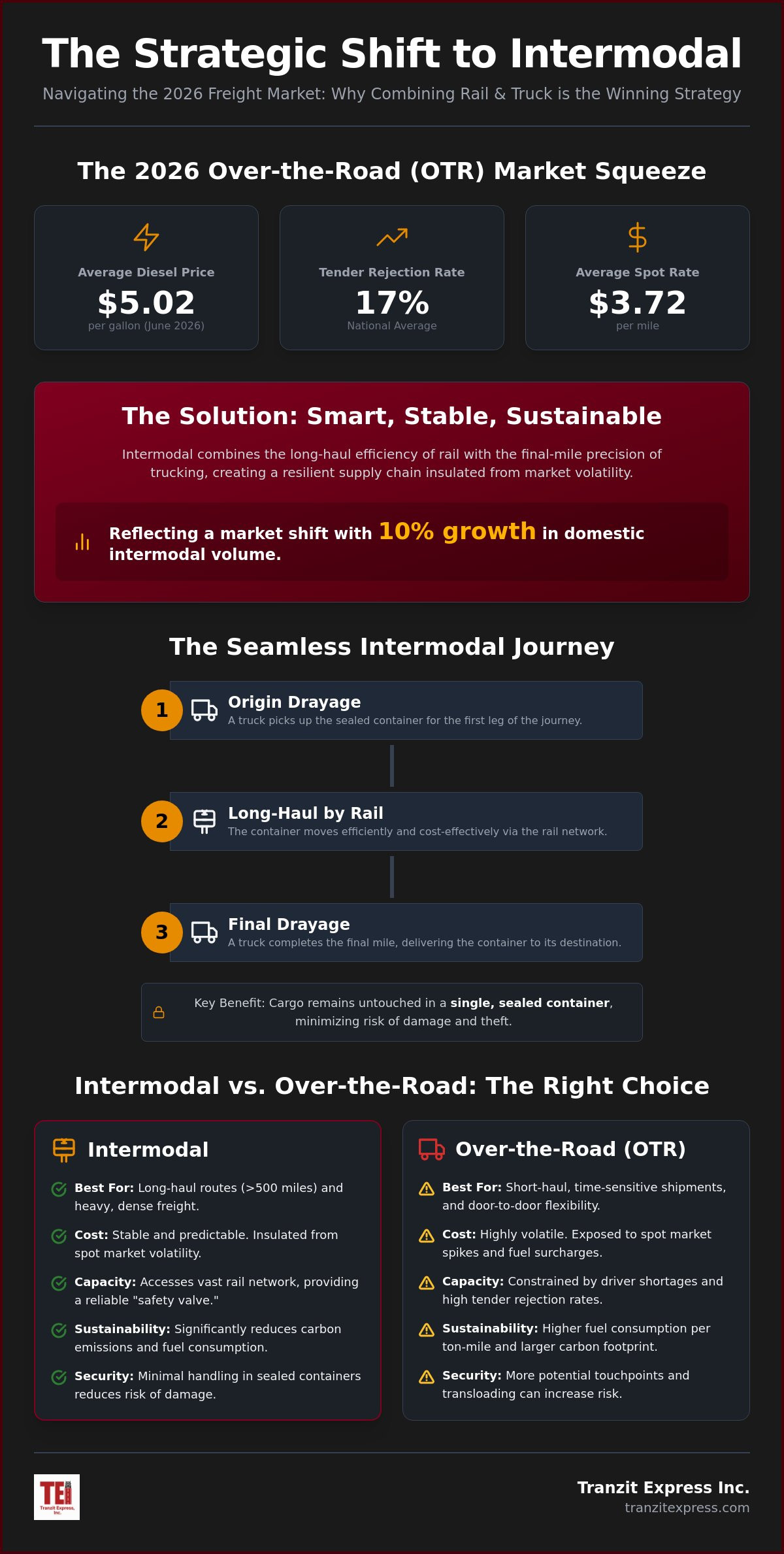
With diesel prices reaching an average of $5.02 per gallon in June 2026 and national truckload tender rejection rates hitting 17%, the traditional reliance on over-the-road shipping has become a significant financial risk. You’re likely managing the pressure of spot rates that are nearing $3.72 per mile while simultaneously answering to corporate mandates to reduce carbon emissions. It’s a complex balancing act that requires a dependable, long-term strategy rather than a series of reactive fixes.
We understand that stability is your priority in this tightening market. This guide shows you how intermodal transportation solutions can streamline your national supply chain, offering a way to secure capacity and reduce costs without sacrificing reliability. You’ll discover how the current 10% growth in domestic intermodal volume reflects a broader shift toward more resilient logistics. We will walk through the specific cost advantages of rail, the latest regulatory updates from the EPA, and the practical steps to integrate these modes into a seamless, professional partnership that protects your bottom line and provides a steady hand at the wheel for your distribution needs.
Key Takeaways
- Learn how to combine the long-haul efficiency of rail with the precise reach of trucks to create a more stable supply chain.
- Discover how intermodal transportation solutions can reduce carbon emissions while providing a cost-effective alternative for routes exceeding 500 miles.
- Master the logistics of the intermodal process, including the critical roles of origin drayage and the long-distance rail line haul.
- Evaluate whether your cargo is better suited for rail or over-the-road trucking based on weight requirements and national capacity trends.
- Understand the value of a dependable logistics partnership in managing complex rail carrier relationships and securing equipment during market shifts.
Understanding Intermodal Transportation Solutions: More Than Just Rail and Road
Intermodal shipping is often simplified as just a combination of rail and road, but in 2026, it represents a sophisticated response to a volatile freight market. At its core, intermodal freight transport involves the movement of goods in a single, sealed container using multiple modes of transportation. This approach prioritizes the inherent strengths of each mode. Long-haul rail provides exceptional fuel efficiency and stable pricing, while trucks offer the necessary precision for door-to-door delivery. As national logistics costs continue to rise, these intermodal transportation solutions have transitioned from a niche alternative to a primary strategy for resilient supply chains.
The evolution of this mode in 2026 is driven by necessity. With truckload capacity tightening and fuel prices remaining unpredictable, the ability to shift the bulk of a journey to rail is no longer just an option; it’s a requirement for maintaining a competitive edge. This shift reflects a deeper philosophy in modern logistics: leveraging the industrial scale of rail networks to handle the heavy lifting while maintaining the flexibility of local drayage for the first and last mile. It’s a balanced system designed to provide order and predictability in an increasingly complex industry.
The Anatomy of an Intermodal Move
The success of this method relies on the “sealed unit” concept. Once your freight is loaded into a standardized 53-foot domestic container, it remains untouched until it reaches its final destination. This lack of cargo handling between modes is a primary security feature that distinguishes it from traditional transloading. By eliminating the need to move individual pallets or items between a trailer and a railcar, shippers significantly reduce the risk of damage and theft. In the current high-stakes environment, this level of consistency provides the peace of mind that professional logistics managers require.
Intermodal vs. Multimodal: Clearing the Confusion
While the terms are often used interchangeably, the distinction lies in the contractual structure and the level of control. Multimodal transportation typically involves a single contract with one carrier who takes full responsibility for the entire journey. In contrast, intermodal shipping allows for separate contracts for each leg of the trip. This structure offers greater flexibility, especially during peak seasons when capacity is tight. Shippers can work with specialized providers to optimize each segment of the route, ensuring that every mile is managed by the most capable hands.
Intermodal is a strategy that keeps cargo in a single vessel from origin to destination. This method is particularly effective for heavy loads and long-distance hauls where rail infrastructure can absorb the burden that would otherwise strain over-the-road capacity. By 2026, the digital integration between rail terminals and drayage carriers has matured, making intermodal transportation solutions a seamless experience that mirrors the visibility and speed of traditional trucking. It’s a dependable partnership between modes that keeps your supply chain moving forward without the stress of constant market fluctuations.
The Strategic Advantages of Intermodal Freight: Efficiency, Cost, and Sustainability
Choosing the right logistics strategy requires looking beyond the immediate shipment. While over-the-road (OTR) trucking offers speed, intermodal transportation solutions provide a level of strategic stability that is difficult to match in a volatile market. By shifting long-haul freight to rail, you insulate your supply chain from the sharp fluctuations of the trucking spot market. This approach acts as a critical safety valve, especially when national tender rejection rates climb and available drivers become scarce. It’s about creating a predictable flow for your goods that doesn’t depend on the daily whims of OTR capacity.
The reliability of rail also brings a level of pricing consistency that high-volume shippers value. Unlike the truckload spot market, which can see rapid price spikes, rail rates are projected to remain in the low single digits for most of 2026. This stability allows you to plan your quarterly and annual budgets with greater confidence. When you partner with a seasoned expert to manage these lanes, you’re not just moving freight; you’re securing a dependable future for your distribution network.
Economic Benefits: Improving Your Bottom Line
The economic advantages of rail typically become most apparent on routes exceeding 500 miles. At this distance, the fuel efficiency of rail starts to significantly outweigh the flexibility of OTR. With diesel prices averaging $5.02 per gallon in June 2026, the fuel-saving profile of rail becomes an undeniable asset. Fuel surcharges for rail are generally lower because locomotives move freight much more efficiently per ton-mile than individual trucks. This efficiency allows for more precise budgeting and a clearer understanding of your rail logistics costs over a fiscal year. To fully leverage these savings, it helps to understand how intermodal freight rates are structured and how they compare to truckload pricing across different lane lengths.
Environmental Impact and Corporate Responsibility
Environmental stewardship has shifted from a corporate preference to a baseline requirement for modern B2B partnerships. Transitioning to rail can reduce a shipment’s carbon footprint by up to 75% compared to traditional trucking. According to data supported by the Intermodal Association of North America (IANA), a single freight train can remove several hundred trucks from the highway. This massive reduction in road congestion and emissions helps your organization meet stringent ESG reporting standards while contributing to broader Net Zero goals. If you’re looking to bring more order and sustainability to your logistics, exploring intermodal transportation solutions can provide the steady hand your supply chain needs to thrive.
Navigating the Intermodal Process: From First-Mile Drayage to Final Delivery
Understanding the mechanics of a move is essential for reducing stress in your supply chain. An intermodal journey is a synchronized sequence of events that requires precise coordination between multiple parties. By breaking the process down into its core components, you can better appreciate how intermodal transportation solutions maintain order across vast distances. This methodical approach ensures that every transition is handled with the care and professionalism your cargo deserves.
The journey begins with origin drayage, where a truck transports the container from your facility to a nearby rail terminal. Once gated in, the container enters the line haul phase. This is the long-distance rail portion of the trip, often spanning thousands of miles between major hubs. Upon arrival at the destination rail ramp, destination drayage takes over to complete the final delivery to the receiver. Throughout this entire sequence, modern visibility platforms provide real-time updates, allowing you to monitor the modal shifts with absolute confidence.
The Critical Role of Drayage
Drayage is often the most complex segment of the process because it involves the transition from public roads to private rail infrastructure. Poorly managed drayage can lead to costly storage fees, known as demurrage, if containers sit at the terminal beyond their allotted free time. To avoid these inefficiencies, it is vital to select reliable intermodal trucking companies that possess deep institutional knowledge of terminal operations and gate protocols. A professional partnership with experienced drayage providers ensures that your freight moves through the terminal quickly and without unnecessary expense. For a deeper look at how to manage the full scope of container pickup and delivery, our guide on intermodal drayage services covers the most common shipper questions, from avoiding demurrage charges to navigating port congestion.
Managing Transit Times and Expectations
In 2026, the widespread adoption of Precision Scheduled Railroading (PSR) has significantly improved the reliability of intermodal schedules. While intermodal may take 1-2 days longer than OTR, the predictability often offsets the speed difference. This reliability allows for better labor planning at your receiving docks and reduces the need for emergency spot-market shipments. When you prioritize a steady and consistent flow over raw speed, you create a more resilient logistical process that benefits every stakeholder in your supply chain. By integrating intermodal transportation solutions into your broader strategy, you gain a dependable hand at the wheel for your most critical long-haul lanes.
Intermodal vs. Over-the-Road (OTR): Choosing the Right Solution for Your Cargo
Deciding between over-the-road trucking and rail-based logistics is a strategic pivot that can define your supply chain’s efficiency. While OTR offers high speed and flexibility, it is often a more expensive choice for long-haul routes. A professional logistics strategy requires a clear framework to determine which shipments belong on the highway and which should transition to intermodal transportation solutions. This decision isn’t just about the lowest rate; it’s about matching the mode to the specific requirements of your freight and your customer’s expectations.
The 500-mile rule of thumb remains the primary benchmark for intermodal viability. Beyond this distance, the fuel efficiency and labor savings of rail typically outweigh the additional time required for drayage and terminal processing. Weight is another critical factor. Rail infrastructure is designed to handle high-density, heavy loads that might push the legal limits of a standard highway trailer. Commodities such as consumer packaged goods, paper products, and durable electronics are particularly well-suited for this mode because they can be easily secured using modern blocking and bracing techniques. These methods have effectively dispelled the “damage myth” by ensuring that cargo remains stable during the gentle oscillations of a rail journey. Understanding the full picture of intermodal freight rates versus truckload pricing across these lanes can help you build a more accurate cost comparison for your specific freight profile.
When to Stick with Truckload (OTR)
Truckload shipping remains the superior choice for short-haul movements, typically those under 400 miles. In these shorter lanes, the time and cost of terminal handling often erase any savings gained from the rail line haul. OTR is also the standard for highly time-sensitive shipments or “just-in-time” manufacturing loads where a delay of even a few hours can disrupt a production line. If your freight requires specialized equipment, such as temperature-controlled units or flatbeds that aren’t readily available in the intermodal network, a dedicated truckload solution provides the necessary security and control.
When Intermodal is the Clear Winner
Intermodal is the undisputed leader for transcontinental shipments, such as those moving from the West Coast ports to East Coast distribution centers. On these long-distance lanes, the cost savings become substantial, especially when you can “lock in” capacity on consistent, high-volume routes. It’s an ideal solution for budget-conscious shipping where lead times are flexible enough to accommodate the 1-2 day difference in transit time. If you’re looking to stabilize your national distribution, exploring the right intermodal transportation solutions can provide the steady, dependable results your business requires.
The Vital Role of an Intermodal Broker in Modern Logistics
Managing a multi-modal journey requires more than just access to equipment; it requires the foresight to anticipate bottlenecks before they impact your schedule. While asset-heavy providers often focus on filling their own containers, a non-asset-based broker offers the flexibility to pivot when market conditions shift. This agility is essential during peak seasons when rail capacity is at a premium and a single carrier’s assets may be fully committed. By working with a broker, you gain access to the entire market rather than being limited to a single fleet’s availability.
With over 25 years of industry experience, we’ve seen how rail carrier relationships can make or break a shipment’s success. A broker acts as the steady hand at the wheel, managing the intricate hand-offs between drayage drivers and rail terminals. When a disruption occurs at the rail ramp, such as a chassis shortage or a terminal delay, you shouldn’t have to manage the fallout. A dependable partner handles these variables on your behalf, providing a sense of order and security in a complex industry. This single point of contact reduces your administrative burden and ensures that your intermodal transportation solutions remain efficient from start to finish.
Coordinating the Complexity
Every intermodal move involves a trail of documentation and specific gate protocols that must be followed to avoid costly delays. An experienced broker streamlines this process by managing the communication between all parties involved in the first, middle, and last mile. Through our portal access, you receive real-time visibility that bridges the gap between different transportation modes, allowing for better planning at your receiving docks. If you’ve ever wondered what does a freight broker do to simplify your routing, the answer lies in this high-level coordination that prevents demurrage and keeps your costs predictable.
Partnering with Tranzit Express Inc.
At Tranzit Express Inc., our service model is built on being a reliable, professional guide with deep institutional knowledge. We don’t just offer intermodal transportation solutions; we provide a collaborative partnership that prioritizes the fulfillment of your promises. Our national network allows us to find capacity even when the OTR market is tight, ensuring your supply chain stays in motion. Making the transition to intermodal should be a seamless and stress-free experience. We invite you to request a quote and discover how a steady, seasoned hand can bring a new level of excellence to your national distribution strategy.
Securing the Future of Your National Supply Chain
As the logistics landscape of 2026 continues to evolve, the integration of rail and road is no longer just a backup plan. It’s a fundamental strategy for maintaining a resilient and cost-effective distribution network. By leveraging the 500-mile rule and modern cargo-securing techniques, you can effectively bypass the volatility of the OTR spot market while significantly reducing your corporate carbon footprint. These intermodal transportation solutions provide the structural stability required to thrive in a high-cost environment.
Navigating these modal shifts requires a partner who understands the intricacies of terminal operations and rail schedules. With over 25 years of industry-leading experience and a national network of Class-I rail and drayage partners, Tranzit Express Inc. offers the stability your business needs. We provide 24/7 visibility and a dedicated B2B partnership focus to ensure your cargo moves with precision and order. Take the first step toward a more predictable logistical future and Request a Dependable Intermodal Quote from Tranzit Express Inc. today. We look forward to providing the steady hand at the wheel for your most critical freight lanes.
Frequently Asked Questions
Is intermodal transportation slower than standard truckload shipping?
Intermodal is generally slower than standard truckload shipping, typically adding one to two days to the total transit time. This difference is due to the additional time required for terminal gate processing and the transition between rail and road. While it’s not the fastest mode, the implementation of Precision Scheduled Railroading has ensured that schedules are highly dependable. For many shippers, this predictability is more valuable than raw speed.
What is the minimum distance required for intermodal to be cost-effective?
The 500-mile rule of thumb is the standard benchmark for cost-effectiveness in intermodal logistics. At distances shorter than this, the costs associated with drayage and terminal handling often outweigh the fuel savings of the rail line haul. For transcontinental routes or long-haul lanes exceeding 750 miles, intermodal transportation solutions offer a significant economic advantage that helps stabilize your annual logistics budget and protect your bottom line.
How does intermodal shipping reduce my carbon footprint?
Intermodal shipping reduces your carbon footprint by leveraging the superior fuel efficiency of locomotives over individual trucks. A single freight train can move one ton of freight nearly 500 miles on just one gallon of fuel. This efficiency can result in a 75% reduction in greenhouse gas emissions compared to traditional over-the-road transport. It’s a practical, professional way for modern corporations to meet their ESG reporting requirements and sustainability goals.
Can any type of freight be shipped via intermodal solutions?
Most dry commodities, such as consumer packaged goods and durable electronics, are ideal for intermodal transport. However, some restrictions apply to hazardous materials and extremely high-value items that require specific security protocols. While intermodal transportation solutions are versatile, over-dimensional freight or time-sensitive manufacturing components may still be better suited for specialized flatbed or van freight services depending on your specific delivery window.
What is drayage and why is it important in intermodal logistics?
Drayage is the specialized trucking service that moves containers between your facility and the rail terminal. It’s the critical link that connects the long-distance rail journey to your door. Efficient drayage management is essential for avoiding storage fees at the ramp and ensuring that your cargo meets its scheduled train departure. A professional broker coordinates these short-haul moves to maintain a seamless flow and reduce the stress of terminal transitions. To understand the full range of costs and operational considerations involved, reviewing a comprehensive resource on intermodal drayage services can help you anticipate accessorial fees and avoid common pitfalls.
Is cargo damage more common in intermodal shipping due to rail vibration?
Cargo damage is not more common on rail, provided that proper blocking and bracing techniques are used. Modern standards ensure that freight is secured to withstand the normal vibrations of the track without shifting. Because the container remains sealed from origin to destination, your goods are actually less exposed to the risks associated with multiple handlings found in traditional transloading. It’s a secure and dependable method for long-distance transport.
How do intermodal rates compare to truckload rates during peak season?
Intermodal rates tend to be much more stable than truckload spot rates during peak shipping seasons. While the over-the-road market often experiences sharp price spikes when capacity is tight, rail rates typically follow a more predictable trajectory. This consistency provides a sense of security for shippers who need to maintain their margins when national demand for trucking equipment reaches its yearly high and capacity becomes scarce.
Can a freight broker help with intermodal if they don’t own the trains?
A freight broker provides essential coordination and flexibility even without owning the rail assets themselves. Non-asset-based brokers maintain deep relationships with Class-I railroads and a national network of drayage providers. This allows them to function as a steady hand at the wheel, finding capacity and alternative routes that an asset-heavy carrier might not be able to offer during a terminal disruption or equipment shortage.