
On January 16, 2026, the landscape of logistics shifted as new FMCSA financial rules took effect, making the choice of your transportation partner more critical than ever. You might worry about the rising threat of double brokering scams or the potential for devastating insurance gaps during a claim. It’s a common anxiety, especially when the legal concept of vicarious liability means an accident on the road could land directly on your doorstep. Partnering with a dedicated carrier compliance freight broker provides the security you need to focus on your core business while a professional team handles the complexities of vetting.
We understand that you need more than just a service provider; you need a steady partner who prioritizes the safety of your cargo as much as you do. In this guide, you’ll discover how a rigorous compliance program shields your company from liability and ensures your freight is always in safe hands. We will examine the hallmarks of a dependable brokerage and provide a clear understanding of the specific safety ratings and financial benchmarks a broker should be checking to protect your supply chain in 2026.
Key Takeaways
- Learn the three essential pillars of compliance including regulatory, insurance, and safety standards that form the foundation of a secure supply chain.
- Master a professional five-point vetting checklist to verify operating authority and validate insurance coverage directly with underwriters.
- Understand how a dedicated carrier compliance freight broker prevents vicarious liability and protects your business from the double brokering trap.
- Discover why specialized loads like flatbed and hot-shot shipping require unique safety verifications beyond standard dry van requirements.
- See how deep industry experience and consistent communication provide a level of security that automated software often misses.
What is Carrier Compliance for a Freight Broker?
Carrier compliance isn’t a one-time event; it’s the meticulous, ongoing verification of a motor carrier’s legal and safety credentials. For a dedicated carrier compliance freight broker, this process serves as the backbone of every shipment. It ensures that the person behind the wheel isn’t just capable of moving goods, but is legally authorized and properly insured to do so. Understanding What is a Freight Broker? helps clarify that these professionals act as the vital link between shippers and carriers, bearing the responsibility of vetting every participant in the supply chain.
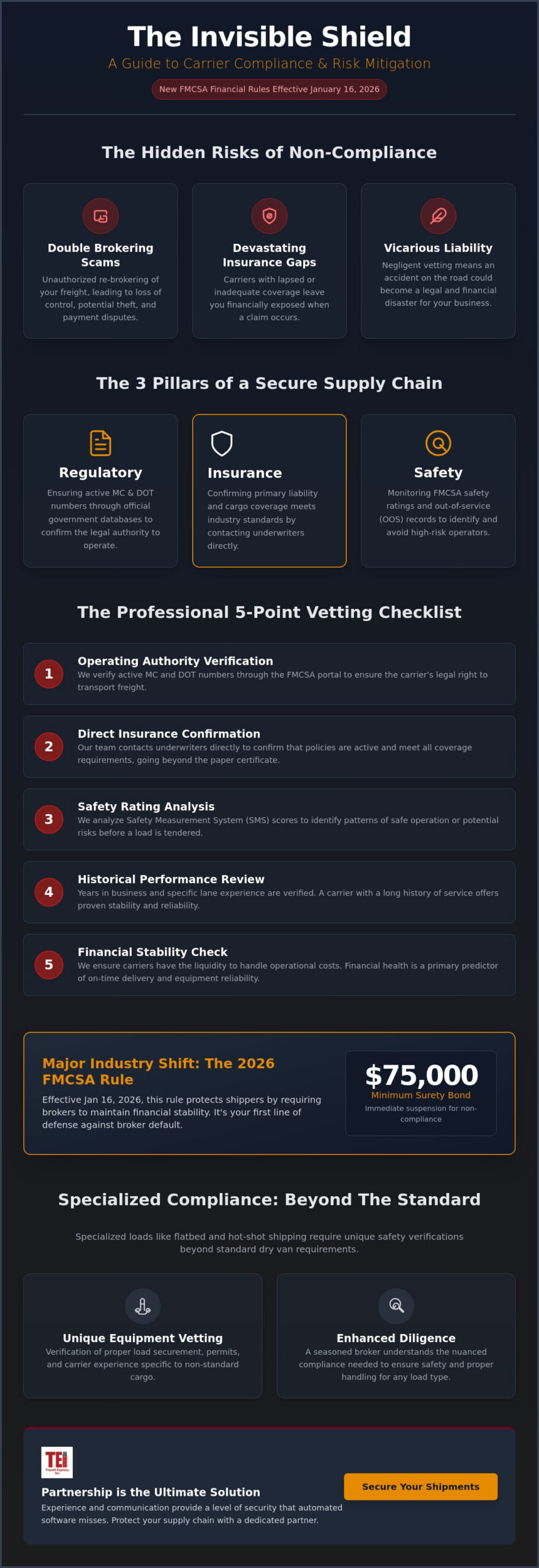
Effective compliance rests on three specific pillars:
- Regulatory: Ensuring active MC and DOT numbers through official government databases.
- Insurance: Confirming primary liability and cargo coverage limits meet or exceed industry standards.
- Safety: Monitoring FMCSA safety ratings and out-of-service (OOS) records to identify high-risk operators.
By 2026, simply checking for a valid MC number is insufficient for modern logistics. Sophisticated fraud and the rise of “chameleon carriers” require a deeper level of investigation. Compliance is now a proactive risk-mitigation strategy that protects your brand’s reputation and your financial interests. It’s the difference between a shipment that arrives on time and one that becomes a legal liability. Safety scores matter. They’re the clearest indicator of how a carrier values your cargo and the public’s safety.
The FMCSA Framework and Broker Responsibility
The logistics industry saw a major shift on January 16, 2026, with the enforcement of the Broker and Freight Forwarder Financial Responsibility Rule. This regulation requires brokers to maintain a $75,000 surety bond or trust fund. If these funds drop below the limit, the FMCSA now issues an immediate suspension of operating authority. This bond serves as a shipper’s first line of defense, ensuring the broker has the financial liquidity to meet their obligations. Utilizing systems like the Unified Registration System allows for real-time verification, making modern vetting more transparent and secure for everyone involved.
Why Compliance is the ‘Invisible Shield’ of Your Cargo
Think of compliance as an invisible shield that deflects potential disasters before they reach your warehouse. There’s a direct correlation between high safety scores and lower cargo damage rates. Carriers with poor maintenance or driver fatigue issues are statistically more likely to experience accidents. By prioritizing carriers with clean SAFER records, we prevent “out-of-service” delays at weigh stations. Professional logistics management provides the peace of mind that your cargo is in the hands of professionals who respect the rules of the road. It’s about order in a complex industry.
The 5-Point Vetting Checklist Every Professional Broker Follows
Consistency is the hallmark of a secure supply chain. A diligent carrier compliance freight broker doesn’t just look for a carrier; they look for a partner who meets five distinct criteria. This methodology ensures that every truck we dispatch is operated by a carrier that values safety and legal integrity as much as we do. By following a structured vetting process, we eliminate the guesswork and provide a reliable framework for every shipment.
- Operating Authority: We verify active MC and DOT numbers through the FMCSA portal to ensure the carrier’s legal right to transport freight across state lines.
- Insurance Verification: Our team goes beyond the paper certificate. We contact underwriters directly to confirm that policies are active and have not been canceled for non-payment or other issues.
- Safety Ratings: We analyze Safety Measurement System (SMS) scores to identify patterns of safe operation or potential risks before a load is ever tendered.
- Historical Performance: Years in business and specific lane experience are verified. A carrier with a long history of service offers a level of stability that newer entities may not yet possess.
- Financial Stability: We ensure carriers have the liquidity to handle fuel and maintenance costs. Financial health is a primary predictor of on-time delivery and equipment reliability.
By adhering to these steps, we provide a level of oversight that protects your bottom line and your reputation. If you are looking for a dependable freight brokerage partner, these vetting standards should be your baseline requirement for any logistics relationship.
Deep Diving into Insurance Standards
Insurance requirements vary depending on the nature of the freight. Auto liability covers road accidents, while cargo insurance protects the actual value of your goods during transit. General liability provides broader protection for non-transit incidents that may occur. For specialized freight, we look for specific endorsements like “reefer breakdown” for temperature-controlled goods or “tarping” coverage for flatbed loads. A Certificate of Insurance (COI) is a standard document that summarizes a carrier’s coverage details and must be verified as current and active before any load is tendered.
Analyzing Safety Data Beyond the ‘Satisfactory’ Rating
A “Satisfactory” rating is only the starting point for a professional carrier compliance freight broker. We examine BASIC scores, which track categories like driver fitness, vehicle maintenance, and hours-of-service compliance. High scores in these areas are red flags that suggest a higher probability of delays or accidents. We pay close attention to the carrier’s “Out of Service” (OOS) rate. If a carrier’s OOS rate is significantly higher than the national average, it indicates a lack of preventative maintenance that could lead to equipment failure on the road.
The Hidden Risks of Non-Compliance: Liability and Scams
The risks of logistics extend far beyond simple transit delays. When a carrier fails to maintain compliance, the consequences can ripple through your entire organization, leading to financial loss and legal turmoil. A professional carrier compliance freight broker acts as a safeguard against these invisible threats. Without this layer of protection, you might find yourself entangled in the ‘double brokering’ trap. This occurs when an unauthorized entity accepts your load and hands it off to another carrier without your permission, often leading to payment disputes or lost cargo.
Insurance gaps present another significant danger to your bottom line. If a carrier’s policy has lapsed or doesn’t cover a specific type of incident, a claim for damaged cargo could be denied immediately. In 2026, the rise of ‘ghost’ carriers has made this even more complex. These fraudulent entities use stolen identities to pose as legitimate businesses, only to disappear once they have possession of your freight. Detecting these sophisticated scams requires more than just software; it requires a seasoned eye and a methodical verification process that looks for inconsistencies in carrier data. Understanding what does a freight broker do as a strategic risk-mitigation partner helps clarify why professional vetting is essential in today’s shrinking carrier market.
Understanding Negligent Hiring in Logistics
Legal precedents have increasingly held shippers responsible for the actions of the carriers they hire. If an accident occurs and it’s proven that the carrier was unsafe or the broker failed to vet them properly, you could face ‘vicarious liability.’ This is often referred to as negligent hiring. Your best defense in a court of law is a documented history of due diligence. By partnering with a broker who maintains rigorous compliance standards, you create a paper trail that proves you took every reasonable step to ensure safety. It’s a proactive way to protect your company’s reputation and financial health. Understanding the key differences in a freight broker vs carrier relationship can help you determine which type of partner provides the strongest layer of documented accountability for your shipments.
Combatting Modern Freight Fraud
Modern freight fraud often involves identity theft within the trucking industry. Scammers create digital footprints that look authentic to the untrained eye. We combat this by cross-referencing information with the FMCSA’s public suspension list, which provides real-time data on brokers and carriers who’ve failed to meet financial requirements. With the rollout of the Motus registration platform in 2026, we have even more robust tools to verify identities. Our carrier compliance freight broker standards involve checking these digital footprints and using secure portals to ensure the person hauling your load is exactly who they claim to be. This level of security provides the order and stability your supply chain requires.
Specialized Compliance for Van, Flatbed, and Hot Shot Loads
Compliance is not a one-size-fits-all solution. While the base requirements for insurance and operating authority remain constant, the operational risks shift significantly when you move from standard equipment to specialized configurations. A professional carrier compliance freight broker understands these nuances and adjusts their vetting process to match the specific demands of the freight. This tailored approach is what ensures your cargo remains secure throughout its journey, regardless of the trailer type or the route taken.
The transition from a standard dry van to an oversized flatbed or a time-sensitive hot shot load requires a broker who knows which questions to ask. Vetting for specialized equipment involves looking past the carrier’s general safety rating to examine their specific experience with the equipment in question. This level of detail is what separates a simple transaction from a high-level B2B partnership built on trust and stability. It’s about ensuring every link in the supply chain is as strong as the first.
Compliance Standards for Van Freight Services
For shippers utilizing van freight services, compliance focuses heavily on trailer integrity and security. We don’t just verify that a carrier has a dry van; we ensure the equipment is food-grade or high-value ready when the shipment demands it. This involves checking for structural issues, odors, or debris that could compromise your goods. Security protocols also differ between Full Truckload (FTL) and Less-than-Truckload (LTL) shipments. In LTL scenarios, the increased number of touchpoints makes rigorous seal-integrity checks and driver documentation even more critical for preventing loss.
Flatbed and Hot Shot Specifics
Flatbed shipping introduces unique safety challenges, particularly regarding load securement and tarping. It’s vital to verify that drivers possess the expertise and the physical equipment, such as Grade 70 chains or heavy-duty straps, to keep loads stable. When dealing with oversized freight, we cross-reference carrier data with state-specific permit requirements to ensure legal transit. You can evaluate your specific project needs using our flatbed freight rates checklist to ensure no detail is overlooked.
Hot shot loads require the same level of scrutiny despite their smaller scale. Even though these carriers use smaller trucks, they must adhere to the same FMCSA safety standards as larger fleets. Our guide to hot shot trucking explains how these agile carriers provide speed without sacrificing security. If you’re ready to secure your next specialized shipment, contact our team to discuss our flatbed and van freight solutions.
Intermodal transportation adds another layer of complexity to the carrier compliance freight broker process. Compliance here involves coordinating across rail and road transitions. We ensure that drayage carriers meet the specific insurance requirements for port and rail yard access, providing a seamless transition for your cargo as it moves between different modes of transport.
Why Partnership with a Seasoned Broker is the Ultimate Solution
In 2026, the technical requirements of the FMCSA are clear, but the execution remains a challenge for many. A professional carrier compliance freight broker does more than just aggregate data; they interpret it through the lens of experience. While software can flag an expired insurance policy, it often fails to detect the subtle inconsistencies in a carrier’s communication or the historical patterns that suggest future instability. This is where the ’25-year advantage’ becomes your strongest asset. Deep industry knowledge allows a broker to identify risks that an algorithm might overlook, ensuring that your supply chain remains resilient in a volatile market. Many shippers who have weighed the decision of freight broker vs carrier find that a seasoned broker’s network and compliance expertise deliver a level of strategic flexibility that working directly with a single trucking company simply cannot match.
Communication is frequently the most undervalued tool in a compliance program. The simple act of a check-call serves a dual purpose. It provides a real-time status update, but it also allows our team to gauge the professional demeanor and preparedness of the driver and dispatcher. Relationship-building with a core group of vetted carriers creates a feedback loop of accountability. When a carrier knows they’re part of a long-term partnership rather than a one-off transaction, they’re more likely to adhere to the high standards we set for safety and performance. This shift from a transactional vendor to a dependable B2B partner provides the order and stability your business requires.
The Role of Technology in Modern Vetting
Modern logistics demands efficiency without sacrificing thoroughness. We use integrated carrier portals to maintain real-time compliance data, ensuring that every document is current and every safety score is monitored daily. These digital tools allow for seamless documentation and reporting, giving you instant visibility into the status of your freight. Tranzit Express Inc. emphasizes a ‘steady hand at the wheel’ by combining these high-tech solutions with high-touch service. This balance ensures that complex logistics remain manageable and transparent for our partners, regardless of the shipment’s destination.
Building a Culture of Reliability
A consistent focus on compliance leads to more than just legal safety; it results in on-time delivery and significantly reduced operational stress. We act as a friendly, supportive guide through the logistics maze, handling the complexities of vetting so you don’t have to. By prioritizing carriers who demonstrate a commitment to excellence, we foster a culture where reliability is the standard, not the exception. This approach provides you with the peace of mind that your cargo is in safe hands. Twenty-five years of institutional knowledge translates to a superior risk management strategy that anticipates disruptions before they impact your bottom line.
Securing Your Supply Chain for the Long Haul
Tranzit Express Inc. brings over 25 years of industry experience to every relationship. We combine advanced carrier and shipper portal access with our own rigorous compliance standards to provide a seamless, secure experience for our clients. You don’t have to navigate the complexities of 2026 regulations alone. We invite you to partner with a reliable freight broker for your national shipping needs and experience the peace of mind that comes with a truly dependable logistics partner. We look forward to helping you build a more secure and efficient future for your freight.
Frequently Asked Questions
Is a freight broker responsible for carrier insurance?
A freight broker is responsible for verifying that a carrier maintains active and adequate insurance coverage before any load is tendered. While the carrier provides the primary liability and cargo policies, the broker must confirm these limits meet or exceed the shipper’s specific requirements. If a broker fails to validate these documents directly with underwriters, they risk exposing the shipper to significant financial gaps during a claim process.
What happens if a freight broker uses a non-compliant carrier?
Using a non-compliant carrier exposes all parties to legal “vicarious liability” and increases the risk of cargo damage or theft. If an accident occurs involving a carrier with poor safety ratings or lapsed authority, the broker and shipper may be held legally responsible for negligent hiring. This often leads to expensive lawsuits and the potential denial of insurance protection for the shipment in question.
How often does a broker need to check carrier compliance?
A professional carrier compliance freight broker monitors carrier status in real-time rather than performing a one-time check. Vetting should occur before every load assignment to ensure that operating authority, safety ratings, and insurance policies haven’t lapsed since the carrier was first onboarded. Reliable brokers use automated monitoring systems to flag any sudden changes in a carrier’s FMCSA status or financial standing immediately.
Can a shipper be sued for a carrier’s accident?
Yes, shippers can be sued under the legal theory of negligent hiring if it’s proven they failed to exercise due diligence in selecting their transportation providers. Courts increasingly hold shippers accountable for ensuring the carriers they use are safe and legally compliant. Working with a broker who maintains documented, rigorous vetting standards is a shipper’s best defense against these types of legal challenges and financial risks.
What is the difference between a carrier’s safety rating and a BASIC score?
A safety rating is a formal designation, such as “Satisfactory,” assigned by the FMCSA following a compliance review, while BASIC scores are dynamic metrics updated monthly. BASIC scores track specific categories like driver fitness and vehicle maintenance through the Safety Measurement System. A broker looks at both to identify performance trends that a static safety rating might miss, providing a more accurate safety profile.
How do I verify a freight broker’s financial responsibility?
You can verify a broker’s financial standing by checking the FMCSA’s public records to ensure they maintain the required $75,000 surety bond or trust fund. As of January 16, 2026, any broker whose bond falls below this limit faces immediate suspension of their operating authority. Shippers should also consult the FMCSA’s live public list of suspended brokers to ensure their logistics partner remains in good standing.
What is double brokering and why is it dangerous?
Double brokering occurs when a carrier accepts a load and then re-assigns it to another carrier without the broker’s knowledge or the shipper’s permission. It is dangerous because the second carrier has not been vetted for safety or insurance, which often voids coverage in the event of an accident. This practice also leads to complex payment disputes and significantly increases the risk of cargo theft or fraud.
Does carrier compliance affect shipping rates?
Carrier compliance can influence shipping rates because highly compliant carriers often invest more in preventative maintenance, driver training, and robust insurance policies. While non-compliant carriers might offer lower initial quotes, they present a much higher total cost of risk. Choosing a carrier compliance freight broker ensures you aren’t paying for the “hidden costs” of delays, accidents, or legal liabilities that arise from poor vetting.