
What if the partner you’ve been avoiding as an “unnecessary middleman” is actually the only one capable of cutting your shipping overhead by double digits? For many leaders, the logistics landscape feels like an uphill battle against rising rates and complex regulations. One of the most significant benefits of using a freight broker for small business is the immediate shift from being a small fish in a big pond to having the collective bargaining power of a national network.
It’s frustrating to watch unpredictable shipping costs eat into your hard-earned margins while you spend hours vetting carriers or tracking late arrivals. You deserve a logistics process that feels like a steady hand at the wheel rather than a constant fire to put out. This article shows how partnering with an experienced broker levels the playing field, providing you with predictable costs and the same shipping rates usually reserved for large corporations.
We’ll examine the strategic advantages of outsourced logistics in 2026, from navigating the latest FMCSA financial security requirements to utilizing advanced portals for real-time visibility. You’ll discover how to reclaim your time and focus on your core business growth while your freight moves with professional precision.
Key Takeaways
- Learn how to access enterprise-level shipping rates by leveraging a broker’s ability to aggregate volume across a national network.
- Understand the primary benefits of using a freight broker for small business to transform shipping from an uncontrolled expense into a strategic advantage.
- Discover why a partnership with a seasoned veteran provides more security and reliability than DIY load boards or rigid direct-carrier contracts.
- Use our checklist to vet logistics partners based on 2026 compliance standards and proven long-term industry expertise.
- Explore how specialized solutions like Van, Flatbed, and Intermodal services can reduce operational stress and support your company’s expansion.
The Logistics Hurdle: Why Small Businesses Struggle with Freight Management
For a growing company, shipping is rarely just a line item; it’s often the largest uncontrolled expense on the balance sheet. While large corporations have dedicated departments to manage these variables, small businesses frequently find themselves at the mercy of market fluctuations. One of the primary benefits of using a freight broker for small business is the ability to gain control over these unpredictable costs. Without this partnership, you’re often forced to accept higher rates because your shipping volume doesn’t provide the leverage needed to negotiate with national carriers. They prioritize high-volume accounts, leaving smaller shippers to pay a premium for the same lane space.
The 2026 regulatory environment adds another layer of difficulty. New FMCSA rules, such as the requirement for brokers to maintain $75,000 in financial security, are designed to protect shippers, but they also mean you must be more diligent in who you choose to work with. Every hour you spend vetting a carrier’s safety record or verifying their ELD compliance is an hour taken away from your core sales and production goals. Understanding the benefits of using a freight broker for small business means recognizing that specialized knowledge is required to stay ahead of these changes. If you’re managing this alone, you’re also responsible for tracking things like the transition to USDOT numbers as primary identifiers or the recent decertification of various Electronic Logging Devices. A single oversight in carrier vetting could lead to your goods being held at a roadside inspection, causing delays that damage your reputation.
The Hidden Costs of DIY Logistics
Managing individual carrier relationships is a heavy administrative burden. When you handle freight yourself, you’re responsible for verifying insurance, checking authority, and tracking every mile. If a shipment is delayed or cargo is damaged, the burden of resolution falls entirely on your shoulders. Small shippers often pay “standard” rates that are significantly inflated compared to what a high-volume broker can secure. These costs aren’t just monetary; they represent a massive drain on your operational focus. A broker acts as a steady hand, absorbing that administrative stress so you can focus on growth.
Scalability and the ‘Glass Ceiling’ of Shipping
Logistics bottlenecks often act as a glass ceiling for growth. You might have the product and the demand to enter a new national market, but without a flexible shipping network, the cost of entry is prohibitive. Seasonal spikes can also paralyze a small operation that lacks the capacity to scale quickly. A broker bridges the gap between your current startup phase and an enterprise-level supply chain. They provide the infrastructure you need to move Flatbed or Van freight across the country without the overhead of a private fleet. This flexibility allows you to say “yes” to larger orders without worrying about how to get them delivered.
Unlocking Competitive Rates and Carrier Capacity
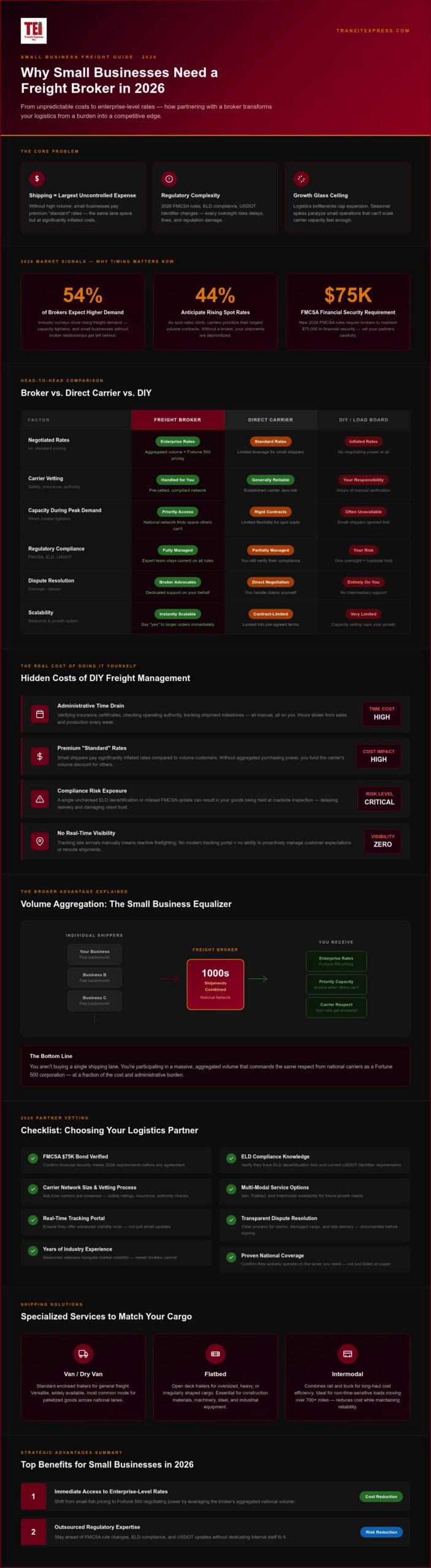
A freight broker is a strategic intermediary that matches shipper needs with carrier capacity. For a growing enterprise, one of the most immediate benefits of using a freight broker for small business is the transformation of your purchasing power. While a single small business might only ship a few pallets or full loads a month, a broker manages thousands of shipments across a national network. This scale allows them to negotiate from a position of strength, securing rates that are typically reserved for Fortune 500 corporations. You aren’t just buying a single lane; you’re participating in a massive, aggregated volume that commands respect from national carriers.
Accessing this capacity becomes critical when the market shifts. Recent industry surveys indicate that 54% of brokers expect higher demand in the coming months, while 44% anticipate an increase in spot rates. When capacity tightens, carriers often prioritize their largest, most consistent contracts. A small business calling a carrier directly during these cycles might find their requests ignored or priced at a significant premium. A broker acts as your advocate, utilizing a pre-vetted network to find space when others cannot. This ensures your supply chain remains moving, regardless of broader market volatility.
Volume Aggregation: The Small Business Equalizer
Brokers function as an equalizer by giving you access to diverse shipping modes that might otherwise be difficult to manage. Whether you require van freight services for standard palletized goods or specialized equipment for flatbed loads, a broker streamlines the process. They also work to reduce “deadhead” miles, the distance a truck drives empty. By matching your outbound freight with a carrier’s need for a backhaul, brokers lower the overall cost of the move. This efficiency is passed directly to you, providing a level of cost consistency that is difficult to achieve through DIY logistics.
Access to Specialized Equipment and Modes
Strategic logistics often requires more than just a standard truck. For long-haul routes where fuel costs and driver hours can bloat your budget, intermodal transportation solutions offer a dependable way to save on costs without sacrificing reliability. When a shipment is smaller but time-sensitive, utilizing hot shot trucking allows for rapid delivery without the expense of a full semi-truck. Navigating these various modes requires deep institutional knowledge. A seasoned broker understands the specific requirements for oversized flatbed cargo or the nuances of rail schedules. For businesses looking to stabilize their logistics, exploring national freight solutions can provide the consistency needed for long-term growth.
Broker vs. Carrier vs. DIY: A Comparison for Small Businesses
Choosing how to move your goods often comes down to a choice between three paths: contracting directly with a carrier, managing everything yourself via digital load boards, or partnering with a broker. For a high-volume shipper with consistent lanes, a direct carrier relationship can offer stability. However, for most growing companies, one of the primary benefits of using a freight broker for small business is the flexibility that asset-based carriers simply cannot provide. A carrier is limited by their own fleet. If their trucks are full or out of service, your freight sits on the dock. In contrast, a broker draws from a vast pool of thousands of pre-vetted carriers, ensuring your goods move even when capacity is tight.
Managing freight yourself through load boards might seem cost-effective initially, but it carries the highest operational risk. In 2026, the complexity of carrier compliance is at an all-time high. With the FMCSA recently decertifying nine ELD models and transitioning to USDOT numbers as primary identifiers, the burden of verification is immense. Effective logistics management for shippers requires a level of oversight that most small business owners simply don’t have time to provide. Without a professional intermediary, you’re responsible for verifying every driver’s credentials and insurance status manually.
The Responsibility Gap: Who Handles the Problems?
When a truck breaks down or a driver misses a pickup, the difference between these models becomes clear. In a DIY scenario, you are the dispatcher. You’re the one chasing updates and trying to find a replacement at the last minute. A broker acts as your single point of contact, handling these disruptions behind the scenes. They also manage the complex paperwork of cargo insurance and claims, providing a layer of protection that direct carrier contracts often lack for smaller accounts. This steady hand ensures that a minor logistical hiccup doesn’t turn into a supply chain disaster.
Technology and Visibility Comparison
Modern logistics requires more than just a phone call; it requires data. One of the hidden benefits of using a freight broker for small business is gaining access to enterprise-level technology without the heavy software subscription costs. Instead of making manual check-calls to drivers, you can utilize a dedicated Shipper Portal for real-time tracking. This technology also streamlines document management, keeping your Bills of Lading (BOLs) and Proof of Deliveries (PODs) organized in one central location. This level of organization is essential for tax purposes and audits, turning a chaotic process into a professional, streamlined operation.
Choosing and Vetting Your Logistics Partner: A Small Business Checklist
Selecting a partner to manage your supply chain is a decision that impacts your reputation as much as your bottom line. In an industry where barriers to entry can be low, the primary benefits of using a freight broker for small business are only realized when you partner with a provider who prioritizes compliance over quick margins. Effective January 16, 2026, the FMCSA requires all brokers to maintain a minimum of $75,000 in financial security. Verifying this bond is your first line of defense. A broker who cannot prove their financial standing is a risk to your operations, especially if carrier payments are delayed or disputed.
Beyond basic authority, you should look for a track record that spans decades rather than months. A firm with over 25 years of experience has weathered multiple market cycles and understands how to maintain capacity when rates spike. This institutional knowledge is what allows a broker to act as a steady hand for your business. They should have a rigorous carrier vetting process that goes beyond checking a USDOT number. This includes monitoring safety ratings, verifying active insurance policies, and ensuring drivers are using compliant Electronic Logging Devices. When you outsource this due diligence, you’re buying security and peace of mind.
The 5 Red Flags to Watch For
Identifying a poor partner early can save thousands in lost time and damaged goods. Be cautious of these warning signs during your initial outreach:
- Unusually low rates: If a quote is significantly lower than the market average, it often signals a “bait and switch” tactic or the use of sub-standard carriers.
- Lack of transparency: A professional partner should provide access to a Shipper Portal for real-time visibility. If they rely solely on manual check-calls, your data is already outdated.
- Slow response times: Logistics moves fast. If a broker takes hours to return a quote or answer a basic compliance question, they won’t be there when a truck breaks down.
- Inadequate insurance: Always ask for proof of cargo insurance and contingent liability coverage.
- New authority: While everyone starts somewhere, a lack of historical data makes it difficult to gauge reliability in a high-stakes environment.
Questions Every Small Business Should Ask
Before signing a contract, engage in a detailed conversation about their operational standards. Ask how they vet carriers for safety and what their specific process is for handling time-sensitive Hot-Shot loads or complex Intermodal routing. You should also inquire about their dedicated support model. Will you have a single point of contact who understands your business, or will you be routed through a generic call center? To prepare for these conversations, it’s helpful to learn more about what does a freight broker do to ensure you’re asking the right technical questions. If you’re ready to stabilize your logistics with a dependable partner, contact Tranzit Express to review your current shipping strategy.
Tranzit Express: Your Dependable Partner in National Freight Solutions
Tranzit Express Inc. has spent over 25 years acting as the steady hand for American small businesses. We understand that in the complex world of shipping, your greatest need isn’t just a truck; it’s a partner who values stability and trust. One of the core benefits of using a freight broker for small business is the ability to tap into institutional knowledge that only comes from decades of industry involvement. Our national reach ensures that your goods move across the country with the same care and precision as a local delivery, regardless of the shipment type or destination.
Our comprehensive suite of services is designed to meet the diverse needs of growing companies. We specialize in several key areas of logistics:
- Van Freight Services for standard palletized inventory and retail goods.
- Flatbed Shipping for oversized, industrial, or specialized equipment.
- Intermodal Transportation to optimize long-haul cost savings and efficiency.
- Hot-Shot Loads for those critical, time-sensitive deliveries that require rapid response.
To support these services, we provide our proprietary Shipper Portal. This tool brings enterprise-level visibility to every load, allowing you to track shipments in real-time and manage your documentation from a single, organized interface. It’s a professional solution that provides the transparency you need to manage your business with confidence.
Stability in an Uncertain Market
In a volatile industry where 54% of brokers expect higher demand and tighter capacity in late 2026, having a veteran partner is essential. Our 25-year history isn’t just a number; it’s a testament to our ability to navigate market shifts without compromising on reliability. We maintain a composed and methodical approach to every shipment, prioritizing safety and integrity above marketing hype. When capacity tightens, our established carrier network ensures your freight doesn’t get left behind. We believe in clear, functional communication that keeps you informed at every stage of the logistical process.
Streamlined Onboarding for Small Shippers
We’ve designed our onboarding process to be as seamless as the solutions we provide. Transitioning from DIY management to a professional brokerage doesn’t have to be complex. We handle the heavy lifting of carrier vetting and compliance monitoring, allowing you to access our vast network without the administrative burden. You don’t need to be a logistics expert to get the benefits of using a freight broker for small business. You simply need a reliable partner who understands your goals. Experience the difference that a steady hand at the wheel can make for your company’s growth. Reach out for a quote today and let us bring a sense of order to your national shipping needs.
Securing Your Supply Chain for 2026 and Beyond
Navigating the complexities of national shipping requires more than just a truck; it requires a strategic partnership built on trust and consistency. By shifting from time-consuming DIY logistics to a professional model, you reclaim the hours needed to scale your core operations. You’ve seen how volume aggregation and specialized equipment access can level the playing field, allowing your company to compete with enterprise-level efficiency.
Understanding the strategic benefits of using a freight broker for small business is the first step toward long-term operational stability. With national coverage and specialized expertise in Van, Flatbed, and Hot-Shot loads, Tranzit Express offers a dependable path forward. Our 25 years of industry experience serve as a steady hand at the wheel, ensuring your goods move safely and on time regardless of market volatility.
Request a reliable freight quote from Tranzit Express today and experience a partnership that prioritizes your peace of mind. Your growth deserves a logistics foundation that is as ambitious and resilient as your business itself.
Frequently Asked Questions
Is a freight broker more expensive than going directly to a carrier?
A freight broker often secures lower rates than a small business can obtain on its own. While brokers earn a commission, they leverage aggregated volume from hundreds of shippers to negotiate wholesale pricing with carriers. Small businesses going direct typically lack the volume to command these discounts. By using a broker, you access these enterprise-level rates, often resulting in a lower total cost than a direct carrier contract.
How does a freight broker help a small business save time?
One of the key benefits of using a freight broker for small business is the elimination of administrative burdens. Instead of spending hours vetting carriers, verifying insurance, and making check-calls, you work with a single point of contact. The broker manages the entire logistical lifecycle, from sourcing capacity to document management. This allows your team to focus on sales and production while a professional handles the heavy lifting of transportation oversight.
Can a freight broker handle specialized shipments like hot-shot or flatbed?
Yes, a professional broker specializes in matching specific freight requirements with the right equipment. Tranzit Express provides access to a wide range of specialized solutions, including Hot-Shot loads for time-sensitive deliveries and Flatbed shipping for oversized or industrial cargo. Rather than searching for niche carriers yourself, a broker utilizes a pre-vetted national network to find the exact equipment needed for your unique shipment, ensuring safety and compliance throughout the move.
What happens if my cargo is damaged during transit when using a broker?
If cargo damage occurs, your broker acts as your advocate during the claims process. They verify that every carrier in their network carries adequate cargo insurance before a load is even assigned. While the carrier is legally responsible for the damage, the broker facilitates the communication and documentation needed to resolve the claim efficiently. This professional oversight provides a layer of protection that DIY shippers often lack when dealing with carriers directly.
Do I lose control of my shipping process by using a freight broker?
Partnering with a broker actually increases your control by providing better visibility and data. You still make all final decisions regarding your shipments, but you gain access to tools like a Shipper Portal for real-time tracking. Instead of losing control, you gain a professional logistics department that executes your strategy. You receive organized reporting and documentation, which allows for more informed decision-making and better long-term planning for your supply chain.
How do I know if a freight broker is legitimate and bonded?
You can verify a broker’s legitimacy by checking their authority through the FMCSA’s licensing and insurance system. Every legitimate broker must maintain a minimum of $75,000 in financial security, often in the form of a surety bond. It is also wise to look for established providers with a long history, such as a 25-year track record. This longevity suggests a consistent commitment to compliance and financial responsibility in a highly regulated industry.
Can a freight broker help with intermodal shipping to save money?
Another of the benefits of using a freight broker for small business is the ability to utilize intermodal transportation to reduce long-haul costs. A broker coordinates the transition between truck and rail, managing the complex scheduling and documentation involved. This mode is often more fuel-efficient and cost-effective for shipments traveling over 1,000 miles. By utilizing a broker’s expertise in intermodal routing, you can stabilize your logistics budget while maintaining the reliability required for your national distribution network.
What technology should a small business expect from a modern freight broker?
A modern broker should provide enterprise-level technology that simplifies your daily operations. You should expect access to a dedicated Shipper Portal where you can request quotes, track loads in real-time, and download digital documents like Proof of Delivery. This technology eliminates the need for manual spreadsheets and endless email chains. It provides a transparent, organized view of your entire shipping history, making it easier to manage audits and analyze your total freight spend.