
Imagine standing on a busy construction site, watching a specialized crew wait for a critical delivery that should have arrived an hour ago. For many logistics managers, the silence of an open road is filled with questions about weather exposure, securement, and the reliability of manual check calls. You likely agree that open-deck freight brings a unique set of challenges where even a minor delay can ripple through an entire project timeline. It’s a high-stakes environment where the lack of transparency often leads to unnecessary stress and operational friction.
This article shows how real-time flatbed load tracking transforms these logistical hurdles into a manageable, transparent asset for your supply chain. By utilizing dedicated shipper portals and modern GPS technology, you can replace guesswork with certainty. We’ll explore how total cargo visibility and automated delay alerts reduce your administrative burden while ensuring your freight remains secure. You’ll discover how a steady, technology-driven approach provides the peace of mind needed to keep your national operations running smoothly and on schedule.
Key Takeaways
- Understand how moving away from manual check calls toward automated data provides a more accurate and stress-free logistics experience.
- Learn how real-time flatbed load tracking utilizes ELD and GPS technology to provide precise, frequent location updates for open-deck freight.
- Discover the strategic value of tracking in protecting high-value cargo from weather exposure and reducing the risk of unauthorized route deviations.
- Find out what to look for when assessing a broker’s digital capabilities, ensuring they offer both advanced tools and professional support.
- See how leveraging a dedicated Shipper Portal and decades of industry expertise creates a seamless partnership built on transparency and trust.
What is Real-Time Flatbed Load Tracking and Why is it Essential?
In the specialized world of open-deck transportation, real-time flatbed load tracking represents the evolution from guesswork to professional certainty. It’s the continuous monitoring of a shipment’s location and status using integrated data streams. Unlike standard freight, flatbed loads are often destined for active construction sites or industrial facilities where timing isn’t just a preference; it’s a requirement for operational safety and efficiency. This technology provides a steady, dependable flow of information that allows all parties to stay informed without the friction of constant manual updates.
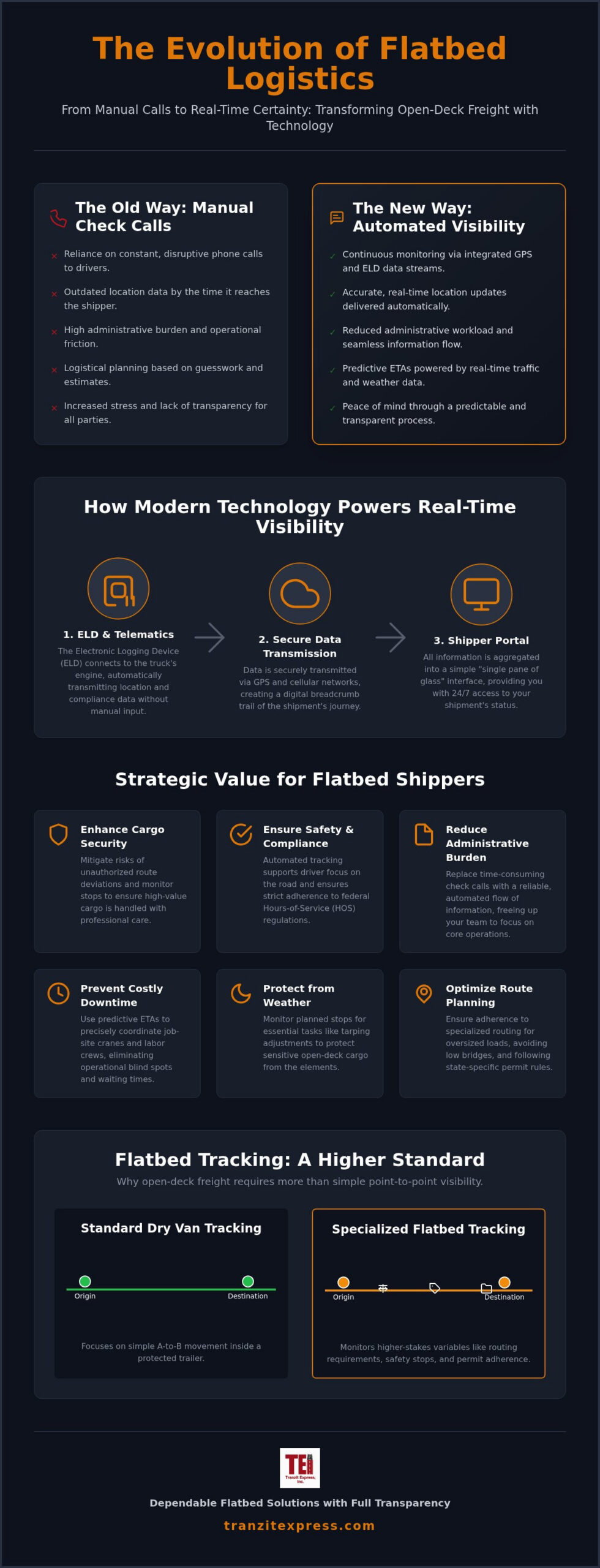
The industry has moved away from the traditional manual check call. In the past, a dispatcher would spend hours on the phone trying to reach drivers for location updates that were often outdated by the time they reached the shipper. Modern freight technology has replaced this reactive cycle with automated GPS and Electronic Logging Device (ELD) data. This shift ensures that the information you receive is both accurate and immediate. For a logistics manager, this transparency serves as the foundation for a reliable B2B partnership, turning a complex move into a predictable process.
The Difference Between Standard and Flatbed Tracking
Standard dry van tracking usually focuses on simple point-to-point movement. However, tracking for flatbeds must account for significantly higher stakes. These loads often involve specialized routing requirements, such as avoiding low bridge heights or adhering to specific weight limits on secondary roads. Precise monitoring is also essential for oversized loads that require state-specific permits and escort vehicles. Additionally, real-time flatbed load tracking allows shippers to monitor stops where drivers must perform essential safety tasks, such as securement checks or tarping adjustments. Knowing exactly when and where these stops occur helps confirm that the cargo is being handled with the necessary professional care.
The Evolution of Logistics Visibility in 2026
As we move through 2026, the focus of visibility has shifted from merely asking “where is my truck?” to “when exactly will it arrive?” Modern systems now integrate predictive analytics to provide highly accurate estimated times of arrival (ETA) based on real-time traffic, weather, and driver hours-of-service data. This level of detail helps job-site managers coordinate cranes and labor crews with precision, preventing costly downtime. Real-time visibility is a proactive management tool that synchronizes transportation data with job-site requirements to eliminate operational blind spots. By using these tools, we ensure that every shipment moves with the quiet confidence of a well-executed plan.
How Modern Technology Powers Real-Time Visibility
Dependable logistics relies on the quality of the data driving it. Modern real-time flatbed load tracking isn’t a single tool but a combination of hardware and software working in unison. By moving away from manual check calls, we’ve created a system where data flows seamlessly from the road to your desk. This technological integration provides a steady, reliable stream of information that allows you to manage your supply chain with the quiet confidence of a seasoned industry professional.
The frequency of data is what separates basic tracking from true visibility. Instead of daily updates, modern systems provide location pings at frequent intervals, ensuring that the map you see is always current. This “single pane of glass” approach aggregates complex telematics into a simple, functional interface. It allows you to focus on your core business while the technology handles the methodical task of monitoring every mile of the journey.
ELD and Telematics Integration
Electronic Logging Devices (ELDs) serve as the backbone of this visibility. These devices connect directly to a truck’s engine, transmitting location data without the need for manual input. This provides a digital breadcrumb trail that confirms exactly where a load is at any given moment. Automated tracking enhances safety by allowing drivers to remain focused on the road, which is especially critical when hauling oversized or sensitive flatbed freight. It also ensures strict compliance with federal hours-of-service regulations, giving you the security of knowing your shipment is moving legally and safely. For those seeking a reliable partner to manage these complexities, our flatbed shipping solutions prioritize this level of technical precision.
Shipper Portals: Your Window into the Supply Chain
To make this data useful, it must be organized into a single, accessible view. A professional shipper portal logistics platform aggregates these various data streams into a live, interactive map. You can see milestones, set custom notifications for arrivals, and review historical performance data to optimize future routes. This level of transparency significantly reduces the administrative burden on your team. Instead of chasing updates through multiple emails, you can simply log in to see the status of your national shipments. While some carriers rely on driver-app-based tracking, integrated telematics often provide a more stable signal for flatbed operations. This ensures that real-time flatbed load tracking remains consistent, providing the steady hand at the wheel that complex supply chains require.
Mitigating Risks: The Strategic Value for Flatbed Shippers
Open-deck freight is distinct because it lacks the protective shell of a dry van. This inherent exposure makes real-time flatbed load tracking a necessity for modern risk management. High-value machinery and sensitive industrial materials are vulnerable to weather damage, road debris, and moisture. When you have a live view of the shipment, you can cross-reference the truck’s position with real-time weather alerts. This allows for proactive communication regarding tarping status or the need for temporary shelter during severe storms, ensuring your cargo arrives in the same condition it was loaded.
Security is another primary concern for high-stakes logistics. Because flatbed loads are highly visible, they can become targets for theft if left in unsecured locations or if they deviate from planned routes. Tracking systems monitor for unauthorized stops or unexpected changes in direction. This level of oversight provides a sense of order and security that manual check calls simply can’t match. By reducing the reliance on redundant communication, your team can focus on higher-level tasks while the system handles the methodical monitoring of the road.
Synchronizing Site Logistics with Load Arrival
Construction sites and industrial plants operate on tight, interconnected schedules. Coordinating cranes, specialized unloading equipment, and labor crews requires precision to avoid operational bottlenecks. If a truck arrives late without notice, you face expensive detention fees and idle labor costs. If it arrives too early, there may not be space to stage the load safely. By integrating professional flatbed freight services USA into your planning, you link transportation data directly to on-site productivity. Accurate arrival forecasting ensures that your crew is ready the moment the truck pulls in, keeping the project moving forward without delay.
Proactive Problem Solving and Exception Management
Exception management is where a dependable broker proves their value as a long-term partner. Using real-time flatbed load tracking, we identify potential delays, such as traffic congestion or mechanical issues, before they become critical problems. Automated geofencing alerts notify shippers of potential delays instantly, allowing for immediate course correction or schedule adjustments. This proactive approach helps maintain high safety standards and ensures that every shipment is treated with professional care. It’s about maintaining a steady hand at the wheel, providing you with the transparency needed to manage a complex supply chain with absolute confidence.
Evaluating a Freight Broker’s Tracking Capabilities
Selecting a partner for open-deck freight requires looking beyond a simple software demo. True real-time flatbed load tracking depends on the broker’s ability to maintain high data standards and rigorous carrier compliance. You need to know how they handle the inevitable hiccups of the road, such as hardware failures or cellular “dead zones” in rural areas. A dependable broker doesn’t just show you a map; they provide a comprehensive strategy for maintaining visibility when technology faces environmental challenges.
The quality of the tracking hardware used by the carrier network is equally critical. A professional logistics provider ensures that their partners use compliant hardware that integrates seamlessly with tracking platforms. This methodical approach ensures that the data you see in your portal is grounded in engine-connected telematics rather than less reliable mobile app signals. It’s about building a foundation of trust through verifiable results rather than marketing claims.
Key Questions to Ask Your Logistics Provider
When vetting a new partner, ask specific questions about their technological infrastructure. Does the broker provide a dedicated, secure portal for shippers to view all active loads in one place? How frequently is the location data updated, and what is the protocol if a GPS signal is lost? For a deeper understanding of these industry standards, you can refer to our guide on what does a freight broker do. These questions help you identify if a provider has the institutional knowledge to handle high-stakes flatbed moves.
The Balance of Technology and Human Expertise
Software alone is often insufficient for the complexities of flatbed logistics. While a digital map shows where a truck is, it doesn’t explain why a driver has pulled over or how a sudden weather front might affect tarping. This is where the human element becomes indispensable. Experienced dispatchers act as the steady hand at the wheel, interpreting real-time flatbed load tracking data to provide context and solutions. They bridge the gap between a data point and a professional decision, ensuring that your communication channels remain clear during time-critical shipments. This combination of advanced tools and veteran insight is what defines a high-level B2B partnership. If you’re looking for a partner that prioritizes both technical precision and personal accountability, explore our Carrier and Shipper Portals to see how we maintain full transparency.
Tranzit Express: Dependable Flatbed Solutions with Full Transparency
Tranzit Express Inc. brings over 25 years of industry knowledge to every shipment we manage. We understand that real-time flatbed load tracking is only as effective as the team interpreting the data. While technology provides the raw location points, our seasoned experts provide the context needed to keep your supply chain moving smoothly. We act as a steady hand at the wheel, ensuring that your open-deck freight is monitored with methodical care from origin to destination across our national network.
Our commitment to excellence is reflected in our focus on high-stakes logistics and reliable performance. We don’t just move freight; we build long-term partnerships based on clear communication and proven results. This collaborative approach allows us to maintain a high standard of order in a complex industry, reducing your administrative stress through consistent, professional performance. We prioritize the fulfillment of our promises over marketing hype, focusing on the seamless delivery of your cargo every time.
A Veteran Approach to National Flatbed Logistics
Managing flatbed loads across the United States requires a deep understanding of diverse regional requirements and equipment types. Whether you’re moving standard open-deck freight or time-sensitive hot shot trucking loads, our team has the institutional knowledge to handle the job. Our long-term relationships with reliable carriers mean we can offer better visibility and more consistent service than brokers who rely solely on automated digital matching. This depth of experience ensures that specialized routing and securement needs are always met with professional precision.
Get Started with Transparent Load Tracking
Accessing our technological tools is a straightforward process designed to integrate into your existing workflow. Through our secure Shipper Portal, you can manage multi-load accounts, view live maps, and access historical data with ease. This transparency ensures that you’re always informed, allowing you to coordinate site arrivals and project timelines with precision. By combining real-time flatbed load tracking with our proactive management style, we eliminate the anxiety of the unknown. We invite you to experience the peace of mind that comes with professional load management and a partnership built on stability and trust.
Secure Your Supply Chain with Professional Load Visibility
Managing open-deck freight shouldn’t be a source of constant anxiety for your team. By prioritizing real-time flatbed load tracking, you gain the transparency needed to protect high-value cargo and synchronize complex job-site arrivals with precision. This methodical approach to logistics ensures that every mile is accounted for, allowing your operations to run without the friction of manual check calls. It’s about replacing uncertainty with a steady, predictable flow of information that keeps your projects on schedule.
Tranzit Express Inc. offers the stability of 25+ years of proven logistics excellence and a national carrier network that maintains full compliance. Our dedicated portals for shippers and carriers ensure that your data is always accessible, secure, and actionable. We invite you to Request a Reliable Flatbed Quote and Experience Real-Time Visibility for your next shipment. Let’s work together to build a dependable partnership that moves your business forward with quiet confidence and professional care.
Frequently Asked Questions
How accurate is real-time flatbed load tracking?
Modern tracking is highly accurate, typically providing location data within a few hundred feet by using integrated ELD and GPS systems. These systems transmit pings at frequent intervals, ensuring the map reflects the truck’s true position. This level of precision allows for reliable project planning and site coordination. It’s a significant improvement over manual check calls, which often rely on outdated verbal reports that don’t account for immediate traffic or road conditions.
Do I need special software to track my shipment with Tranzit Express?
No, you don’t need to install any specialized software to monitor your shipments. You can access all tracking data through our secure Shipper Portal using any standard web browser. This centralized platform aggregates all your active loads into a single, functional interface. It’s designed for ease of use, providing a clear window into your supply chain without requiring additional technical overhead or complex installations on your internal systems.
What happens if the tracking system goes offline during transit?
If a tracking signal is temporarily lost due to a cellular dead zone, our team provides the human oversight needed to maintain continuity. Our experienced dispatchers monitor these gaps and verify the shipment’s status through direct communication with the driver if necessary. Once the vehicle re-enters a service area, the system automatically updates with the historical data. This combination of technology and professional expertise ensures you’re never left without a clear update.
Can real-time tracking help reduce my flatbed shipping costs?
Yes, real-time flatbed load tracking helps reduce costs by improving operational efficiency and minimizing expensive job-site delays. Accurate arrival forecasting allows you to coordinate labor and equipment, such as cranes, more effectively to avoid idle time. Additionally, precise monitoring helps prevent detention fees that occur when trucks are held past their scheduled window. By streamlining these logistics, you reduce the administrative burden and financial friction associated with manual tracking methods.
Is real-time tracking available for hot-shot and intermodal loads too?
Yes, we provide tracking capabilities for all our core services, including hot-shot and intermodal transportation. Whether you’re moving a time-critical hot-shot load or a complex intermodal shipment, the same level of transparency applies. Our portals are designed to handle various equipment types and transit methods, ensuring you have a consistent experience across your entire logistics portfolio. This versatility makes it easier to manage a diverse range of national freight requirements.
How does tracking improve safety for oversized flatbed freight?
Tracking improves safety for oversized loads by ensuring drivers adhere to specialized routing and permit requirements. We monitor the truck’s position to verify it stays on approved roads that accommodate its specific height and weight. If a driver deviates from the planned route, we’re alerted immediately, allowing us to provide guidance before a safety issue occurs. This proactive approach is essential for protecting both the cargo and the public during complex moves.
Will I receive automated alerts if my flatbed load is delayed?
You can customize your notification settings within the Shipper Portal to receive automated alerts for specific milestones or delays. The system uses geofencing to detect when a truck enters or leaves a designated area, triggering an instant update. If real-time flatbed load tracking identifies a significant delay due to traffic or weather, you’ll be notified immediately. This allows you to adjust your project schedule and inform your site crew without waiting for a manual report.
Does tracking eliminate the need for phone calls to the broker?
While digital tracking significantly reduces the need for routine check calls, it doesn’t replace the value of professional communication. The system handles the methodical task of location monitoring, which frees up your time for more strategic work. However, our team remains available to provide context and solve complex problems that data alone cannot address. We use technology to enhance our partnership, ensuring you always have a steady hand at the wheel when needed.