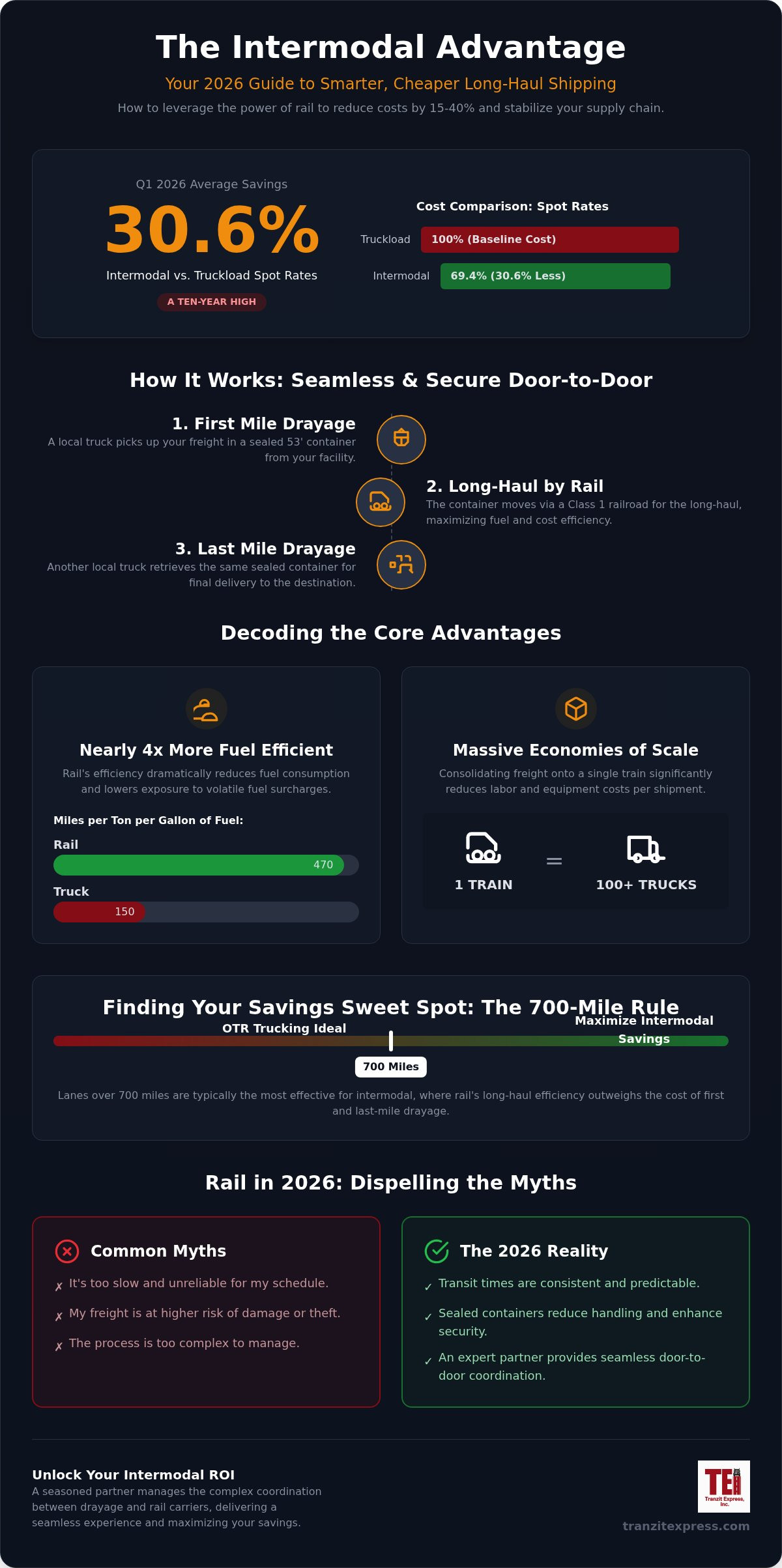
In the first quarter of 2026, the average savings for intermodal spot rates versus truckload spot rates reached 30.6%, the highest level in over a decade. This surge in intermodal freight cost savings comes at a critical time for shippers facing diesel prices averaging $5.50 per gallon and persistent truckload driver shortages. You’ve likely felt the budget pressure as volatile fuel surcharges and tightening capacity make long-haul logistics feel increasingly unpredictable. At Tranzit Express, we believe maintaining a reliable supply chain shouldn’t mean sacrificing your bottom line to market volatility.
It’s frustrating to watch shipping margins erode while trying to meet rising carbon footprint reporting requirements. You need a solution that balances efficiency with environmental responsibility without risking your delivery schedules. This guide will show you how to leverage intermodal transportation to reduce your long-haul shipping costs by 15-40% while ensuring seamless, door-to-door execution. We’ll explore the latest 2026 market data, examine why rail is nearly four times more fuel-efficient than over-the-road trucking, and provide a clear roadmap for integrating intermodal into your national logistics strategy.
Key Takeaways
- Learn how the strategic use of 53-foot domestic containers creates a more flexible and dependable long-haul shipping strategy.
- Identify your ideal shipping lanes by applying the 700-mile rule to maximize intermodal freight cost savings while maintaining consistent delivery schedules.
- Understand the massive efficiency gains of rail transport, which can move freight significantly further per gallon of fuel than traditional over-the-road trucks.
- Gain peace of mind by separating rail myths from reality, particularly regarding modern security standards and transit time predictability in 2026.
- See how a seasoned partner manages the complex coordination between drayage and rail carriers to provide a seamless door-to-door experience.
Understanding Intermodal Freight and Its Cost-Saving Potential
At its core, intermodal freight transport is the strategic combination of rail and truck power to move goods over long distances. Unlike traditional transloading, which requires physically moving cargo from one piece of equipment to another, intermodal keeps your goods sealed within a single 53-foot domestic container for the entire journey. This distinction is vital. It eliminates the risk of damage during handling and ensures a seamless transition between the highway and the tracks. For shippers focused on intermodal freight cost savings, this method represents a reliable way to bypass the high overhead of long-haul trucking without sacrificing the reach of local delivery.
The Synergy of Rail and Trucking
The success of an intermodal move relies on a well-coordinated handoff between three distinct segments. First, a drayage truck picks up the container from your facility, providing the “first mile” flexibility that rail alone cannot offer. This container is then loaded onto a Class 1 railroad for the long-haul middle leg, where rail’s massive scale creates significant efficiency. Once the train reaches the destination terminal, another drayage truck completes the “last mile” delivery to the receiver. This process allows your cargo to remain secure and untouched throughout the trip. By utilizing rail for the bulk of the mileage, you reduce the reliance on expensive over-the-road fuel and labor while maintaining the door-to-door convenience your customers expect.
The “Steady Hand” of 2026 Logistics
By 2026, the logistics market has become increasingly complex. Shippers face persistent driver shortages in the truckload sector and a diesel market that remains highly sensitive to global events. In this environment, intermodal acts as a stabilizing force for your transportation budget. While truckload rates often fluctuate wildly based on immediate capacity, rail schedules and pricing offer a level of predictability that helps you plan with confidence. There is a clear psychological and financial benefit to knowing your long-haul capacity is secured. Choosing intermodal isn’t just a way to lower your per-mile rates; it’s a strategic decision to partner with a mode that offers consistent performance when the trucking market becomes volatile. It provides the order and security needed to manage high-volume supply chains effectively.
Decoding the Cost Advantages: Intermodal vs. Over-the-Road (OTR)
The financial gap between rail and truckload has widened significantly in recent months. In the first quarter of 2026, average savings for intermodal spot rates compared to truckload reached 30.6%, marking a ten-year high. These intermodal freight cost savings aren’t just the result of market fluctuations; they stem from a fundamentally more efficient operational model. While truckload rates are heavily tied to the immediate availability of drivers and equipment, rail relies on massive consolidation to keep costs predictable. Shippers who transition their long-haul lanes to rail are often able to secure contract savings of around 26.3%, providing a buffer against the pricing spikes common in the spot market.
Fuel Efficiency and the Surcharge Gap
Fuel remains the most volatile variable in any logistics budget. With diesel averaging $5.50 per gallon in early 2026, the efficiency of the power unit is paramount. A standard over-the-road truck typically moves freight between 100 and 150 miles on a single gallon of fuel. In contrast, a freight train can move one ton of cargo approximately 470 miles on that same gallon. This discrepancy creates a massive difference in fuel surcharge (FSC) structures. Rail surcharges are less sensitive to sudden diesel price spikes because the underlying energy consumption is so much lower. The fuel efficiency ratio of rail is approximately four times higher than that of standard dry van trucking.
Scalability and Economies of Scale
The ability to move more with less is the primary driver of rail’s economic advantage. A single train can carry over 100 containers, managed by a small crew and a few engines. Moving that same volume over the highway requires 100 separate trucks, 100 engines, and 100 drivers. This consolidation reduces the labor and maintenance costs that carriers eventually pass on to shippers. Additionally, modern rail networks are designed to minimize “empty miles” by balancing equipment flows across national hubs. By integrating Advanced Logistics and Multimodal Transport strategies, companies can leverage this massive capacity during peak seasonal surges without facing the predatory pricing often found in the trucking spot market.
Beyond direct line-haul expenses, sustainability has become a tangible cost-saving metric. Many shippers now use rail to meet strict carbon footprint reporting requirements, which can lead to corporate tax benefits or carbon credits. Reducing your environmental impact isn’t just about corporate responsibility; it’s a practical way to future-proof your supply chain against evolving emissions regulations. Those looking to stabilize their long-term spend find that intermodal transportation offers the most consistent path toward these goals. This transition allows you to maintain high service standards while capturing the structural savings that only rail can provide.
Identifying Your Intermodal Savings Sweet Spot
Maximizing your logistics budget requires a precise understanding of where rail outperforms traditional trucking. While the potential for intermodal freight cost savings is significant, these results are not automatic across every lane in your network. Achieving the 15-40% reduction in spend mentioned earlier depends on identifying the “sweet spot” where the efficiency of the rail leg successfully offsets the fixed costs of drayage. For most national shippers, this calculation begins with a clear look at distance, weight, and terminal proximity.
The 700-Mile Rule and Beyond
The 700-mile rule remains the primary benchmark for intermodal ROI. Since every intermodal move requires a truck at both ends of the journey, the rail portion must be long enough to dilute those drayage expenses. When a shipment travels fewer than 700 miles, the cost of the two truck moves often consumes the savings generated by the train. However, as the distance increases, the cost per mile drops dramatically. Shippers can use our shipper portal to analyze their current lane data and identify high-value opportunities where rail networks are most efficient. This level of visibility turns complex routing into a manageable, data-driven process.
Beyond distance, weight sensitivity plays a crucial role in your modal choice. In specific corridors, specialized rail equipment can sometimes accommodate heavier payloads that would exceed highway weight limits for standard dry vans. This allows you to move more product in fewer shipments, further driving down your total landed cost. When paired with a methodical evaluation of your inventory cycles, you can match these heavier, slower-moving loads with rail schedules to create a steady, predictable flow of goods that keeps your warehouse teams prepared.
Seasonal Capacity and High-Volume Corridors
Intermodal serves as an essential safety valve during periods of extreme market volatility. During produce seasons or the late-year holiday surge, truckload capacity often disappears or becomes prohibitively expensive on the spot market. Rail offers a “just-in-case” cost-saving strategy by providing consistent capacity on high-traffic national corridors. While truckload rates might spike due to local driver shortages, the Class 1 railroads maintain a steady rhythm of service. This reliability allows you to shift high-volume, non-urgent freight to the tracks, preserving your truckload budget for the shipments that truly require “just-in-time” delivery. By balancing these two modes, you create a resilient supply chain that isn’t at the mercy of seasonal price hikes.
Overcoming the Myths of Rail Logistics and Reliability
Despite the clear intermodal freight cost savings available in today’s market, some shippers remain cautious. Their hesitation often stems from outdated stories of slow transit times or damaged cargo. In 2026, the reality of rail logistics has shifted significantly. Modern Class 1 railroads and professional brokerages have invested heavily in technology and infrastructure to ensure that choosing rail is no longer a compromise on quality. Choosing rail is now a sophisticated way to capture sustainable intermodal freight cost savings without sacrificing the security of your goods.
Cargo Security and Damage Prevention
One common misconception is that rail transport is inherently rougher on freight than highway travel. While the physics of a train differ from a truck, the ride quality of modern rail is exceptionally stable. Most damage occurs not during the rail journey itself, but during improper loading or the drayage transition. We utilize advanced blocking and bracing techniques to secure cargo, ensuring it stays in place throughout the trip. This methodical approach to loading protects your products against the unique lateral forces of rail movement.
Security at rail terminals has also evolved. Today’s terminals are high-security zones with gated access, 24/7 surveillance, and strict container tracking. To maintain these standards across the entire journey, our process for carrier compliance requires every drayage partner to meet rigorous safety and insurance benchmarks. This steady hand at every transfer point ensures your goods arrive in the same condition they left. You don’t have to worry about the “black hole” of tracking when every partner in the chain is held to the same high standards.
Transit Time Realities in 2026
Evaluating speed requires looking at door-to-door transit times rather than just the time spent on the tracks. While a standard intermodal move might add a day or two compared to a single-driver truckload, expedited intermodal services in 2026 often rival standard over-the-road speeds on major national corridors. For many shippers, this slight difference in time is a manageable trade-off for the significant budget relief rail provides. It allows you to align your shipping schedule with your inventory cycles more effectively.
The tracking gaps that once plagued rail are a thing of the past. Modern containers are frequently equipped with GPS sensors, allowing for real-time visibility through advanced portals. When you partner with an experienced guide, you gain access to professional communication that keeps you informed of every milestone. If you are ready to see how reliable and secure your long-haul shipping can be, reach out to Tranzit Express to review your current network opportunities.
Partnering with a Freight Broker to Unlock Intermodal ROI
Unlocking the full potential of intermodal freight cost savings requires a sophisticated approach to rail contracts and terminal operations. Negotiating directly with Class 1 railroads is a specialized task; one that typically requires massive annual volumes to access the competitive tier-1 rates that drive real ROI. Most small to mid-sized shippers find that partnering with an expert is the most effective way to capture these discounts. A veteran partner provides the leverage needed to secure stable pricing while shielding your budget from the volatility of the spot market. This structural advantage allows you to compete with much larger organizations on a level playing field.
Navigating Complex Routing and Documentation
The administrative side of an intermodal move is significantly more complex than a standard truckload shipment. You aren’t just managing one carrier; you are coordinating origin drayage, the rail middle-leg, and destination drayage. A reliable freight broker serves as your single point of entry for the entire journey. We handle the precise documentation and timing required to keep these three parties in sync, which reduces the workload on your internal team. This oversight ensures that your intermodal transportation solutions remain fully compliant and properly insured at every handoff. If a terminal delay occurs, we resolve it directly with the rail carrier, preventing the “blame game” that often happens in multi-party logistics.
Accessing National Carrier Networks
Reliability in the intermodal sector depends heavily on the quality of the drayage network at both ends of the rail line. With over 25 years of experience, we have built a national network of carriers who meet our strict standards for performance and communication. This deep institutional knowledge allows us to find capacity even when the broader market is tight or driver shortages are impacting specific regions. Whether your freight requires specialized handling or you are also managing flatbed freight, having a partner who understands the entire logistics spectrum is a clear advantage. We focus on building long-term B2B partnerships that prioritize your peace of mind and the steady movement of your cargo. Clear communication and proven results are the hallmarks of a professional, modern logistical strategy.
Securing Your Supply Chain for the Long Haul
As logistics requirements in 2026 continue to evolve, the shift toward rail is no longer just a trend; it’s a strategic necessity for shippers who value stability. By identifying lanes over 700 miles and leveraging the inherent fuel efficiency of Class 1 railroads, you can achieve significant intermodal freight cost savings while meeting your sustainability targets. You don’t have to navigate the complexities of drayage coordination or terminal management on your own.
Tranzit Express brings over 25 years of industry experience to every shipment. Our national network of qualified carriers and real-time tracking via our shipper portal ensure your cargo moves with the precision and care it deserves. We focus on providing a steady hand at the wheel, turning complex routing into a seamless door-to-door experience. Request a Dependable Intermodal Quote from Tranzit Express today to start optimizing your network for 2026 and beyond. We’re ready to build a partnership that prioritizes your peace of mind and your bottom line.
Frequently Asked Questions
How much can I save with intermodal vs. truckload?
Shippers typically see savings of 15% to 40% on long-haul lanes compared to traditional truckload services. In the first quarter of 2026, average savings for intermodal spot rates reached 30.6%, while contract rates offered a 26.3% advantage. These intermodal freight cost savings are driven by rail’s superior fuel efficiency and lower labor costs per ton-mile. By consolidating cargo onto high-capacity Class 1 railroads, you reduce the impact of volatile highway diesel prices on your budget.
Is intermodal shipping slower than standard trucking?
Intermodal transit usually adds one to three days to a standard over-the-road schedule, depending on the lane and terminal efficiency. While a single-driver truck moves continuously, rail involves transitions between drayage trucks and terminals. However, expedited intermodal services on major national corridors can often match standard truckload speeds. We recommend aligning intermodal moves with your inventory cycles to ensure that the cost benefits are captured without disrupting your production or delivery requirements.
What is the minimum distance where intermodal makes sense?
The general industry benchmark for intermodal ROI is a distance of at least 700 miles. At this length, the lower cost of the rail middle-leg successfully offsets the fixed expenses of origin and destination drayage. While some specialized short-haul corridors are emerging in 2026, the most significant savings occur on transcontinental or long-haul national lanes. We analyze your specific network data to identify where the rail’s efficiency provides the most dependable financial advantage.
Can any freight be shipped via intermodal containers?
Most dry, non-perishable goods that fit in a standard 53-foot domestic container are ideal candidates for intermodal transport. This includes consumer packaged goods, electronics, textiles, and various industrial materials. However, highly time-sensitive shipments or those requiring specialized temperature control may still be better suited for van freight services. Our team helps you evaluate your product mix to determine which lanes can be transitioned to rail for long-term budget stability and order.
How is cargo protected from damage on a train?
Cargo is protected through standardized blocking and bracing techniques designed to handle the specific lateral forces of rail travel. Modern rail cars provide a surprisingly smooth ride, but proper securement inside the container is essential. We work with carriers who follow rigorous loading protocols to ensure your freight stays in place from door to door. This methodical approach minimizes handling risks and ensures your goods arrive in the same condition they were loaded.
Do I need special insurance for intermodal freight?
While standard cargo insurance covers intermodal moves, it’s important to verify that your policy accounts for the specific liability limits of rail carriers. Rail liability is often lower per pound than that of common motor carriers. We ensure that our drayage partners and rail contracts meet high compliance standards to provide a layer of security for your shipments. Professional brokerages help you navigate these requirements so that your high-value freight is always adequately protected.
What happens if there is a delay at the rail terminal?
If a terminal delay occurs, our team manages the communication between the rail carrier and the drayage providers to minimize the impact. Delays can result from terminal congestion, weather, or equipment availability. We monitor these situations in real-time and adjust drayage schedules to avoid unnecessary detention or demurrage fees, which can range from $100 to $300 per day. Having a seasoned partner ensures that these disruptions are handled with a steady, professional hand.
How do I track my intermodal shipment in real-time?
You can track your shipments through our advanced shipper portal, which provides real-time visibility into your cargo’s location. Many modern 53-foot containers are equipped with GPS sensors that close the traditional tracking gaps of the past. This technology allows you to see when your freight enters a terminal, departs on a train, and arrives for final drayage. Clear, transparent communication is the foundation of our partnership, ensuring you always have the data you need.