
Imagine a scenario where a single slip in your broker’s vetting process leaves your entire operation legally vulnerable to a highway incident. This concern frequently troubles logistics managers, particularly with the evolving regulatory environment in 2026. You’re likely already challenged by the need to maintain an efficient supply chain while simultaneously adapting to new safety standards. We recognize that you require more than just a service; you need a collaborator who sees freight broker carrier compliance as an ongoing safeguard, not merely a fleeting administrative task.
This article will reveal how stringent carrier compliance standards effectively reduce risk, enhance safety, and shield your business from potential logistics liabilities. Given the FMCSA’s comprehensive overhaul of the CSA scoring system and the introduction of new financial responsibility triggers effective January 16, 2026, the tolerance for mistakes has vanished. We will offer a precise overview of current compliance requirements, covering everything from the latest electronic medical verification mandates to the updated violation categories. Ultimately, you’ll gain the assurance needed to assess your broker’s vetting procedures and substantially lessen your insurance and legal risks.
Key Takeaways
- Understand why freight broker carrier compliance has shifted from simple onboarding to a continuous monitoring model to protect your business from vicarious liability.
- Learn how to verify the “Big Three” benchmarks of authority, insurance, and safety to ensure every carrier hauling your freight is legally active and properly covered.
- Discover the risks of “one-and-done” vetting and how real-time monitoring tools catch insurance lapses before they impact your supply chain.
- Identify critical red flags, such as unusually low rates or missing documentation, that often signal a breakdown in a broker’s compliance standards.
- See how a seasoned partner uses decades of experience and transparent portals to provide a steady hand in managing complex regulatory requirements.
What is Carrier Compliance for Freight Brokers?
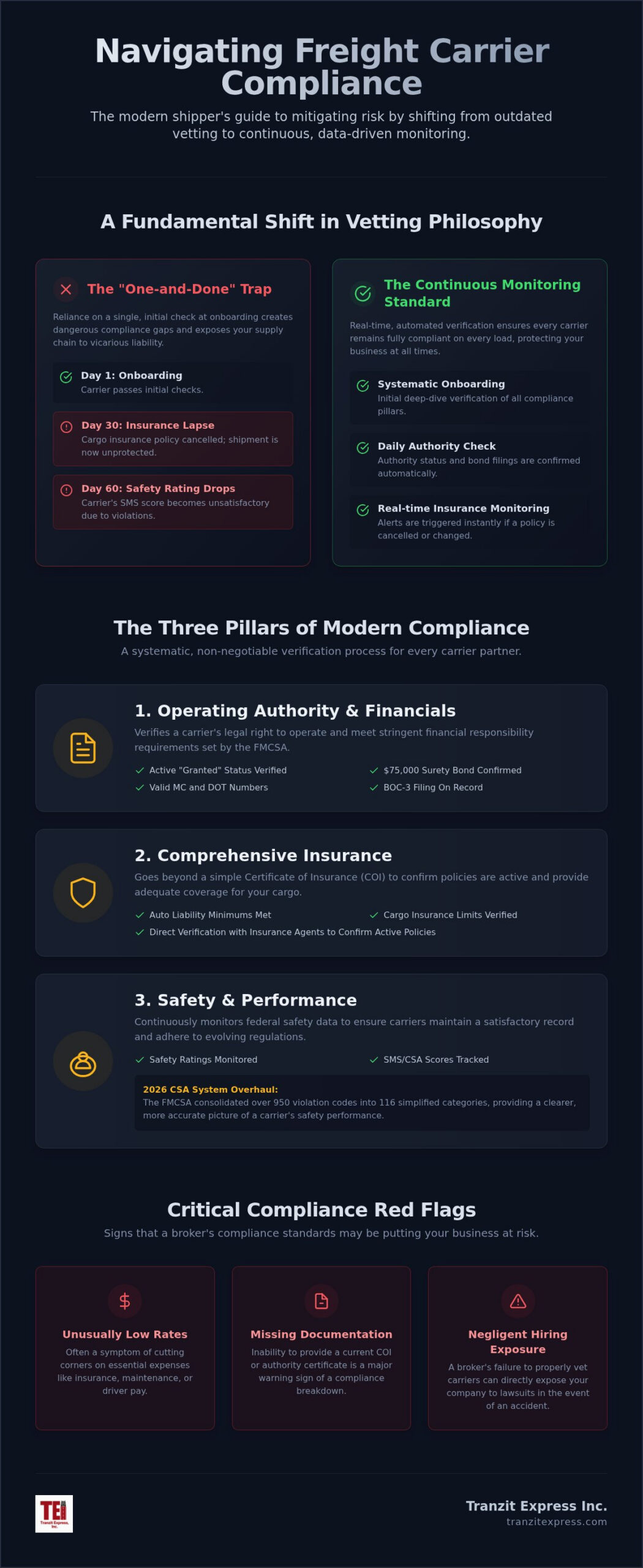
Carrier compliance is the systematic verification process that ensures a motor carrier has the legal right and safety fitness to transport freight. While many view it as a simple administrative hurdle, it’s actually the foundation of a secure supply chain. Understanding What is a Freight Broker? helps clarify their role as a vital intermediary and gatekeeper. By 2026, the industry has moved away from “one-and-done” vetting. Modern freight broker carrier compliance now requires continuous monitoring to account for real-time changes in a carrier’s status.
The regulatory environment became significantly more complex on January 16, 2026, when the FMCSA updated financial responsibility requirements. Brokers must now ensure their partners maintain a $75,000 surety bond or trust fund with a hard suspension trigger if assets fall below that level. Additionally, as of early 2026, loan and finance companies can no longer provide BMC-85 trust funds; assets must be cash, U.S. Treasury Bonds, or FDIC-backed letters of credit. This shift means that a carrier who was compliant yesterday might not be today. Relying on outdated spreadsheets is no longer a viable strategy for protecting your cargo.
The Core Components of a Compliant Carrier
A dependable compliance program focuses on three non-negotiable pillars. First, we verify active operating authority through MC and DOT numbers. It’s critical to distinguish between Active and Revoked status, as hauling freight without authority can lead to immediate shipment seizures. Second, we confirm insurance coverage, specifically looking for adequate Auto Liability and Cargo Insurance limits. Finally, we monitor safety ratings and SMS scores. The 2026 overhaul of the CSA scoring system has consolidated over 950 violations into 116 grouped types, providing a more accurate picture of a carrier’s safety performance before a truck ever reaches your dock.
Why Shippers Cannot Afford to Ignore Compliance
Neglecting these standards exposes your business to massive legal and financial risks. If an accident occurs, a shipper can be sued for negligent hiring if their broker failed to properly vet the carrier. This vicarious liability often leads to settlements that far exceed the value of the cargo itself. Beyond the courtroom, service failures from non-compliant carriers damage your brand reputation. When a shipment is delayed due to an ELD violation or a suspended authority, the financial loss isn’t just the freight; it’s the trust you’ve built with your clients. Using a broker who prioritizes freight broker carrier compliance ensures that your supply chain remains a source of stability, not a liability.
The ‘Big Three’ of Compliance: Authority, Insurance, and Safety
Achieving excellence in freight broker carrier compliance requires a focused look at three primary pillars: authority, insurance, and safety. These aren’t just boxes to check; they’re indicators of a carrier’s operational health. A seasoned broker knows that a carrier’s status can change in an instant, making real-time verification essential for protecting your shipments and your business reputation.
Verifying Operating Authority and Financial Responsibility
The first pillar is active operating authority. We look for a “Granted” status in the FMCSA system. Anything marked as “Pending” or “Revoked” is an immediate disqualification. Under the FMCSA updates effective January 16, 2026, brokers and carriers face stricter financial oversight. This includes the requirement for a $75,000 surety bond or trust fund with a hard seven-day replenishment trigger. For a detailed look at these operational standards, you can consult this Broker Regulations and Compliance Guide. We also confirm that the carrier has a valid BOC-3 filing on record, ensuring they have designated process agents in every state where they operate.
Insurance Verification: Beyond the Certificate
A Certificate of Insurance (COI) is only a snapshot in time. To ensure your cargo is truly protected, we often go beyond the paper and contact insurance agents directly to verify that policies remain active. This is particularly vital for specialized moves, such as flatbed freight services USA, where cargo values and risks are often higher. We look for “Any Auto” coverage rather than “Scheduled Auto” policies, which only cover specific vehicles listed on the policy. This distinction prevents a scenario where a claim is denied because the carrier used a truck not explicitly named in their insurance documents.
Analyzing Safety Data and SMS Scores
Safety data provides a window into a carrier’s culture. We analyze Behavior Analysis and Safety Improvement Categories (BASIC) scores to identify patterns of risk. The 2026 CSA overhaul has simplified this by consolidating violations into 116 grouped types, but the human element remains key. A “Conditional” safety rating serves as a yellow flag, indicating that while the carrier is legal to operate, they have failed to meet one or more safety standards and require significant broker oversight before being trusted with your freight. We also monitor Out-of-Service (OOS) rates. If a carrier’s OOS rate exceeds the national average, it suggests a lack of maintenance that could lead to equipment failure. Managing these complexities is part of our commitment to being a dependable logistics partner for your business.
Onboarding vs. Continuous Monitoring: Avoiding the ‘One-and-Done’ Trap
Many shippers assume that once a carrier passes an initial vetting process, they’re safe to use indefinitely. This “one-and-done” mentality is one of the most dangerous traps in the industry. A carrier’s status is dynamic, not static. It’s a snapshot of their legality at a single point in time. Effective freight broker carrier compliance must be an active, daily discipline rather than a checkbox on an onboarding form. If a broker isn’t monitoring their network in real-time, they’re essentially flying blind after the first load is booked.
The Risks of Static Vetting
Consider a common scenario: a carrier’s insurance policy expires exactly 30 days after they are onboarded. If your broker only checks documentation once a year, that carrier could haul your freight for eleven months without valid coverage. This gap is where double brokering often thrives. Bad actors may present legitimate credentials during the initial setup only to hand off the freight to an unvetted third party later. Robust logistics management for shippers requires a broker who re-verifies every carrier before every single dispatch. This ensures that authority and insurance are active at the precise moment the wheels start turning.
Implementing Real-Time Monitoring Systems
In 2026, technology allows for seamless integration with FMCSA databases, providing instant alerts when a carrier’s safety score dips or their authority is suspended. However, software alone isn’t enough. A “steady hand” is required to interpret these data spikes and distinguish between a minor clerical error and a major safety violation. This balanced approach is especially critical when managing large carrier pools for van freight services, where volume can sometimes mask individual compliance failures. By maintaining a historical database of carrier performance, we can spot trends that automated tools might miss, providing a layer of security that only comes from decades of industry experience.
Beyond real-time alerts, a comprehensive compliance program tracks a carrier’s long-term safety trends and reliability. It’s not just about whether they’re legal today; it’s about whether they have a consistent track record of excellence. When a broker maintains this level of detail, they can proactively remove carriers from their network before a safety issue becomes a cargo claim. This methodical oversight transforms compliance from a reactive task into a proactive shield for your supply chain.
Red Flags: How to Spot Compliance Gaps in Your Supply Chain
Maintaining a secure supply chain requires a keen eye for what’s absent just as much as what’s present. While we’ve discussed the necessity of continuous monitoring, you must also be able to spot the subtle indicators of a breakdown in freight broker carrier compliance. Often, the most obvious sign is a rate that sits significantly below the market average. If a price seems too good to be true, it’s likely because the broker is bypassing expensive but essential vetting steps to save on overhead. Proper compliance isn’t a cost center; it’s an investment in your company’s protection.
Specialized modes require even more vigilance. For example, hot shot trucking demands specific insurance endorsements and equipment standards that differ from standard long-haul trucking. A broker who treats every load the same, regardless of the equipment type or the complexity of the lane, is a liability. Communication breakdowns serve as the final warning. If your broker is vague about which carrier is actually hauling your freight or cannot provide immediate documentation upon request, your supply chain is at risk.
Broker Red Flags for Shippers
A dependable partner should be an open book. If a broker cannot provide a written carrier vetting policy, they likely don’t have one. Transparency is the hallmark of a professional relationship. You should always know who is behind the wheel. The absence of a digital portal for tracking and documentation is another major red flag in 2026. Without a centralized system to view compliance documents and real-time updates, you’re forced to rely on verbal promises, which offer no protection in a court of law.
Carrier Red Flags During Dispatch
The red flags often become more visible once a load is dispatched. Drivers who refuse to use ELD integrations or provide tracking updates are often trying to hide hours-of-service violations. Similarly, if the equipment that arrives at your dock doesn’t match the documentation provided at booking, the risk of a cargo claim or safety incident skyrockets. Finally, be wary of any pressure to use non-standard payment methods. Fraudulent actors often push for immediate, untraceable payments to bypass the standard financial protections of a legitimate brokerage. If you want to ensure your freight is handled by a team that values order and security, reach out to Tranzit Express for a consultation on our vetting standards.
Partnering for Protection: The Tranzit Express Standard
In a logistics landscape that feels increasingly volatile, stability is the most valuable commodity a broker can offer. At Tranzit Express, we’ve spent over 25 years refining a standard for freight broker carrier compliance that prioritizes the security of your business above all else. We don’t view ourselves as a mere vendor in your supply chain. We function as a dedicated partner, providing the steady hand needed to navigate the complex regulatory updates of 2026 without disrupting your operations.
Our approach is built on the belief that order reduces stress. By implementing methodical processes and maintaining open lines of communication, we remove the guesswork from carrier selection. Shippers deserve to know that their freight is in safe hands. Our institutional knowledge allows us to anticipate shifts in FMCSA policy before they become problems for your dock, ensuring that every load we manage is backed by a legacy of reliability and professional excellence.
A Steady Hand in Carrier Vetting
Our vetting process is far more than a software scan. While we utilize modern tools to track authority and insurance, our seasoned team conducts a multi-step verification for every new carrier partner. We verify the “Big Three” benchmarks discussed earlier, but we also look deeper into a carrier’s operational history. Our team maintains a strict commitment to only utilizing carriers with proven safety records that consistently meet our elevated internal benchmarks. This level of scrutiny is especially vital for specialized intermodal transportation solutions, where the transition between rail and road requires precise coordination and impeccable documentation. We ensure that every link in that chain is as strong as the first.
Technology Meets Experience
Transparency is the cornerstone of trust. To provide our partners with 20/20 visibility, we’ve developed dedicated Carrier and Shipper Portals that act as a single source of truth for every shipment. These portals streamline the exchange of documentation and provide real-time tracking, but they’re always backed by a human expert. We believe that technology should enhance professional B2B communication, not replace it. When a data spike occurs or a regulation changes, you won’t be left to interpret a dashboard alone. Our experts are always available to provide clarity and guidance, ensuring a seamless experience from booking to delivery. If you’re ready to experience a higher standard of service, contact Tranzit Express to secure your next load with a compliant partner.
Securing Your Supply Chain for the Future
The logistics industry in 2026 demands a level of vigilance that goes far beyond traditional vetting. As regulatory standards for freight broker carrier compliance continue to evolve, the distinction between a simple vendor and a true liability partner becomes clear. By prioritizing continuous monitoring and understanding the nuances of the updated CSA scoring system, you protect your business from the financial and legal risks of negligent hiring. Order and transparency aren’t just goals; they’re the requirements for a resilient supply chain.
Tranzit Express Inc. brings over 25 years of industry experience to every shipment. We combine a rigorous carrier vetting process with modern technology, providing you with 20/20 visibility through our dedicated Shipper and Carrier Portals. This blend of seasoned professional oversight and real-time data ensures that your freight remains in safe, capable hands. We invite you to partner with a dependable freight broker today. Together, we can build a logistical process that is as secure as it is efficient. Your peace of mind is our primary objective as we navigate the complexities of the road ahead.
Frequently Asked Questions
What is the difference between carrier evaluation and carrier compliance?
Carrier evaluation focuses on the quality of service, such as on-time performance and equipment reliability. Carrier compliance is the systematic verification of a motor carrier’s legal right and safety fitness to operate. While evaluation helps you choose a high-performing partner, compliance protects your business from legal liability. A robust freight broker carrier compliance program ensures every truck meets FMCSA standards before it arrives at your dock.
How often should a freight broker recheck a carrier’s compliance status?
A broker should verify a carrier’s status before every single dispatch. Static vetting, where documentation is only checked once a year, leaves your supply chain vulnerable to insurance lapses or authority suspensions. We utilize real-time monitoring tools that integrate with FMCSA data to catch changes the moment they happen. This continuous oversight is the only way to ensure that the carrier hauling your freight remains legal and fully insured.
What happens if a carrier’s insurance lapses while my freight is in transit?
If insurance lapses during transit, the carrier is technically operating illegally. This situation creates a significant gap in coverage that could leave you responsible for cargo damage or third-party liability claims. To mitigate this risk, we verify that policies are active at the time of booking and monitor for expiration dates. Using a broker with a rigorous freight broker carrier compliance process ensures that these lapses are identified before the load is ever assigned.
What is an Out-of-Service (OOS) order and why does it matter to me?
An Out-of-Service order is a directive issued by safety inspectors that prohibits a driver or vehicle from operating until a specific violation is corrected. These orders typically stem from serious mechanical issues or hours-of-service violations. For a shipper, an OOS order results in immediate delays and potential shipment seizures. We monitor carrier OOS rates compared to national averages to ensure we only partner with fleets that prioritize proactive maintenance.
Does carrier compliance protect me from double brokering?
Yes, rigorous compliance standards are a primary defense against double brokering. By requiring carriers to provide specific equipment details and verifying their authority, we ensure the company booking the load is the one actually hauling it. We also use digital tracking and portal updates to confirm the driver’s identity and location. This layer of transparency prevents unauthorized third parties from taking possession of your freight and compromising your insurance coverage.
What insurance limits should I require from my freight broker’s carriers?
Standard industry requirements typically include a minimum of $1,000,000 in Auto Liability and $100,000 in Cargo Insurance. However, specialized loads may require higher limits. We review these policies to ensure they include “Any Auto” coverage rather than “Scheduled Auto” restrictions. This verification ensures that the specific vehicle transporting your goods is fully covered. We also confirm that the insurance provider is a reputable company with a strong financial rating.
How can I verify if my freight broker is properly bonded?
You can verify a broker’s bond status through the FMCSA’s Licensing and Insurance system. As of January 16, 2026, all brokers must maintain a $75,000 surety bond or trust fund. If their financial security falls below this level, the FMCSA triggers a hard suspension within seven days. We maintain a clear record of our financial responsibility to provide our partners with the peace of mind that their shipments are backed by a stable organization.
Can a carrier with a ‘Conditional’ safety rating still haul my freight?
A carrier with a “Conditional” rating is legally allowed to operate, but the rating indicates they have failed to meet one or more safety standards. While they can haul freight, they require significantly more oversight. We generally prioritize carriers with “Satisfactory” ratings to minimize risk. If a “Conditional” carrier is considered, we conduct an exhaustive review of their specific violations and current SMS scores to ensure they meet our high internal safety benchmarks.