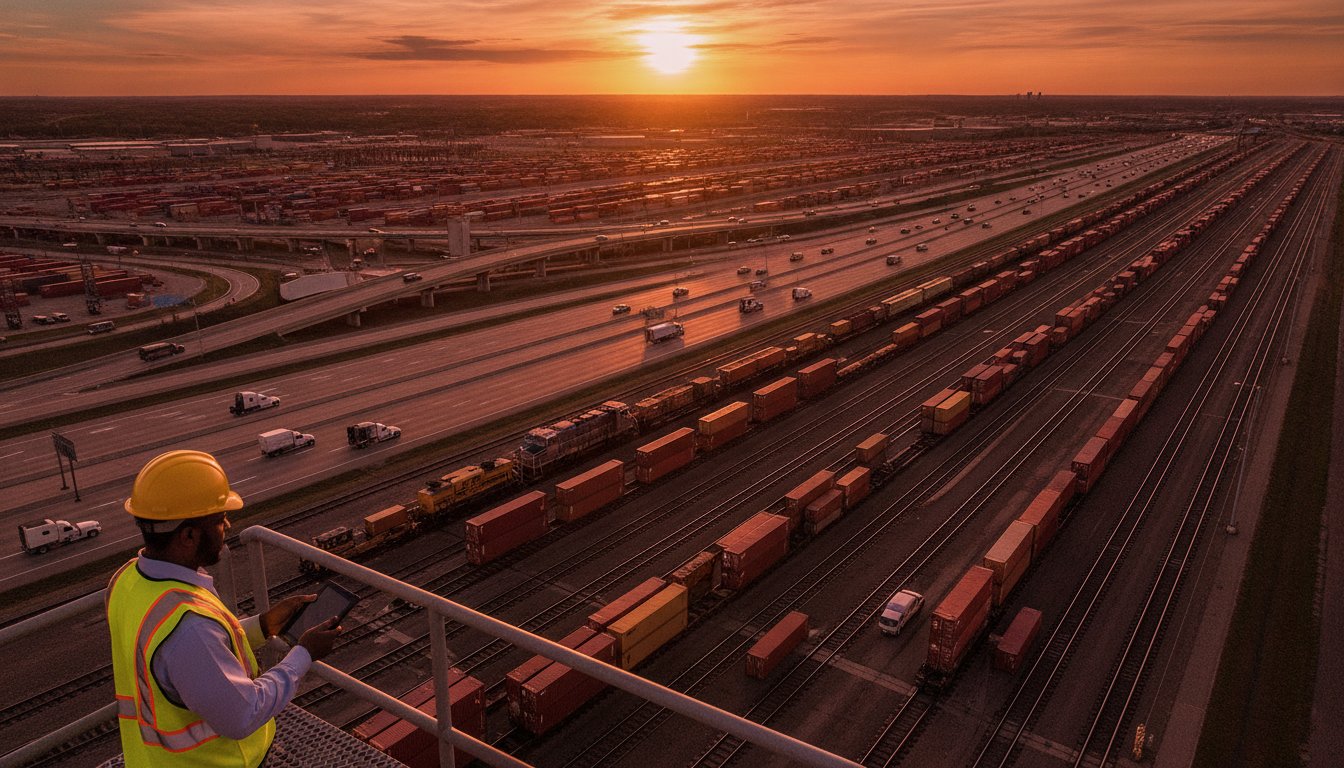
The most expensive freight decision you can make in 2026 might be the one you’re already making by default. If your long-haul strategy relies entirely on over-the-road trucking, you’re absorbing every fuel price spike, every capacity crunch, and every peak-season rate surge without a viable alternative in place. That’s a significant exposure for any supply chain to carry.
You already know the pressure. Fuel costs don’t ease up, reliable capacity gets harder to secure when you need it most, and sustainability goals are no longer a future concern — they’re a present one. These aren’t new frustrations, but they are intensifying ones.
This guide is built to give you a clear, practical understanding of intermodal trucking: how it works, where it delivers real value, and what it takes to execute it well at a national scale. You’ll learn how combining rail efficiency with road flexibility can meaningfully lower your freight spend on long-haul lanes, stabilize your capacity through market fluctuations, and move your operation toward measurable sustainability improvements. What follows is a straightforward look at how to make intermodal transportation a strategic asset rather than an unfamiliar risk.
Key Takeaways
- Intermodal trucking combines the cost efficiency of rail with the last-mile flexibility of road transport — and in 2026, it has matured into a serious strategic option for national shippers, not just a budget alternative.
- The 500-mile threshold is a practical decision point: loads traveling beyond it are typically where intermodal delivers measurable cost savings over over-the-road trucking, even when accounting for transit time differences.
- Rail’s reduced sensitivity to diesel price swings gives intermodal shippers a meaningful buffer against fuel surcharge volatility — a structural advantage that compounds over high-volume, long-haul lanes.
- Intermodal freight can reduce carbon emissions by up to 60% compared to OTR, making it one of the most direct levers available for shippers working toward documented sustainability targets.
- Managing the handoffs between drayage carriers, rail operators, and receivers requires experienced coordination — the right broker partner turns that complexity into a controlled, repeatable process.
Understanding Intermodal Trucking in the Modern Supply Chain
At its core, intermodal trucking is the integration of two or more transportation modes, typically rail and motor carrier, to move a single shipment from origin to destination without ever unloading the cargo itself. The freight stays sealed inside the same standardized container throughout the entire journey. What changes is the vehicle carrying it. For a deeper background on the practice and its global development, the Wikipedia entry on intermodal freight transport provides a useful reference point.
In 2026, that definition understates what intermodal has become. For years, shippers treated it as a fallback, a cost-cutting measure you turned to when budgets were tight and transit time flexibility existed. That perception has shifted. Rail infrastructure investment, improved terminal technology, and tighter coordination between Class I railroads and drayage networks have collectively elevated intermodal into a primary lane strategy for serious national shippers. It’s not a compromise. It’s a deliberate choice.
The standardized 53-foot domestic container is the physical foundation that makes this work. It loads the same way a standard dry van does, which means your freight team doesn’t face a learning curve at the dock. Once sealed, that container moves seamlessly between a truck chassis and a rail flatcar without the cargo being touched. That continuity is what gives intermodal its reliability advantage on long-haul corridors.
Within a broader national logistics strategy, intermodal transportation functions as a high-volume backbone. It handles the heavy lifting across long distances while over-the-road trucking covers the regional and time-sensitive moves where rail can’t compete. The two modes aren’t rivals; they’re complements.
The Intermodal Lifecycle: From Origin to Destination
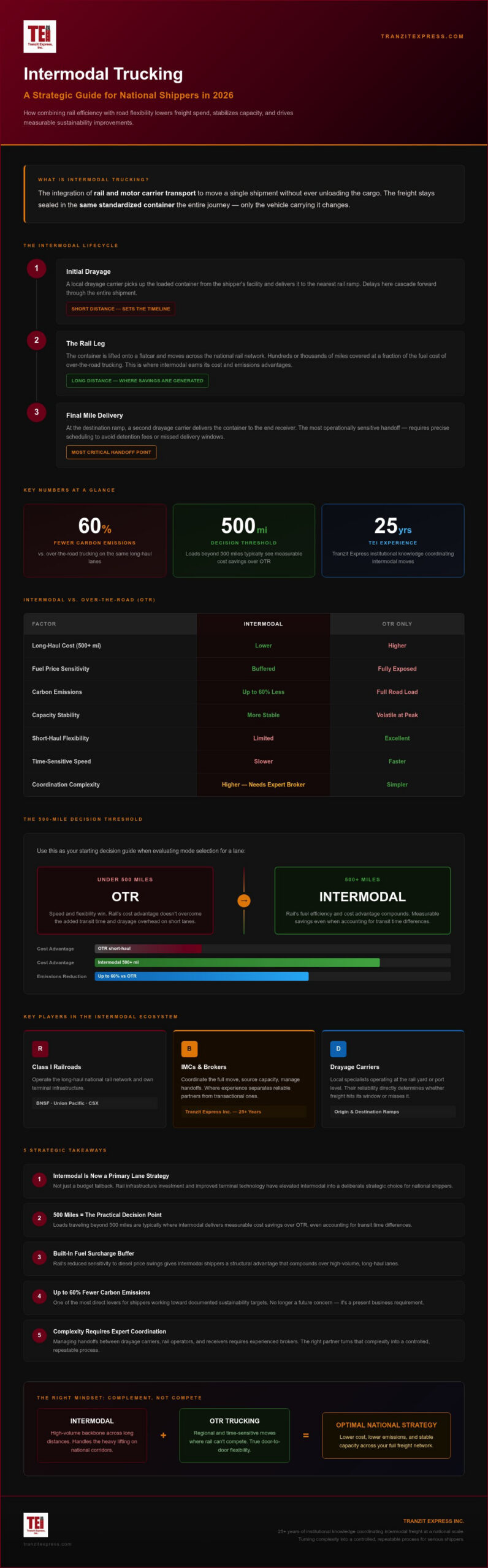
Every intermodal shipment moves through three distinct phases. Understanding each one clarifies where the value is generated and where coordination matters most.
- Initial drayage: A local drayage carrier picks up the loaded container from the shipper’s facility and transports it to the nearest rail ramp. This leg is typically short, but it sets the entire timeline in motion. Delays here cascade forward.
- The rail leg: The container is lifted onto a flatcar and moves across the national rail network. This is where intermodal earns its cost and emissions advantages, covering hundreds or thousands of miles at a fraction of the fuel cost of over-the-road transport.
- Final mile delivery: At the destination ramp, another drayage carrier takes over, pulling the container to the end receiver. This handoff is the most operationally sensitive point in the process and requires precise scheduling to avoid detention fees or missed delivery windows.
Key Entities in the Intermodal Process
Three categories of partners make the system function. Class I Railroads, including carriers like BNSF, Union Pacific, and CSX, operate the long-haul rail network and own the terminal infrastructure. Intermodal Marketing Companies (IMCs) and brokers like Tranzit Express Inc. sit in the middle, coordinating the full move, sourcing capacity, and managing the handoffs that shippers don’t have the bandwidth to manage directly. With over 25 years of institutional knowledge in this space, that coordination role is where experience genuinely separates reliable partners from transactional ones. Drayage carriers are the local specialists operating at the rail yard or port level, and their reliability directly determines whether your freight hits its window or misses it.
The Mechanics of Intermodal Freight: Drayage and Rail Integration
Understanding how intermodal trucking actually functions at the mechanical level is what separates shippers who use it effectively from those who encounter preventable delays and unexpected costs. The physical transfer of a container between a truck chassis and a rail flatcar, known as container-on-flatcar (COFC) handling, is executed at rail ramps using large gantry cranes or reach stackers. The container itself never opens. The cargo never moves. What changes is the platform beneath it, and that simplicity is the entire point.
What makes or breaks the economics of that process, however, isn’t the lift itself. It’s everything surrounding it.
Dwell time is one of the most consequential cost variables in intermodal freight. When a container sits at a rail ramp beyond its allotted free time window, storage fees accumulate quickly. Those fees are avoidable, but only with precise scheduling coordination between the inbound rail arrival, the drayage carrier’s availability, and the receiver’s readiness to accept the load. According to U.S. freight transportation statistics published by the Bureau of Transportation Statistics, rail remains the most fuel-efficient surface freight mode, but that efficiency advantage erodes when dwell time charges are absorbed into the total move cost. Controlling dwell time isn’t optional. It’s part of the rate calculation.
Drop-and-hook operations are what keep intermodal velocity intact. Rather than a drayage driver waiting at a facility while a container is loaded or unloaded, they drop the container and immediately hook to a pre-staged one. This keeps the drayage carrier productive and keeps your freight moving on schedule. Shippers whose facilities aren’t configured for drop-and-hook often experience slower turn times, which can affect rail cut-off windows and push a shipment to the next available train departure.
Terminal location also shapes your first-mile and last-mile costs more than most shippers initially anticipate. A rail ramp 15 miles from your origin is a very different cost profile than one 80 miles out. Mapping your freight lanes against actual ramp locations, not just the existence of rail service in a region, is a foundational step in determining where intermodal delivers genuine savings.
The Critical Role of Drayage
Drayage is the shortest leg of the intermodal journey and the most operationally sensitive. Rail ramp congestion is real, and carriers without established ramp relationships can face delays that compress your delivery window. Experienced drayage partners know the terminal rhythms, the appointment systems, and the congestion patterns that vary by facility and day of week. For heavy or oversized loads, specialized chassis and permits add another coordination layer that requires advance planning rather than last-minute scrambling.
Equipment Standards and Availability
The 53-foot domestic container is the industry standard for a straightforward reason: it mirrors the interior dimensions of a standard dry van, which means your loading process doesn’t change. Chassis availability at both ends of the rail leg is a separate but equally important consideration. The chassis pool system, where carriers share a common inventory of equipment managed through a pool provider at major terminals, directly affects how quickly your container can be picked up after the rail leg completes, and in 2026, pool availability at high-volume ramps remains a variable worth monitoring closely with your logistics partner.
Managing these moving parts consistently is where an experienced partner earns its value. If you’re evaluating how intermodal fits your specific lane structure, connecting with a seasoned intermodal coordinator early in the process will surface the ramp, chassis, and drayage considerations that aren’t visible from a rate sheet alone.
Intermodal vs. Over-the-Road (OTR): A Strategic Comparison
Choosing between intermodal trucking and over-the-road transport isn’t a question of which mode is better in the abstract. It’s a question of which mode is better for a specific lane, a specific commodity, and a specific set of operational priorities. Getting that decision right consistently is what separates shippers who capture freight savings from those who leave them on the table.
The 500-mile threshold is the practical starting point for this analysis. Below that distance, the economics rarely favor intermodal. The terminal handling, the drayage legs on both ends, and the rail transit time collectively add friction that OTR simply doesn’t carry on shorter moves. Once you cross 500 miles, the equation begins to shift. The fuel efficiency of rail starts to outweigh the added complexity, and by 750 miles or more, the cost advantage becomes difficult to ignore on consistent, high-volume lanes. Bureau of Transportation Statistics freight data confirms that rail is the most fuel-efficient surface freight mode available, and that structural advantage compounds significantly across long-haul distances.
Transit time is the trade-off shippers most often cite as their hesitation point. Intermodal typically adds one to two days compared to a direct OTR move on the same lane. That lag is real, and it deserves honest consideration rather than dismissal. For shippers with flexible delivery windows or predictable inventory cycles, that extra day is easily absorbed into the planning process. For time-critical shipments, it isn’t. The key is matching the mode to the freight’s actual requirements, not its theoretical ones.
Capacity reliability is where intermodal holds a structural advantage that’s easy to underestimate in stable markets and impossible to ignore in volatile ones. Rail schedules don’t evaporate during peak season the way truckload capacity does. When spot rates spike and available drivers thin out, intermodal lanes continue operating on published schedules. For shippers managing high-volume seasonal surges, that stability is a meaningful operational buffer.
On cargo security, the concerns are largely outdated. Modern intermodal containers are sealed at origin and remain sealed through the entire rail leg. Damage claims in intermodal freight are driven primarily by improper loading, not by the rail journey itself. Shippers who load correctly and work with experienced partners don’t see materially different cargo security outcomes compared to OTR.
When to Choose Intermodal Trucking
- Long-haul lanes of 750 miles or more with consistent weekly volume, where the cost advantage is most pronounced and predictable.
- Non-perishable commodities that can absorb a one-to-two day transit difference without affecting customer commitments or inventory health.
- High-volume seasonal surges where truckload capacity becomes scarce and rate volatility makes spot market dependence expensive.
When OTR Trucking Remains Superior
- Time-critical shipments that require expedited freight broker services with no tolerance for transit variability.
- Short-haul moves under 500 miles, where rail transfer costs and drayage on both ends eliminate any potential savings.
- Fragile or high-value goods that require continuous driver oversight and direct point-to-point control throughout the move.
Neither mode wins universally. The shippers who perform best treat this as a portfolio decision: building intermodal into the lanes where it delivers clear value, while maintaining OTR capacity for the freight that genuinely needs it.
Maximizing Efficiency: Cost, Capacity, and Sustainability
Three forces are reshaping how serious shippers evaluate their freight spend in 2026: fuel volatility, sustainability accountability, and the demand for real-time operational visibility. Intermodal trucking addresses all three, not as a side benefit, but as a structural feature of how the mode works. Understanding each one in practical terms changes how you think about long-haul lane strategy.
Start with fuel. Rail moves freight at roughly three to four times the fuel efficiency of over-the-road transport, and that efficiency gap has a direct consequence for your fuel surcharge exposure. Diesel price spikes hit OTR carriers immediately and fully. Rail operators, drawing on a different energy cost structure, absorb those swings differently. The result is a measurable buffer against the surcharge volatility that erodes your freight budget on high-volume lanes. Over a full year of consistent intermodal volume, that buffer compounds into real savings.
Strategic load planning sharpens those savings further. Peak season surcharges on truckload capacity are driven by demand outpacing available drivers. Rail schedules don’t respond to that dynamic the same way. Shippers who commit volume to intermodal lanes ahead of peak windows lock in more predictable rates, avoiding the spot market exposure that makes Q4 freight budgets difficult to control. The planning discipline required isn’t complex; it’s mostly a matter of building lead time into your booking process rather than reacting to capacity signals after they’ve already moved against you.
Sustainability as a Business Driver
Rail freight produces significantly lower carbon emissions per ton-mile than over-the-road transport, with reductions commonly cited at up to 60% compared to OTR. For shippers carrying documented ESG commitments, that’s not a marketing claim; it’s a measurable input to your annual carbon reporting. A single intermodal train consolidates freight that would otherwise require hundreds of individual truck movements, and that consolidation effect scales directly with your volume. Beyond current reporting requirements, intermodal also positions your supply chain to hedge against future carbon pricing frameworks. If carbon taxes become a cost reality in domestic freight, the emissions advantage built into rail today translates into a cost advantage tomorrow.
Technological Visibility in 2026
The perception that freight “disappears” once it’s on the rail network is outdated. Real-time GPS tracking, automated milestone notifications, and electronic bills of lading have closed the visibility gap that once made intermodal feel like a black box. In 2026, a well-connected logistics partner gives you the same operational transparency on a rail move that you’d expect from a live OTR dispatch. Integrating shipper portal logistics into your workflow means your team has continuous access to shipment status, documentation, and exception alerts without chasing updates manually. That kind of structured data flow doesn’t just improve visibility; it reduces the administrative burden on your operations team and keeps your receivers informed without extra coordination overhead.
Technology is a tool. It’s only as useful as the partner managing the process behind it. Connect with Tranzit Express to see how 25 years of intermodal coordination translates into reliable, visible freight movement on your lanes.
The Broker’s Role: Navigating Intermodal Complexity with Tranzit Express
Intermodal trucking involves more moving parts than any single party can manage in isolation. A drayage carrier picks up your container. A Class I railroad moves it across the country. A second drayage carrier delivers it to your receiver. Each handoff is a potential failure point, and none of those parties communicate with each other on your behalf. That coordination gap is precisely where an experienced broker earns its place in your supply chain.
Tranzit Express has spent 25 years building the institutional knowledge required to manage those handoffs without friction. That tenure matters in ways that aren’t obvious from a rate sheet. It means established relationships with drayage operators at the ramps your freight actually uses. It means knowing which rail terminals run tight on chassis availability on Mondays, which receivers need extra lead time, and when to escalate a delay before it compounds into a missed window. Proactive communication isn’t a feature; it’s the standard the entire operation is built around.
When a rail disruption occurs, a broker without broad network access is stuck. The response is limited to whatever assets are already in play. Tranzit Express operates differently.
The Value of a Non-Asset Based Partner
Because Tranzit Express doesn’t own a fleet, there’s no financial incentive to push freight toward a particular mode or carrier. Access spans the full national rail and trucking network, which means the recommendation you receive reflects what’s actually right for your cargo, your lane, and your timeline. When rail disruptions occur, pivoting to over-the-road capacity happens without renegotiating a relationship from scratch. That flexibility is a structural advantage that asset-based carriers simply can’t replicate.
Getting Started with Intermodal
Beginning the process is straightforward. Requesting a comprehensive intermodal transportation solutions quote starts with your lane data: origin, destination, commodity type, weekly volume, and delivery window requirements. From that information, a clear picture of where intermodal delivers genuine value on your specific freight mix takes shape quickly.
Onboarding with Tranzit Express in the first 30 days is a structured process, not a trial-and-error period. Your lanes get mapped against ramp locations. Carrier compliance standards are confirmed before any freight moves. Shipper portal access is configured so your team has continuous visibility from the moment a container is picked up to final delivery confirmation. The goal is a repeatable, controlled process from day one, not a learning curve absorbed at your freight’s expense.
In a market where complexity is the norm, a steady and experienced hand managing the details isn’t a luxury. It’s the difference between an intermodal program that performs and one that creates more problems than it solves.
Your Long-Haul Strategy Deserves a Stronger Foundation
Intermodal trucking has matured into a genuine strategic asset for national shippers, not a fallback option. The case is clear: long-haul lanes beyond 500 miles carry real cost savings potential, rail’s structural fuel efficiency buffers your budget against diesel volatility, and the emissions reductions are measurable enough to move the needle on documented sustainability commitments.
What determines whether those advantages actually land in your operation is execution. Precise drayage coordination, controlled dwell time, and seamless rail-to-road handoffs don’t happen by accident. They happen through experienced, consistent management of every step in the process.
Tranzit Express brings over 25 years of institutional logistics knowledge to that coordination, with full national coverage and integrated shipper portals that keep your team informed at every milestone. It’s the kind of steady, proven partnership that turns a complex freight mode into a repeatable, reliable program.
If you’re ready to build a stronger long-haul strategy, partner with a veteran freight broker for your national intermodal needs. The right foundation makes all the difference.
Frequently Asked Questions About Intermodal Trucking
Is intermodal trucking slower than standard long-haul trucking?
Yes, intermodal trucking typically adds one to two transit days compared to a direct over-the-road move on the same lane. That difference is real and shouldn’t be minimized. For shippers with flexible delivery windows or predictable inventory cycles, that extra day is easily planned around. The trade-off is a more stable, schedule-driven service that doesn’t disappear during peak season capacity crunches the way truckload options sometimes do.
What is the minimum distance where intermodal becomes cost-effective?
The practical threshold is 500 miles, though the savings become more pronounced at 750 miles and beyond. Below 500 miles, the terminal handling fees and drayage costs on both ends of the rail leg tend to offset any fuel efficiency advantage. On shorter lanes, over-the-road trucking is simply the more economical choice. The further your freight travels, the more the rail leg’s efficiency compounds into measurable savings.
Can any type of freight be shipped via intermodal trucking?
Most dry, non-perishable freight ships well via intermodal. Consumer goods, industrial components, retail products, and packaged commodities are all common candidates. Freight that doesn’t fit intermodal well includes temperature-sensitive shipments requiring refrigeration, hazardous materials with specific handling restrictions, and oversized loads that exceed standard container dimensions. If your commodity fits a standard 53-foot container and can absorb a day or two of additional transit time, it’s worth evaluating for intermodal lanes.
How does intermodal trucking help reduce my company’s carbon footprint?
Rail freight produces significantly fewer carbon emissions per ton-mile than over-the-road transport, with reductions commonly cited at up to 60% compared to OTR. A single intermodal train consolidates what would otherwise require hundreds of individual truck movements, and that consolidation effect scales directly with your shipping volume. For companies carrying documented ESG commitments or preparing for potential future carbon pricing frameworks, intermodal transportation is one of the most direct operational levers available.
What happens if there is a delay on the rail leg of the journey?
Rail disruptions do occur, and how they’re handled depends entirely on who’s managing your freight. An experienced broker with broad network access can pivot to over-the-road capacity without starting from scratch on carrier relationships. At Tranzit Express, proactive communication is the standard response to any disruption: your team is notified early, options are presented clearly, and the recovery plan is executed without requiring you to manage the coordination yourself. Reactive scrambling is what happens when you don’t have an experienced partner in place.
Do I need special insurance for intermodal shipping?
Standard cargo insurance policies don’t always cover intermodal moves the same way they cover OTR shipments, so it’s worth reviewing your current coverage with your insurance provider before your first intermodal move. Rail carriers operate under different liability frameworks than motor carriers, and the limits can differ significantly. Your logistics partner should be able to walk you through the coverage considerations specific to your commodity type and lane structure so there are no surprises if a claim arises.
How is cargo secured in a container to prevent damage during rail transit?
The container itself is sealed at origin and remains sealed through the entire rail leg, so the freight isn’t handled or transferred during the journey. Damage in intermodal freight is driven primarily by improper loading practices, not by the rail movement itself. Blocking, bracing, and load distribution inside the container matter considerably. Shippers who follow proper load securement standards and work with experienced partners don’t see materially different cargo security outcomes compared to standard over-the-road moves.
What is the difference between drayage and intermodal trucking?
Drayage is a component of intermodal trucking, not a separate mode. It refers specifically to the short truck legs at either end of an intermodal move: the pickup from your facility to the rail ramp, and the delivery from the destination ramp to your receiver. Intermodal trucking describes the complete, multi-modal shipment from origin to destination. Drayage is what connects the rail network to your dock, and its reliability directly determines whether your freight hits its delivery window or misses it.