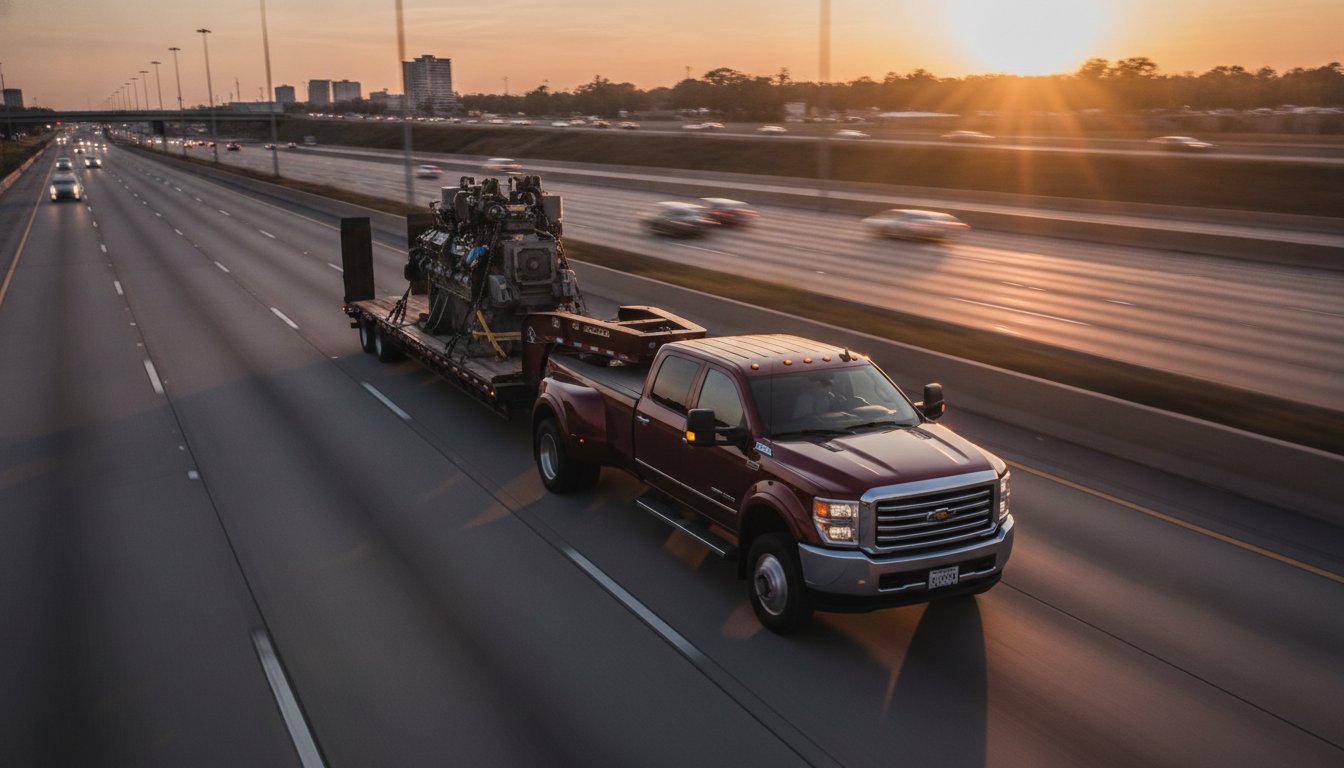
What if your most urgent, specialized shipments didn’t have to wait for a full truckload or get lost in the slow shuffle of standard freight? For many growing companies, the logistics process often feels like a difficult choice between paying for empty space you don’t need or missing a critical deadline that could impact a long-term contract. You understand that in a high-stakes market, consistency and speed are the foundations of trust. Relying on hot shot freight for small business is no longer just an emergency backup; it’s a strategic method to ensure your most time-sensitive payloads arrive exactly when they are promised.
We recognize the pressure of managing complex deliveries while trying to maintain a lean operation. This guide will show you how hot shot services provide the precision and flexibility required to handle specialized loads with the care they deserve. We’ll walk through the practical benefits of this shipping model, current 2026 industry standards for equipment and compliance, and how a dependable logistics partnership can reduce your operational stress. By the end, you will have a clear roadmap for using agile shipping to protect your margins and satisfy your most demanding customers.
Key Takeaways
- Understand how hot shot freight for small business uses specialized Class 3 to 5 rigs to bypass the delays of traditional cross-docking for time-sensitive loads.
- Learn to optimize your logistics budget by paying for the speed and specific vehicle size you need, rather than an entire 53-foot trailer for smaller payloads.
- Identify the specific volume and urgency thresholds that make hot shot shipping the most strategic choice for your 24-hour delivery windows.
- Master the essential steps for preparing your first shipment, from recording precise load dimensions to securing a compliant Bill of Lading.
- Discover the value of a dependable broker partnership that provides a steady hand and instant access to a national network of vetted, compliant carriers.
What is Hot Shot Freight for Small Business Operations?
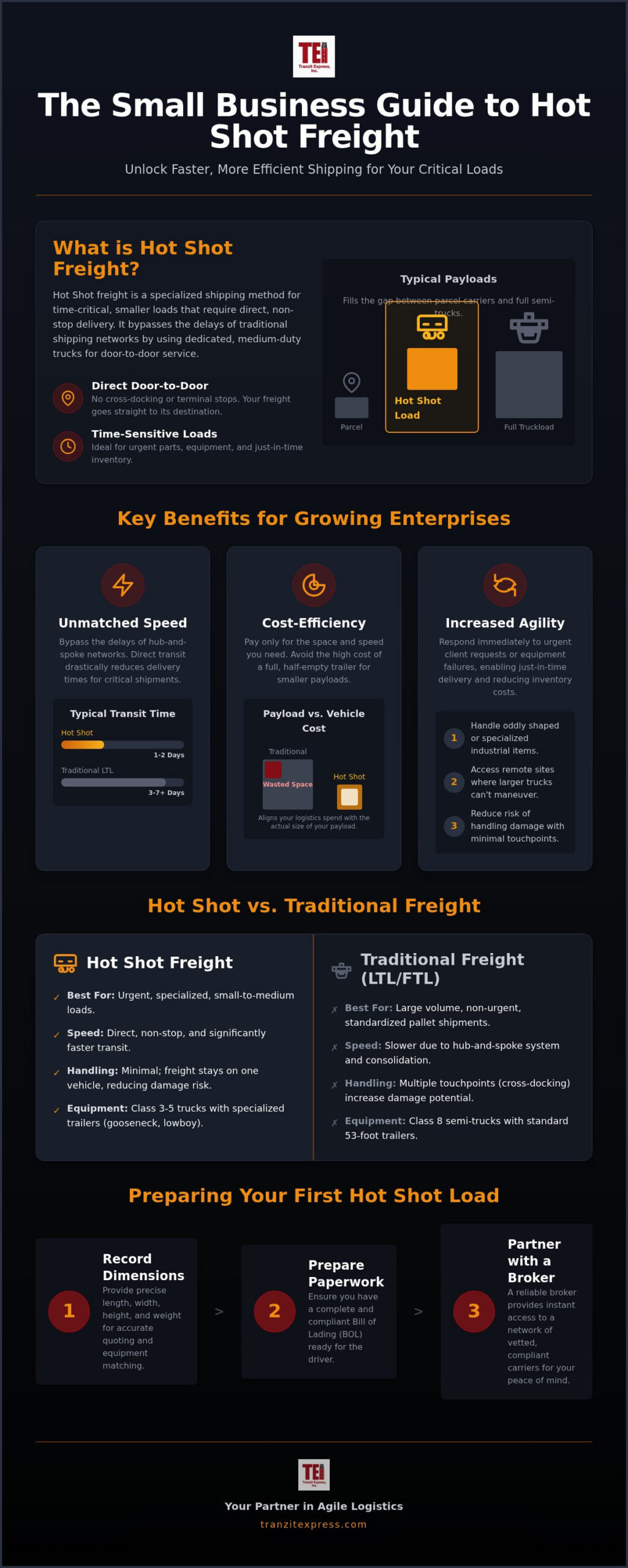
In the logistics sector, Hotshot trucking refers to the specialized transportation of smaller, time-critical loads that don’t justify the use of a full 53-foot trailer. Unlike standard shipping methods that rely on consolidation and hub-and-spoke networks, hot shot freight for small business focuses on direct, door-to-door delivery. This service typically utilizes medium-duty Class 3, 4, or 5 trucks to move freight that is too large for a parcel carrier but too small for a traditional semi-truck. It effectively fills the gap between small package delivery and full truckload (FTL) services, providing a middle ground for companies that need agility without the overhead of massive equipment.
Small business owners often confuse “expedited” with “hot shot” shipping. While both prioritize speed, expedited freight usually involves moving standard cargo through an accelerated network, sometimes using cargo vans or air transport. Hot shot shipping is defined by the equipment and the load itself. It often involves specialized, heavy, or oddly shaped items that require flatbed trailers and open-deck access. This distinction matters because hot shot carriers provide the specific structural capacity to handle industrial equipment while maintaining the speed of an expedited courier.
Several sectors find this model indispensable. In construction, a missing part for a crane can halt a multi-million dollar project. Manufacturing plants use these services to keep just-in-time production lines moving when a component shortage occurs. The energy sector, particularly oil and gas, relies on these rigs to transport drill bits or valves to remote sites where larger trucks struggle to maneuver.
The Equipment Behind Hot Shot Services
The backbone of this service is the heavy-duty pickup truck, such as a Ford F-350 or Ram 3500. These vehicles are paired with specialized trailers like goosenecks, which provide stability for heavier weights, or lowboys for taller equipment. Tilt deck trailers are also common for easy loading of machinery. This equipment versatility allows for specialized load handling that standard box vans simply cannot provide, making hot shot freight for small business a more capable option for industrial needs.
Why ‘Hot Shot’ is a Strategic Term for Shippers
The term originated in the Texas oil fields, where drivers would “hot shot” parts to drilling rigs to prevent costly downtime. Today, it has evolved into a sophisticated on-demand logistics tool. It acts as a safety valve for emergency supply chains, ensuring that critical failures don’t lead to operational paralysis. Hot shot freight is a dedicated, non-stop delivery solution for smaller payloads that require immediate attention.
Key Benefits of Hot Shot Shipping for Growing Enterprises
The primary advantage of utilizing hot shot freight for small business is the significant increase in delivery speed. Traditional shipping models often rely on hub-and-spoke networks where your cargo is unloaded and reloaded multiple times at various consolidation centers. This process, known as cross-docking, adds days to the transit time and increases the potential for handling damage. Hot shot shipping bypasses these centers entirely. Your freight moves on a dedicated vehicle directly from your facility to the customer. This direct route is essential for maintaining the high standards of reliability that your clients expect.
Cost-efficiency is another critical factor for expanding companies. It’s rarely economical to pay for the unused space in a standard 53-foot trailer when you only have a few pallets or a single piece of heavy machinery. By choosing a smaller, more appropriate vehicle, you align your logistics spend with the actual size of your payload. This targeted approach makes hot shot freight for small business a practical tool for protecting your margins while still providing premium, expedited service for your most important orders.
Increasing Supply Chain Agility
Agility is a competitive advantage. When a job site experiences an equipment failure or a client places an urgent order, you need to respond immediately. Hot shot services allow you to pivot without disrupting your standard logistics. Utilizing just-in-time delivery also means you can reduce the amount of capital tied up in on-site inventory. Knowing that a reliable carrier is en route provides a level of peace of mind that allows you to focus on high-level operations rather than tracking delayed shipments. If you’re looking for a steady hand to manage your next urgent payload, our team is ready to help through our streamlined shipper portal.
Lowering Overhead on Small Payloads
Operating smaller Class 3 to 5 rigs is inherently more fuel-efficient than running a heavy-duty Class 8 truck for a light load. These savings are often reflected in the overall shipping rate. You also avoid the “LTL wait.” Standard Less-Than-Truckload shipments can sit in terminals for days while the carrier finds enough freight to fill a trailer. For a more detailed look at how different shipping methods compare, you might find The Complete Guide to Van Freight Services helpful for evaluating your options. Avoiding these delays ensures that your capital and your products keep moving forward without unnecessary interruptions.
Hot Shot vs. Traditional Freight: Making the Right Choice
Choosing the right shipping method requires a clear understanding of your load’s physical characteristics and its timeline. Hot shot freight for small business is highly effective, but it has distinct physical boundaries. Typically, these loads consist of payloads that fit on a 30 to 40-foot trailer and stay below the weight limits of Class 3 to 5 vehicles. If your cargo exceeds 16,500 pounds or requires the expansive deck space of a 53-foot trailer, transitioning to a traditional full truckload is usually the safer and more compliant path. Recognizing these thresholds early prevents logistical bottlenecks and ensures you don’t overpay for the wrong equipment.
The defining factor in this decision is often the 24-hour window. If your customer needs a critical replacement part by tomorrow morning to avoid a factory shutdown, the speed of a medium-duty rig is unmatched. Over distances ranging from 200 to 800 miles, these specialized carriers often outperform regional LTL networks. They move with a sense of purpose that standard freight schedules can’t always accommodate, providing a dependable solution for high-stakes deliveries that require immediate attention.
Hot Shot vs. LTL (Less-Than-Truckload)
LTL is typically the most budget-friendly option for non-urgent goods that can withstand multiple transfers. However, every time a forklift touches your cargo at a terminal, the risk of damage increases. Hot shot offers a ‘no-touch’ advantage where the cargo stays on the same trailer from the moment it’s secured until it reaches the destination. While a standard LTL shipment covering 500 miles often requires two to three business days for consolidation, a dedicated hot shot driver can typically complete the same door-to-door delivery in under 12 hours.
When to Utilize a Flatbed Shipping Broker
Some loads require open-deck access for side-loading or overhead cranes but don’t fill a full-size flatbed. This is where a specialized broker becomes a vital partner for your business. They can source rigs equipped with ramps or winches for small machinery that cannot be driven onto a standard trailer. To understand how these open-deck solutions fit into a broader logistics strategy, you can explore our guide on Flatbed Freight Services USA. This expertise ensures that your specialized cargo is handled with the correct equipment and the steady hand of a seasoned professional.
How to Prepare and Manage Your First Hot Shot Load
Successfully managing hot shot freight for small business requires a methodical approach to preparation. Because these loads move on smaller trailers with tighter weight tolerances, there is less room for error than with a standard 53-foot van. Precision is the foundation of a successful delivery. When you provide exact dimensions and weight, you ensure the carrier can safely accommodate your cargo on their specific trailer type. This attention to detail prevents delays at the loading dock and ensures your equipment is secured correctly for the journey ahead.
Documentation is equally vital. Every shipment must be accompanied by a clear and accurate Bill of Lading (BOL). This document acts as the legal contract between your business and the carrier. It should clearly outline the pickup and delivery addresses, the total piece count, and any specialized handling instructions. If your cargo requires protection from the elements, specify the need for tarping. If it involves machinery that needs to be winched onto the deck, include those details early. Clear instructions help the driver arrive with the correct tools, such as heavy-duty straps or chains, to secure your payload safely.
The final step in preparation is visibility. High-stakes logistics shouldn’t involve guessing games. By utilizing a professional shipper portal, you can access real-time tracking that keeps you informed of the load’s progress. This transparency allows you to provide your customers with accurate arrival times, which builds long-term trust. If you are ready to streamline your shipping process, you can access our shipper portal to begin coordinating your next load with a steady hand at the wheel.
Compliance and Safety Standards
Safety is a non-negotiable aspect of professional logistics. As of 2026, hot shot carriers must maintain strict Electronic Logging Device (ELD) compliance to track driver hours and ensure road safety. Before booking, verify that the carrier has the appropriate DOT safety ratings and insurance limits. Federal regulations require a minimum of $750,000 in liability insurance, but many high-value loads require higher coverage. A dependable broker handles this vetting process for you, ensuring every carrier in the network meets these rigorous standards.
Best Practices for Seamless Communication
Proactive communication is the hallmark of a professional logistics partnership. Rather than reacting to delays, set clear pickup and delivery windows to avoid unnecessary detention fees. These fees occur when a driver is kept waiting beyond the agreed-upon time, which can disrupt their schedule and your budget. For a deeper dive into these operational strategies, you may find our guide on How to Manage Hotshot Freight a valuable resource for your team.
Partnering with a Reliable Hot Shot Freight Broker
Partnering with a professional broker provides a layer of security that is difficult to achieve when working directly with individual owner-operators. Managing hot shot freight for small business requires constant vigilance, especially when deadlines are tight and cargo is specialized. A broker like Tranzit Express acts as a steady hand at the wheel, absorbing the logistical complexity so you can focus on your core operations. We provide a bridge to a national network of vetted carriers, ensuring that every driver assigned to your load meets strict compliance and safety standards.
With over 25 years of industry experience, we’ve navigated every imaginable routing challenge and urgent deadline. This institutional knowledge is invaluable when you’re faced with an emergency shipment that cannot afford a single mistake. Instead of managing multiple relationships, you gain a single point of contact for all your logistical needs. Whether your payload requires Van Freight Services, Flatbed Shipping, or specialized Hot-Shot Loads, we coordinate the details with the same level of excellence and consistency. This unified approach reduces the administrative burden on your team and ensures that every shipment, regardless of mode, is handled with professional care.
The Tranzit Express Advantage: Stability and Trust
Our status as a seasoned veteran in the freight industry means we prioritize reliable communication above all else. In high-pressure situations, you don’t need marketing hype; you need clear, honest updates. Our proprietary shipper portal simplifies this process, allowing you to manage urgent loads with a few clicks. This technology, combined with our commitment to on-time delivery, transforms a simple transaction into a collaborative B2B partnership. We view ourselves as an extension of your team, dedicated to maintaining the order and efficiency your business requires to scale.
Finding Reliable Hot Shot Trucking Quotes
When evaluating a quote, it’s tempting to focus solely on the bottom-line price. However, a low rate often comes at the expense of service speed, equipment quality, or insurance coverage. A professional quote should reflect a balance of excellence and efficiency. Requesting a quote through a trusted broker allows you to see the difference that professional vetting and a dedicated support team can make. For a comprehensive look at the criteria you should use to evaluate potential partners, we recommend reading our guide on Choosing a Hot Shot Freight Broker. This strategic approach ensures your cargo is in safe hands from pickup to final delivery.
Strengthen Your Logistics Strategy with Agile Shipping
Implementing a dedicated shipping model allows your company to respond to market demands with precision. By choosing hot shot freight for small business, you gain the ability to move specialized, time-sensitive loads without the delays or damage risks associated with traditional consolidation centers. This approach protects your customer relationships and ensures your most critical equipment arrives exactly when it’s needed. We understand that stability is the foundation of every successful B2B partnership, and our team is committed to providing that steady hand at the wheel.
With over 25 years of industry excellence and a national network of vetted carriers, we provide the security your business deserves. Our on-time delivery guarantee ensures that your urgent payloads remain a priority from pickup to final destination. We invite you to Request a Dependable Hot Shot Freight Quote Today and experience the difference that seasoned expertise brings to your supply chain. We look forward to helping your business reach its next milestone with confidence and professional support.
Frequently Asked Questions
What exactly is considered a ‘hot shot’ load for a small business?
A hot shot load is a time-critical shipment that is too small for a full truckload but requires the speed and attention of a dedicated vehicle. These loads often consist of industrial parts, construction materials, or specialized machinery that must reach a destination without the delays of a traditional consolidation network. Utilizing hot shot freight for small business ensures that your specific payload receives the driver’s full focus from the moment of pickup until final delivery.
How much weight can a typical hot shot truck carry?
A typical hot shot rig can handle payloads weighing up to approximately 16,500 pounds. This capacity depends on the Gross Vehicle Weight Rating (GVWR) of the Class 3, 4, or 5 truck and the specific trailer configuration used. It’s essential to provide accurate weight measurements during the quoting process so your broker can assign a vehicle with the appropriate structural capacity to transport your cargo safely and legally.
Is hot shot freight more expensive than standard LTL shipping?
Hot shot shipping generally has a higher per-mile rate than standard Less-Than-Truckload (LTL) because you are paying for a dedicated, non-stop service. While LTL is more budget-friendly for non-urgent goods, it involves multiple transfers and longer lead times at various terminals. For urgent payloads, hot shot freight for small business is often more economical than paying for a full-size 53-foot trailer that remains mostly empty.
Does hot shot freight require special insurance for my small business cargo?
Your carrier must maintain federal minimum insurance levels, but you should always verify that their cargo insurance covers the full replacement value of your shipment. While the federal minimum for auto liability is $750,000, high-value specialized equipment often requires additional cargo coverage. A professional broker vetting process includes confirming these limits to ensure your business is protected against unforeseen incidents during transit.
Can hot shot trucks handle oversized or oddly shaped equipment?
Yes, the open-deck nature of most hot shot trailers makes them ideal for oversized or oddly shaped equipment. Rigs equipped with gooseneck or lowboy trailers can accommodate taller machinery that would not fit inside a standard dry van. This versatility allows you to ship industrial components or construction tools that require specialized loading and securement methods like heavy-duty chains, straps, or winches.
How quickly can a hot shot broker find a carrier for an urgent load?
A professional broker can typically secure a vetted, compliant carrier within a few hours for most urgent requests. Because hot shot operators are often independent owner-operators looking for immediate loads, a national network allows for rapid matching. This speed is a primary reason why companies utilize these services for emergency supply chain failures or site-specific equipment needs where every hour of downtime is costly.
What is the difference between hot shot and expedited shipping?
The difference lies in the equipment used rather than just the speed of delivery. Expedited shipping is a broad category for any accelerated freight, which might use cargo vans, straight trucks, or even air transport. Hot shot shipping specifically refers to the use of medium-duty trucks and trailers to move industrial or heavy cargo that requires a flatbed or open-deck configuration for specialized handling.
Do I need a commercial driver’s license (CDL) to hire a hot shot service?
You don’t need a commercial driver’s license to hire a service, as the licensing requirements apply only to the vehicle operator. At the federal level, a driver isn’t required to have a CDL if the combined weight rating of the truck and loaded trailer stays under 26,001 pounds. If your specific shipment requires a heavier configuration that exceeds this limit, a professional broker will ensure the assigned driver holds the necessary Class A CDL.