
A single missed delivery window in the hot shot market doesn’t just delay a project; it can dismantle an entire supply chain’s profitability for the quarter. When your most time-sensitive cargo is on the line, the difference between a successful arrival and a costly disaster often rests on the expertise of your hot shot freight broker. You likely already feel the mounting pressure of fluctuating fuel costs, with diesel averaging $4.57 per gallon in July 2026, and recognize how these overheads can lead to hidden fees or corner-cutting by unvetted carriers.
It’s natural to feel a sense of anxiety when handing over high-value, urgent loads to an external partner, especially with the complexities of 2026 ELD mandates and insurance standards. This guide provides a strategic framework for selecting a partner who acts as a steady hand at the wheel. You’ll discover how a professional hot shot freight broker mitigates operational risk, manages strict compliance, and ensures on-time delivery through a pre-vetted network of specialized carriers. We’ll examine the essential criteria for vetting partners, the impact of current regulatory enforcement, and how portal technology offers the real-time visibility required for total peace of mind.
Key Takeaways
- Understand why specialized communication is the foundation of successful hot shot logistics compared to standard dry van shipping.
- Learn how to verify carrier compliance and ensure specific equipment, such as dually trucks and gooseneck trailers, matches your load’s weight requirements.
- Identify the essential steps for vetting a hot shot freight broker, including the use of the FMCSA’s Licensing and Insurance system to verify active surety bonds.
- Discover the hidden operational risks of self-managing load boards and how professional coordination saves hours of administrative labor.
- Gain insights into leveraging national carrier networks and tracking portals to maintain constant visibility over your most time-sensitive freight.
Understanding the Strategic Role of a Hot Shot Freight Broker
A hot shot freight broker serves as a specialized intermediary that matches time-sensitive, smaller loads with carriers utilizing medium-duty equipment. Unlike general logistics providers, this role requires a deep understanding of expedited requirements and the specific capabilities of dually trucks or gooseneck trailers. To understand the foundational mechanics of this industry, one might ask: What is a Freight Broker? Essentially, they’re the bridge that ensures cargo moves with precision while maintaining the highest standards of safety and compliance.
In the hot shot sector, communication standards are significantly higher than in standard van freight. When a shipment is urgent, silence is a liability. A professional hot shot freight broker provides a steady hand, managing the constant flow of data between the shipper and the carrier to ensure every milestone is met. This partnership reduces administrative overhead by acting as an extension of your own shipping department, handling the vetting and coordination that would otherwise consume your team’s day. It’s about creating a sense of order in a high-pressure environment.
The Critical Need for Expedited Logistics
Modern supply chains often face “line-down” situations where a single missing component halts production, costing thousands of dollars per hour. In these high-stakes moments, professional hot shot trucking becomes a strategic necessity. A broker manages the last-minute nature of these requests by maintaining a pre-vetted network of carriers ready to deploy at a moment’s notice. This readiness ensures that your most critical freight doesn’t wait on a standard dispatch cycle. It’s a proactive approach to risk management.
Broker vs. Dispatcher: Clearing the Confusion
It’s common to confuse brokers with dispatchers, but the legal and operational differences are substantial. A broker represents the shipper’s interests, focusing on cargo safety, insurance compliance, and national coordination. While a dispatcher works directly for the carrier to keep their trucks moving, a broker carries the responsibility of verifying that every carrier in the chain meets rigorous safety standards. For national accounts, this distinction is vital. A broker coordinates multiple carriers across different regions, providing a single point of contact and a unified billing process. This structure provides the security and order necessary to manage complex, time-sensitive logistics without the chaos of individual carrier management.
Specialized Equipment and Carrier Compliance Standards
Precision in hot shot logistics begins with the mechanical specifications of the equipment. A professional hot shot freight broker does not simply find an available driver; they perform a technical audit to ensure the vehicle matches the load’s physical requirements. This often involves sourcing dually trucks equipped with gooseneck trailers, which provide the stability and weight distribution necessary for dense, time-sensitive cargo. Because these shipments often bypass traditional cross-docking, the initial equipment choice determines the safety of the entire transit.
Weight capacity is a critical regulatory hurdle that a broker must manage. In 2026, staying within the Gross Combination Weight Rating (GCWR) is essential for legal compliance. If the combined weight of the truck and trailer reaches 26,001 lbs or more, the driver must possess a Commercial Driver’s License (CDL). An experienced broker verifies these ratings upfront to prevent roadside delays or out-of-service orders. Adhering to FMCSA freight broker regulations ensures that every carrier in the network is properly documented and meets federal safety standards.
Matching Freight to the Right Trailer
The variety of hot shot trailers requires a broker’s keen eye for detail. Low-profile step decks are often necessary for taller equipment to clear bridge heights, while standard flatbeds suffice for shorter, palletized loads. The broker also confirms that the carrier possesses specific securement tools, such as heavy-duty tarps for weather protection or specialized ramps for self-propelled machinery. This level of oversight prevents the common frustration of a driver arriving at a job site without the tools needed to load the cargo safely. Partnering with a provider that prioritizes these rigorous standards allows shippers seeking a reliable logistics partner to focus on their core operations.
Vetting for Reliability and Safety
Safety vetting is a continuous process rather than a one-time check. A dependable broker monitors SafeStat and CSA scores to identify any patterns of equipment failure or hours-of-service violations. They also verify that the carrier’s Electronic Logging Device (ELD) is active and not on the FMCSA’s revoked list, a critical check following the 2026 enforcement updates. Carrier compliance serves as the essential foundation for ensuring the security and legal integrity of every shipment. Beyond basic authority, the broker confirms that the carrier maintains at least $1,000,000 in primary liability and $100,000 in cargo insurance, providing a necessary layer of financial protection for high-value freight.
Evaluating Brokerage vs. Self-Managed Load Boards
Many shippers are tempted by the immediate, low-cost bids found on public load boards. However, the lowest price often masks significant operational risks that can jeopardize time-sensitive cargo. A professional hot shot freight broker provides a layer of security that an automated directory cannot replicate. While a board is a passive tool, a broker is an active partner who assumes responsibility for the shipment’s success. This oversight is vital when dealing with urgent freight where a single service failure can halt a production line or delay a critical infrastructure project.
The administrative burden of self-managing freight is frequently underestimated. Finding a truck on a public board might seem simple, but vetting the driver, verifying insurance, and negotiating rates requires substantial labor. A broker typically handles 20 or more phone calls and status updates for a single load, freeing your team to focus on higher-value tasks. Additionally, established brokers provide access to “private fleets.” These are reliable, specialized carriers who work exclusively through trusted partnerships and rarely post their equipment on public boards, ensuring your cargo is handled by the industry’s top performers. Growing companies that rely on hot shot freight for small business operations find that this access to pre-vetted private fleets is especially valuable for maintaining a lean, competitive logistics strategy.
The Risk of the ‘Anonymous’ Carrier
Public boards are often targeted by bad actors looking to engage in double-brokering or cargo theft. Without a rigorous, multi-step vetting process, you risk your freight being handed off to an unauthorized third party without your knowledge. A reliable freight broker acts as your primary defense, using proprietary databases and decades of industry experience to identify red flags before the truck arrives. You gain a single point of contact who provides consistent, honest updates, rather than chasing an anonymous driver who may stop answering the phone when a delay occurs.
Cost-Benefit Analysis for High-Stakes Shipping
When calculating the value of a broker’s margin, it’s essential to consider the broader return on investment. The cost of a missed delivery window often far exceeds the service fee of a professional coordinator. With diesel prices averaging $4.57 per gallon in July 2026, carriers are under immense pressure to stay profitable; this can sometimes lead to corner-cutting on public boards. A broker leverages their total shipping volume to secure competitive rates while maintaining high service standards. Modern technology portals further streamline this process by providing real-time tracking and digital documentation, ensuring the entire “quote-to-cash” cycle is efficient, transparent, and orderly.
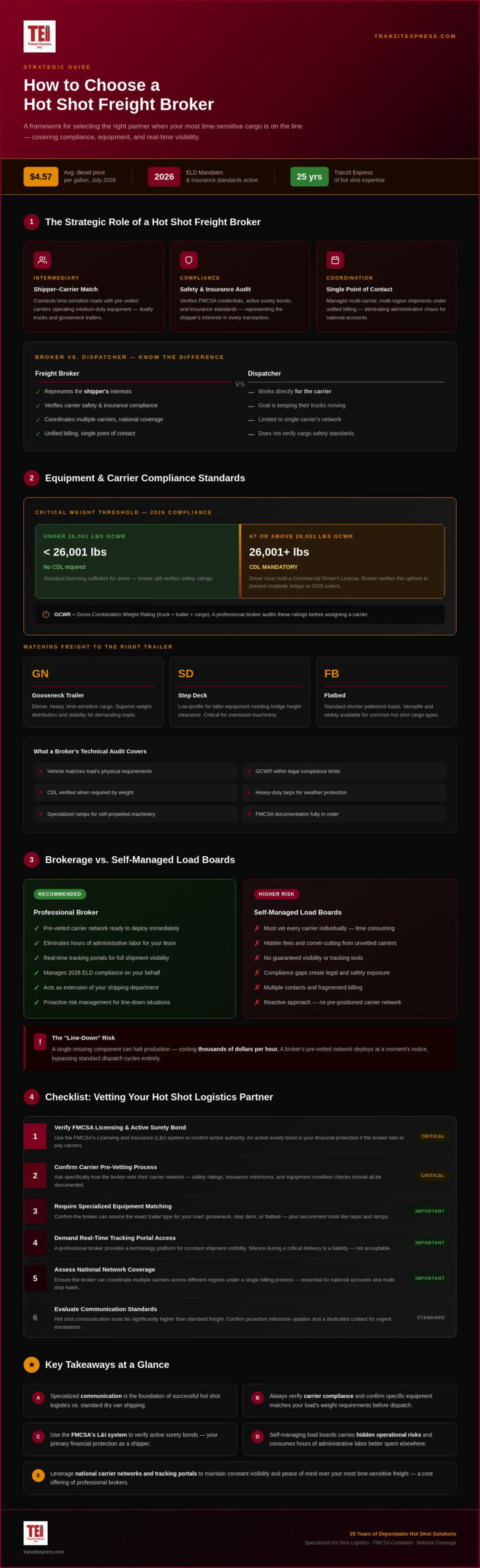
Checklist: Vetting Your Hot Shot Logistics Partner
Selecting a partner for urgent logistics requires a methodical approach that prioritizes long-term stability over short-term convenience. The first step involves verifying the firm’s credentials through the FMCSA’s Licensing and Insurance (L&I) system. Every legitimate hot shot freight broker must maintain an active surety bond and the appropriate operating authority to legally facilitate your shipments. Verification through these official channels ensures the company is financially accountable and compliant with federal standards, providing a necessary layer of security for your cargo.
Experience in the specific hot shot niche is non-negotiable. Standard dry van brokerage involves different timelines and equipment requirements that don’t always translate to expedited hauling. You should request references from other shippers who have similar time-sensitive needs. A professional firm should also offer modern visibility tools, such as proprietary tracking portals, to reduce the need for manual check calls. These systems provide the real-time transparency required for high-stakes coordination, ensuring you always know the status of your freight. For those ready to secure their supply chain, reaching out to a firm with reliable logistics solutions is the best way to ensure professional oversight.
Essential Questions to Ask
During the vetting process, ask specific questions about their carrier qualification protocols. You need to know exactly how they verify that a carrier’s insurance is currently active and meets the $100,000 cargo minimum before every load. Inquire about their after-hours support; urgent loads don’t always follow a nine-to-five schedule, and you need a partner who is available for weekend hot shots. It’s essential to prioritize a partner with a track record spanning at least 20 years to ensure they possess the institutional knowledge required to handle complex disruptions. This depth of experience acts as a safeguard against the common pitfalls of the expedited market.
Red Flags to Avoid
Be cautious of brokers who cannot provide a physical office address or verifiable bond information upon request. Transparency is a hallmark of a professional partnership. If a firm is vague about hot shot trucking quotes or hides line-haul rates behind bundled fees, they may not be acting in your best interest. Inconsistent communication during the initial quoting phase is often a precursor to service failures during transit. A dependable broker maintains a steady, professional rhythm from the first point of contact, ensuring that every detail of the shipment is organized and clearly communicated.
Tranzit Express: 25 Years of Dependable Hot Shot Solutions
Tranzit Express Inc. has provided a steady hand at the wheel for shippers since the late 1990s. As a seasoned hot shot freight broker, we’ve spent over 25 years refining the processes required to move time-sensitive cargo across the 48 contiguous states. We understand that in the expedited market, stability is the most valuable asset a partner can provide. Our legacy is built on the quiet confidence that comes from deep institutional knowledge and a commitment to professional excellence that avoids the hype of modern startups.
The Tranzit Advantage centers on a high-level B2B partnership designed to reduce the inherent stress of urgent logistics. We don’t just match loads to trucks; we coordinate a seamless experience through clear, declarative communication and advanced technology. Our proprietary Shipper Portal serves as a central hub for transparent tracking and digital documentation. This system ensures that every stakeholder has real-time visibility without the need for repetitive manual follow-ups, creating a sense of order in a complex industry.
A Partnership Built on Trust
Trust isn’t built overnight. It’s the result of decades spent vetting carriers and managing complex schedules. Our seasoned team possesses the foresight to anticipate logistical hurdles before they manifest as delays. Because we maintain long-standing relationships with the nation’s top-performing hot shot carriers, we can source specialized equipment even in remote areas or during periods of high market volatility. We treat on-time delivery as a non-negotiable standard, prioritizing the fulfillment of our promises above all else. This dependable approach ensures your freight is handled by professionals who value consistency as much as you do.
Streamlining Your Logistics for 2026
Efficiency in 2026 requires more than just fast trucks; it requires integrated data and methodical cost control. By incorporating our Shipper Portal into your daily workflow, your team can achieve faster quoting and streamlined document management. We offer customized reporting tools that allow you to analyze historical data and identify opportunities to reduce your annual freight spend. This results-oriented focus helps shift your logistics strategy from reactive to proactive. Getting started is a straightforward process. We invite you to contact our team for a personalized hot shot logistics assessment, allowing us to demonstrate how a professional hot shot freight broker can provide the security and stability your supply chain deserves.
Securing Your Supply Chain for a Successful 2026
Navigating the complexities of expedited logistics requires a partner who values precision over speed alone. Choosing a professional hot shot freight broker is a strategic decision that shifts the burden of carrier vetting, compliance monitoring, and equipment matching away from your internal team. This approach ensures that your most time-sensitive cargo is handled by specialists who understand the rigorous demands of the current regulatory environment. By prioritizing stability and clear communication, you protect your production timelines and your bottom line.
Tranzit Express brings over 25 years of industry-leading experience to every shipment, offering a national network of pre-vetted hot shot carriers and an advanced Shipper Portal for real-time cargo visibility. It’s time to replace the anxiety of urgent shipping with the quiet confidence of a seasoned veteran. We invite you to Request a Dependable Hot Shot Quote from Tranzit Express today. We’re ready to provide the steady hand at the wheel that your business deserves and we look forward to ensuring your freight arrives exactly when it’s needed.
Frequently Asked Questions
What is the difference between a hot shot broker and a standard freight broker?
A hot shot broker specializes in smaller, time-sensitive loads moved by medium-duty equipment, whereas a standard broker often focuses on full 53-foot dry van or refrigerated trailers. The hot shot niche requires a deeper understanding of specific equipment like gooseneck trailers and dually trucks. Because these shipments are usually urgent, the communication rhythm is much faster to accommodate tight delivery windows and last-minute requests.
How much does it cost to use a hot shot freight broker?
Pricing for hot shot services is determined by several factors, including the load’s urgency, the required equipment, and the total distance. Since these are expedited shipments, rates typically reflect the premium nature of on-demand service. A professional broker provides value by negotiating competitive rates within their carrier network and managing all compliance paperwork, which helps shippers avoid the hidden costs of service failures or unvetted carriers.
Can a hot shot broker handle oversized or overweight loads?
Yes, many hot shot carriers can handle oversized or overweight loads, but this requires careful coordination by the broker. Overweight loads often push the vehicle into CDL requirements if the combined weight exceeds 26,001 lbs. Your broker will verify that the carrier has the appropriate permits and equipment, such as heavy-duty ramps or specialized trailers, to move the cargo safely and legally across state lines.
How does a broker verify that a hot shot carrier is properly insured?
Brokers use a multi-step verification process that includes checking the FMCSA’s Licensing and Insurance system and contacting the carrier’s insurance provider directly. This ensures that the primary liability and cargo insurance policies are active and meet industry standards. A professional hot shot freight broker won’t rely on outdated paperwork; they confirm that every carrier in their network is currently compliant before any cargo is loaded.
What types of trailers do hot shot brokers typically source?
Brokers typically source a variety of open-deck equipment, including 40-foot flatbeds, gooseneck trailers, and low-profile step decks. These trailers are chosen based on the specific needs of the freight, such as the need for a lower deck height for tall equipment or the stability provided by a gooseneck hitch. This specialized equipment allows for efficient loading and unloading in locations where a standard semi-truck might struggle to navigate.
How quickly can a hot shot broker find a truck for an urgent load?
A specialized broker can often source a truck within hours, or even minutes, due to their established network of pre-vetted carriers. Because hot shot logistics is built on speed, these professionals maintain constant contact with drivers who are ready for immediate dispatch. This rapid response is essential for emergency situations where every hour of delay results in significant financial losses for the shipper.
What information do I need to provide for a hot shot freight quote?
To receive an accurate quote, you need to provide the exact weight, dimensions (length, width, and height), and any special handling requirements like tarping. It’s also vital to specify the pickup and delivery locations and the required timeframe. Providing this information upfront allows the broker to match your load with the most efficient equipment and avoid any regulatory issues regarding weight or height limits.
Is hot shot trucking safer than shipping via a standard dry van?
Hot shot shipping offers distinct security advantages because your cargo is often the only item on the trailer. This “exclusive use” nature reduces the risk of damage that occurs during the multiple loading and unloading cycles common in standard LTL or dry van shipping. The specialized focus of a hot shot freight broker ensures that your cargo receives dedicated attention from pick-up to final delivery. Shippers looking to build a more resilient process can benefit from reviewing a comprehensive guide on how to manage hotshot freight to implement a dependable booking system and eliminate the unpredictability of the spot market.