
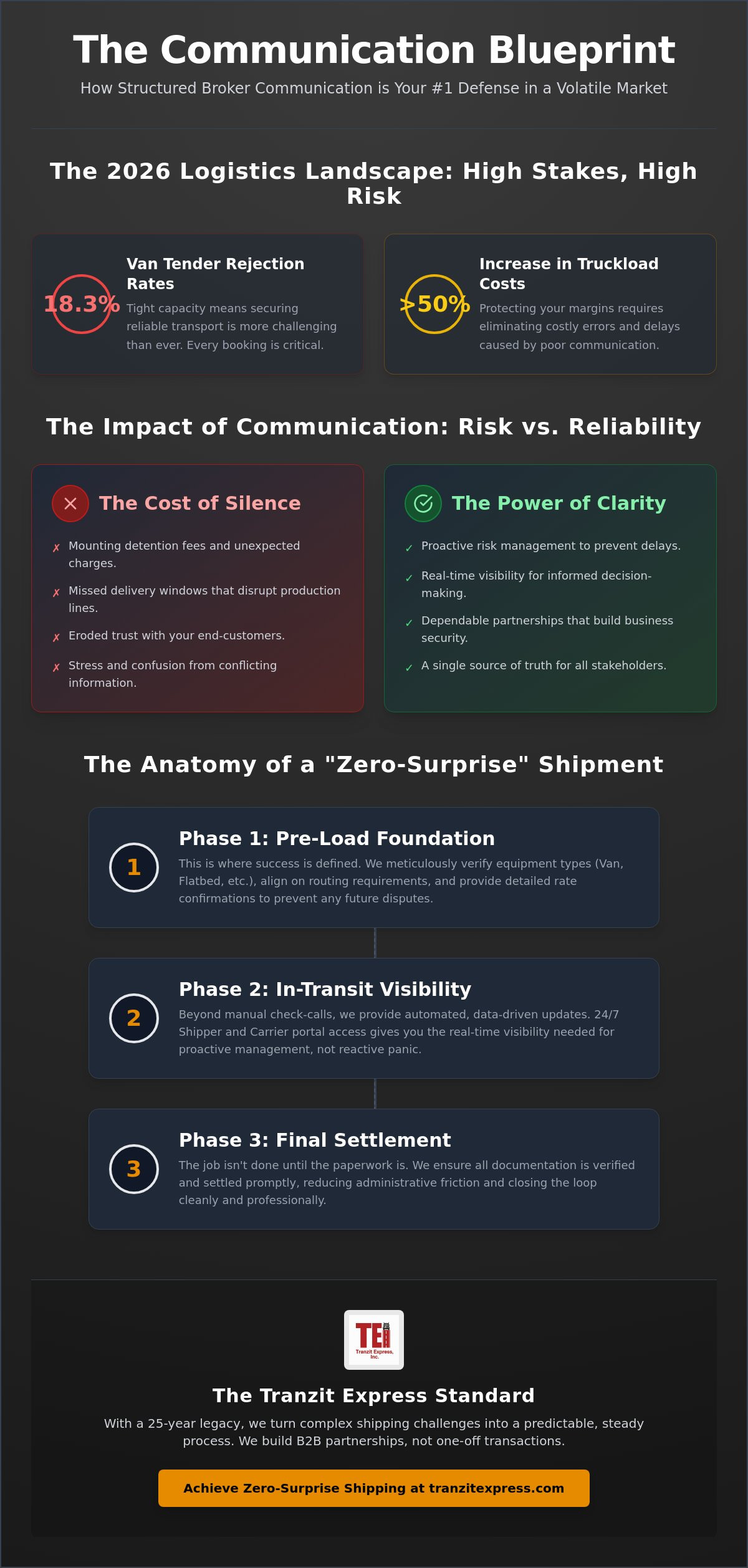
In a market where van tender rejection rates have climbed to 18.3 percent and new FMCSA financial rules can lead to immediate authority suspensions, the silence from a broker is a significant business risk. You’ve likely experienced the frustration of “ghosting” right when a high-value shipment faces an issue. Professional freight broker communication is no longer a soft skill; it’s a structured framework for risk mitigation that keeps your supply chain moving. It serves as the bridge between complex data and the steady, dependable results your operations require.
We understand that you need reliability and order in an increasingly complex industry. This guide explains how clear communication prevents costly delays, provides the real-time visibility you require, and simplifies access to essential tracking data through dedicated portals. You will learn how a steady, proactive approach to exception management ensures your business achieves zero-surprise shipping throughout 2026. We’ll outline the specific standards that define a professional partnership and how those standards protect your bottom line from the volatility of the current market.
Key Takeaways
- Understand why structured information exchange is your primary defense against market volatility and capacity constraints in 2026.
- Learn to navigate the full communication lifecycle of a load, from initial equipment verification to final settlement.
- Discover how Shipper and Carrier portals offer 24/7 visibility and document access to reduce the need for manual check-calls.
- Identify the specific red flags of poor freight broker communication during the quoting phase to avoid unreliable partners.
- See how a 25-year legacy of logistics expertise can turn complex shipping challenges into a predictable, steady process.
The Strategic Role of Communication in Modern Logistics
In the high-stakes environment of 2026, freight broker communication represents much more than a simple status update; it’s the structured exchange of data and intent between shippers, brokers, and carriers. This flow of information serves as the primary defense against a volatile market where van tender rejection rates have reached 18.3 percent and diesel prices sit at $4.832 per gallon. When capacity is tight and costs are high, a professional freight broker acts as the central steady hand, coordinating multiple moving parts to ensure that every shipment remains on schedule and within budget.
A breakdown in this exchange often leads to immediate financial consequences. Without clear, documented instructions and real-time updates, businesses face mounting detention fees and missed delivery windows that disrupt entire production lines. We view communication as a logistical tool that provides order in a complex industry. By prioritizing clarity, a broker can mitigate the impact of market fluctuations and provide the stability your business demands to maintain its competitive edge.
Beyond Status Updates: Communication as Risk Management
Proactive reporting is a fundamental component of modern risk management. When a broker maintains transparency, they can prevent small logistical hiccups from spiraling into expensive cargo delays that affect your bottom line. This level of openness builds a long-term B2B partnership rather than a series of one-off transactions. It’s about creating a sense of security through consistent excellence. Proactive communication is the ability to resolve an exception before the shipper notices a delay. By identifying potential issues early, such as equipment shortages or traffic disruptions, a broker ensures the supply chain remains seamless and dependable.
The Cost of Silence in the Freight Industry
The “hidden costs” of unreturned calls and vague tracking data are often more damaging than the initial delay itself. When a broker goes silent during a crisis, it erodes the trust between shippers and their end customers; a damage that’s difficult to repair with a simple apology. Poor communication often leads to conflicting information between the carrier and the shipper, creating unnecessary stress and confusion. A professional partner takes full ownership of the message, even when the news is difficult to deliver. This honesty allows you to make informed decisions and manage your own customers’ expectations with confidence, ensuring that your reputation for reliability remains intact despite the challenges of the road.
The Anatomy of Professional Freight Broker Communication
Professional freight broker communication is a continuous, multi-phase dialogue that provides structure to the logistical process. It doesn’t begin when the truck arrives or end when the cargo is dropped off. Instead, it functions as a lifecycle that starts at the initial quote and concludes only when the final documentation is verified and settled. In a year where all-in truckload costs have risen more than 50 percent, every interaction must be purposeful and accurate to protect your margins. Effective logistics management for shippers depends on this kind of structured, lifecycle-driven approach to ensure that rising costs and capacity constraints never catch your operation off guard.
A seasoned broker manages this lifecycle with a methodical rhythm. This approach ensures that all parties, from the warehouse floor to the accounting department, possess a clear understanding of the shipment’s status. By treating communication as a sequence of verified milestones, we reduce the stress of high-stakes shipping and replace uncertainty with a sense of order.
Clear Expectation Setting and Load Verification
The “Pre-Load” phase is where the foundation of a successful delivery is built. It requires the meticulous verification of equipment types, ensuring that the carrier arriving on-site matches the specific needs of the freight. Whether your cargo requires Van Freight Services, Flatbed Shipping, or specialized Hot-Shot Loads, a professional broker confirms these details before the wheels move. This stage also involves aligning on specialized routing requirements, particularly for Intermodal Transportation where coordination between rail and road is vital. Detailed rate confirmations are essential at this point; they act as the definitive record that prevents payment disputes and administrative friction later in the process.
Real-Time Visibility and Milestone Reporting
The “In-Transit” phase has evolved beyond the traditional manual check call. In 2026, the industry standard relies on automated, data-driven status updates that provide real-time visibility. With van tender rejection rates reaching 18.3 percent, knowing exactly where your freight sits in the network allows you to adapt to capacity constraints proactively. For high-priority or expedited loads, a professional broker provides a higher frequency of updates to ensure your production schedules remain intact. If an exception occurs, such as a mechanical issue or a weather delay, a reliable partner provides immediate clarity. They take ownership of the situation, offering solutions rather than excuses. You can gain a clearer perspective on your current shipments by utilizing our Shipper Portal Access, which centralizes all tracking data in one accessible location.
Post-Delivery Transparency and Documentation
The final phase of the communication lifecycle involves seamless documentation and billing transparency. A professional broker ensures that Proof of Delivery (POD) documents and invoices are processed accurately and made available quickly. This efficiency is critical for your accounting teams, especially as diesel prices fluctuate at $4.832 per gallon and operational costs remain high. By providing easy access to history and documentation, a broker helps you maintain a lean, organized back office. This commitment to the full lifecycle is what transforms a simple shipment into a dependable, long-term B2B partnership.
Technology vs. The Human Touch: Balancing Portals and People
The evolution of logistics technology has introduced a level of precision that was once unattainable. Modern freight broker communication now relies on a sophisticated balance between digital efficiency and human expertise. While portals provide the infrastructure for transparency, the seasoned professional provides the context and judgment required to manage a complex supply chain. We believe technology should serve as a bridge that connects shippers to their cargo without replacing the accountability of a dedicated partner. It’s about using tools to enhance the quality of the relationship, not to hide behind a screen.
In 2026, the volume of freight related to data centers has increased by 18 percent, requiring more specialized oversight for high-value equipment. This shift highlights why a “steady hand at the wheel” is more important than ever. Technology provides the data, but the experienced broker provides the solution. This combination of reliable tools and personal accountability ensures that your business receives the support it needs, exactly when it needs it most. It allows for a more methodical and logical flow of information that mirrors a streamlined logistical process.
The Value of Shipper and Carrier Portals
In a national distribution network, 24/7 access to information is a requirement for operational success. Our Shipper Portal Access and Carrier Portal Access provide a centralized environment where every load-related message and document is securely stored. This eliminates the need for repetitive phone calls to retrieve a Bill of Lading (BOL) or Proof of Delivery (POD). Accounting teams can streamline their processes by accessing history and billing data instantly. Having all communications in one secure location ensures that there’s a single, verified version of the truth for every shipment, reducing the risk of conflicting information between parties. For modern businesses, this level of easy access is non-negotiable.
When Automated Systems Aren’t Enough
Red Flags: Identifying Poor Communication Before You Book
Selecting a logistics partner requires more than comparing rates; it’s a vetting process centered on transparency and accountability. If a broker’s initial response during the quoting phase is slow, it’s a primary indicator of how they’ll handle your cargo once it’s on the road. Effective freight broker communication should be evident from the first interaction. You deserve a partner who provides clear, declarative answers rather than vague promises. To protect your supply chain, follow this methodical vetting process before awarding a load:
- Evaluate Initial Responsiveness: A professional broker should respond to quote requests promptly. If they’re hard to reach when they’re earning your business, they’ll likely disappear when an issue arises.
- Inquire About Exception Protocols: Ask for their specific, step-by-step process for handling in-transit delays. A “steady hand” always has a plan for weather, traffic, or mechanical failures.
- Verify Digital Infrastructure: Ensure they provide Shipper Portal Access. Real-time visibility shouldn’t require a manual request; it should be available at your fingertips.
- Assess Specialized Knowledge: Verify they speak the language of your specific freight. A broker handling Flatbed Shipping or Intermodal Transportation must understand the unique equipment and routing requirements involved.
By following these steps, you can distinguish between a transactional service and a true dependable freight partner who values the security of your shipments.
The “Ghosting” Phenomenon and How to Avoid It
The most catastrophic red flag in logistics is “ghosting.” This occurs when a broker stops answering calls or emails specifically because a load is delayed or an issue has occurred. This behavior often stems from a sales-heavy culture that prioritizes volume over operational excellence. An operations-focused partner, however, takes ownership of the message. They understand that difficult news delivered early is better than silence. When vetting a broker, ask how they’ve handled a recent delivery failure. Their honesty about past challenges is a better indicator of reliability than a claim of perfection. For a comprehensive overview of the freight broker communication best practices that separate reliable partners from unreliable ones, reviewing a structured framework can help you ask the right questions during the vetting process.
Vetting for Carrier Compliance and Safety
In 2026, communication regarding carrier safety is a legal necessity. Following the Supreme Court’s May 22, 2026, decision in Montgomery v. Caribe Transport II, broker liability for carrier safety has increased. Additionally, the FMCSA now enforces a strict $75,000 surety bond requirement that went into effect on January 16, 2026. A professional broker must be able to clearly communicate their vetting standards. They should maintain a rigorous process for verifying insurance, safety ratings, and compliance with the June 2026 Executive Order on supply chain compliance. Working with a broker who prioritizes these standards provides a level of security that protects your business from third-party risks. For a deeper understanding of how to navigate these regulatory changes and capacity challenges, review our comprehensive guide on logistics management for shippers in 2026.
The Tranzit Express Standard: 25 Years of Dependable Partnership
For over 25 years, Tranzit Express Inc. has functioned as a steady hand at the wheel for shippers across the United States. We’ve built our reputation on the belief that professional freight broker communication is the foundation of every successful delivery. Our team doesn’t just move cargo; we manage a comprehensive range of solutions, including Van Freight Services and Flatbed Shipping, with a single standard of excellence. We invite you to experience a logistics partnership where stability and trust are prioritized over marketing hype. Our goal is to provide a sense of order in an industry that’s often characterized by complexity and noise.
A seasoned industry veteran knows that clear communication is a tool for risk mitigation. By maintaining a methodical and logical flow of information, we ensure that every stakeholder possesses the data they need to make informed decisions. This commitment to excellence is what transforms a simple transaction into a long-term B2B relationship. We speak with the quiet confidence of a team that has navigated decades of market shifts, ensuring your business remains secure regardless of external volatility.
A Legacy of Stability in a Complex Industry
Two decades of institutional knowledge allow us to maintain a composed and reassuring style, even when market conditions are at their most challenging. We’ve seen cycles of tightening capacity and significant regulatory changes, and we’ve learned that clear, declarative statements are the best way to project security to our clients. While we offer a national reach, you’ll always receive the focused attention of a dedicated logistics team that understands your specific business needs. Tranzit Express Inc. treats every shipment as a high-stakes partnership, not just a commission. This long-term perspective is what reduces stress for our clients and provides a sense of order in a complex industry. Our deep institutional knowledge ensures that your freight broker communication is always professional, purposeful, and accurate.
Streamlining Your Supply Chain Today
Modern logistics demands digital efficiency without sacrificing the human touch. Our Shipper Portal Access provides you with immediate visibility into your supply chain, allowing you to track Hot-Shot Loads or Intermodal Transportation milestones 24/7. This technology empowers our team to spend more time on proactive exception management rather than manual status updates. Getting started is a straightforward and methodical process. When you request a quote, you’re not just getting a price; you’re receiving a commitment to clear, on-time delivery backed by a quarter-century of expertise. We prioritize the fulfillment of promises over marketing hype, ensuring your cargo is always in reliable hands.
Securing Your Supply Chain for the Road Ahead
Effective freight broker communication is the primary defense against the volatility of the modern market. Throughout this guide, we’ve examined how structured data exchange and proactive exception management prevent the “ghosting” and delays that disrupt your operations. By balancing the 24/7 visibility of our Shipper Portal with the judgment of seasoned professionals, you gain a sense of order in a complex industry. A reliable partnership is built on the consistent fulfillment of promises rather than marketing hype.
Tranzit Express Inc. brings over 25 years of institutional knowledge to every load. Our comprehensive national coverage for Van, Flatbed, and Intermodal freight ensures that your cargo moves with the precision your business demands. We invite you to experience a level of service where transparency and stability are the standard, not the exception. You’ve seen the red flags to avoid; now it’s time to partner with a steady hand at the wheel.
Request a Reliable Freight Quote from Tranzit Express and discover the peace of mind that comes from a truly dependable logistics partnership.
Frequently Asked Questions
How often should a freight broker provide updates on my shipment?
A professional broker should provide updates at least once daily for standard shipments and multiple times per day for expedited or high-priority loads. This ensures you have consistent visibility into your cargo’s progress. For specialized services like Hot-Shot Loads, updates often occur at every major milestone. Clear freight broker communication removes the need for you to initiate check-calls, allowing your team to focus on core operations while maintaining full confidence in the delivery schedule.
What is the difference between a freight broker and a carrier in terms of communication?
The broker acts as the central coordinator for multiple parties, while the carrier focuses on the physical operation of the vehicle. Shippers communicate with the broker to manage documentation, billing, and multi-load scheduling. The broker then translates these requirements to the carrier. This structure provides a single point of accountability, reducing the complexity of managing individual drivers and ensuring that specialized instructions for Flatbed Shipping or Van Freight Services are followed precisely.
Can I track my freight in real-time through a broker?
You can track your freight in real-time by utilizing modern digital tools like our Shipper Portal Access. These systems aggregate GPS data from carriers to provide a live view of your shipment’s location and estimated arrival time. This 24/7 visibility is a standard requirement for national distribution in 2026. It allows your warehouse teams to prepare for arrivals with precision, minimizing detention time and improving overall facility efficiency without requiring manual status requests.
What should I do if my freight broker stops answering my calls?
If a broker stops answering your calls during a delay, you should immediately document the lack of response and prepare to escalate the issue. Silence is a catastrophic red flag that suggests a lack of operational control. In such cases, it’s vital to transition your volume to a partner who prioritizes transparency. A dependable broker takes ownership of difficult news and provides solutions, ensuring that your supply chain remains resilient even during disruptions.
How do Shipper Portals improve communication efficiency?
Shipper Portals improve efficiency by centralizing all load-related messages, tracking data, and essential documents like the Bill of Lading in one secure location. This reduces the administrative burden on your accounting and logistics teams by providing instant, 24/7 access to information. By eliminating the need for repetitive emails and phone calls, these portals create a more methodical and logical workflow that supports a streamlined logistical process for your entire organization.
What information should be included in a professional rate confirmation?
A professional rate confirmation must include the specific equipment type, confirmed pick-up and delivery times, total agreed-upon cost, and any specialized routing instructions. It should also detail requirements for services like Intermodal Transportation or Flatbed Shipping. This document acts as the definitive record for the shipment. Clear freight broker communication at this stage prevents payment disputes and ensures that all parties have a shared understanding of the load’s expectations before the wheels move.
How does a broker communicate delays or exceptions to the shipper?
A broker should communicate exceptions immediately via phone or portal notification, accompanied by a specific recovery plan. Whether the delay is caused by weather or mechanical issues, the focus should be on clarity and solution-oriented action. By identifying potential hurdles early, a professional partner allows you to manage your end-customers’ expectations. This proactive approach prevents small hiccups from becoming expensive cargo delays, maintaining the order and stability your business requires.
Why is experience important when evaluating a broker’s communication style?
Experience is vital because it provides the institutional knowledge required to navigate complex logistical challenges that algorithms cannot solve. A broker with 25 years of experience understands the nuances of different freight types and can anticipate disruptions before they occur. This “steady hand” approach ensures that communication remains calm and effective even during market shifts. Seasoned professionals prioritize the fulfillment of promises, offering a level of security that newer firms often struggle to replicate. Applying proven freight broker communication best practices built on decades of industry experience is what separates a truly reliable partner from one that simply reacts to problems after they arise.