With van load-to-truck ratios climbing to 10.61 in mid-2026, the era of surplus capacity has ended, leaving many shippers struggling to secure reliable van freight services. It’s a common frustration to face sudden communication gaps or discover hidden surcharges that disrupt your quarterly budget. You likely feel the pressure of maintaining a seamless supply chain while market conditions tighten and regulatory requirements for driver documentation become more rigorous. You deserve a logistics partner who acts as a steady hand at the wheel, providing order and predictability in a complex industry.
We believe that logistics should be a source of stability for your business, not a cause for anxiety. This guide will show you how to master the complexities of van shipping and optimize your national operations for maximum reliability in 2026. We’ll explore how to achieve predictable schedules through professional carrier vetting and how dedicated portal access can significantly reduce your administrative workload. By the end of this article, you’ll have a clear roadmap for achieving transparent pricing models and total confidence in your logistics partnership.
Key Takeaways
- Understand why dry van shipping remains the most dependable method for moving palletized goods across the United States.
- Identify the specific advantages of FTL and LTL models to ensure your shipping strategy aligns with both your timeline and your budget.
- Master the essential steps for securing your supply chain, including rigorous carrier vetting and professional cargo preparation standards.
- Learn how to utilize specialized van freight services, such as hot-shot loads, to handle time-sensitive shipments with precision.
- Discover how 25 years of logistics expertise and dedicated portal access can simplify your administrative processes and provide total shipment transparency.
What are Van Freight Services? Defining the Core of National Logistics
At its core, van freight involves the transportation of palletized or loose goods within fully enclosed, secure trailers. This method is the primary driver of the American supply chain, offering a protected environment for cargo that doesn’t require temperature control. While other modes exist for specialized needs, dry van shipping remains the most popular choice in the United States because of its simplicity and widespread availability. It provides a literal shield against the elements, protecting your investment from rain, wind, and road debris during transit.
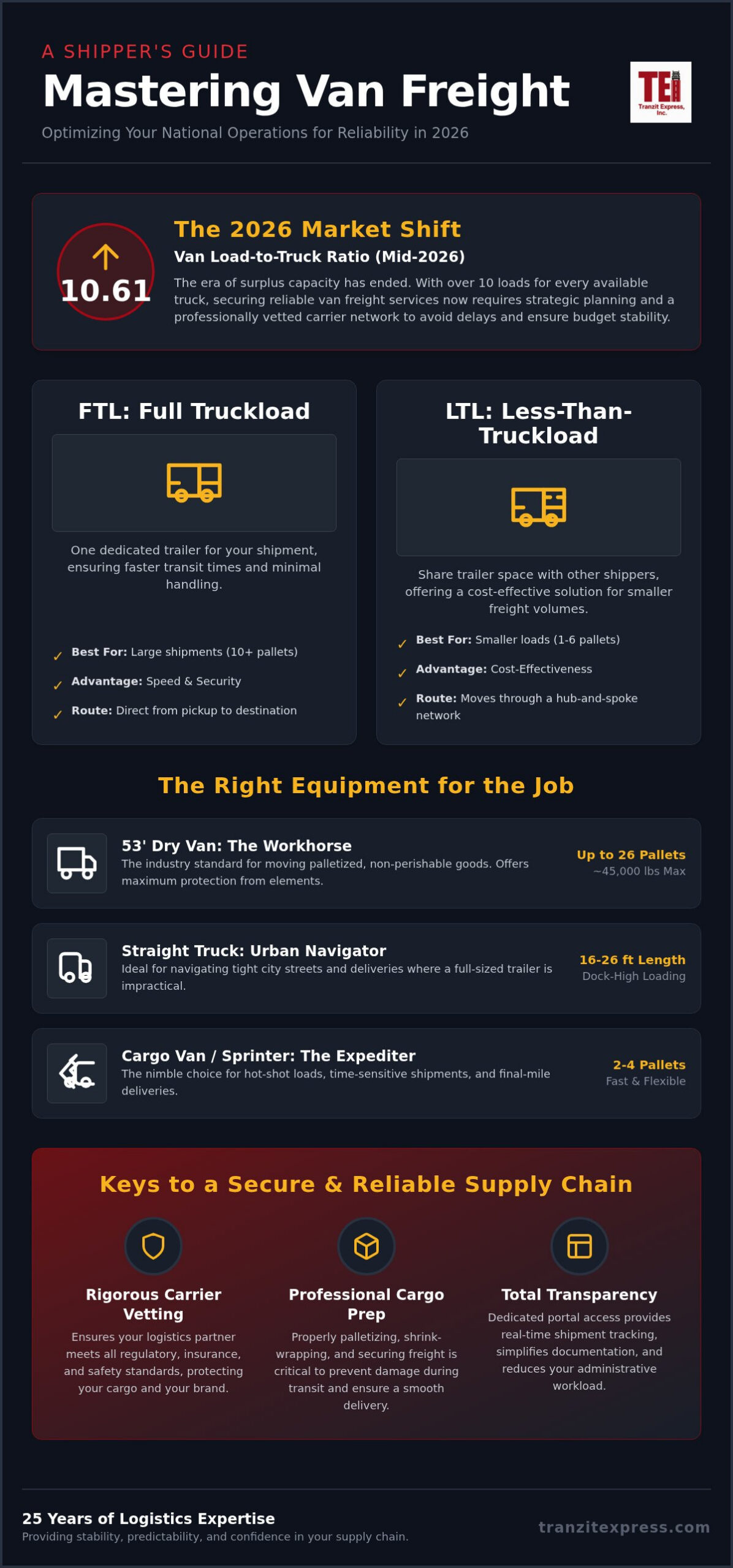
The national logistics landscape in 2026 has entered a period of significant tightening. After several years of excess capacity, the market has reset. Data from July 2026 shows a van load-to-truck ratio of 10.61, indicating that finding reliable van freight services requires more strategic planning than in the past. This shift means that professional oversight and carrier vetting are more critical than ever to ensure your cargo moves without delay. For a business seeking stability, understanding these fundamentals is the first step toward a more resilient shipping strategy.
The Importance of Versatility in Van Transport
One reason van transport is so prevalent is its incredible versatility. These trailers handle a vast range of commodities, from high-value consumer electronics to bulk non-perishable food items. Because the trailers are enclosed and lockable, they’re the industry standard for sensitive cargo that requires a high level of security. Retailers and manufacturers rely on this consistency to keep their shelves stocked and production lines moving. This reliability helps reduce the stress of inventory management, allowing you to focus on growth rather than logistics headaches.
Van Freight vs. Other Shipping Modes
Choosing the right mode depends on your cargo requirements and budget. Unlike flatbed shipping, which is designed for oversized items that require crane loading, van freight is built for efficiency and protection. It’s often more cost-effective than specialized equipment because of the sheer volume of available trailers. When evaluating your options, it’s helpful to understand the nuances of Truckload shipping and how it differs from intermodal or less-than-truckload solutions. Dry van freight typically utilizes a standard 53-foot enclosed trailer, providing a versatile solution for transporting up to 26 standard pallets of non-perishable goods. This standardization makes it easier to plan your warehouse operations and loading schedules with precision.
Types of Van Freight: From Standard Dry Vans to Specialized Solutions
The variety within van freight services ensures that every shipment, regardless of its size or destination, finds a secure and appropriate home. While the 53-foot dry van is the undeniable workhorse of the American highway system, it isn’t always the most efficient choice for every load. Professional logistics management requires a deep understanding of when to deploy specialized equipment to maintain both speed and cost-effectiveness. A seasoned partner knows that the right equipment choice is the first step toward a stress-free delivery.
For smaller, time-sensitive requirements, cargo vans and sprinters offer a nimble alternative. These vehicles are ideal for hot-shot loads where a full trailer would be overkill and a waste of resources. In urban environments where tight corners and restricted parking make large trailers impossible, straight trucks provide the necessary maneuverability to complete the mission. According to the American Trucking Associations, the industry relies on this diverse fleet to navigate the unique geographical challenges of our national infrastructure. Even specialized needs, such as temperature-sensitive goods, can be accommodated through refrigerated van variants, often called reefers, which provide a climate-controlled environment for delicate cargo.
Selecting Equipment Based on Cargo Volume
Matching your load size to the correct trailer dimensions is a fundamental step in reducing unnecessary costs. You shouldn’t have to pay for empty space when your shipment only requires a fraction of a standard trailer. Strategic use of cargo vans for expedited freight can often bypass the delays associated with traditional hub-and-spoke networks. It’s also vital to consider weight limits, as national routing is heavily influenced by state-specific regulations and bridge laws. If you’re unsure which vehicle fits your current needs, exploring our van freight services can help clarify the most efficient path forward.
Specialized Van Configurations
Standard trailers often require additional features to handle specific logistical hurdles. For example, lift-gate services are essential when delivering to locations that lack a formal loading dock. For high-end medical equipment or fragile electronics, air-ride suspension provides an extra layer of protection by absorbing road vibrations that could damage sensitive internal components. Within the trailer, logistics tracks and e-track systems allow for the secure bracing of complex loads, preventing shifting during transit. These specialized tools transform a simple enclosed box into a sophisticated transport solution, ensuring your cargo arrives in the same condition it left. This methodical approach to equipment selection acts as a steady hand at the wheel, protecting your cargo from the start of its journey to the finish.
FTL vs. LTL: Determining the Most Efficient Van Freight Strategy
Choosing between Full Truckload (FTL) and Less-Than-Truckload (LTL) is one of the most significant decisions a logistics manager faces. It isn’t merely a matter of load size. It involves a careful balance of transit speed, cargo safety, and total cost. Professional van freight services provide the framework needed to make these choices with confidence, ensuring that your goods move through the national network without unnecessary delays or expenses. Understanding the nuances of each method allows you to tailor your strategy to the specific needs of every shipment.
The “break-even” point between these two modes typically occurs when a shipment occupies between 6 and 10 standard pallets. At this volume, the cost of an LTL shipment may begin to approach the price of a dedicated truckload. Beyond the base rate, you must consider the value of time and the risk of damage. Freight brokers play a vital role in this process by consolidating LTL shipments, leveraging their networks to secure competitive rates that individual shippers might not access on their own. This consolidation provides a sense of order in a market that can otherwise feel fragmented and unpredictable.
When to Choose Full Truckload (FTL)
Full Truckload is the primary choice for priority shipments that cannot afford the delays associated with multiple stops. When you secure an FTL trailer, your cargo is the only priority for that driver. This direct routing is essential for national long-haul shipments where speed is the primary driver of success. Because the trailer remains sealed from the point of origin to the destination, FTL significantly reduces the risk of damage. High-value goods or fragile items benefit from this minimal handling, providing you with peace of mind that your investment is well-protected throughout its journey.
Navigating the Complexity of LTL
Less-Than-Truckload shipping offers a cost-sharing model that is ideal for smaller loads, but it requires a methodical approach to documentation. Freight classes play a major role in determining your bottom line, as they are based on the density, stowability, and liability of your cargo. Accurate weighing and dimensioning are non-negotiable; even small discrepancies can lead to costly re-classification fees. Focusing on Optimizing your dry van shipments for efficiency can help you navigate these hurdles. By prioritizing precision in your cargo preparation, you reduce administrative friction and ensure a smoother partnership with your carrier network.
Optimizing Your Shipments: Best Practices for Secure and Timely Transport
Reliable van freight services are built on a foundation of disciplined execution. Once you’ve determined your equipment needs and chosen between FTL or LTL strategies, the focus shifts to the practical steps that ensure a seamless transit. Optimization isn’t a single event; it’s a series of methodical choices that protect your cargo and your bottom line. By establishing rigorous standards for vetting and preparation, you can transform a complex national move into a predictable, orderly process.
Communication protocols are the final piece of the optimization puzzle. Clear, consistent updates between the shipper and the broker eliminate the guesswork that often leads to administrative friction. When everyone is aligned on pickup windows, delivery requirements, and specialized handling needs, the entire supply chain moves with greater efficiency. This collaborative approach shifts the focus from simple transactions to a long-term partnership where your success is the primary metric of excellence.
The Vetting Process: Ensuring Carrier Compliance
The security of your investment begins with rigorous carrier vetting. It’s essential to verify FMCSA safety ratings and confirm active operating authority through MC numbers before any cargo is loaded. In 2026, this process has become even more critical due to new regulations that took effect on April 28, requiring stricter identity and legal presence verification for non-domiciled Commercial Driver’s License holders. We manage this oversight by leveraging over 25 years of industry experience to vet every carrier in our network. This comprehensive compliance check reduces your risk and ensures that only qualified, insured professionals handle your shipments. To secure your next shipment with a vetted professional, explore our van freight services today.
Leveraging Logistics Technology
Modern logistics requires more than just a truck and a driver; it requires digital transparency. Utilizing a dedicated shipper portal allows you to manage loads with a few clicks, reducing the administrative burden on your team. These platforms facilitate automated documentation and digital Bill of Lading (BOL) processes, which minimize the errors often found in manual paperwork. Real-time tracking provides the visibility needed to identify potential delays before they become disruptions, allowing for proactive routing adjustments that prevent supply chain bottlenecks. This technology doesn’t replace the human element; rather, it acts as a steady hand at the wheel, providing the data necessary to make informed, confident decisions for your national logistics needs.
Proper cargo preparation is equally vital to ensuring timely transport. Following professional palletization standards prevents shifting and damage during long-haul transits. Secure wrapping and clear labeling aren’t just suggestions; they’re the standard for any high-stakes logistics operation. When combined with advanced tracking and rigorous vetting, these practices create a robust framework for reliability.
Partnering with Tranzit Express: Dependable Van Freight Management
Choosing the right provider for your van freight services is the final and most critical step in securing your supply chain. In an industry often characterized by high-energy claims and unproven technology, Tranzit Express offers a different approach. We bring over 25 years of national logistics expertise to every shipment, acting as a seasoned guide for businesses that value consistency over marketing hype. We don’t view our clients as simple transactions; we treat every load as a critical partnership that requires meticulous attention to detail and a commitment to excellence.
Our comprehensive solutions are designed to address the full spectrum of your transportation needs. Whether you require standard dry vans, specialized hot-shot loads, flatbed shipping, or intermodal freight, our team provides a unified point of contact for your entire operation. This breadth of service, combined with our dedicated shipper and carrier portals, ensures that your communication remains streamlined and your documentation is always accessible. We provide the order and predictability necessary to thrive in a complex national market.
A Steady Hand at the Wheel
The market tightening seen in mid-2026, with load-to-truck ratios reaching 10.61, has made capacity management more difficult for many shippers. Our decades of experience allow us to navigate these capacity crunches effectively by leveraging long-standing relationships and deep institutional knowledge. We pride ourselves on being a quietly confident logistics partner. We don’t need to be flashy because our results speak for themselves. This grounded, practical approach ensures on-time delivery and reliable communication, even when regional spot rates fluctuate or regulatory requirements shift. You can rely on us to remain a steady hand at the wheel, regardless of market volatility.
Getting Started with Your Van Freight Quote
Securing reliable transport shouldn’t be an arduous process. You can request a freight quote online in just a few minutes through our streamlined portal. To provide the most accurate pricing, please have your shipment’s origin and destination zip codes, total weight, pallet count, and commodity type ready. Once you submit your request, our team reviews the details to ensure the equipment matches your specific needs. The transition from a quote to a confirmed load is handled with the same methodical professionalism that defines our entire operation. We guide you through the process, providing clear signposts at every stage so you always know exactly where your cargo stands.
Secure Your Supply Chain with Expert Oversight
Mastering the logistics landscape in 2026 requires more than just finding a truck; it demands a strategic approach to capacity management and carrier compliance. By understanding the nuances between FTL and LTL models and prioritizing professional vetting, you can protect your cargo from the unpredictability of the national market. These van freight services act as the backbone of your operations, and their success depends on the precision of your planning and the reliability of your partners.
Tranzit Express provides the steady hand at the wheel that your business needs to navigate these complexities. With 25+ years of industry experience and a robust national carrier network, we offer the stability and order required for high-stakes logistics. Our dedicated shipper support portal ensures that you maintain full visibility over every shipment while reducing your administrative burden. We invite you to experience the difference that a seasoned B2B partnership can make for your bottom line.
Request a Reliable Van Freight Quote from Tranzit Express and take the first step toward a more predictable shipping schedule. We look forward to helping you move your business forward with confidence.
Frequently Asked Questions
What is the standard size of a dry van trailer?
The standard dry van trailer used in national logistics is 53 feet long, 102 inches wide, and 110 inches high. This configuration provides enough internal volume to accommodate up to 26 standard 48×48-inch pallets when they aren’t double-stacked. These dimensions are the industry standard for national logistics, ensuring compatibility with most loading docks across North America.
How much weight can a standard 53-foot van carry?
A standard 53-foot dry van can typically carry between 42,000 and 45,000 pounds of cargo. This limit is dictated by federal law, which restricts the gross vehicle weight to 80,000 pounds, including the tractor and the trailer itself. It’s essential to distribute the weight evenly over the axles to maintain compliance with Department of Transportation regulations during transit.
What is the difference between a freight broker and a carrier?
A carrier owns the physical trucks and employs the drivers who transport your goods, while a freight broker acts as the strategic intermediary. As a broker, we leverage a vast network of vetted carriers to find the most efficient and cost-effective van freight services for your specific needs. This model provides you with greater flexibility and capacity than a single carrier could offer on its own.
How does Tranzit Express vet its carriers for safety?
We employ a rigorous vetting process that includes verifying FMCSA safety ratings, active operating authority, and comprehensive insurance coverage. With over 25 years of experience, we’ve developed a methodical approach to compliance that reduces risk for our shippers. We also ensure carriers meet the new 2026 identity verification standards for non-domiciled CDL holders to maintain the highest safety protocols.
Can I track my van freight shipment in real-time?
Yes, you can monitor your shipment’s progress through our dedicated shipper portal. This platform provides real-time visibility and automated status updates, allowing you to identify potential bottlenecks before they impact your schedule. This transparency is a core part of our commitment to providing a stress-free logistics experience for our partners.
Is van freight suitable for time-sensitive or expedited loads?
Van freight is highly suitable for time-sensitive loads, particularly when utilizing hot-shot loads or dedicated sprinter vans. These smaller vehicles can bypass traditional hub-and-spoke delays, moving your cargo directly to its destination. For larger priority shipments, our Full Truckload (FTL) van freight services offer the fastest transit times by eliminating intermediate stops and handling.
What industries benefit most from van freight services?
Retail, manufacturing, and consumer electronics industries are the primary beneficiaries of enclosed van transport. Any business moving palletized, non-perishable goods that require protection from the weather and road debris will find this mode essential. The security of a locked, enclosed trailer is also a high priority for companies transporting sensitive medical equipment or high-value materials.
How do I get a van freight quote for a national shipment?
You can obtain a quote for a national shipment by visiting our online portal and providing a few key details. We’ll need the origin and destination zip codes, the total weight of the cargo, the pallet count, and the type of commodity being shipped. Our team of experts will then review your requirements to provide an accurate, transparent pricing model that reflects current market conditions.